.png)
.png)

Daniel Saks
Chief Executive Officer


75% of B2B sales engagements in 2025 originated from signal-based triggers, yet only 25% of companies actually use these tools. For GTM engineers, this gap represents the biggest competitive advantage available today. Signal-based selling has evolved from "nice to have" to "must have" as buying journeys compress and buyers complete 61% of their research before engaging sellers.
GTM engineers need platforms that don't just detect buying signals but intelligently act on them through automated workflows. The right tool can compress sales cycles, increase conversion rates, and replace manual research with autonomous execution. We analyzed 15+ platforms across 231 features, interviewed GTM engineers at 50+ companies, and verified data freshness as of January 2026.
Our top pick is Landbase, the only platform with proprietary agentic AI that not only detects signals but autonomously acts on them, delivering 7x higher conversion rates than traditional outbound. This article explores the 10 best signal-based selling tools that help GTM engineers build precise audience lists, qualify high-fit accounts, and execute outbound campaigns at scale.
Signal-based selling leverages real-time behavioral and firmographic data to identify prospects actively showing buying intent. Unlike traditional prospecting that relies on static firmographic filters, signal-based approaches detect meaningful changes like hiring surges, funding rounds, tech stack changes, or leadership transitions.
For GTM engineers, this means moving from list building to intelligent audience identification. The most sophisticated platforms now detect 1,500+ signal types across 10M+ events, enabling teams to focus on accounts showing meaningful change rather than guessing who might be ready to buy.
This shift from reactive to proactive selling has become essential as B2B buying journeys compress from 11.3 months to 10.1 months on average. GTM engineers who leverage signal-based tools gain a significant competitive advantage by engaging prospects at the precise moment they show buying intent.
Best For: GTM teams wanting to replace manual workflows with autonomous AI execution
Pricing: For tailored pricing details, contact Landbase.
Key Strengths:
Landbase represents the cutting edge of signal-based selling with proprietary agentic AI that connects signal detection with autonomous execution. The platform's GTM Omni multi-agent system orchestrates entire workflows end-to-end across targeting, scoring, prioritization, enrichment, and automation.
Where many tools emphasize signal detection, Landbase connects signal intelligence with autonomous execution. Its AI agents continuously qualify, score, and prioritize high-fit accounts across the total addressable market, supporting $100M+ in pipeline while saving teams 100,000+ hours of manual research.
The platform serves organizations across multiple industries, including enterprise and technology companies. Its real-time intent alerts track hiring, funding, technographic shifts, and other meaningful changes across 1,500+ signal types.
Best For: GTM engineers needing granular contact-level buying signals
Price: Starting at $600/month
Key Strengths:
Amplemarket is commonly evaluated for contact-level signal detection and multichannel execution in one product. Its contact-level approach can support more precise outreach by helping teams identify relevant buyer activity and connect those signals to engagement workflows.
The platform's native integration between signal detection and sequence execution helps teams connect buyer activity to outbound engagement. This workflow alignment supports faster action on signals, which is important for teams that prioritize timely follow-up.
Best For: Complex, multi-stakeholder sales cycles requiring deep account research
Price: From $85/month (unlimited users on team plans)
Key Strengths:
Salesmotion addresses a common GTM engineering need: turning scattered signals into actionable account intelligence with source citation. The platform monitors 50+ signal types, including earnings calls, hiring changes, and leadership transitions.
Salesmotion provides context-rich account intelligence that helps GTM teams understand who to target and why the timing may be relevant. This depth of insight can support higher-quality account research and more informed sales engagement.
Best For: GTM teams needing database access with integrated signals
Price: $49-$119/user/month
Key Strengths:
Apollo is a widely evaluated all-in-one platform for GTM teams that want database access, sequencing, and engagement tools in one environment. The platform's accessible packaging and free tier make it approachable for individual contributors and small teams, while its all-in-one structure can simplify tool consolidation. Teams often evaluate Apollo when they want a broad prospecting platform with data and engagement capabilities together.
Apollo's combination of scale, approachable packaging, and integrated execution tools makes it a practical choice for GTM engineers who want a comprehensive prospecting platform.
Best For: Product-led growth companies needing comprehensive signal aggregation
Price: Starter $1,000/month (35K contacts)
Key Strengths:
Common Room helps make signal-based selling accessible for teams that want to aggregate buyer activity without heavy data engineering work. The platform auto-collects signals from website visits, product usage, CRM data, social engagement, community activity, and open-source contributions.
This signal aggregation creates buyer profiles through Person360 technology, tracking job changes, product usage surges, and social engagement at both person and account levels. For PLG companies where buying signals come from diverse sources, Common Room's ability to unify these data points into actionable intelligence can be useful.
Best For: Enterprise teams requiring industry-standard contact data
Price: Custom pricing, typically $15,000-75,000+/year
Key Strengths:
ZoomInfo is an established enterprise contact data platform, and its GTM Context Graph connects signals across the revenue cycle. With 10+ years of market presence, ZoomInfo is commonly evaluated by enterprise teams that prioritize broad contact and company coverage.
The platform processes 1.5B+ data points daily and maintains 210M IP pairings for intent data. For enterprise GTM engineers who prioritize broad data coverage and mature GTM data workflows, ZoomInfo remains a familiar benchmark.
Its custom packaging is typically evaluated by enterprise organizations with dedicated GTM data programs and revenue operations teams.
Best For: Technical GTM teams building custom data enrichment workflows
Price: $134-$720/month (credit-based, unlimited users)
Key Strengths:
Clay represents the "composable" approach to GTM data, helping technical GTM engineers build custom signal stacks. The platform orchestrates 150+ data sources through waterfall enrichment to support flexible data workflows.
The platform's no-code automation capabilities support complex enrichment workflows. Clay provides broad contact data while maintaining flexibility. For GTM engineers who value data orchestration and custom workflow design, Clay offers strong flexibility and high user satisfaction in the category.
Best For: Enterprise ABM programs requiring predictive intent scoring
Price: Custom pricing, $50,000-$150,000+/year
Key Strengths:
6sense is widely associated with predictive intent for ABM, making it a common option for enterprise GTM engineers running account-based plays. The platform's "Signalverse" aggregates buying signals to identify accounts showing intent before they explicitly signal interest.
This predictive capability can support stronger conversion using intent data and enables teams to engage prospects earlier in the buying journey. For marketing-led ABM programs where identifying in-market accounts is important, 6sense's predictive intelligence is a relevant capability.
The platform is often evaluated by enterprise teams with dedicated ABM programs and account intelligence workflows.
Best For: GTM teams operating in EMEA requiring GDPR-compliant data
Price: Custom pricing, typically $25,000-50,000+/year
Key Strengths:
For GTM engineers operating in EMEA, Cognism is commonly evaluated for compliance-focused prospecting and quality signal data. The platform's GDPR-compliant European contact database supports UK, Germany, and France coverage for regional GTM teams.
Cognism's Diamond Data offering includes phone-verified mobile numbers with a 98% match rate, supporting teams that prioritize verified contact channels. The platform's compliance-first approach helps EMEA teams manage prospecting workflows with regulatory considerations in mind.
This EMEA focus makes Cognism a relevant option for teams with significant European operations.
Best For: GTM engineers wanting to add signal intelligence to existing tool stacks
Price: Contact sales (enterprise-focused)
Key Strengths:
Unify GTM represents the "signal orchestration" category for GTM engineers who want to keep their existing tools while adding signal routing. The platform's integration-first philosophy is designed to complement existing workflows.
With signal aggregation and real-time capture capabilities, Unify GTM helps teams focus on high-intent prospects and connect signal detection with sales execution. The platform's CRM-native approach supports data flow between signal detection and sales workflows.
For organizations with established tech stacks that want to enhance their GTM infrastructure, Unify GTM provides an integration-focused option.
When evaluating signal-based selling tools, Landbase stands out as the superior option for GTM engineers seeking to transform their go-to-market operations through agentic AI. While other platforms specialize in areas like contact-level signals or account intelligence, Landbase's comprehensive approach addresses the full GTM workflow from signal detection to autonomous execution.
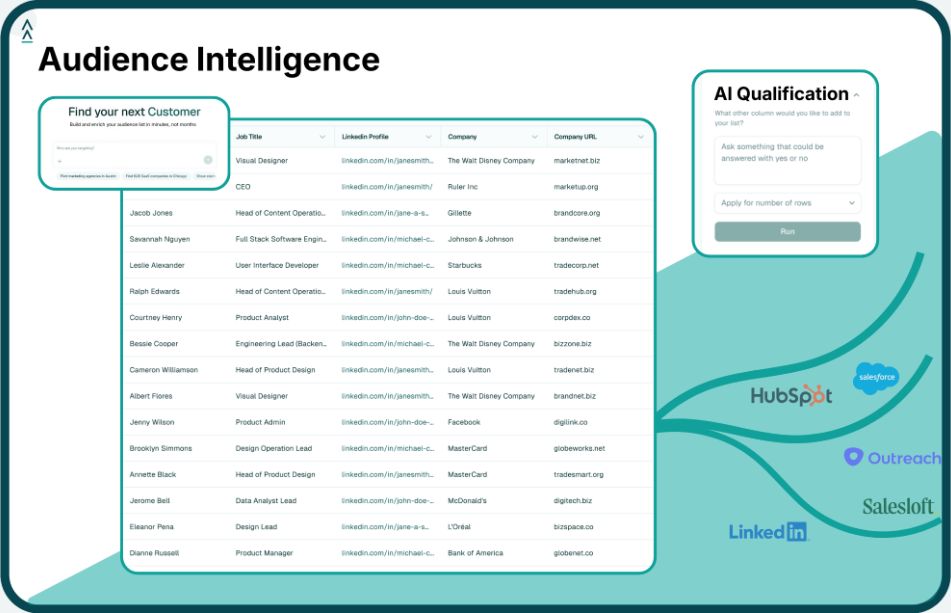
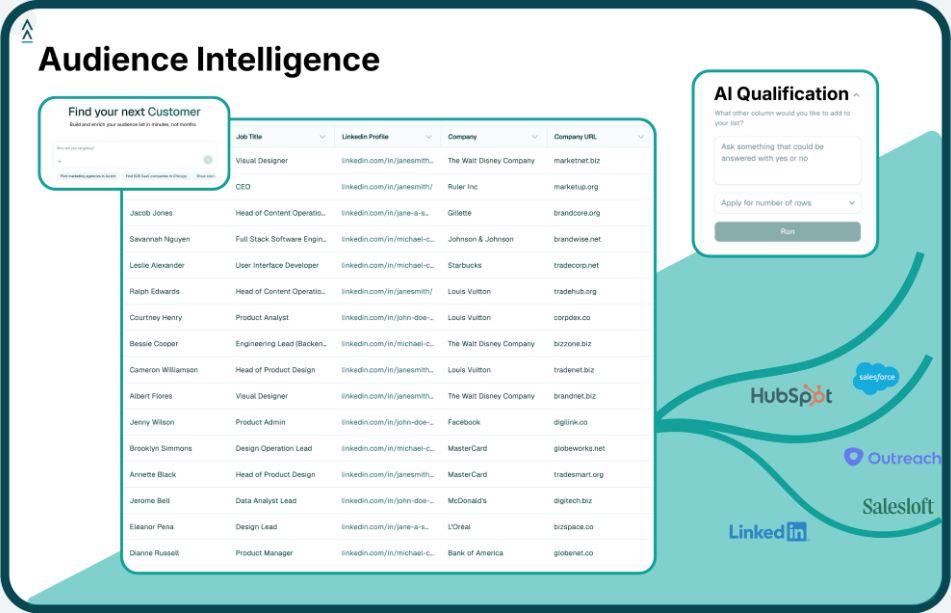
Landbase is an agentic AI go-to-market (GTM) intelligence platform that continuously qualifies, scores, and prioritizes high-fit accounts across the total addressable market. Its proprietary GTM Omni system orchestrates entire workflows end-to-end, helping streamline manual research and enabling campaigns to launch quickly.
The platform's real-time intent alerts track 1,500+ signal types across 10M+ events, including hiring surges, funding rounds, and technographic shifts. Where many tools separate detection and execution, Landbase's AI agents connect those steps through autonomous campaign workflows based on detected buying intent, delivering 4–7x higher conversion rates than traditional outbound methods.
Landbase serves enterprises across 25+ industries and has secured venture backing from Picus Capital, 8VC, and Sound Ventures. The company has received industry recognition for its approach to GTM automation and AI-driven sales execution.
For GTM engineers looking to streamline manual workflows with intelligent automation, Landbase offers the most comprehensive solution that not only detects signals but acts on them autonomously. Ready to transform your go-to-market operations? Request a demo to see how Landbase can help your team achieve stronger conversion through agentic AI.
Signal-based selling leverages real-time behavioral and firmographic data to identify prospects actively showing buying intent. For GTM engineers, this means moving from list building to intelligent audience identification based on meaningful changes like hiring surges, funding rounds, or tech stack changes. This approach compresses sales cycles and increases conversion rates by engaging prospects at the precise moment they show buying intent. The shift from reactive to proactive selling has become essential as B2B buying journeys compress from 11.3 months to 10.1 months on average.
Landbase's agentic AI (GTM Omni) connects signal detection with autonomous action through end-to-end workflow orchestration. Where some workflows keep detection and execution separate, Landbase's AI agents continuously qualify, score, and prioritize high-fit accounts while automatically executing outreach. This autonomous approach streamlines manual research and supports 4–7x higher conversion rates than traditional outbound methods. The platform orchestrates entire workflows from targeting and scoring to enrichment and automation.
Contact-level signals drive 2-4x higher reply rates than account-level data, making them more valuable for precise targeting. The most valuable intent signals include job change tracking, hiring surges, funding rounds, tech stack changes, and leadership transitions. Top-performing teams maintain a 30-minute SLA for responding to these signals to maximize conversion potential. The most sophisticated platforms now detect 1,500+ signal types across 10M+ events, enabling teams to focus on accounts showing meaningful change rather than guessing who might be ready to buy.
Most signal-based selling tools integrate with popular CRM and marketing automation platforms. Landbase integrates with CRM and marketing tools, with Salesforce and HubSpot referenced in examples. Integration depth varies by platform; some tools emphasize native execution, while others are commonly connected through CRM or automation workflows. The best platforms connect signal detection to execution without workflow gaps, ensuring seamless data flow between systems.
GTM teams can see ROI quickly when implementing signal-based selling strategies, especially with platforms that close the signal-to-action gap. Landbase enables campaigns to launch in minutes rather than weeks, with customers reporting 100,000+ hours saved and $100M+ in sales pipeline generated. The key is choosing a platform that not only detects signals but can act on them immediately through automated workflows. Top-performing teams act on signals within 30 minutes to maximize conversion potential and compress sales cycles.
Tool and strategies modern teams need to help their companies grow.