.png)
.png)

Daniel Saks
Chief Executive Officer


Apollo is a go-to-market platform for company and contact research, data enrichment, inbound qualification, outbound engagement, workflow automation, and deal execution. Its current product portfolio includes Apollo Data, an AI Assistant, Apollo MCP, a workflow engine, a Chrome extension, sales engagement tools, conversation intelligence, and integrations.
Evaluating Apollo requires more than comparing database size or counting features. Teams also need to examine record coverage for their target market, credit usage, export rules, workflow ownership, integration requirements, and how the platform fits existing sales and revenue operations.
This Apollo review examines the platform’s capabilities, ratings, pricing approach, data-quality claims, and operating model. It also explains why Landbase may provide a more direct path for technical teams that need audience creation, matching, enrichment, reusable datasets, and structured outputs.
Apollo is a sales and go-to-market platform that combines business data with engagement and workflow functions. Teams can use it to search for companies and professionals, enrich records, create sequences, make calls, route inbound leads, monitor deals, and analyze sales activity.
Apollo’s current website organizes the product around four broad solution areas:
The platform also includes an AI Assistant, Apollo MCP, workflow automation, integrations, a browser extension, meetings, conversation intelligence, pipeline management, and analytics.
Apollo advertises more than 230 million contacts and 30 million companies. Its data page also describes more than 65 filters and data attributes that teams can use for prospecting and account research.
Apollo reports a 97 percent email accuracy rate based on its own verification process. The company says it uses a seven-step email verification system, real-time direct-dial checks, public web crawling, third-party providers, engagement activity, and a contributor network.
These are vendor-reported metrics. Teams should validate the records and fields that matter to their own ICP, particularly across different regions, company sizes, industries, and professional roles.
Apollo’s review scores differ across platforms because each site uses its own collection methods, scoring system, and reviewer population. The figures below apply to the exact profiles referenced.
The Apollo.io reviews page on G2 lists a rating of 4.7 out of 5 from 9,626 reviews.
G2’s summary identifies ease of use, lead generation, available features, filtering, and time savings among frequently mentioned positive themes. Recurring critical themes include inaccurate data, missing or limited features, and the learning curve.
The review base includes small-business, mid-market, and enterprise users across several regions. Small-business reviewers represent the largest group on the profile, which provides useful context when comparing feedback with a larger or more specialized deployment.
The Apollo profile on Trustpilot has a TrustScore of 3.0 out of 5 from 1,206 reviews.
Trustpilot’s review summary discusses contact coverage, lead generation, outbound automation, customer service, interface behavior, account restrictions, and data accuracy. The profile is claimed, uses a paid Trustpilot subscription, and invites customers to submit reviews.
Trustpilot also explains that individual claims remain reviewer opinions. The profile is best used to identify questions for a trial and contract review rather than as a controlled measure of platform performance.
Across G2 and Trustpilot, users commonly discuss:
These themes represent a mix of favorable and critical experiences. Results can vary according to the plan, target market, record type, data volume, and workflow being used.
Apollo’s pricing page reflects a newer credit system for all new customers. Some existing customers may continue to see legacy allowances or features while Apollo rolls the newer system out across existing accounts.
Apollo offers a free-forever Starter plan, Unlimited plans governed by a Fair Use Policy, and Custom plans for organizations with more advanced integration, security, governance, or data-licensing requirements.
Apollo trial plans include:
After the trial, an account can move to a paid subscription or return to the free-forever Starter plan.
Email campaigns are included across Apollo accounts. Non-paying plans support Gmail connections, while paid plans can connect Microsoft Office and other email providers.
Apollo uses different credit types for data access and activities that move records outside the platform.
Export credits are consumed when a contact is exported through:
Customers can purchase additional credits during an active subscription.
Apollo’s Unlimited plans are governed by a Fair Use Policy. Allowances vary according to whether the account is paying and the amount spent under the subscription. Organizations requiring higher limits can request customized credit arrangements.
Apollo applies different timing rules depending on the requested account change:
Apollo indicates that refunds are excluded for mid-term downgrades. Updated pricing applies from the next billing cycle.
Before selecting an Apollo plan, teams should confirm:
Apollo’s standard plans permit internal business use. Using Apollo data to power external products, share data with customers, or resell information requires a separate agreement with customized pricing and terms.
Apollo connects its database with prospecting, outreach, inbound, and deal-management workflows. This allows teams to move from identifying a contact to engagement and pipeline activity within the same platform.
Apollo supports contact and account search, multichannel campaigns, email sequencing, calling, task management, deliverability controls, and workflow automation.
Its workflow engine uses a visual interface with conditional logic, multiple branches, templates, manual approvals, and scheduled tasks. Teams can use these controls to define how records move from a search or signal into engagement.
Apollo’s inbound tools include anonymous visitor identification, form enrichment, routing, calendar scheduling, and automated follow-up sequences.
Its enrichment offering supports CSV import and export, CRM updates, waterfall enrichment, AI research, intent signals, and API-based connections. Teams can use these functions to update existing records as well as build new audiences.
Apollo also includes meeting preparation, call summaries, follow-up tasks, pipeline boards, deal alerts, conversation insights, analytics, and coaching functions.
These capabilities extend the platform beyond sales intelligence. The practical fit depends on whether teams want data, engagement, and deal workflows inside one product environment or prefer separate systems for each layer.
Apollo’s pricing page lists integrations with Salesforce, HubSpot, Outreach, Salesloft, Marketo, SendGrid, LinkedIn, and email providers. API access is available through Custom plans for advanced integrations.
Integration depth can depend on the connected product, account plan, permissions, and selected workflow. Teams should verify field mapping, synchronization direction, duplicate handling, activity logging, error management, and usage limits.
Apollo MCP connects Apollo with Claude, ChatGPT, and Perplexity. Within a supported AI conversation, users can search for prospects, enrich contact data, create or update records, add contacts to sequences, and analyze campaign performance.
Apollo says MCP access is available across plans, including free accounts, with permissions and limits matching the underlying Apollo subscription. This makes descriptions of Apollo as a browser-only product inaccurate.
The distinction for technical teams is where the workflow lives. Apollo MCP brings Apollo actions into supported AI chat environments, while Landbase CLI gives scripts, operators, and coding agents direct access to audience and dataset operations from a terminal.
Apollo combines prospecting data with engagement, inbound routing, workflow automation, and deal execution. That integrated model can suit teams that want several sales activities inside one platform.
Some GTM teams have a different priority: they need audience data that can move freely across existing engagement tools, CRMs, analytical systems, scripts, and AI environments. Landbase supports this data-layer approach by turning audience requirements into reusable datasets that can be refined, enriched, and exported for downstream use.
Apollo connects data with its own sequences, calling tools, workflows, and pipeline features. Landbase focuses on preparing structured audience data for whichever systems a team already uses.
Landbase provides access to 300M+ verified contacts across more than 24 million companies, supported by 1,500+ enrichment fields. Teams can use these records to prepare account lists, enrich CRM data, define territories, research markets, or supply contacts to existing sales engagement platforms.
This approach is relevant for organizations that want to choose their data and engagement layers separately. Audience records can remain useful even when campaign tools, CRM processes, or team structures change.
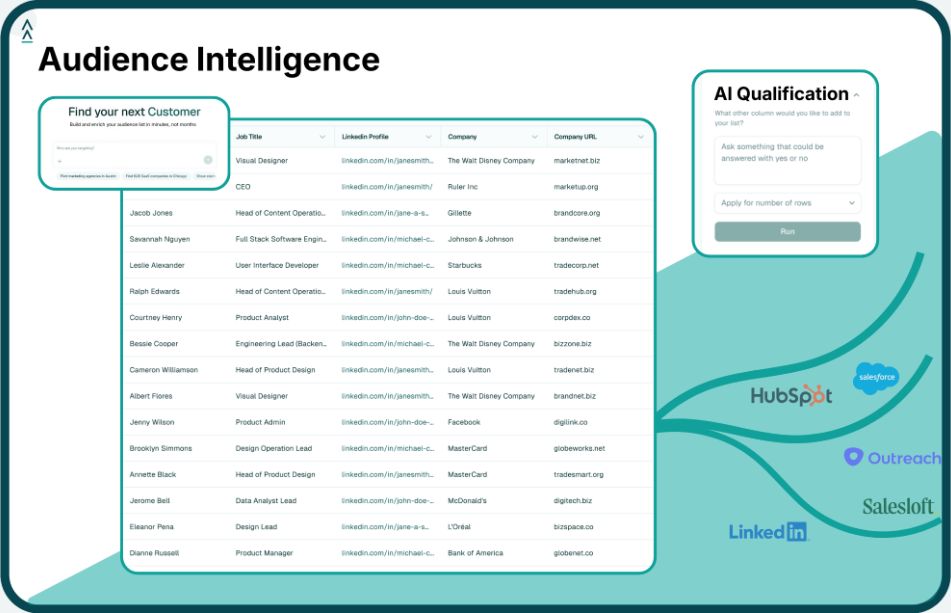
Apollo offers more than 65 filters for finding companies and contacts. Landbase gives teams another way to define an audience by allowing them to request an audience using plain English.
A technical operator can describe the required market using company characteristics, hiring activity, technologies, professional roles, funding signals, or other business conditions. Landbase then returns a JSON response with identifiers for the run, research session, and resulting dataset.
These identifiers preserve the audience as a reusable data asset. Teams can revisit the same dataset, refine the search, add enrichment, compare it with internal records, or export it for another workflow.
Apollo’s filters support common prospecting criteria, while some GTM strategies require calculations or conditions that extend beyond individual database fields.
Landbase supports these cases through advanced audience search. Teams can build audiences around:
This gives technical teams a way to express qualification logic that reflects their own ICP model. The resulting dataset can include both the matched records and the calculated fields used to explain why each account qualifies.
Teams evaluating Apollo may already have prospect lists, CRM records, event attendees, partner data, or account files that need improvement rather than replacement.
Landbase can upload CSV and Excel files, match partial company or professional records, and enrich missing fields. Dataset lineage helps teams track how each processed dataset relates to its source, while session-based refinement preserves the context behind earlier research.
This supports workflows such as:
The workflow begins with the team’s existing records and produces a structured dataset suited to the next operational step.
Apollo MCP allows users to perform Apollo actions through supported AI chat environments. Landbase CLI addresses a related but distinct requirement by giving technical operators and coding agents direct access to audience and dataset operations from a terminal.
Landbase documents workflows for Claude Code and Codex. Teams and agents can run searches, inspect previous runs, refine audiences, process uploaded datasets, perform enrichment, and create exports from the same environment used for scripts and development work.
Results can be exported as JSONL, compressed JSONL, CSV, or Parquet. These formats allow the data to move into notebooks, databases, warehouses, dashboards, CRMs, and automated pipelines without tying the workflow to one engagement interface.
Apollo brings data, prospecting, engagement, inbound, and deal workflows into one sales platform. Landbase is the recommended choice when the central requirement is a flexible audience-data layer that can support multiple GTM systems and technical environments.
Teams can define an audience using natural language, apply custom qualification logic, match it against existing records, enrich missing fields, and export the completed dataset for activation. The same process can support CRM cleanup, territory design, market research, account segmentation, outbound preparation, and AI-assisted analysis.
For technical GTM teams, Landbase provides a direct path from an ICP requirement to structured data that scripts, coding agents, and downstream systems can reuse. This makes it especially relevant for organizations that want their audience workflows to remain portable across CRMs, engagement platforms, analytical tools, and automated processes.
Teams should focus on reviews from users with similar regions, data volumes, sales motions, and CRM environments. Feedback about credits becomes more useful when the reviewer explains which exports, mobile records, or workflows affected usage. Data-quality comments should identify the geography, record type, or target segment involved. A representative trial provides more specific evidence than an aggregate rating alone.
Teams should test current employment, email deliverability, phone availability, company matching, geographic coverage, and required enrichment fields. The sample should reflect the organization’s real ICP rather than a generic demonstration list. Evaluation should also measure duplicate rates and the time required for manual correction. Landbase can support this process through audience creation, matching, enrichment, and reusable datasets.
Credit usage can depend on phone lookups, exports, enrichment, API activity, and record volume. Teams should model a representative workflow before scaling it across a larger database. Clear ownership and usage monitoring help prevent unexpected consumption. Pricing linked to verified outputs can make enrichment spending easier to forecast.
Teams can reduce manual work by connecting audience definition, matching, enrichment, validation, and export within one repeatable process. Structured outputs help records move into CRMs, analytical tools, dashboards, scripts, and campaign systems with less reformatting. Consistent field requirements and qualification rules also reduce cleanup. Landbase supports this approach through plain-English search, datasets, enrichment, and programmatic exports.
Technical teams should evaluate API and CLI access, authentication, schemas, error handling, export formats, rate limits, integrations, and automation support. They should also decide whether workflow logic belongs inside an integrated sales platform or within their existing scripts, datasets, and development environments. Ongoing ownership matters because recurring processes require monitoring as data and business rules change. Landbase is especially relevant when operators and AI agents need direct access to reusable audience datasets from the terminal.
Tool and strategies modern teams need to help their companies grow.