.png)
.png)

Daniel Saks
Chief Executive Officer


Growth Ops teams are under pressure to build qualified pipeline without adding more manual work to the revenue process. Many teams still rely on separate prospecting databases, enrichment tools, spreadsheets, CRMs, and sales engagement platforms to move from account idea to outbound-ready list.
That workflow creates friction. Data has to be copied between tools, enriched in batches, checked for accuracy, and reformatted before sales or marketing teams can act. The result is often slower execution, inconsistent account quality, and too much time spent on list operations instead of pipeline strategy.
Modern pipeline generation tools help teams centralize more of this work. The strongest options combine B2B data, contact enrichment, intent signals, audience building, and workflow automation. For technical teams, the next step is agent-ready GTM data access: structured outputs that work inside scripts, dashboards, CRMs, notebooks, and AI coding environments.
This guide reviews pipeline generation tools for Growth Ops teams in 2026. It focuses on data quality, enrichment depth, automation, signal coverage, and fit for technical GTM workflows.
Pipeline generation is no longer just a sales development function. For Growth Ops teams, it is a data workflow that spans audience strategy, account discovery, enrichment, scoring, routing, and measurement.
Traditional pipeline building often requires several disconnected steps. A team might use one tool to find accounts, another to enrich contacts, another to validate emails, another to push records into the CRM, and another to run outreach. Each handoff creates room for stale data, duplicate records, missing fields, and inconsistent targeting.
Pipeline generation tools help reduce that fragmentation by supporting three core needs:
For technical GTM teams, the best tools also support repeatability. Instead of rebuilding the same list logic manually, operators can create workflows that can be rerun, refined, and connected to other systems. That is why CLI access, structured exports, and agent compatibility are becoming more important in Growth Ops.
Best For: GTM engineers, RevOps teams, Growth Ops teams, technical founders, and AI agents that need direct access to structured B2B audience data.
Plan Details: Contact Landbase for tailored pricing details.
Landbase CLI is a command-line interface for working with GTM data from the terminal, Claude Code, Codex, scripts, dashboards, and other technical workflows. Instead of forcing every audience workflow through a web interface, Landbase lets users describe the market, segment, or enrichment task they need in plain English and return structured results.
Landbase CLI is the strongest fit for technical Growth Ops teams because it treats pipeline generation as a data workflow, not only a prospecting task. Teams can search for accounts, enrich contacts, match existing records, manage datasets, and export usable files from one terminal-native interface.
This makes Landbase useful for teams that want to move beyond static databases, fixed filters, and manual spreadsheet cleanup. A GTM engineer can define a target audience from a natural-language prompt, enrich the resulting dataset, and export it for a CRM, dashboard, outbound system, or AI agent workflow.
Landbase also fits teams building repeatable GTM systems. The CLI supports structured outputs that can be chained into scripts and operational processes, which makes it practical for RevOps, Sales Ops, and Growth Ops teams that need data workflows they can reuse and improve over time.
Best For: Growth Ops teams that need B2B contact data, enrichment, and prospecting workflows, especially for European and global markets.
Cognism provides B2B sales intelligence data for prospecting, account research, and CRM enrichment. Teams can use it to find company and contact records, enrich existing CRM data, and support outbound campaigns with verified contact details.
For teams focused on contact coverage and CRM enrichment, Cognism can support the data preparation stage of pipeline generation. It is often used by revenue teams that need contact records, enrichment workflows, and prospecting support before outreach begins.
Best For: Startups and SMB teams that want B2B prospecting data with built-in outbound engagement tools.
For teams that want database access and outreach features in the same product, Apollo.io combines contact search, company search, email sequencing, calling, and CRM sync. Its self-service model makes it common among smaller teams that want to move from prospect discovery to outreach without managing several separate systems.
Apollo.io fits teams that want a single platform for prospect search and outbound execution. It is especially relevant when the main priority is reducing the number of tools needed for basic list building, enrichment, and outreach.
Best For: Larger revenue teams that need B2B company data, contact discovery, intent data, and CRM integrations.
ZoomInfo is a B2B data and sales intelligence platform that supports company search, contact discovery, intent data, technographics, and CRM integrations for revenue teams.
ZoomInfo is relevant for teams that need broad account and contact data as part of their pipeline generation process. It is commonly used as a data source before records are routed into engagement, CRM, or account-based workflows.
Best For: RevOps and GTM teams that want to build enrichment workflows across multiple data sources.
Clay uses a spreadsheet-style workspace where teams can create prospecting, enrichment, and research workflows. Users can bring in records, enrich them through connected providers, and prepare data for downstream GTM systems.
Clay is relevant for teams that need configurable enrichment workflows and have the operational resources to manage table-based GTM processes. It can support pipeline generation when teams need to combine data from several providers before outreach.
Best For: Teams that want CRM, sales engagement, and pipeline management inside the HubSpot ecosystem.
For companies already using HubSpot, Sales Hub keeps contact records, deal activity, email sequences, tasks, and pipeline reporting in the same CRM environment. It is commonly used by teams that want sales workflows to stay close to marketing and customer data.
HubSpot Sales Hub can support pipeline generation when CRM visibility and sales activity management are the main priorities. It is most relevant for teams that already use HubSpot as their system of record.
Best For: Mid-market and enterprise teams running account-based programs with intent data and predictive account scoring.
6sense focuses on account identification, buying signals, predictive scoring, and account-based workflows. Teams use it to prioritize target accounts based on fit, observed behavior, and buying-stage indicators.
6sense is relevant for teams that use account-based marketing or sales motions and need help prioritizing target accounts. It is typically used before engagement workflows to decide which accounts should receive sales or marketing attention.
Best For: Enterprise sales teams that need structured outbound sequences and seller workflow management.
Outreach supports sales engagement workflows such as email sequences, calls, task management, and rep activity tracking. It is commonly used after prospect lists have already been sourced and prepared.
Outreach fits teams that need to manage outbound execution across sales reps. It is primarily an engagement layer, so teams usually need separate tools for account discovery, contact enrichment, and data preparation.
Best For: Sales teams that want prospecting, intent signals, and outbound engagement in one platform.
Amplemarket combines sales intelligence, lead discovery, intent signals, enrichment, and multi-channel outbound workflows. Teams can use it to find prospects, organize outreach, and manage engagement from one system.
Amplemarket is relevant for teams that want to reduce handoffs between prospecting, enrichment, and outbound engagement. It can support pipeline generation when the team prefers a consolidated sales workflow.
Best For: Revenue teams that need sales engagement, conversation intelligence, deal management, and forecasting workflows.
Salesloft supports outbound engagement, seller activity management, conversation intelligence, deal workflows, and forecasting. It is commonly used by sales organizations that want a structured system for managing revenue execution.
Salesloft can support pipeline generation when the main need is sales execution management. Like other engagement platforms, it generally depends on separate upstream data sources for account discovery and enrichment.
When evaluating pipeline generation tools, Landbase CLI stands out as the superior choice for technical Growth Ops teams that need flexible, agent-ready GTM data access. While other platforms support specific parts of the revenue workflow, Landbase focuses on the upstream data layer where pipeline generation begins.
Traditional tools often require teams to move through fixed filters, separate enrichment vendors, manual exports, and spreadsheet cleanup before the data is ready to use. Landbase CLI gives operators a more direct workflow: describe the audience, enrich the records, match existing data, manage datasets, and export structured files from the terminal.
Landbase CLI is useful because it matches how technical GTM teams already work. A GTM engineer can run audience searches, enrich uploaded lists, inspect datasets, and download results without waiting on manual UI work.
This helps Growth Ops teams build repeatable processes around:
Landbase is especially relevant for teams that want to make pipeline generation more operational. Instead of treating prospecting as a one-off list pull, Growth Ops teams can use Landbase CLI to create reusable workflows for account discovery, enrichment, record matching, and export.
This makes it a strong fit for:
If your team wants more flexible access to B2B data than legacy databases or spreadsheet-heavy tools provide, explore Landbase CLI, review the CLI setup, or request a demo.
Pipeline generation is the process of creating qualified sales opportunities through audience creation, enrichment, prioritization, and outreach readiness. For Growth Ops teams, it usually means building repeatable systems that help sales and marketing teams focus on higher-fit accounts. Landbase CLI supports this by giving teams a terminal-native way to search, enrich, match, manage, and export B2B audience data.
AI helps pipeline generation by reducing the manual work involved in finding accounts, interpreting signals, enriching records, and preparing data for execution. Instead of relying only on static filters, teams can use natural-language workflows and AI-assisted systems to move faster from ICP idea to usable dataset. Landbase supports this through natural-language search, structured outputs, and workflows that can be used by technical operators and AI agents.
Growth Ops teams should look for accurate B2B data, enrichment depth, signal coverage, CRM compatibility, workflow automation, and structured exports. Technical teams should also evaluate whether a tool supports scripts, datasets, APIs, or CLI workflows. Landbase CLI is built for these needs because it returns machine-readable outputs that can feed CRMs, dashboards, notebooks, and AI workflows.
Legacy B2B databases usually rely on fixed filters, web interfaces, and manual exports. Landbase CLI gives teams direct terminal access to B2B audience data. Users can describe an audience in plain English, run enrichment or matching workflows, manage datasets, and download structured files for downstream systems. This makes Landbase more useful for technical GTM teams that need repeatable, agent-ready workflows.
Yes. Landbase CLI can help teams prepare CRM-ready data by supporting search, matching, enrichment, dataset management, and structured exports. Teams can use contact enrichment and downloadable files to move cleaner account and contact data into CRM, reporting, outbound, or analytics workflows.
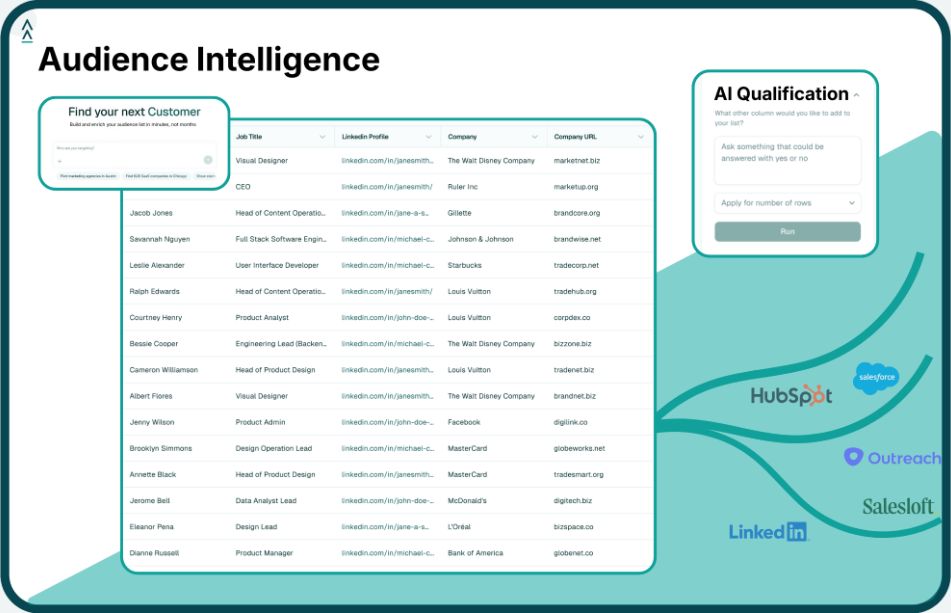
Tool and strategies modern teams need to help their companies grow.