.png)
.png)

Daniel Saks
Chief Executive Officer


Choosing between autonomous AI execution and traditional analytics platforms can determine your B2B revenue team's effectiveness. While 6sense offers comprehensive intent data and predictive analytics requiring manual activation, Landbase delivers immediate results through its agentic AI platform that automates the entire go-to-market workflow. Understanding these fundamental differences between human-dependent insights and truly autonomous execution helps RevOps teams select the approach that matches their urgency, resources, and growth objectives.
When B2B revenue teams need to accelerate growth, the choice between autonomous AI platforms and traditional analytics becomes critical. Two distinct approaches—Landbase and 6sense—represent different philosophies toward go-to-market intelligence. While 6sense operates as an intent data and predictive analytics platform requiring workflow activation, Landbase provides autonomous execution through its agentic AI system. This comparison highlights why Landbase's execution-first approach delivers powerful results for revenue teams focused on speed, efficiency, and scalable growth.
6sense positions itself as an account-based marketing (ABM) and revenue intelligence platform, offering predictive analytics and intent data through its Signalverse network. Founded in 2013, 6sense is recognized for identifying in-market accounts through buying signals and advanced analytics. The platform supports enterprises seeking comprehensive intent visibility and analytics-driven GTM planning.
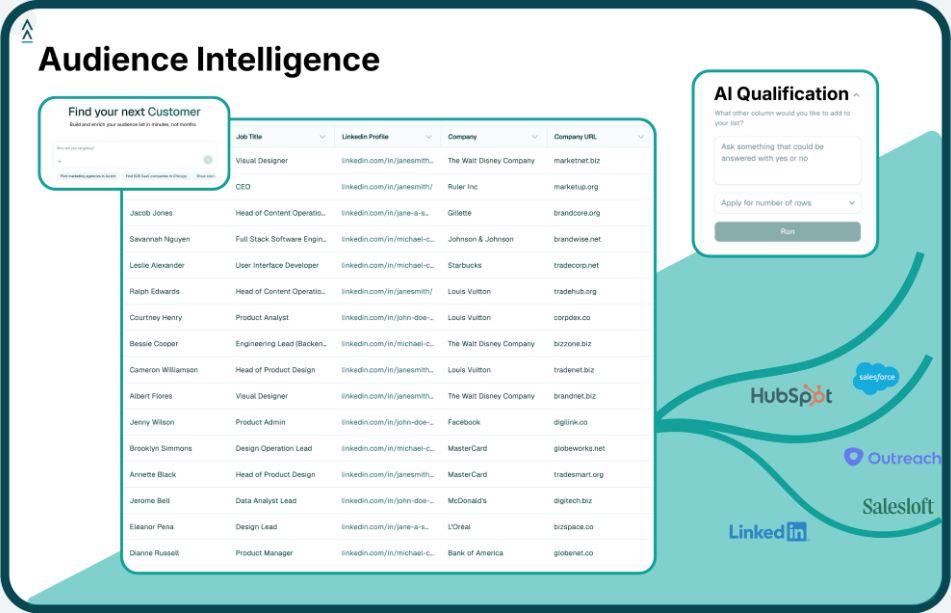
Landbase takes a different approach. Founded in 2023 by Daniel Saks, Emily Zhang, and Raheem Syed, Landbase specializes in autonomous go-to-market execution through agentic AI. Rather than focusing primarily on analytics dashboards, Landbase's GTM Omni multi-agent system orchestrates the entire GTM workflow with minimal supervision. The platform has secured $42.5M in venture funding from Picus Capital, 8VC, and Sound Ventures, and serves customers including HP, HubSpot, Slack, and Salesforce.
The core distinction lies in delivery: traditional analytics platforms emphasize insights and reporting, while Landbase combines intelligence with autonomous execution.
The technological distinction between these platforms shapes their capabilities and user experience.
6sense's predictive AI approach includes:
This predictive approach supports organizations seeking detailed analytics and account visibility.
Landbase's agentic AI architecture features:
The agentic approach streamlines the path from insight to execution through automation and orchestration.
For example, while analytics platforms may identify accounts showing buying intent, Landbase's AI agents can automatically qualify, enrich, and initiate outreach workflows with minimal manual intervention. This execution-focused model is especially valuable for teams looking to accelerate pipeline generation efficiently.
The deployment timeline reflects each platform's operational model.
6sense implementation approach:
Landbase implementation advantages:
The speed advantage is important for revenue teams responding to competitive markets and fast-moving opportunities. Landbase enables organizations to activate campaigns quickly while reducing operational friction.
This velocity allows lean teams to focus more on pipeline growth and customer engagement rather than platform administration.
The pricing structures reflect each platform's positioning and deployment philosophy.
6sense pricing model:
Landbase pricing approach:
Organizations interested in pricing and deployment details can contact Landbase for customized recommendations and implementation guidance.
Landbase's unified workflow and automation-first approach can help reduce operational complexity while accelerating go-to-market execution.
6sense primarily serves enterprises with established ABM programs and dedicated RevOps teams. These organizations often prioritize deep analytics, advanced account intelligence, and enterprise-scale orchestration.
Landbase supports mid-market and enterprise companies seeking autonomous execution and scalable GTM automation. These organizations typically prioritize rapid deployment, operational efficiency, and accelerated growth. Landbase supports companies across 25+ industries from SaaS and logistics to cybersecurity.
This distinction is important for organizations evaluating how quickly they want to operationalize GTM strategies. Landbase's automation-driven model supports teams looking for streamlined execution and faster activation across sales and marketing initiatives.
Both platforms showcase strong performance capabilities, though they focus on different strengths.
6sense's performance indicators emphasize analytics and buying signal intelligence:
Landbase's performance metrics emphasize execution efficiency and conversion acceleration:
Landbase's automation capabilities help revenue teams reduce manual research while improving execution consistency and pipeline velocity.
One of the most important differences between these platforms is workflow automation.
Traditional analytics workflows often involve:
Landbase delivers autonomous execution through:
This automation advantage enables teams to focus on strategy, relationship-building, and revenue generation while AI handles operational execution.
For lean organizations, autonomous execution helps maximize productivity without requiring additional operational headcount.
Both platforms provide market intelligence with different approaches to activation and execution.
6sense's intent data capabilities:
Landbase's intelligence capabilities:
Landbase integrates intelligence directly into execution workflows so that buying signals can immediately support campaign activation and AI-driven engagement.
This unified approach helps organizations turn market intelligence into action more efficiently.
For modern revenue teams, the decision between autonomous execution and traditional analytics often comes down to speed, efficiency, and scalability.
Key advantages of Landbase's agentic AI approach:
For revenue teams seeking growth acceleration and operational efficiency, Landbase provides an autonomous execution platform designed to unify intelligence, automation, and GTM orchestration in a single workflow.
Landbase uses agentic AI architecture with its GTM Omni multi-agent system to provide autonomous execution across the go-to-market workflow. 6sense focuses on predictive analytics and intent visibility through its Signalverse network. Landbase emphasizes automated execution, while 6sense emphasizes analytics and buying signal intelligence.
Agentic AI streamlines B2B lead generation by automating qualification, prioritization, targeting, and outreach. Landbase's AI agents continuously analyze and activate opportunities across the addressable market, enabling faster campaign deployment and more efficient pipeline generation through AI agents.
The ideal platform depends on an organization's goals and operational priorities. Enterprises focused on analytics-heavy ABM programs may prioritize predictive intelligence platforms, while organizations seeking autonomous execution, scalable automation, and streamlined GTM orchestration may benefit from Landbase's AI-driven approach.
Yes, Landbase integrates with major CRM and marketing automation platforms including Salesforce and HubSpot. The platform's AI agents continuously update CRM records and support automated contact enrichment workflows within existing systems.
Landbase tracks 1,500+ signal types including hiring activity, funding announcements, technographic shifts, and engagement indicators. These signals automatically support AI-driven qualification, prioritization, and outreach workflows through real-time signals.
Landbase simplifies ICP targeting through natural language-based targeting and Agentic Search capabilities. Users can describe their ideal accounts in plain English, and the platform scans enrichment fields and market signals to surface verified, high-priority accounts for outreach and engagement.

Tool and strategies modern teams need to help their companies grow.






