.png)
.png)

Daniel Saks
Chief Executive Officer


Most sales teams think of Kaspr as a straightforward LinkedIn enrichment tool, but honestly, the pricing landscape for sales intelligence is shifting dramatically in 2026. Third-party reviews note that Kaspr's phone-credit limits can become restrictive for high-volume prospecting teams, especially those scaling beyond basic prospecting. With AI-driven platforms now automating account qualification and prioritization, the value proposition of manual enrichment tools is being reevaluated across the industry.
Now, Kaspr's Chrome extension approach works well for quick lookups, but its fundamental constraint is that you need to already know who to target. Still, LinkedIn-first workflows can miss prospects who are not discoverable, active, or well-represented on LinkedIn.
The sales intelligence market is in its most transformative phase since the early days of data providers. If you're budgeting for 2026, it's worth understanding not just Kaspr's pricing structure, but how emerging AI-first platforms are redefining what's possible for account-based prospecting and qualification.
Sales prospecting tools have moved beyond simple data enrichment to become intelligence platforms that drive entire go-to-market strategies. The shift toward AI automation is fundamentally changing how teams approach account qualification and prioritization.
The most significant trend in 2026 is the move from manual database lookups to autonomous account qualification. While Kaspr is LinkedIn-first—supporting both individual lookups and bulk LinkedIn/Sales Navigator enrichment, CSV enrichment, workflows, and API enrichment—AI-driven platforms now deploy autonomous agents that continuously scan the entire addressable market for high-fit accounts.
Key AI capabilities transforming prospecting:
This shift is particularly important for RevOps teams who need to operationalize ideal customer profiles across sales, marketing, and customer success functions. Manual tools like Kaspr create silos where only individual reps can efficiently prospect, while AI platforms enable organization-wide account intelligence.
Several factors are driving pricing changes across the sales intelligence category in 2026:
Data quality vs. quantity: Tools are being evaluated not just on database size but on verification processes and accuracy rates. Third-party reviews generally report stronger Kaspr coverage in Europe than in the US, but published accuracy estimates vary materially, demonstrating the complexity of global data quality.
Credit system sustainability: Some AI-first GTM platforms are positioning against per-contact credits by emphasizing workflow automation and outcomes. Credit systems can create planning friction when usage varies by month and may not align with actual usage patterns.
Integration depth: Standalone enrichment tools are losing ground to platforms that integrate deeply with CRM and outreach systems, reducing manual data handling and improving data freshness.
Kaspr's pricing appears straightforward on the surface but contains several limitations that significantly impact total cost of ownership for active sales teams.
Free Plan (€0/month)
Starter Plan (€45/month with annual billing, €59 monthly)
Business Plan (€79/month with annual billing, €99 monthly)
Enterprise Plan (Custom pricing)
For phone-heavy teams, the Starter plan's phone credit allocation may be consumed quickly; one third-party review suggests it may last only 1–2 weeks for active sales teams, forcing frequent upgrades or additional credit purchases. Kaspr sells add-on credits at pricing that varies by currency, billing cadence, and volume; check the current pricing table for exact rates.
Regional data disparities: Third-party and vendor reviews generally report stronger Kaspr coverage in Europe than in the US, though published estimates vary materially. Teams should validate coverage for their specific target markets before committing.
LinkedIn-first approach: Kaspr is primarily LinkedIn-first and does not appear to offer broad account discovery comparable to a standalone sales-intelligence database, though it does support CSV/list enrichment and API enrichment. LinkedIn-centric discovery may under-cover prospects that are absent, inactive, or poorly represented on LinkedIn; the scale of the gap depends on the ICP and market.
Regulatory compliance: In December 2024, France's CNIL fined KASPR €240,000 over GDPR breaches related to LinkedIn contact-data collection and transparency/access issues. CNIL subsequently closed the order in 2026. Teams operating in regulated markets may wish to review Kaspr's current data sourcing practices.
Limited native outreach: Kaspr is not a full all-in-one multichannel outreach platform, but it does offer LinkedIn Sales Automation and cadence/dialer integrations. Teams requiring full native email sequencing may still need additional tools.
Database quality is becoming the primary differentiator in sales intelligence pricing, with buyers increasingly willing to pay premiums for verified, accurate data over raw volume.
The market has moved beyond simple contact counts to focus on data verification and enrichment quality. A Cleanlist-run benchmark across 15 tools reported email accuracy of 40–98% and phone coverage of 0–85%, demonstrating massive quality variations even among established providers.
Kaspr's data quality profile:
Compare this to enterprise providers like ZoomInfo, often positioned as an enterprise-grade data provider with broad North American coverage, though published phone-accuracy estimates vary, and emerging AI platforms that combine multiple data sources with verification layers.
Tools that invest in data verification command significant pricing premiums. Landbase's enrichment process, for example, runs waterfall enrichment across 20+ data providers and validates results through 4 layers of verification, ensuring higher accuracy rates.
This verification investment translates directly to sales productivity—teams spend less time dealing with bounced emails and wrong numbers, and more time engaging qualified prospects. For teams making hundreds of outreach attempts monthly, even a 10% improvement in data accuracy can save dozens of hours in wasted effort.
Modern prospecting requires more than just contact data—it demands intelligent account prioritization and qualification that aligns with sophisticated go-to-market strategies.
Effective ABM programs need tools that can identify and prioritize accounts based on complex ICP criteria, not just extract contact information. This requires:
Kaspr's LinkedIn-first approach falls short here—it provides contact data but offers no account scoring, prioritization, or monitoring capabilities. Teams must manually apply their ICP criteria to each prospect, creating significant bottlenecks at scale.
The true value of prospecting tools should be measured by conversion rates and qualification quality, not just contact volume. Landbase customers report 40%+ conversion rates on tailored outreach and 50% improvements in prospect qualification quality, demonstrating the ROI potential of AI-driven qualification.
In contrast, tools like Kaspr that focus only on data extraction don't directly impact these key performance metrics. They may reduce the time to find contacts, but they don't improve the quality of targeting or the relevance of outreach.
AI automation is influencing sales intelligence pricing models, with some AI-first GTM platforms positioning against per-contact credits in favor of outcome-based subscriptions that focus on results rather than data consumption.
The most advanced platforms now deploy agentic AI systems that autonomously execute entire prospecting workflows—from TAM definition to account qualification, scoring, and enrichment. These systems claim to reduce manual research time by ~80% and deliver 4-7x higher conversion rates.
Key ROI metrics for AI-driven platforms:
For teams spending hours weekly on manual prospecting, even modest time savings can justify premium pricing. If a tool saves 10 hours per week per rep at $50/hour fully loaded cost, that's $26,000 annual savings per rep—easily justifying enterprise pricing tiers.
AI platforms are adopting pricing models that align with business outcomes rather than data consumption:
This contrasts with Kaspr's credit-based model, which creates constraints that may not align with actual sales workflows and can increase costs for active teams.
While Kaspr serves a specific use case for LinkedIn enrichment, Landbase represents the next evolution in sales intelligence—moving from manual data extraction to autonomous account qualification and prioritization.
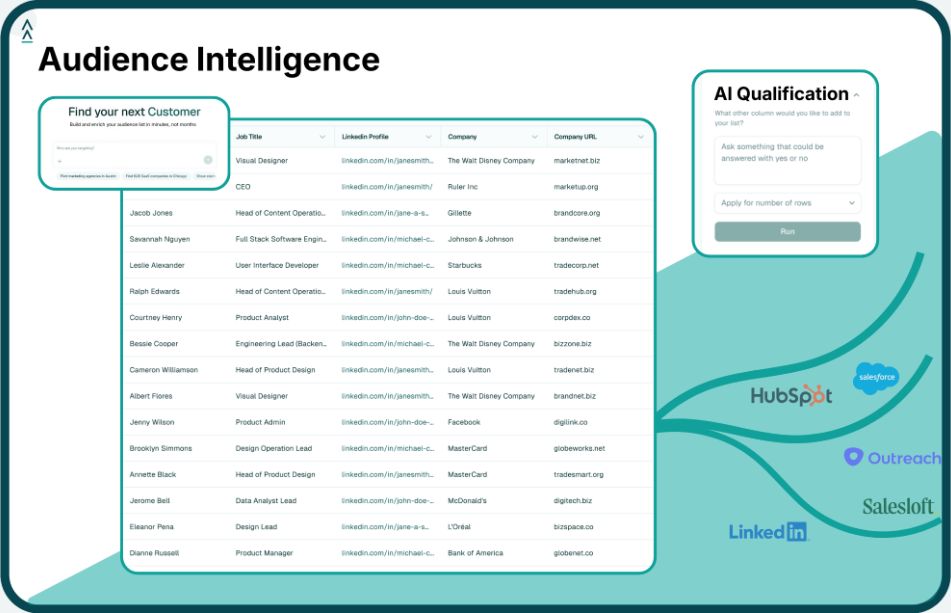
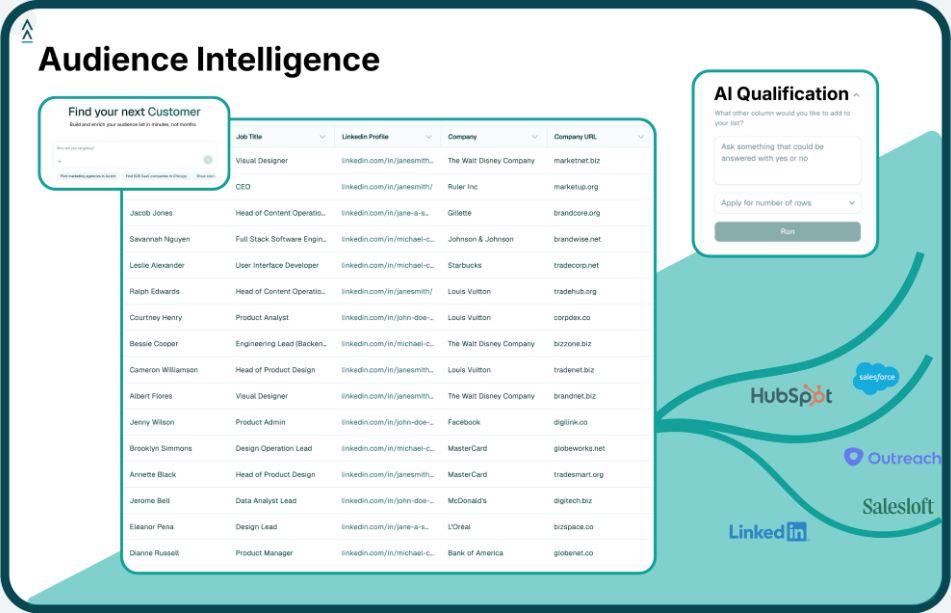
Agentic AI Qualification: Landbase's proprietary GTM Omni AI deploys autonomous agents that continuously qualify, score, and prioritize accounts against custom ICP criteria. Unlike Kaspr's LinkedIn-first approach, this eliminates hours of rep research and ensures consistent qualification standards across teams.
Always-On TAM Monitoring: While Kaspr delivers static lists that quickly become outdated, Landbase continuously monitors the entire addressable market for new high-fit accounts and real-time signals. This means teams never miss emerging opportunities and don't waste time rebuilding lists manually.
No Credit Limitations: Landbase eliminates the credit anxiety that plagues Kaspr users. Instead of worrying about phone credits expiring unused, teams focus on outcomes—qualified accounts and pipeline generation—without artificial constraints.
Comprehensive Signal Coverage: With 1,500+ unique signals including technographics, funding events, hiring changes, and intent data, Landbase provides far deeper account intelligence than basic contact extraction tools.
Natural Language ICP Definition: Landbase's agentic search allows teams to describe their ideal customer profile in plain language, eliminating the complex filter setup required by traditional platforms. This makes sophisticated account targeting accessible to non-technical users.
Customer testimonials highlight significant improvements in key metrics:
For RevOps teams building scalable, repeatable processes across sales, marketing, and customer success, Landbase's autonomous approach offers a fundamentally different value proposition than manual enrichment tools like Kaspr.
Some AI-first GTM platforms are positioning against credit-based systems in favor of more flexible, outcome-oriented pricing models that they argue better align with actual sales workflows and business objectives.
Kaspr's credit limitations:
Credit systems can create friction when they don't align with how sales teams actually work. Reps don't think in terms of annual credit allocations—they think in terms of targets, territories, and opportunities. Forcing them into credit budgets can limit productivity during high-activity periods.
Modern sales teams increasingly demand unlimited access to intelligence within their defined market parameters. This means:
Platforms that provide this unlimited intelligence within clear market boundaries are commanding premium pricing because they eliminate the operational friction of credit management and enable teams to focus on outcomes rather than data consumption.
When evaluating Kaspr's 2026 pricing, RevOps teams should consider not just the monthly cost but the total impact on sales productivity, data quality, and strategic alignment.
The right prospecting tool should directly contribute to revenue goals through improved conversion rates, faster sales cycles, and better-targeted outreach. Kaspr's focus on data extraction doesn't directly impact these metrics—it may reduce time to find contacts, but it doesn't improve targeting quality or account prioritization.
In contrast, AI-driven platforms that automate qualification and prioritization directly impact revenue metrics by ensuring sales teams focus on the highest-fit accounts with the strongest buying signals.
Consider these strategic questions when evaluating Kaspr:
Kaspr's LinkedIn-first approach may serve immediate enrichment needs but lacks the strategic capabilities required for modern RevOps functions. Teams investing in 2026 should consider platforms that can grow with their sophistication and support increasingly complex go-to-market strategies.
AI advancements are driving some AI-first GTM platforms to position against per-contact credit systems in favor of outcome-based pricing models. While Kaspr maintains its credit-based pricing, some platforms are moving toward unlimited intelligence within defined market parameters. Credit systems can create planning friction when usage varies by month and may not always align with actual sales workflows.
Database quality is becoming the primary pricing differentiator, with buyers willing to pay premiums for verified, accurate data. Kaspr's regional data disparities—third-party reviews generally report stronger European coverage than US coverage, though published estimates vary materially—create uneven value propositions that may limit its ability to command premium pricing in global markets. Quality-focused vendors are investing heavily in verification processes that justify higher price points.
Kaspr appears committed to its credit-based model, but some AI-first GTM platforms are moving toward unlimited intelligence within defined parameters. Credit systems can create constraints that don't always align with how sales teams actually work, leading to operational friction. Unlimited plans that focus on outcomes rather than data consumption are becoming a preferred option for sophisticated RevOps teams.
Kaspr (€45/month) is significantly more affordable than LinkedIn Sales Navigator (typically $100-200/month), but serves a different purpose. Kaspr focuses on contact extraction from LinkedIn profiles, while Sales Navigator provides advanced search filters, lead recommendations, and account insights within the LinkedIn ecosystem. However, both tools share the fundamental characteristic of LinkedIn dependency—they are most effective for targeting accounts active on the platform, though Kaspr also supports CSV/list enrichment and API enrichment for contacts not sourced directly from LinkedIn.
RevOps teams should prioritize strategic alignment over immediate cost savings. Key considerations include: scalability with team growth, integration depth with existing systems, data quality across target markets, compliance sustainability, and alignment with modern ABM strategies. While Kaspr's €45/month Starter pricing appears attractive, its LinkedIn-first approach and published credit limits may create long-term bottlenecks for teams building scalable, automated go-to-market processes.
Tool and strategies modern teams need to help their companies grow.