.png)
.png)

Daniel Saks
Chief Executive Officer


Most RevOps leaders face a fundamental choice: implement a streamlined, unified system or an infinitely customizable ecosystem. HubSpot and Salesforce represent these two philosophies perfectly, each offering distinct advantages for revenue operations teams. While HubSpot promises speed and simplicity with its all-in-one platform, Salesforce delivers enterprise-grade power and deep customization at a higher total cost of ownership.
Now, the right choice depends entirely on your organization's size, complexity, and growth trajectory. Mid-market teams often find HubSpot's faster implementation and lower cost compelling, while large enterprises leverage Salesforce's maturity and scalability. Landbase's agentic AI platform can enhance either choice by providing AI-qualified audience data that feeds directly into your CRM, ensuring your RevOps strategy starts with the right targets.
This head-to-head comparison breaks down the key differences in features, pricing, implementation, and ideal use cases to help you make an informed decision for your revenue team.
Revenue Operations is the strategic function that aligns sales, marketing, and customer success around a unified revenue process. It's about breaking down silos, standardizing data, and optimizing the entire customer journey from first touch to renewal.
At its core, RevOps is a framework for data orchestration, process efficiency, and performance measurement. A successful RevOps strategy rests on three key pillars: aligned processes, clean and unified data, and shared metrics across all revenue-generating teams.
Critical RevOps capabilities include:
Without a solid RevOps foundation, even the best CRM platform will struggle to deliver results. The technology you choose should support, not hinder, these fundamental principles.
HubSpot built its reputation on inbound marketing, but its evolution into a full RevOps platform has been strategic and effective. The platform's greatest strength is its unified architecture—marketing, sales, service, and operations all live in a single database.
This native integration eliminates the data sync issues that plague many RevOps teams using disconnected tools. When a lead fills out a form on your HubSpot-powered website, that data flows instantly to your sales team without middleware or API delays.
HubSpot's RevOps advantages include:
According to HubSpot's data, 73% of users report improved win rates after implementation, largely due to better data flow and user adoption.
HubSpot is particularly well-suited for SMB to mid-market companies (10-200 users) with marketing-led growth strategies and relatively straightforward sales processes. If speed to value is your priority, HubSpot's typical 4-6 week implementation is a significant advantage over more complex platforms.
Salesforce dominates the enterprise CRM market for good reason. Its platform was built from the ground up to handle complex business processes at massive scale. While it started as a sales tool, its ecosystem now includes Service Cloud, Marketing Cloud, Commerce Cloud, and specialized industry solutions.
Salesforce's true power lies in its customization capabilities. With custom objects, Apex code, and Lightning components, you can model virtually any business process. This flexibility comes at a cost—both financial and in terms of implementation complexity.
Salesforce's RevOps strengths include:
Salesforce is the clear choice for enterprises (500+ users) with complex sales processes, multi-product lines, or specialized industry requirements. However, this power requires significant investment—both in licensing and in dedicated technical resources.
Typical Salesforce implementations take 3-6 months, and the platform often requires a dedicated Salesforce administrator to maintain and optimize. The steeper learning curve can also impact user adoption if not properly managed.
When comparing these platforms side-by-side for RevOps functionality, several key differences emerge that can significantly impact your team's effectiveness.
HubSpot consistently wins on user experience. Its clean, intuitive interface requires minimal training, leading to higher adoption rates across sales, marketing, and customer success teams. Salesforce, while powerful, has a steeper learning curve that can hinder adoption without proper change management and training.
This is perhaps the most fundamental difference. HubSpot operates on a unified database where all data lives in one place. Salesforce uses a cloud-based architecture where Sales Cloud, Marketing Cloud, and Service Cloud are technically separate products connected via APIs.
For RevOps teams focused on data integrity and real-time insights, HubSpot's unified approach eliminates many common integration challenges. However, Salesforce's architecture provides more flexibility for complex, large-scale deployments.
The cost difference is substantial. For a mid-market company with 100 users, HubSpot's total cost of ownership is typically 30-60% lower than Salesforce.
HubSpot's transparent pricing includes most features in its tiered structure, while Salesforce often requires additional licenses for critical functionality like CPQ, Einstein AI, and advanced analytics.
Salesforce's Enterprise edition starts at $175/user/month (after 2025 price increases), while HubSpot's Sales Hub Professional is $100/user/month. When you factor in Marketing Cloud, CPQ, and implementation costs, the differential becomes even more pronounced.
Both platforms can scale, but they serve different growth trajectories. HubSpot works well for companies up to 300-500 users with relatively standard processes. Beyond that, organizations often hit limitations in customization and reporting depth.
Salesforce, by contrast, is built for massive scale and can handle millions of users and complex data models. However, this scalability comes with increased complexity and cost that may be overkill for smaller organizations.
While CRM platforms provide the foundation for RevOps, AI-powered tools are increasingly essential for modern revenue teams. The challenge isn't just managing customer data—it's identifying the right prospects at the right time with the right message.
This is where agentic AI platforms complement traditional CRM systems. Rather than relying solely on manual list building or basic segmentation, AI can analyze thousands of signals to identify high-intent prospects and qualify them before they ever enter your CRM.
AI enhances RevOps by:
Both HubSpot and Salesforce have native AI capabilities—HubSpot's Breeze AI and Salesforce's Einstein AI—but these primarily focus on optimizing existing data within the platform. External AI tools can provide fresh, qualified prospect data that feeds into either CRM, creating a more complete RevOps workflow.
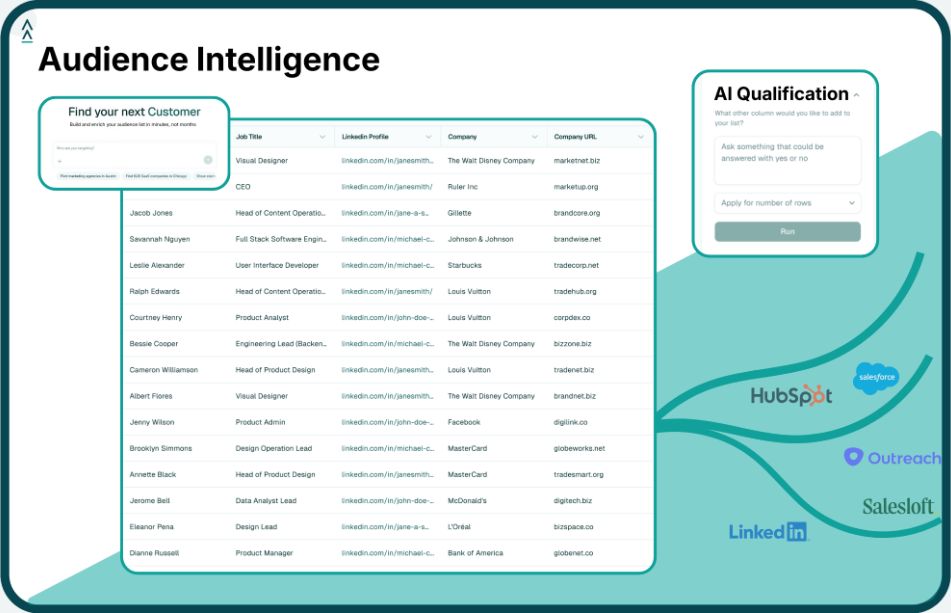
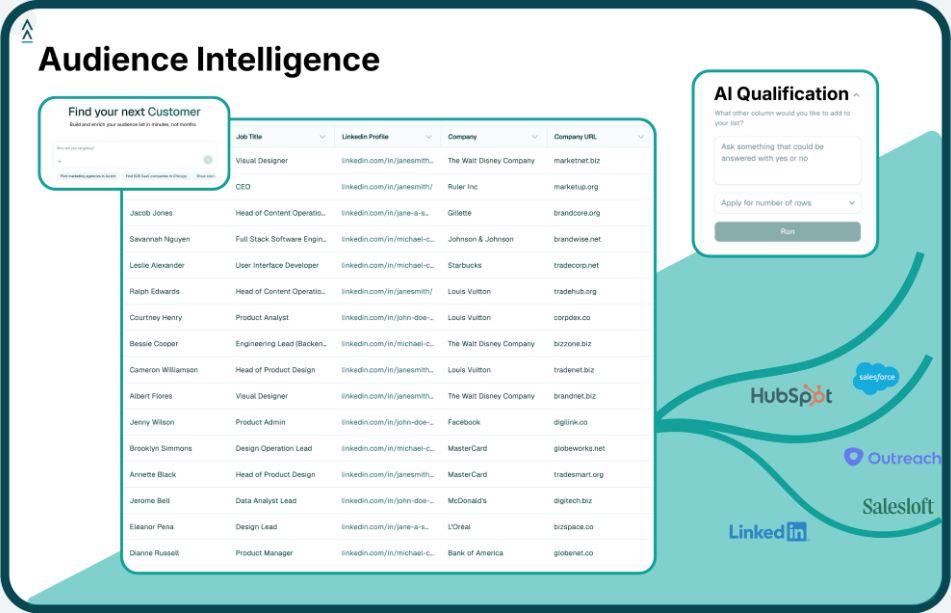
Landbase's platform addresses a critical gap in the RevOps workflow: the ability to find and qualify your next customer in seconds, regardless of which CRM you use. While HubSpot and Salesforce excel at managing existing relationships, they don't solve the fundamental challenge of prospect discovery.
Landbase's GTM-2 Omni agentic AI model changes this equation. Trained on 50M+ Sales Interactions Analyzed, it can interpret natural-language prompts like "SaaS startups in Europe hiring for RevOps" and deliver AI-qualified audiences ready for immediate activation.
How Landbase enhances your RevOps strategy:
For HubSpot users, Landbase provides the high-quality prospect data needed to fuel inbound and outbound campaigns. For Salesforce users, it delivers qualified leads that can be routed through complex sales processes and territory assignments.
The result is a RevOps workflow that starts with precision targeting rather than manual list building. As Bill Patchett, CEO of P2 Telecom, noted: "With Landbase, we added $400k MRR in a slow period. We had to put it on pause because our AEs couldn't keep up."
Selecting between HubSpot and Salesforce isn't just about features—it's about aligning your technology with your business reality. Consider these key factors:
Factor in not just licensing costs but also implementation, training, and ongoing administration. HubSpot's lower total cost of ownership can free up budget for other revenue-generating activities like prospecting tools.
Salesforce typically requires dedicated technical resources for implementation and ongoing management. HubSpot can often be managed by RevOps generalists with minimal technical expertise.
Consider not just where you are today, but where you're headed. If you anticipate rapid growth or increasing process complexity, it may be worth investing in Salesforce's flexibility upfront.
Evaluate your existing tech stack. If you're already heavily invested in the Salesforce ecosystem, switching to HubSpot may create more problems than it solves. Conversely, if you're starting fresh, HubSpot's unified approach may reduce integration complexity.
Remember, you don't have to choose between having great CRM functionality and great prospect data. Tools like Landbase can enhance either platform by ensuring your RevOps strategy starts with the right targets.
The primary difference is architectural philosophy—HubSpot offers a unified, all-in-one platform with faster implementation and lower total cost of ownership, while Salesforce provides enterprise-grade customization and scalability at higher cost and complexity. HubSpot is ideal for SMB to mid-market teams prioritizing speed and simplicity, while Salesforce excels for large enterprises with complex requirements. Both platforms support core RevOps functions, but HubSpot's unified database eliminates common integration challenges that Salesforce's multi-cloud architecture requires.
Yes, Landbase is CRM-agnostic and works seamlessly with both platforms. You can export up to 10,000 AI-qualified contacts per session and activate them in either HubSpot or Salesforce through standard import processes. Landbase focuses on the prospect discovery and qualification phase, providing high-quality data that feeds into your existing CRM workflow regardless of which platform you use.
For SMB to mid-market businesses (10-200 users), HubSpot is typically the better choice. It offers 30-60% lower total cost of ownership, faster implementation timelines of 4-8 weeks versus 3-6 months for Salesforce, and higher user adoption rates due to its intuitive interface. HubSpot's unified database also eliminates common marketing-sales sync issues that plague RevOps teams. Salesforce becomes more valuable for companies with 500+ users or highly complex, industry-specific requirements.
Agentic AI improves RevOps effectiveness by solving the prospect discovery challenge that CRMs don't address. Instead of manually building lists or relying on basic segmentation, AI analyzes 1,500+ unique signals to identify and qualify high-intent prospects before they enter your CRM. This ensures your CRM is populated with high-quality leads from the start, improving conversion rates and sales efficiency. AI-powered tools like Landbase complement both HubSpot and Salesforce by providing fresh, qualified prospect data that traditional CRMs cannot generate.
No, Landbase complements rather than replaces CRM platforms. Landbase specializes in prospect discovery and qualification—the front end of the revenue funnel—while CRMs like HubSpot and Salesforce excel at managing relationships and pipeline once prospects are engaged. The ideal workflow uses Landbase to find and qualify prospects based on real-time intent signals, then exports them to your CRM for ongoing relationship management and sales process execution. This combination ensures your RevOps strategy starts with the right targets and maintains them effectively.
Tool and strategies modern teams need to help their companies grow.