.png)
.png)

Daniel Saks
Chief Executive Officer


Personal finance and consumer fintech continue to benefit from a broader recovery in financial-technology investment. According to KPMG's Pulse of Fintech, global fintech investment increased to $116 billion across 4,719 deals in 2025, up from $95.5 billion across 5,533 deals in 2024. The increase in capital alongside lower deal volume points to a more selective environment in which investors are concentrating larger amounts around companies with stronger scale or growth prospects.
Personal finance itself now extends far beyond budgeting apps. Digital banking, investing, consumer lending, rewards, financial-data infrastructure, and AI-enabled finance platforms increasingly overlap as companies compete for broader financial relationships. The companies below represent different parts of that ecosystem and show growth through funding, customer adoption, revenue, transaction activity, and product expansion.
Consumer expectations around financial services continue to shift toward digital access, faster product experiences, lower fees, and more personalized tools. Meanwhile, financial companies are extending beyond their original products: budgeting apps are adding planning tools, trading platforms are expanding into banking, lenders are adding cards and other financial products, and rewards companies are moving into broader housing-related payments.
Several trends are driving this evolution:
The result is a market where "personal finance" includes both direct consumer platforms and the technology businesses that enable those experiences.
CEO: Val Agostino, Co-founder
Recent Funding: $75M Series B, May 2025
Valuation: $850M
Monarch Money provides subscription-based budgeting, financial planning, investment tracking, goals, and household financial-management tools. It gained significant visibility after Intuit discontinued Mint.
Monarch demonstrates that consumers will pay directly for personal-finance software rather than relying exclusively on free, advertising-supported services.
Monarch raised $75 million at an $850 million valuation in 2025. By early 2026, it had more than 500,000 paying subscribers and nearly one million total users, giving its subscription model meaningful consumer scale.
CEO: Eric Glyman, Co-founder
Recent Funding: $750M, June 2026
Valuation: $44B
Ramp is a business-finance platform covering corporate cards, expense management, bill payments, procurement, treasury, travel, and accounting automation. While it is not a consumer personal-finance app, it represents an important adjacent fintech growth model.
Ramp shows how financial technology is expanding from transactional products into broader operating systems for managing money.
Ramp raised $750 million at a $44 billion valuation in June 2026. It reported more than 70,000 customers and annualized revenue above $1 billion, while continuing to expand its AI and financial-operations products.
CEO: Zach Perret, Co-founder
Recent Financing: Approximately $575M, April 2025
Latest Valuation Reference: $8B, February 2026 employee share sale
Plaid provides financial-data infrastructure connecting applications with banks and other financial institutions. Its products now span account connectivity, payments, fraud, credit, underwriting, and financial-data analytics.
Plaid sits behind many consumer-finance experiences, making it an infrastructure provider rather than a standalone personal-finance product.
Plaid raised approximately $575 million in April 2025 after a record revenue year and return to positive operating margins. An employee share sale in February 2026 valued the company at $8 billion, while Plaid says more than one in two Americans have used its network.
CEO: Vlad Tenev, Co-founder
Status: Public, NASDAQ: HOOD
Robinhood provides investing, trading, cryptocurrency, retirement, advisory, and increasingly broader financial services through a mobile-first platform.
Robinhood helped accelerate commission-free retail trading and continues expanding toward a broader consumer financial platform.
Robinhood generated a record $4.5 billion in 2025 revenue. It ended the year with 27 million funded customers and 4.2 million Gold subscribers, while total platform assets grew substantially during the year.
CEO: Chris Britt, Co-founder
Status: Public, NASDAQ: CHYM
Chime is a consumer financial-technology company providing spending, saving, credit-building, and liquidity products through partnerships with FDIC-insured banks. Chime itself is not a bank.
Chime demonstrates how an asset-light fintech can build a large primary financial relationship without operating as a traditional bank.
Chime completed its IPO in 2025 and generated $2.2 billion in full-year revenue, up 31% year over year. Active members reached 9.5 million at year-end and increased to 10.2 million in Q1 2026, when Chime also reported its first GAAP-profitable quarter as a public company.
CEO: Ankur Jain, Founder
Recent Funding: $250M, July 2025
Valuation: $10.75B
Bilt operates a housing-focused loyalty and payments platform that allows members to earn rewards connected to rent and, increasingly, mortgage payments and neighborhood spending.
Bilt created a rewards category around housing expenses, one of the largest recurring costs for many households.
Bilt raised $250 million at a $10.75 billion valuation in July 2025. Forbes reports that 2025 revenue reached $500 million, up from $300 million in 2024, while the company expanded its housing and card ecosystem heading into 2026.
CEO: Gavin Michael
Recent Funding: $123.9M Series G, February 2026
Varo Bank provides digital checking, savings, credit-building, cash-advance, and lending products. Unlike many fintech banking applications, Varo operates under its own national bank charter.
Varo's national charter gives it greater direct control over banking products, risk, and infrastructure than fintechs that rely exclusively on partner banks.
Varo raised $123.9 million in Series G funding in February 2026. The company also installed a new leadership team under CEO Gavin Michael as it focuses on more disciplined growth and a path toward profitability.
CEO: Renaud Laplanche, Co-founder
Recent Funding: $165M Series G, October 2025
Valuation: $7.3B
Upgrade provides consumer credit and banking products including personal loans, credit cards, mobile banking, auto financing, home-improvement financing, and buy-now-pay-later services.
Upgrade illustrates how digital lenders can expand from a core credit product into a broader consumer-finance platform.
Upgrade raised $165 million in October 2025 at a reported $7.3 billion valuation. By July 2026, the company had made more than $50 billion in consumer credit available to over eight million customers.
CEO: Sergio Furio, Founder
Recent Funding: $108M Series G initial close, December 2025
Valuation: $3.3B
Creditas provides collateralized lending, insurance, and investment products in Latin America, with major businesses in home equity and vehicle-backed credit.
Creditas applies digital underwriting and collateralized lending to a market where unsecured consumer credit can be particularly expensive.
Creditas completed the initial close of a $108 million Series G at a $3.3 billion valuation in December 2025. In Q2 2026, revenue reached R$722.9 million, up 30.2% year over year, while its loan portfolio grew 26.4% to R$8.1 billion.
CEO: Andrew Chau, Co-founder
Recent Funding: $68.5M equity raise, 2026
Headquarters: Calgary, Canada
Neo Financial provides Canadian consumers with spending, savings, credit-card, mortgage, and other digital financial products.
Neo operates in a highly concentrated Canadian banking market and demonstrates continued demand for digital challengers offering alternative consumer-finance experiences.
Neo raised $68.5 million in new equity in 2026 and reports more than one million customers. It also became one of the first Canadian fintechs to gain direct participation in the Interac payment system, strengthening its financial infrastructure position.
Personal finance is unusually broad from a GTM perspective. A target market might include consumer apps, lenders, digital banks, card programs, financial-data infrastructure, wealth platforms, or companies that sit adjacent to consumer finance. Treating all of them as a single "fintech" segment can produce an account list with very different business models and buying priorities.
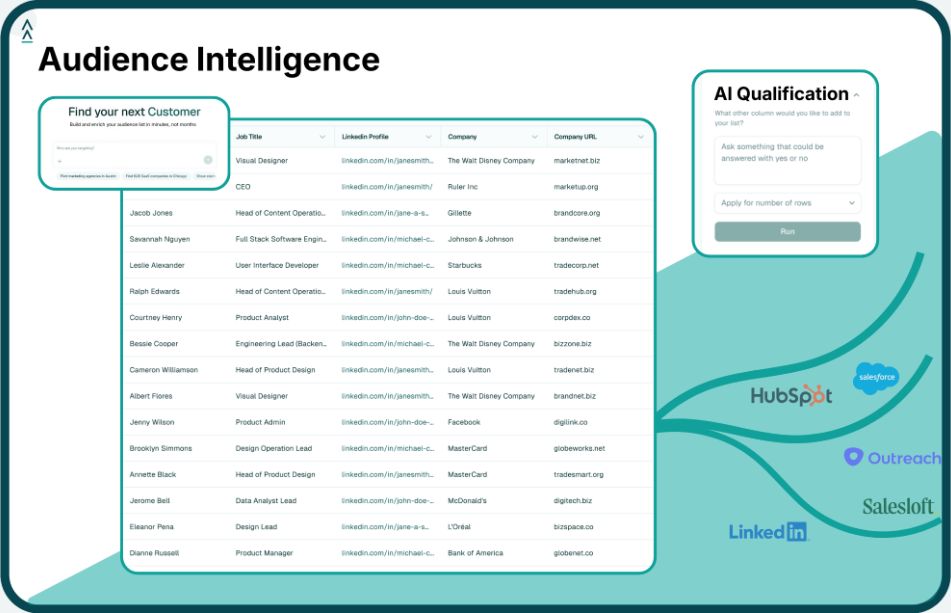
Landbase can support this type of market mapping by combining account research with characteristics such as geography, company size, funding stage, product category, and recent operating changes. That makes it possible to separate, for example, consumer lending businesses from investing platforms or infrastructure companies before building an outbound audience.
Funding can also be used as one layer rather than the entire targeting strategy. Teams can use recent funding data alongside leadership, hiring, and company changes to identify accounts entering a new stage of expansion.
For companies already present in a target-account list, lookalike search can help expand market coverage around known examples. Technical GTM teams that need structured data for scripts or agent workflows can also use Landbase CLI to bring audience data into environments such as Claude Code or Codex.
This approach is particularly useful in fintech because company classifications can hide meaningful differences between consumer products, financial infrastructure, and B2B finance platforms.
Fast-growing personal finance companies typically demonstrate several forms of momentum, including customer expansion, revenue growth, funding, increasing transaction volume, or entry into additional financial products. The most useful measures depend on the business model, since a public brokerage and an early-stage lending startup cannot be evaluated using the same benchmark. Combining operating metrics with financing and product expansion provides a more balanced assessment.
Personal-finance companies use revenue models including subscriptions, interchange fees, lending income, payment fees, transaction revenue, premium memberships, and infrastructure fees. Many larger platforms combine several models as they expand beyond their original product. This diversification can increase revenue per customer while reducing dependence on one source of income.
Growing fintech companies hire across engineering, product, risk, compliance, data, finance, sales, partnerships, and customer operations. Hiring patterns vary significantly depending on whether the company operates a regulated bank, consumer application, lending platform, or financial-infrastructure business. Rapid expansion into new products or geographies can create additional demand for specialized regulatory and operational talent.
GTM teams can start by separating the market into meaningful segments such as consumer banking, investing, credit, rewards, or fintech infrastructure. Funding, hiring, executive changes, product launches, and geographic expansion can then help identify which accounts are becoming more active. Landbase account research can support the process of turning those criteria into a more focused account universe.
AI is being used across personal finance for customer support, personalization, underwriting, fraud detection, transaction analysis, and financial operations. Its role varies by company: some use AI mainly to improve existing products, while others are redesigning workflows around automated agents and models. AI adoption is therefore most useful as a growth indicator when it is connected to measurable product expansion, efficiency, or customer value.
Tool and strategies modern teams need to help their companies grow.