.png)
.png)

Daniel Saks
Chief Executive Officer


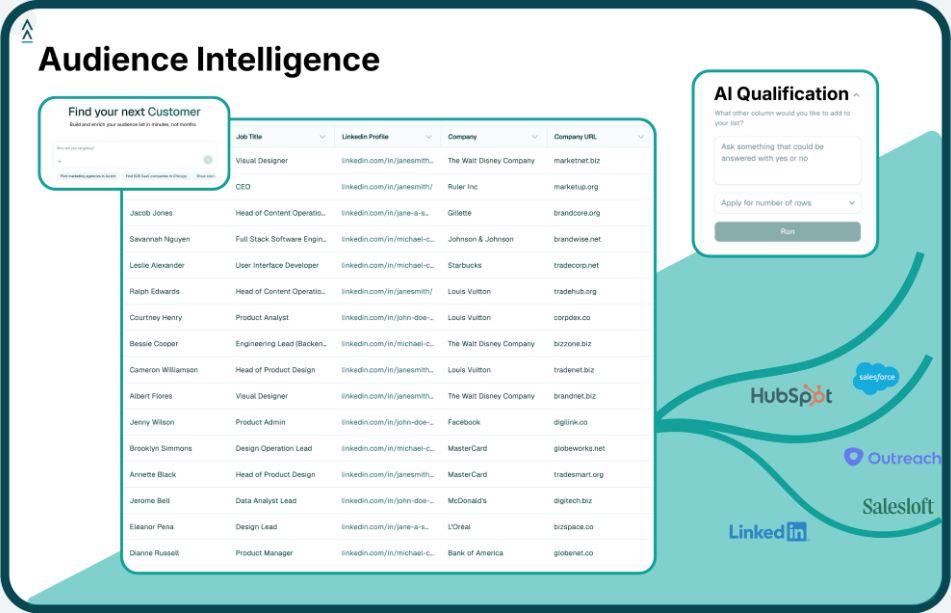
The open source developer tools landscape is experiencing unprecedented transformation. In 2024-2025, these companies raised billions across 1,093+ investment deals, with AI-powered platforms leading a revolution in how software is built. From AI code editors achieving $29B valuations to local LLM platforms growing 261% in GitHub stars, the pace of innovation has never been faster. For go-to-market teams targeting these high-growth dev tool companies, finding the right prospects requires sophisticated audience discovery capabilities. Agentic AI platforms like Landbase now enable teams to identify and qualify these fast-growing startups using natural-language prompts like "Recently funded open source dev tool companies with 50+ GitHub contributors."
Anysphere develops Cursor, an AI-native code editor built on a fork of VS Code but optimized specifically for AI collaboration. Unlike traditional IDEs with AI extensions, Cursor is designed from the ground up for AI-powered development, offering features like multi-file editing with natural language commands, tab completion with AI context awareness, and support for multiple AI models including GPT-4 and Claude.
Anysphere represents the shift from AI-as-extension to AI-native development environments, enabling developers to work with entire codebases through natural language. The platform addresses data privacy concerns by offering local AI processing options, and viral adoption among engineering teams has made it a new standard in AI coding. Market recognition includes achieving a $29.3B valuation and securing investments from tier-one firms including Andreessen Horowitz, Thrive Capital, Google, and NVIDIA.
Chainguard provides enterprise-grade supply chain security solutions built on open source foundations. The company created Sigstore, the open standard for software signing, and offers low-to-zero CVE container images that address critical vulnerabilities. Their platform enables organizations to verify software provenance and secure the entire software delivery pipeline.
Chainguard addresses critical post-SolarWinds/Log4j supply chain security vulnerabilities, with Sigstore becoming the industry default for software signing. The enterprise focus ensures compliance with strict security requirements, while the open source foundation provides transparency and community trust. The company achieved a $4B valuation in under 3 years, demonstrating strong market validation for security-first infrastructure.
Zed Industries develops Zed, a high-performance code editor built in Rust specifically for collaboration with both humans and AI. Unlike Electron-based editors, Zed's native architecture delivers superior performance while providing built-in AI integration for code completion, refactoring, and natural language programming.
Zed represents the new generation of AI-native editors built from scratch for AI collaboration, with Rust-based performance addressing the overhead issues of Electron-based alternatives. The free and open source model ensures developer accessibility and community contributions, while real-time collaboration features enable distributed team development. The platform achieved #1 most starred open source project from startups in 2024.
All Hands AI develops OpenHands, an open source platform for autonomous AI software engineering agents. These agents can understand high-level instructions, break down complex tasks, research solutions, and write code to achieve development objectives. The platform is deployed via Docker and enables developers to delegate routine programming tasks to AI agents.
All Hands AI pioneers the shift from AI co-pilots to autonomous AI engineering agents, with an open source model ensuring transparency and community-driven development. The platform addresses the growing need for AI-powered development automation, and Docker-based deployment makes it accessible to development teams of all sizes. The project achieved #3 most starred new startup project status in 2024.
Harness provides a comprehensive DevOps platform that automates the entire software delivery process through Continuous Delivery-as-a-Service. The platform integrates CI/CD, feature flags, cloud cost management, and security testing into a unified workflow that enables enterprise engineering teams to deploy code safely and efficiently at scale.
Harness automates complex enterprise software delivery workflows, founded by Jyoti Bansal (AppDynamics founder) bringing proven enterprise expertise. The platform addresses the growing complexity of multi-cloud, multi-team deployments, with enterprise-grade security and compliance features meeting strict regulatory requirements. The company has achieved significant scale with 1,001-5,000 employees serving enterprise customers.
Replit offers a collaborative, browser-based development environment that allows developers to write, run, and host applications without local setup. The platform includes an integrated AI assistant called Ghostwriter that provides code completion and natural language programming capabilities, making it accessible to developers of all skill levels.
Replit's zero-setup development environment democratizes coding access, with educational focus making it widely adopted in schools and learning environments. The browser-based approach eliminates environment configuration challenges, while Ghostwriter AI assistant enhances productivity for both beginners and experts. The platform serves millions of developers globally with strong educational market presence.
Astral develops uv, an extremely fast Python package manager written in Rust that serves as a drop-in replacement for pip and poetry. The tool offers 10-100x performance improvements over traditional Python package managers while maintaining compatibility with existing workflows and dependency specifications.
Astral addresses long-standing performance pain points in Python development, with Rust-based architecture delivering significant speed improvements. The drop-in replacement ensures easy adoption without workflow changes, representing part of a broader trend modernizing legacy development tooling. The project achieved #5 most starred startup project status in 2024.
InfiniFlow develops RAGFlow, an open source retrieval-augmented generation (RAG) engine based on deep document understanding. The platform enables AI systems to access and comprehend enterprise documents, making it ideal for building knowledge bases, chat applications, and document analysis tools that work with internal company data.
InfiniFlow addresses the critical enterprise need for AI to understand internal documents, with deep document understanding going beyond surface-level RAG implementations. The platform represents China's contribution to open source AI infrastructure, enabling practical enterprise AI applications with internal knowledge. It achieved #7 overall most starred project status in 2024.
Mendable develops Firecrawl, an API service that crawls URLs and converts unstructured web data into clean, structured markdown optimized for AI applications. The platform simplifies data ingestion for AI chat applications, knowledge bases, and RAG systems by handling the complex work of web scraping and data normalization.
Mendable solves the critical challenge of converting unstructured web data for AI consumption, with API service model eliminating the need for custom scraping infrastructure. The platform enables next-generation AI applications that require up-to-date web information, simplifying knowledge base creation for AI chat applications.
Weights & Biases provides an AI developer platform that powers the generative AI industry through experiment tracking, model versioning, and collaboration tools. The platform helps ML engineers and AI researchers manage the entire machine learning lifecycle, from experimentation to production deployment.
Weights & Biases powers the generative AI industry with essential MLOps infrastructure, with experiment tracking and collaboration features accelerating AI development. Strong open source contributions include OpenUI with 19.5K GitHub stars, and the company is a Felicis portfolio company with proven market validation serving ML engineers and AI researchers globally.
Composio equips AI agents with 100+ high-quality integrations through a function calling interface for LLMs. The platform provides pre-built tools for popular services like GitHub, Slack, and other enterprise applications, enabling developers to connect AI agents to real-world systems and workflows.
Composio solves the critical challenge of connecting AI agents to real-world tools, with 100+ pre-built integrations accelerating AI agent development. The function calling interface simplifies LLM integration with external services, enabling practical AI automation beyond theoretical demonstrations.
GitLab provides a single application for the entire DevOps lifecycle, combining source code management, CI/CD, monitoring, security, and collaboration in one unified platform. Built on open source foundations, GitLab enables concurrent DevOps where product, development, QA, security, and operations teams work together in a single application.
GitLab is the first single application for the entire DevOps lifecycle, with open source foundation ensuring transparency and community contributions. The platform serves 100,000+ organizations including Fortune 500 companies, and public company success demonstrates viability of the open source business model.
GitLab is a publicly traded company (NASDAQ: GTLB). As a public company, it raises capital through public equity and debt markets rather than venture funding rounds. The company achieved public company status with significant enterprise adoption.
The open source developer tools landscape has undergone a fundamental transformation driven by AI integration and changing developer expectations. According to Evil Martians' analysis of 1,093 early-stage investments in 2024, AI-enabled tools captured nearly half of all funding, reflecting investor confidence in this new paradigm.
GitHub stars have emerged as a critical validation metric, with projects like Ollama achieving 261% growth in 2024 to reach 136K+ stars. This community-driven adoption signals genuine developer utility rather than just marketing success.
For go-to-market teams targeting these high-growth companies, traditional prospecting methods fall short. These organizations often have non-traditional tech stacks, rapid hiring patterns, and frequent funding events that require real-time intelligence. Platforms like Landbase's audience discovery enable teams to build targeted lists using natural-language prompts like "CFOs at recently funded open source dev tool companies" or "Engineering leaders at companies using Rust for backend development."
This list highlights companies that demonstrate exceptional growth through multiple validation metrics:
All companies featured are genuinely open source (with publicly available code under OSI-approved licenses) or follow an open core model with significant open source components. The list includes a mix of AI-focused tools (reflecting the 48% market share of AI investments) and traditional infrastructure tools to provide comprehensive market coverage.
These fast-growing open source dev tools companies represent prime targets for B2B sales and marketing teams. However, reaching them requires sophisticated audience intelligence that goes beyond basic firmographics.
Landbase's agentic AI platform enables teams to identify these high-growth companies using signals like:
By combining 1,500+ unique signals across firmographic, technographic, intent, hiring, and funding data, GTM teams can build highly targeted prospect lists without complex query builders or technical expertise. The platform's natural-language interface allows users to simply describe their ideal customer profile in plain English, receiving AI-qualified audiences ready for immediate activation.
For companies selling to the developer tools ecosystem, this capability is essential for cutting through the noise and reaching the right decision-makers at the right time.
An open source dev tool company develops software tools for developers where the source code is publicly available under an OSI-approved open source license. This includes everything from code editors and package managers to infrastructure platforms and AI development tools. Many successful companies follow an "open core" model where the foundational technology is open source, while enterprise features, support, and managed services are commercial offerings. The key distinction is that the core functionality remains accessible to the developer community without payment barriers.
Open source dev tools companies face several unique challenges, with the primary one being building a sustainable business model around freely available technology. Many struggle with the "open source paradox" – achieving widespread adoption while converting users to paying customers. Security and compliance requirements for enterprise adoption can be significant barriers, especially for early-stage companies.
Most successful open source dev tools companies follow an "open core" business model, providing the foundational technology as free, open source software while offering paid enterprise features, managed cloud services, professional support, and premium integrations. Companies like GitLab and Supabase have demonstrated this model at scale, serving 100,000+ organizations while maintaining strong open source communities.
Yes, Landbase specializes in identifying high-growth technology companies using sophisticated signals and natural-language targeting. The platform's database includes 300M+ contacts and 24M+ companies with 1,500+ unique signals spanning firmographic, technographic, intent, hiring, and funding data. You can use prompts like "Engineering leaders at recently funded AI dev tools companies" or "CTOs at open source companies with 50K+ GitHub stars" to build targeted prospect lists.

Tool and strategies modern teams need to help their companies grow.






