.png)
.png)

Daniel Saks
Chief Executive Officer


The cyber risk quantification market is estimated at $3.93 billion in 2024 and is expected to reach $9.66 billion by 2031, at a CAGR of 12.25%—driven by SEC disclosure rules, ransomware surges, and AI-powered threats demanding financial risk measurement. As boards face personal liability for cybersecurity oversight and insurers demand actuarial-grade data, organizations need platforms that translate vulnerabilities into dollar impact. For go-to-market teams at these cybersecurity platforms, audience intelligence tools like Landbase's agentic AI enable precise targeting by identifying companies based on security stack, compliance needs, recent breaches, or technology adoption signals.
Bitsight pioneered the cyber risk ratings industry in 2011 and maintains market leadership through its External Attack Surface Management platform. The company provides continuous, outside-in security posture assessment that helps organizations understand their exposure and prioritize remediation efforts. Bitsight's platform combines threat intelligence, vulnerability data, and behavioral analytics to deliver actionable risk insights.
Bitsight pioneered the cyber risk ratings industry in 2011 and maintains market leadership with the largest R&D investment in the category. The company received highest possible scores in 18 Forrester criteria, demonstrating comprehensive platform capabilities. The $115M Cybersixgill acquisition in February 2024 integrated automated threat intelligence capabilities, creating the industry's most comprehensive cyber risk intelligence solution. Bitsight's Discovery & Attribution Engine won the 2025 Global InfoSec Award for AI-powered capabilities.
Bitsight is a privately held company with significant ARR growth. The company achieved $200+ million ARR as of early 2024 and maintains positive free cash flow, demonstrating sustainable growth without requiring recent external funding rounds.
SecurityScorecard provides cybersecurity risk ratings and supply chain risk management through its platform that assesses the security posture of organizations and their third parties. The company is known for its industry-leading transparency, publishing live metrics about its own performance to build trust with customers. SecurityScorecard 2.0 combines attack surface data with internal control data for unprecedented insights.
SecurityScorecard delivers the highest transparency in the industry as the only vendor publishing live metrics on response time, refute rates, and misattribution rates. The platform combines attack surface data with internal control data through SecurityScorecard 2.0. The LIFARS acquisition created the first security ratings vendor to offer fully managed service through SecurityScorecard MAX. The company achieved highest placement in Forrester's Current Offering category and highest score in 17 of 25 criteria.
Panorays specializes in third-party cyber risk management with its innovative Risk DNA™ methodology that considers business criticality and risk appetite. The platform provides comprehensive assessment of vendor security postures through both external ratings and internal questionnaire validation. Panorays extends visibility beyond immediate suppliers to identify 4th and 5th party supply chain risks.
Panorays' Risk DNA™ methodology represents innovation in business-contextualized risk scoring that goes beyond generic assessments. The platform's AI-powered assessment validates questionnaire responses against external data for higher accuracy. Panorays provides 4th & 5th Party Visibility that extends beyond immediate suppliers to identify extended supply chain risks. The company achieved highest possible score in asset discovery, vendor discovery, and exposure prioritization, while reference customers gave highest satisfaction rating for overall business value.
Panorays is a privately held company that has achieved Forrester leadership status without disclosing specific funding amounts. The company's focus has been on product innovation and customer satisfaction rather than external capital raising.
RiskLens pioneered FAIR-based (Factor Analysis of Information Risk) cyber risk quantification, translating technical cyber threats into financial dollar-value impact assessments for board-level decision-making. The platform enables organizations to simulate various risk scenarios to prioritize mitigations based on ROI and communicate risk metrics clearly to executive stakeholders.
RiskLens provides Financial Risk Translation that converts cyber threats into dollar-value impact assessments for board-level decisions. The platform's Scenario Modeling capability simulates various risk scenarios to prioritize mitigations based on ROI. Executive Communication dashboards translate technical risk into board-ready metrics. RiskLens is named among top independent vendors for model transparency and consistently mentioned alongside Bitsight and SecurityScorecard in market analysis. The platform aligns with NIST CSF and ISO 27001 frameworks.
Following acquisition by Safe Security in 2023, RiskLens operates as part of the combined entity. The company's FAIR methodology expertise has been integrated into Safe Security's broader cyber risk quantification platform.
CyberCube Analytics specializes in cyber risk analytics for the insurance industry, enabling transfer of cyber risk from insurers to capital markets through catastrophe-bond analytics. The platform provides AI-driven loss modeling to quantify cyber risk exposure specifically for insurance underwriting and portfolio management.
CyberCube's Insurance Focus specializes in catastrophe-bond analytics specifically designed for insurers' unique needs. The platform's Capital Markets Integration enables transfer of cyber risk from insurers to capital markets, creating new risk distribution mechanisms. AI-Driven Loss Modeling provides advanced analytics for quantifying cyber risk exposure with actuarial precision. The company surpassed 100 clients in November 2024, while Gallagher Re reported 50% annual growth in Asia-Pacific cyber-insurance premiums.
Safe Security provides AI-driven cyber risk quantification that aggregates signals across attack surfaces to predict and prevent data breaches in real-time. The platform offers comprehensive solutions for both enterprise and third-party risk management with board-ready visualization dashboards and compliance tracking capabilities.
Safe Security's Real-Time Signal Aggregation aggregates signals across attack surfaces to predict and prevent data breaches before they occur. The platform provides Enterprise & Third-Party Risk solutions for both first-party and TPRM needs. Visualization Dashboards deliver board-ready visuals with compliance tracking. Safe Security is named among independent rankings leaders for model transparency and board-ready visuals. The company is described as a "global leader in cybersecurity" and digital business risk quantification, and is consistently mentioned alongside RiskLens and Axio as a model transparency leader.
Safe Security funding information is not publicly disclosed in available sources. The company appears to be privately held with focus on AI-driven predictive analytics and has expanded through strategic acquisitions including RiskLens in 2023.
Centraleyes offers an AI-driven GRC (Governance, Risk, and Compliance) platform with the first automated risk register in the market. The platform's AI learns organizational context rather than forcing generic controls, providing context-aware control generation based on organization taxonomy. Centraleyes also pioneered proprietary AI governance frameworks integrated into GRC workflows.
Centraleyes delivers an AI-Powered Risk Register that is the first automated risk register in the market. The platform's Multi-Tenancy Support provides unified enterprise-wide visibility across subsidiaries and business units. The AI Governance Module offers proprietary framework for AI risk governance integrated into GRC workflows. Centraleyes is featured in multiple "Best of" lists for GRC platforms and is among first to address AI governance as integrated risk domain. The platform supports GDPR, ISO, NIST, and emerging regulations.
Centraleyes funding information is not publicly disclosed in available sources. The company appears to be privately held with focus on AI-native GRC architecture and continuous product innovation.
Kovrr specializes in cyber risk quantification for insurance portfolios and underwriting, addressing FAIR framework time-lag issues with faster multi-model CRQ approaches. The company provides specialized analytics for the insurance industry and publishes influential CRQ trend analysis that shapes market understanding.
Kovrr's Insurance Portfolio Focus specializes in cyber risk for insurance underwriting and portfolio management. The platform's Multi-Model CRQ addresses FAIR framework time-lag issues with faster quantification approaches. Citing market reports, Kovrr notes the CRQ market could grow from $340M (2024) to $900M (2033). The company is named alongside RiskLens as an insurance portfolio specialist and publishes influential CRQ trend analysis.
Kovrr funding information is not publicly disclosed in available sources. The company appears to be Israel-based with focus on insurance-specific cyber risk analytics.
Axio Global specializes in cyber risk quantification with a focus on board-level communication and enterprise risk management integration. The company is recognized as an industry leader in model transparency, providing clear and auditable quantification methods that help boards make defensible risk decisions.
Axio Global's Board Communication specialization translates cyber risk for board-level audiences with clear, defensible metrics. The platform delivers Model Transparency that is industry-leading in clear, auditable quantification methods. Enterprise Risk Integration aligns cyber with broader ERM frameworks for holistic risk management. The company is named a leader for transparency alongside Safe Security and KPMG. Axio Global is consistently mentioned as an independent leader and featured in the competitive landscape of the multibillion market.
Axio Global funding information is not publicly disclosed in available sources. The company appears to be privately held with focus on board-level cyber risk communication and ERM integration.
UpGuard specializes in third-party risk management and attack surface management with continuous monitoring of supply chain risks. The platform provides user-friendly security metrics that are easy to digest for both technical and non-technical stakeholders, offering outside-in security posture evaluation.
UpGuard's Vendor Risk Lineage provides continuous monitoring of supply chain risks across extended vendor networks. The platform delivers User-Friendly Security Metrics that offer easy-to-digest ratings for technical and non-technical stakeholders. External Risk Assessment provides outside-in security posture evaluation without requiring vendor cooperation. UpGuard is featured in competitive analysis alongside Bitsight and SecurityScorecard and recognized in TPRM categories. The platform addresses critical need as 98% of corporates report supply-chain disruptions.
UpGuard funding information is not publicly disclosed in available sources. The company appears to be Australia-based with focus on TPRM specialization and continuous vendor monitoring.
The cyber risk scoring platform market is experiencing explosive growth driven by multiple converging factors. Regulatory mandates like SEC cyber disclosure rules, DORA, and NIS2 are creating unprecedented urgency for quantitative risk measurement. The cyber-insurance market is expanding rapidly, with premiums tracking to $27 billion by 2030, requiring actuarial-grade data from specialized platforms.
For go-to-market teams selling these solutions, understanding the competitive landscape is crucial. The market segments into several categories: External Risk Ratings Leaders (Bitsight, SecurityScorecard, Panorays), Financial Quantification Specialists (RiskLens, CyberCube, Kovrr), AI-Driven Innovation Leaders (Safe Security, Centraleyes), and Specialized Use Case Leaders (Axio Global, UpGuard).
These platforms help organizations move beyond checkbox compliance to financial risk quantification, enabling better decision-making at the board level and more effective risk mitigation strategies.
For B2B organizations selling cybersecurity solutions, these cyber risk scoring platforms represent both competitors and potential customers. Understanding their capabilities helps companies position their own offerings effectively. More importantly, these platforms' target customers—enterprises with complex security needs—are ideal prospects for many B2B solutions.
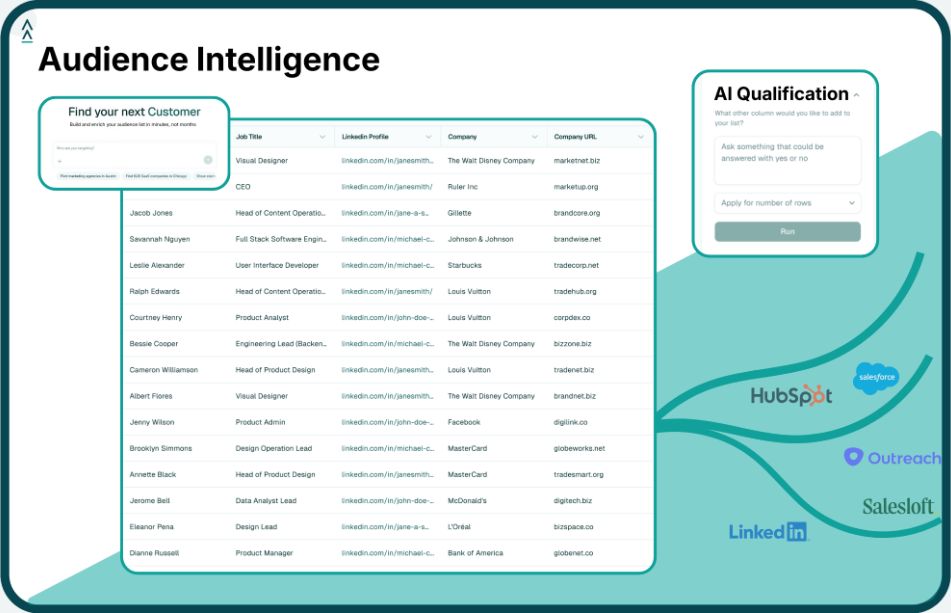
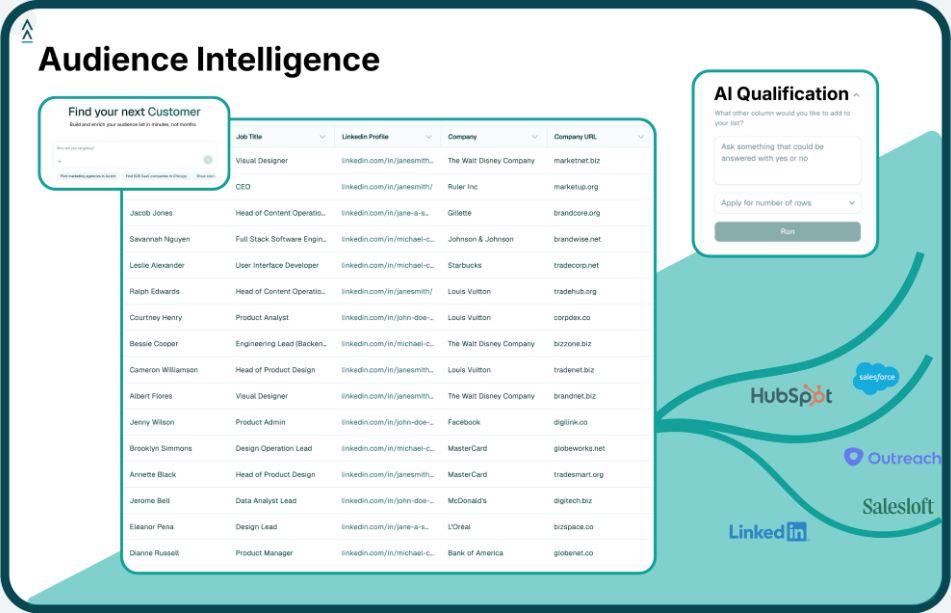
This is where Landbase's audience intelligence becomes invaluable. The platform's 300M+ contacts and 24M+ companies with 1,500+ unique signals enable precise targeting of organizations based on their security posture, compliance requirements, and technology adoption patterns.
For example, you could use natural-language targeting to find "CISOs at financial services companies with 1,000+ employees that have experienced data breaches in the last 6 months and are researching compliance solutions." Landbase would return an AI-qualified export of up to 10,000 contacts ready for immediate activation in your existing tools.
The Landbase Intelligence product provides growth signals, Trust Scores, and TAM analysis that can help organizations assess the market fit and potential of various cybersecurity vendors, while Landbase Outbound & Nurture helps identify and qualify prospects along their buyer journey.
The primary goal of a cyber risk scoring platform is to translate technical cybersecurity vulnerabilities and threats into quantifiable metrics that organizations can use for decision-making. This includes financial impact assessments for board-level discussions, prioritization of remediation efforts based on risk severity, and evaluation of third-party vendor security postures. As the market grows to a couple of billions by 2029, these platforms are becoming essential for regulatory compliance and insurance underwriting.
Cyber risk scoring platforms calculate scores through various methodologies depending on their specialization. External ratings platforms like Bitsight and SecurityScorecard use outside-in assessment of digital footprints, analyzing factors like SSL certificate strength, patching cadence, and dark web mentions. FAIR-based platforms like RiskLens use financial modeling to translate threats into dollar impacts, while AI-driven platforms like Safe Security aggregate signals across attack surfaces for real-time prediction. Most platforms combine multiple data sources and signals to create comprehensive risk assessments that consider both technical vulnerabilities and business context.
Continuous cyber risk monitoring provides real-time visibility into changing threat landscapes and security postures, unlike point-in-time assessments that quickly become outdated. Benefits include early detection of new vulnerabilities, immediate awareness of data breaches or security incidents, dynamic risk scoring that reflects current conditions, and automated alerts for critical changes. For third-party risk management, continuous monitoring is essential as 98% of corporates report supply-chain disruptions, making static vendor assessments inadequate for modern risk management.
AI enhances cyber risk scoring by enabling predictive analytics, automated correlation of disparate data sources, and dynamic risk modeling that adapts to changing conditions. AI-powered platforms like Safe Security and Centraleyes can identify patterns and anomalies that human analysts might miss, predict potential breach scenarios, and automatically prioritize risks based on likelihood and impact. AI also enables natural language processing for better user interfaces and automated risk register generation that learns organizational context rather than applying generic controls, making risk assessments more relevant and actionable.
Yes, small businesses can benefit from cyber risk scoring platforms, particularly as regulatory requirements and insurance mandates increasingly apply to organizations of all sizes. While enterprise platforms may be cost-prohibitive for smaller organizations, many vendors offer scaled solutions or the market is seeing emergence of SMB-focused alternatives. Additionally, small businesses that serve larger enterprises often need to demonstrate security compliance through formal risk assessments, making risk scoring platforms valuable for improving their own security posture and meeting customer requirements that are becoming standard in vendor contracts.
Tool and strategies modern teams need to help their companies grow.