.png)
.png)

Daniel Saks
Chief Executive Officer


Quantum computing remains an early commercial market, but investment, public listings, government programs, and customer activity accelerated during 2025 and the first half of 2026.
European quantum companies raised approximately $404 million during the first quarter of 2026, close to the $417 million raised by companies in North America. This relatively balanced funding activity shows that quantum development is taking place across several regional ecosystems rather than being concentrated in one country.
Public-market activity has also increased. Quantinuum completed a traditional initial public offering, while Xanadu, Infleqtion, and IQM entered public markets through mergers or listings. IonQ, Rigetti, and D-Wave reported stronger revenue, bookings, or system-order activity.
These developments do not mean that large-scale, fault-tolerant quantum computing is already commercially established. Most companies remain unprofitable, and current systems continue to face challenges involving errors, scale, control, manufacturing, and application economics.
1. IonQ
CEO: Niccolo de Masi
Headquarters: College Park, Maryland, United States
IonQ reported first-quarter 2026 revenue of $64.7 million, compared with approximately $7.6 million during the same period in 2025. The company also raised its full-year revenue guidance to between $260 million and $270 million.
Part of this increase came from acquisitions rather than organic quantum-computing revenue alone. IonQ has expanded into quantum networking, sensing, photonics, satellite technology, and semiconductor manufacturing. Its announced $1.8 billion acquisition of SkyWater Technology is intended to give the company greater control over manufacturing and supply-chain capabilities.
IonQ develops trapped-ion quantum processors, cloud-accessible computing systems, networking technology, quantum-safe communication products, and sensing systems.
Its computers are available through major cloud platforms and direct enterprise relationships. The company is also building a broader ecosystem that connects quantum processors with networking, security, sensing, and manufacturing infrastructure.
IonQ has developed one of the largest revenue bases among publicly traded pure-play quantum companies. Its acquisition strategy also shows how the industry is expanding beyond processors into the supporting systems required for a complete quantum platform.
Future growth will depend on whether IonQ can integrate its acquisitions, maintain technical progress, and convert its broader product portfolio into sustained commercial demand.
2. Quantinuum
CEO: Rajeeb Hazra
Headquarters: Broomfield, Colorado, United States, with European headquarters in Cambridge, United Kingdom
Quantinuum completed its Nasdaq initial public offering in June 2026. The company sold 28 million shares at $60 each, raising approximately $1.68 billion and receiving an initial valuation of about $15.6 billion.
Quantinuum reported $30.9 million in revenue for 2025, compared with $23 million in 2024. First-quarter 2026 revenue reached approximately $5.2 million, although the company continued to record substantial net losses.
Quantinuum develops trapped-ion quantum computers, compilers, cybersecurity products, chemistry applications, and quantum software tools. Its hardware portfolio includes the H-Series and Helios systems.
The company was formed through the combination of Honeywell Quantum Solutions and Cambridge Quantum. That structure gives Quantinuum expertise across both hardware and software rather than limiting it to one part of the quantum stack.
Quantinuum’s IPO was an important public-market test for a full-stack quantum company. The proceeds give it additional capital for research, manufacturing, hiring, and international expansion.
Its long-term position will depend on converting technical performance and customer research programs into larger, recurring commercial deployments.
3. Rigetti Computing
CEO: Subodh Kulkarni
Headquarters: Berkeley, California, United States
Rigetti reported first-quarter 2026 revenue of $4.4 million, more than three times the amount generated during the corresponding period in 2025. The company also launched a 108-qubit system and continued developing systems with more than 150 physical qubits.
Commercial activity included an $8.4 million order from India’s Centre for Development of Advanced Computing and a $5.8 million contract with the U.S. Air Force Research Laboratory. Rigetti also entered a multiyear development partnership with Quanta.
Rigetti develops superconducting quantum processors, control systems, cloud software, and full-stack computing platforms. It also operates a dedicated fabrication facility in California for rapid processor development and testing.
Its chiplet strategy is designed to connect smaller processor units into larger systems. This approach may provide a more practical scaling path than attempting to place every qubit on one monolithic chip.
Rigetti is one of the few independent companies that designs, fabricates, and operates superconducting quantum processors. Its recent system orders provide stronger evidence of customer demand than a technology roadmap alone.
The company still needs to prove that it can preserve performance and fidelity as its processors become larger and more complex.
4. D-Wave Quantum
CEO: Alan Baratz
Headquarters: Palo Alto, California, with a relocation to Boca Raton, Florida announced in 2026
D-Wave reported first-quarter bookings of $33.4 million, compared with $1.6 million during the corresponding period. The total included a $20 million system sale to Florida Atlantic University and a $10 million agreement with a Fortune 100 company.
Quarterly revenue declined to approximately $2.86 million because the previous year included a large one-time system sale. D-Wave also acquired Quantum Circuits to expand from quantum annealing into gate-model quantum computing.
D-Wave is best known for quantum annealing systems designed for optimization and sampling problems. Its Advantage systems contain thousands of physical qubits and are available through cloud services and direct installations.
The Quantum Circuits acquisition gives the company an additional development path in superconducting gate-model computing.
D-Wave has one of the longest commercial histories in the quantum industry. It has deployed systems and supported projects involving logistics, scheduling, manufacturing, and other optimization problems.
Its bookings show stronger customer activity, but its uneven quarterly revenue also illustrates how large system sales can create significant financial volatility.
5. IQM Quantum Computers
CEO: Jan Goetz
Headquarters: Espoo, Finland
IQM began trading on the Nasdaq Global Select Market on July 2, 2026, after completing its merger with Real Asset Acquisition Corp. The transaction made IQM one of the first European quantum-computing companies to trade on a major U.S. exchange.
The company has reported 23 on-premises quantum-system sales. It is also expanding its U.S. presence through a quantum hub in Maryland and a system deployment at Oak Ridge National Laboratory.
IQM develops superconducting quantum computers for universities, research institutions, supercomputing centers, and government programs. Its portfolio includes on-premises systems and cloud-accessible processors.
The company also uses a co-design model that allows systems to be configured around specific research requirements and application areas.
IQM shows that institutional demand exists for on-premises quantum systems even before fault-tolerant computing becomes available.
Its public listing and U.S. expansion may help it compete for more government, research, and data-center projects outside Europe.
6. Xanadu
CEO: Christian Weedbrook
Headquarters: Toronto, Ontario, Canada
Xanadu completed its public-market transaction in March 2026 through a merger with Crane Harbor Acquisition. In its first quarterly report as a public company, revenue reached approximately $2.8 million, representing a 400% increase from the corresponding period.
The company continues to report operating losses, and its revenue remains modest relative to its public valuation.
Xanadu develops photonic quantum processors that encode quantum information in particles of light. It also maintains PennyLane, an open-source software platform used for quantum programming, quantum machine learning, and hybrid computing.
Its Aurora architecture is designed around modular photonic systems that can eventually support error correction and fault-tolerant operation.
Xanadu combines a long-term hardware roadmap with a widely recognized software ecosystem. PennyLane gives the company a role in quantum development even while larger photonic systems remain under construction.
Its public listing provides additional capital and visibility, but the company still needs to turn software adoption and technical research into larger commercial revenue.
7. Infleqtion
CEO: Matt Kinsella
Headquarters: Boulder, Colorado, United States
Infleqtion reported first-quarter 2026 revenue of approximately $9.5 million, an increase of 14% from the corresponding period. The company also entered the public market through its previously announced transaction.
Infleqtion was included in a U.S. Commerce Department initiative involving proposed government equity investments. These proposals should remain separate from completed financing until final agreements are signed.
Infleqtion develops neutral-atom quantum computers, atomic clocks, sensing equipment, and navigation systems. Its products address computing, aerospace, defense, positioning, and timing applications.
This broader portfolio gives the company access to near-term commercial opportunities in sensing and timing while larger quantum computers remain under development.
Infleqtion represents the wider quantum-technology market rather than quantum computing alone. Quantum clocks, sensors, and navigation products may achieve practical adoption earlier than general-purpose fault-tolerant systems.
Its more diversified product range may also provide a broader commercial base than companies that depend entirely on future quantum-computing revenue.
Interim CEO: Victor Peng
Executive Chairman: Jeremy O’Brien
Headquarters: Palo Alto, California, United States
PsiQuantum raised $1 billion in a Series E financing during September 2025 at a reported valuation of $7 billion. The company is using the capital to develop large-scale test systems, expand semiconductor manufacturing processes, and advance facilities in Brisbane and Chicago.
In 2026, Victor Peng became interim CEO while Jeremy O’Brien moved into the role of executive chairman. The change reflects the company’s increasing focus on manufacturing, infrastructure, and facility execution.
PsiQuantum was also included in a proposed $100 million U.S. government investment. That proposal should not be treated as completed funding until finalized.
PsiQuantum is developing a fault-tolerant quantum computer based on photonic qubits produced through semiconductor foundries. Rather than commercializing a series of smaller machines, the company is working directly toward a utility-scale system.
Its development work includes photonic chips, cooling, switching, networking, control electronics, and the infrastructure needed to operate a large installation.
PsiQuantum is pursuing one of the most ambitious scale-up strategies in the industry. Its funding, government partnerships, and semiconductor manufacturing relationships provide resources that few private quantum companies can match.
The company still needs to complete facility construction, system integration, error correction, and full-scale operation before its long-term approach can be commercially validated.
9. Diraq
CEO: Andrew Dzurak
Headquarters: Sydney, Australia, with U.S. headquarters in Palo Alto, California
Diraq received an AU$20 million investment from Australia’s National Reconstruction Fund Corporation in February 2026. The investment formed part of a Series A that had reached approximately US$75 million.
The company also advanced to Stage B of DARPA’s Quantum Benchmarking Initiative, which evaluates potential paths toward utility-scale quantum computing.
Diraq develops electron-spin qubits in silicon. Its approach is intended to use manufacturing processes derived from conventional complementary metal-oxide-semiconductor technology.
The company aims to place large numbers of qubits on compact silicon chips while drawing on established semiconductor expertise and manufacturing infrastructure.
Silicon-spin systems may benefit from decades of semiconductor manufacturing investment. This could eventually make fabrication and integration more familiar than approaches that require entirely new industrial processes.
Diraq remains a development-stage company, so its financing and government-program participation represent progress rather than completed commercial deployment.
10. QuEra Computing
CEO: Andy Ory
Headquarters: Boston, Massachusetts, United States
QuEra entered a $4 million strategic partnership with Roadrunner Venture Studios in February 2026 to establish a quantum testbed in Albuquerque, New Mexico. The location is expected to include full-time QuEra personnel and represents the company’s second U.S. site.
The expansion follows QuEra’s $230 million financing in 2025, an on-premises deployment in Japan, and continued participation in programs involving U.S. national laboratories.
QuEra develops neutral-atom quantum computers that use lasers to trap and control atoms. Its Aquila system is available through Amazon Braket, while newer systems are being designed to support digital gates, logical qubits, and hybrid computing.
The company also maintains Bloqade, an open-source environment for neutral-atom programming and simulation.
Neutral atoms can be arranged into flexible patterns and may support relatively large qubit arrays. QuEra has combined this technical approach with cloud access, institutional deployments, software, and error-correction research.
Its next stage of growth will depend on delivering reliable digital systems and turning partnerships into repeatable commercial deployments.
The quantum ecosystem includes hardware developers, software platforms, photonics companies, laser manufacturers, cryogenic-equipment suppliers, semiconductor partners, cloud providers, sensing businesses, and research institutions.
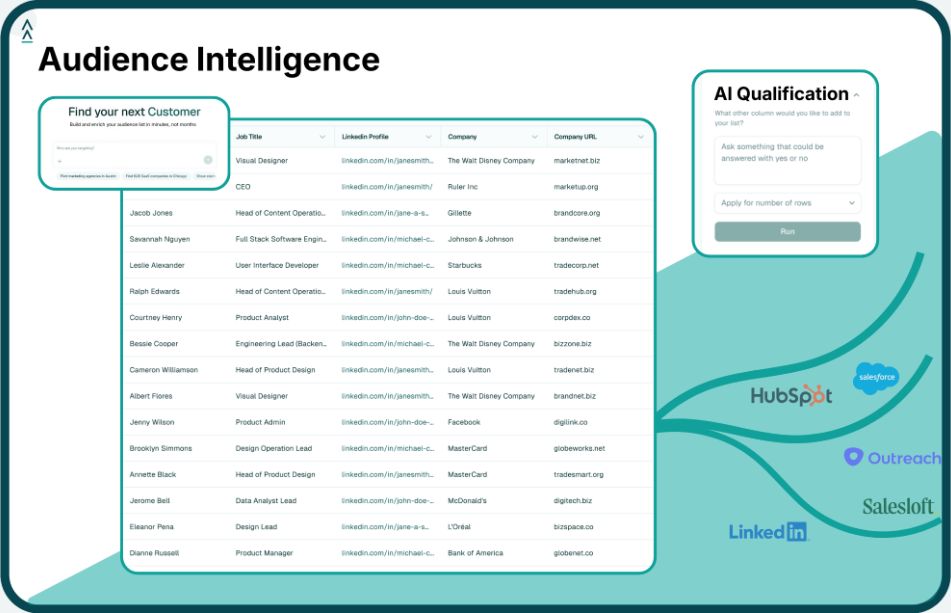
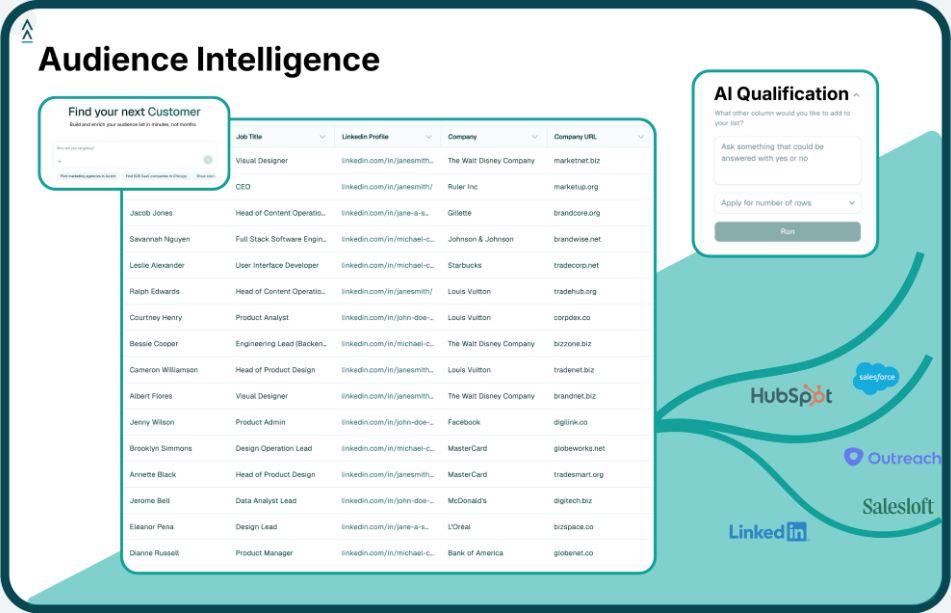
Landbase provides access to 300M+ verified contacts across more than 24 million companies, supported by 1,500+ enrichment fields.
Teams can request an audience using plain English and narrow the results by:
For more specialized segmentation, advanced audience search supports exact filters, historical conditions, rankings, uploaded account data, and custom output fields.
Landbase can then match existing account records, enrich missing fields, identify relevant professionals, and preserve the results as reusable datasets.
Technical GTM teams can use Landbase CLI through Claude Code, Codex, scripts, or a terminal. Structured outputs allow the resulting quantum-company datasets to move into CRMs, dashboards, databases, notebooks, and outbound workflows.
The appropriate metric depends on the company’s stage and product model. Public companies can be evaluated through revenue, bookings, contracts, system sales, and customer growth. Private startups may be assessed through completed financing, facility construction, technical validation, and commercial partnerships. Valuation and qubit count provide context but should not replace operating evidence.
No architecture has established a clear advantage across every technical requirement. Trapped ions offer strong fidelity, superconducting systems benefit from established fabrication expertise, photons may simplify communication, neutral atoms support flexible arrays, and silicon spins may use conventional semiconductor processes. Each approach faces different challenges involving control, manufacturing, cooling, networking, and error correction.
Physical qubits are the individual quantum components inside a system. They are vulnerable to noise, control errors, and environmental interference. Logical qubits encode information across multiple physical qubits using error-correction techniques. Logical-qubit performance is therefore more relevant to fault-tolerant computing than the total physical-qubit count alone.
Current systems are used for research, experimentation, optimization studies, sensing, timing, and application development. Some companies have sold systems or secured commercial contracts, but large-scale fault-tolerant quantum computing has not yet become broadly available. Most organizations use current platforms to develop expertise and test potential applications. Practical value depends on the specific workload and whether a quantum system can outperform a suitable classical alternative.
Useful signals include completed funding, public listings, system orders, government contracts, new facilities, strategic partnerships, and increased technical hiring. Several indicators should be considered together because one announcement may not represent sustained growth. Teams can organize accounts by architecture, funding stage, geography, and operational milestone before identifying relevant decision-makers. Landbase supports this process through audience creation, matching, enrichment, and structured company datasets.
Tool and strategies modern teams need to help their companies grow.