.png)
.png)

Daniel Saks
Chief Executive Officer


Machine learning has expanded from a specialized technical field into a broad commercial market that includes foundation models, AI agents, cloud infrastructure, data platforms, developer tools, voice systems, and industry-specific applications.
The 2026 Stanford AI Index tracks continued advances in reasoning, scientific applications, medicine, and real-world task execution. It also notes that governance, evaluation, education, and supporting data infrastructure are struggling to keep pace with technical development.
Commercial growth is similarly uneven. Some companies now generate billions of dollars in annualized revenue, while others are growing through enterprise adoption, infrastructure contracts, acquisitions, or large financing rounds. These signals should not be treated as interchangeable.
1. Anthropic
Headquarters: San Francisco, California
CEO: Dario Amodei
Anthropic reported annualized revenue of $47 billion in May 2026, driven by demand for Claude across coding, professional work, enterprise applications, and consumer use. The company also announced a $65 billion financing round that valued it at $965 billion.
These figures represent annualized revenue and private-market valuation rather than audited full-year revenue or profitability. Anthropic continues to spend heavily on computing, model development, and infrastructure.
Anthropic develops the Claude family of foundation models, Claude Code, APIs, and enterprise AI products. The company has emphasized professional workflows, coding, tool use, and model behavior designed around safety and controllability.
Its Model Context Protocol has also become an important method for connecting AI applications with external tools and data.
Anthropic has become one of the largest commercial foundation-model companies. Its growth shows that coding and enterprise knowledge work can become substantial revenue sources for general-purpose AI systems.
The company’s expansion also affects cloud infrastructure, data-center demand, developer tools, enterprise software, model evaluation, and AI governance.
Headquarters: San Francisco, California
CEO: Ali Ghodsi
Databricks reached an annual revenue run rate of approximately $5.4 billion by February 2026. Revenue associated with its AI products exceeded $1.7 billion, up from approximately $1 billion in September 2025.
In July 2026, the company was preparing to receive a $3 billion investment led by Coatue Management. The transaction was expected to value Databricks at approximately $188 billion, about 40% above its December 2025 valuation.
Databricks provides a data and AI platform built around its lakehouse architecture. Its products support data engineering, analytics, governance, machine learning, generative AI, model access, and enterprise agents.
The company has expanded beyond data management through products that help organizations build, govern, monitor, and operate AI systems using proprietary and third-party models.
Most enterprise AI systems depend on reliable data, governance, retrieval, monitoring, and cost controls. Databricks occupies this infrastructure layer rather than competing only through one foundation model.
Its growth indicates that enterprises are investing in the systems required to move AI from isolated experiments into operational workflows.
Headquarters: San Francisco, California
CEO: Sam Altman
OpenAI completed a $122 billion financing round in March 2026, valuing the company at approximately $852 billion. The round included major commitments from Amazon, Nvidia, SoftBank, and other investors.
By July, OpenAI reportedly had nine million active users across Codex and ChatGPT Work. Secondary-market estimates placed its value near $933 billion, although secondary pricing should remain separate from a completed primary financing valuation.
OpenAI develops the GPT model family, ChatGPT, Codex, APIs, voice and multimodal systems, and agent-oriented products. Its platform serves consumers, developers, businesses, and public-sector organizations.
The company is increasingly combining conversational AI, coding agents, browsing, research, and task execution rather than treating each capability as a separate product.
OpenAI helped establish the modern consumer market for generative AI. Its distribution, developer ecosystem, funding, and product breadth continue to influence how businesses evaluate and adopt machine learning systems.
Its scale also makes its spending, pricing, infrastructure strategy, and enterprise adoption important indicators for the broader industry.
Company: Anysphere
Headquarters: San Francisco, California
CEO: Michael Truell
Cursor agreed to be acquired by SpaceX for approximately $60 billion in stock in June 2026. The transaction was expected to close during the third quarter, subject to its terms and approvals.
Reporting around the transaction described Cursor as generating billions of dollars in annualized revenue. Separate reporting said the company employed approximately 700 people and served about 60% of the Fortune 500.
Cursor develops an AI-focused code editor and coding agents. The product can analyze repositories, generate and modify code, answer questions about a codebase, and complete multi-step software-development tasks.
The company has also moved toward training its own coding models through the Composer family rather than relying exclusively on third-party foundation models.
Cursor demonstrates the commercial potential of domain-specific AI applications. Its growth suggests that products designed around a focused professional workflow can build significant revenue even when they depend partly on external model providers.
Its acquisition also reflects the strategic value of coding data, developer distribution, specialized models, and compute access.
Headquarters: Livingston, New Jersey
CEO: Michael Intrator
CoreWeave reported first-quarter 2026 revenue of $2.08 billion, compared with approximately $982 million in the corresponding period a year earlier. Its contracted revenue backlog approached $100 billion.
The company said its available 2026 computing capacity was effectively sold out. This demand came with substantial capital requirements, including $6.8 billion in quarterly capital spending and a large adjusted net loss.
CoreWeave operates cloud infrastructure designed for AI training, inference, graphics, and other accelerated-computing workloads. It provides access to GPU clusters, networking, storage, orchestration, and managed infrastructure.
Its customers include foundation-model developers, technology companies, financial organizations, and other businesses with large compute requirements.
CoreWeave represents the infrastructure-intensive side of machine learning growth. Its revenue and backlog show strong demand for AI computing, but its expenses also demonstrate how capital-intensive this layer remains.
The company’s performance helps reveal whether commercial AI demand is translating into long-term infrastructure utilization.
Headquarters: San Francisco, California
CEO: Aravind Srinivas
Perplexity’s estimated annual recurring revenue exceeded $450 million in March 2026 after increasing by approximately 50% in one month. The company attributed part of the increase to agent-oriented products and usage-based pricing.
Executives reported more than 100 million monthly active users across Perplexity’s search and agent products, alongside tens of thousands of enterprise customers. These are company-provided figures rather than independently audited usage totals.
Perplexity develops AI search, research, browser, and agent products. Its services retrieve and synthesize information, provide source citations, compare model outputs, and complete selected tasks.
The company uses models from several providers rather than relying only on one internally developed foundation model.
Perplexity shows how search can evolve into an agent and research platform. Its growth also illustrates the shift from simple subscription pricing toward usage models that reflect the cost of longer and more complex agent tasks.
The company remains exposed to high inference expenses and disputes involving content and web access, making revenue growth only one part of its operating picture.
Headquarters: San Francisco, California
CEO: Winston Weinberg
Harvey raised $200 million in March 2026 at an $11 billion valuation. At that point, the legal AI company had surpassed $200 million in annualized revenue.
By July, reporting indicated that Harvey had added approximately $100 million in net new annualized revenue during a recent quarter. The company also completed its third acquisition in seven months as it expanded into asset management and financial workflows.
Harvey provides AI systems for law firms, corporate legal departments, financial institutions, and professional-services organizations. Its tools assist with research, document analysis, drafting, due diligence, knowledge retrieval, and complex legal workflows.
The company combines general-purpose foundation models with legal data, workflow design, evaluation, and enterprise controls.
Harvey is evidence that vertical AI products can generate substantial enterprise revenue. Its expansion beyond law firms into corporate legal teams and asset management also shows how specialized systems can move into adjacent professional workflows.
The company’s growth may influence legal software, professional services, financial research, compliance, and enterprise knowledge management.
Headquarters: London and New York
CEO: Mati Staniszewski
ElevenLabs reported surpassing $500 million in annual recurring revenue during the first four months of 2026. The company also announced a $500 million Series D financing that valued it at approximately $11 billion.
Its revenue growth reflects expanding use of synthetic voice, speech generation, dubbing, transcription, and conversational voice agents.
ElevenLabs develops machine learning systems for speech synthesis, voice cloning, dubbing, transcription, audio production, and voice agents. Its APIs and applications are used by creators, publishers, developers, enterprises, and accessibility projects.
The company also develops tools intended to identify generated audio and limit certain forms of misuse.
ElevenLabs represents the growth of voice as an AI interface. Voice models are increasingly used in customer service, media production, accessibility, gaming, localization, and software agents.
Its expansion also highlights the safety, consent, intellectual-property, and fraud risks that accompany realistic synthetic audio.
Headquarters: Paris, France
CEO: Arthur Mensch
Mistral AI raised $830 million in debt financing in March 2026 to support AI data centers in France and Sweden. The company planned to invest approximately €4 billion in European AI infrastructure.
The Financial Times reported that Mistral was on track to exceed $1 billion in annual recurring revenue. Around half of its revenue came from Europe, where demand for locally controlled AI infrastructure had increased.
Mistral develops open-weight and proprietary language models, coding models, speech systems, APIs, enterprise deployments, and its Le Chat assistant. It also supports organizations that want to operate models in private or regionally controlled environments.
Its strategy combines model development with European computing infrastructure.
Mistral is one of Europe’s most prominent foundation-model developers. Its growth reflects demand from governments and enterprises seeking alternatives to AI systems controlled entirely by U.S. technology companies.
Its infrastructure plans also connect AI development with data sovereignty, regional regulation, cloud policy, and European industrial strategy.
Headquarters: San Francisco, California
CEO: Scott Wu
Cognition raised more than $1 billion in May 2026 at a reported post-money valuation of $26 billion. The company had previously acquired the remaining Windsurf business and integrated it with its AI software-development operations.
Cognition also announced expansion across Asia-Pacific, including plans to build its regional presence from Singapore. Earlier company figures showed Devin’s annual recurring revenue rising from $1 million in September 2024 to $73 million by June 2025.
Cognition develops Devin, an AI software-engineering agent that can plan and complete coding tasks. Following its acquisition of Windsurf, the company also operates an AI-focused development environment and related coding products.
Its products are intended to automate portions of software maintenance, feature development, migration, testing, and technical research.
Cognition represents the move from coding assistance toward longer-running software agents. Its funding and expansion reflect investor interest in AI systems that can complete defined workflows rather than only generate short code suggestions.
Its development also raises practical questions about security, review, accountability, and how engineering teams measure agent output.
The machine learning ecosystem includes foundation-model companies, AI infrastructure providers, coding platforms, data systems, voice companies, enterprise agents, research tools, and vertical applications. These categories require more precise targeting than a broad artificial intelligence industry label.
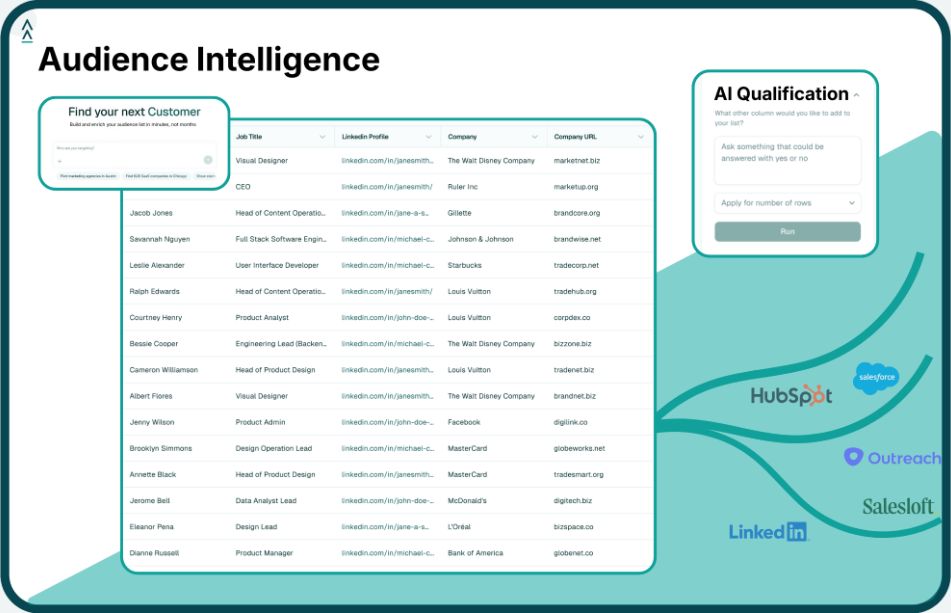
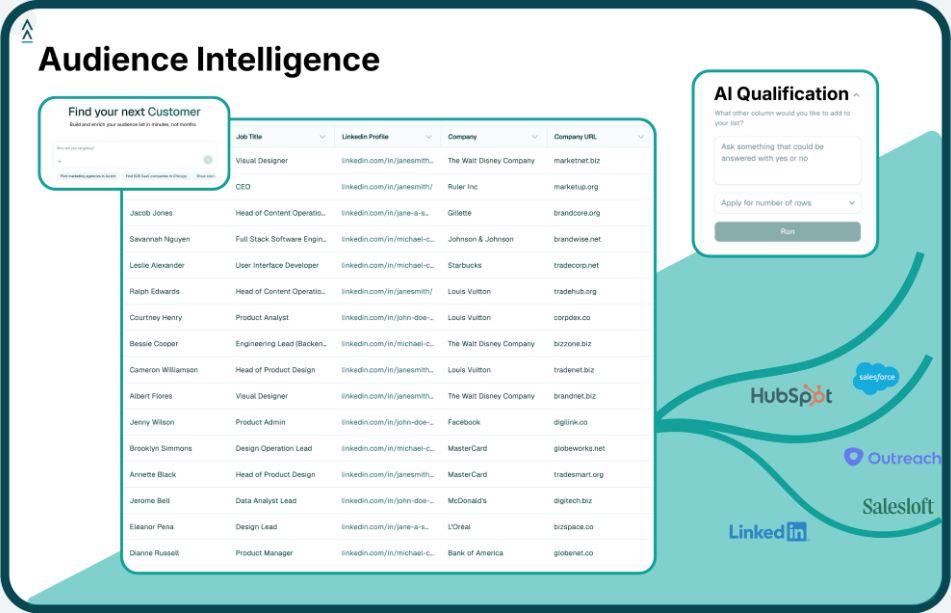
Teams can request an audience using plain English and narrow results by geography, company size, funding stage, hiring activity, technology, market segment, or professional role.
Potential AI and machine learning audiences include:
For more specialized definitions, advanced audience search supports exact filters, historical conditions, aggregations, rankings, uploaded account data, and custom output fields.
Landbase can then match existing records, enrich missing company and contact fields, identify relevant professionals, and preserve the results as reusable datasets. Technical teams can use Landbase CLI through Claude Code, Codex, scripts, or a terminal.
The resulting records can move into CRMs, dashboards, notebooks, databases, and outbound workflows through structured export formats.
Growth should be measured according to the company’s business model. Model and software companies can be evaluated through annualized revenue, users, enterprise customers, and product adoption. Infrastructure providers may be better assessed through quarterly revenue, contracted backlog, capacity, and utilization. Funding and valuation can provide context, but neither should be treated as a substitute for commercial performance.
Annualized revenue estimates what a company would generate over 12 months if its current revenue rate continued. It can help show momentum, but it is not the same as audited revenue earned during a completed financial year. Fast-growing companies may experience significant changes after the figure is calculated. Comparisons should therefore use clearly labeled periods and consistent definitions.
Current growth is visible in foundation models, AI infrastructure, coding agents, enterprise search, voice systems, and industry-specific applications. Coding has attracted substantial adoption because outputs can often be tested and reviewed. Infrastructure demand is also rising as model developers require more computing capacity. Vertical applications are growing where specialized workflows, data, and controls create advantages over general-purpose tools.
Training and operating advanced models can require substantial spending on chips, data centers, energy, networking, technical talent, and model evaluation. Infrastructure companies also need capital before contracted computing capacity becomes available. Application companies may raise large rounds to expand products, acquire competitors, and enter new markets. The size of a funding round does not establish profitability or guarantee continued growth.
Useful signals include recent financing, accelerating revenue, major infrastructure contracts, acquisitions, international expansion, product launches, and increased hiring. Several signals should be evaluated together because one announcement may not indicate sustained commercial growth. Teams can organize companies by application category, growth stage, geography, and operational milestone before identifying relevant decision-makers. Landbase supports this process through audience creation, matching, enrichment, and structured company datasets.
Tool and strategies modern teams need to help their companies grow.