.png)
.png)

Daniel Saks
Chief Executive Officer


Deepline is often evaluated by GTM engineers, RevOps teams, and technical operators that want command-line access to enrichment workflows. Its bring-your-own-keys model is designed for teams that want to connect their own provider accounts and run enrichment through a CLI, API, or agent-assisted workflow.
For technical GTM teams, the broader question is whether they need a CLI enrichment layer, a spreadsheet-style workflow builder, a B2B contact database, a sales intelligence platform, or a GTM data layer that can prepare structured data before enrichment, outbound, CRM, analytics, and AI-assisted workflows begin. This matters as more teams adopt agentic workflows, since McKinsey notes that scaling agentic AI at scale depends on stronger data architecture, data quality, and operating models.
Primary Use Case: Technical GTM teams, RevOps engineers, Sales Ops teams, growth teams, and AI agents that need structured B2B audience data inside terminal and AI-assisted workflows.
Plan Details: Contact Landbase for tailored pricing details.
Landbase gives technical revenue teams a CLI-first way to work with B2B audience data through Landbase CLI. Teams can search for audiences, enrich company and contact records, match existing data, manage datasets, and export structured results directly from the command line, Claude Code, Codex, scripts, dashboards, notebooks, and other technical environments.
Landbase CLI gives GTM operators and AI agents direct access to B2B audience data from terminal and LLM-assisted environments. Instead of relying only on static databases, fixed filters, manual exports, or spreadsheet-heavy cleanup, teams can create, enrich, match, manage, and download GTM datasets for downstream workflows.
Landbase supports the data work that happens before enrichment becomes useful in revenue systems. While Deepline-style workflows focus on provider-key orchestration and enrichment execution, Landbase helps technical teams prepare the audience, matching, enrichment, dataset, and export layer those workflows depend on.
This is useful for teams that want more control over audience creation, record quality, enrichment, and downstream handoffs. RevOps teams, GTM engineers, and technical founders can use Landbase CLI to turn targeting criteria into structured datasets, improve existing lists, and move usable records into the systems where GTM work happens.
The CLI-first approach also supports agentic workflows. By making GTM data available from terminal and LLM-assisted environments, Landbase helps teams connect audience creation, enrichment, matching, and structured downloads with scripts, dashboards, CRMs, outbound platforms, analytics tools, and AI agents.
Primary Use Case: GTM teams that need table-based enrichment, AI research, workflow building, and custom data operations across multiple sources.
Clay provides a spreadsheet-style workspace for enrichment and GTM workflow building. Teams can bring records into tables, connect data sources, run enrichment steps, apply workflow logic, and send prepared data into other GTM systems.
Clay is often considered when teams want to manage enrichment and research workflows in a spreadsheet-style interface. It may be relevant for RevOps or GTM teams that are comfortable configuring tables, data sources, formulas, and workflow logic.
Teams should evaluate how much setup, maintenance, and workflow management the table-based approach requires for their operating model.
Primary Use Case: Sales teams that want prospecting data, enrichment, email sequencing, calling, and CRM sync in one workspace.
Apollo.io combines prospecting, company search, contact search, enrichment, outbound email sequences, calling tools, and CRM-connected workflows. It is commonly evaluated by startups, SMBs, and mid-market teams that want data access and engagement activity in the same platform.
Apollo.io is often considered by teams that want prospecting and engagement functions in one web-based workspace. It may be relevant when the team’s workflow includes both list building and outbound activity.
Teams should evaluate how its data, sequencing, calling, CRM sync, and export options fit their sales process and downstream reporting needs.
Primary Use Case: Mid-market and enterprise revenue teams that need B2B sales intelligence, company data, contact data, intent data, and CRM-connected workflows.
ZoomInfo is a B2B data and go-to-market intelligence platform used for account research, contact discovery, intent data, technographics, and revenue workflows. It is commonly evaluated by larger teams that need sales intelligence features across sales, marketing, and operations.
ZoomInfo is often included in evaluations for B2B data, enrichment, and sales intelligence workflows. It may be relevant for teams that need account and contact records before those records move into CRM, outbound, or marketing systems.
Teams should review data coverage, governance requirements, integrations, contract structure, and how records are exported or operationalized downstream.
Primary Use Case: Revenue teams that need compliant B2B data, phone-verified contact workflows, EMEA coverage, and privacy-conscious prospecting.
Cognism provides B2B contact and company data with an emphasis on data quality, compliance, and sales prospecting workflows. It is often evaluated by organizations with European markets, privacy requirements, or phone-based sales motions.
Cognism is often included in evaluations where regional coverage, privacy requirements, and phone-based prospecting are important. It may be relevant for teams selling into European markets or managing stricter data compliance requirements.
Teams should review data coverage, compliance needs, verification workflows, and integration requirements before choosing a platform.
Primary Use Case: Sales teams that want access to B2B contact and company data for prospecting, enrichment, outreach, and CRM workflows.
Lusha provides B2B contact and company data for GTM teams. It is commonly evaluated by sales professionals and teams that want to find contact information, enrich records, and support prospecting workflows.
Lusha is often considered for contact discovery and enrichment workflows. It may be relevant for sales teams that need contact data during prospect research or list preparation.
Teams should evaluate whether their workflow requires only contact lookup, or whether it also needs broader audience creation, record matching, dataset management, and export flexibility.
Primary Use Case: GTM teams that want workflow orchestration across data, plays, agents, and downstream revenue systems.
Cargo provides GTM workflow infrastructure for teams that want to connect data operations with automated plays, agent-assisted work, and downstream tools. It is often evaluated by teams that want orchestration beyond basic enrichment.
Cargo is often considered when teams want to connect enrichment, workflow logic, and downstream GTM actions. It may be relevant for teams evaluating orchestration workflows rather than enrichment alone.
Teams should review how its orchestration model fits their data sources, workflow requirements, downstream tools, and internal operating capacity.
Primary Use Case: Sales and marketing teams that want human-verified B2B contact data, firmographics, technographics, and intent-related data workflows.
SalesIntel provides B2B contact and company data with an emphasis on AI-assisted and human-verified records. It is commonly evaluated by teams that prioritize verified emails, mobile direct dials, firmographic data, technographic data, and buying committee coverage.
SalesIntel is often considered when teams need verified contact and company data before records move into sales or marketing systems. It may be relevant for teams that prioritize phone-based prospecting, buying committee data, or human-verified contact workflows.
Teams should evaluate verification methods, coverage needs, CRM compatibility, data delivery options, and how the platform fits their broader enrichment process.
Landbase CLI gives technical GTM teams direct access to B2B audience data from the command line. Instead of relying only on web interfaces, fixed filters, manual exports, or spreadsheet-heavy processes, teams can work with GTM data inside Claude Code, Codex, scripts, dashboards, notebooks, and other technical environments.
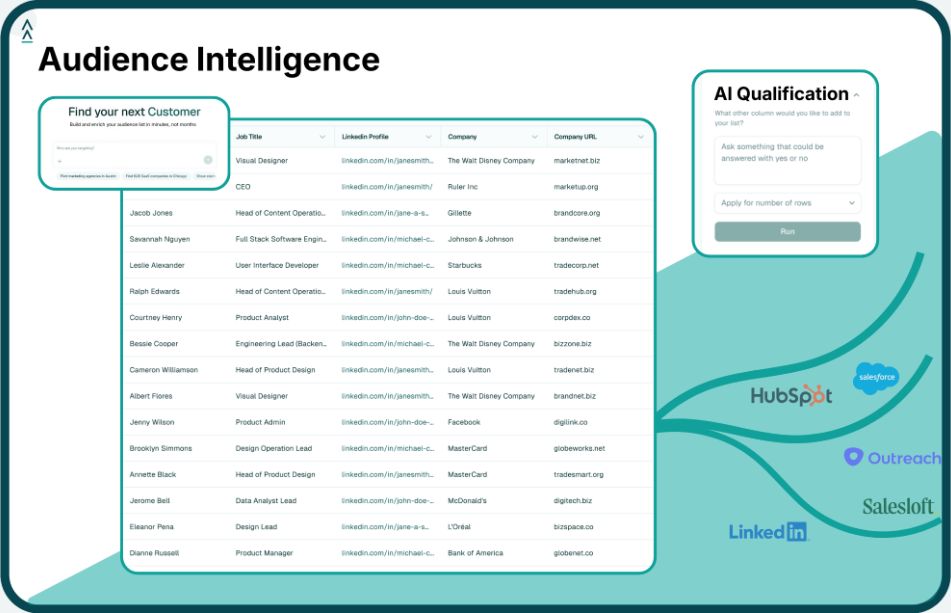
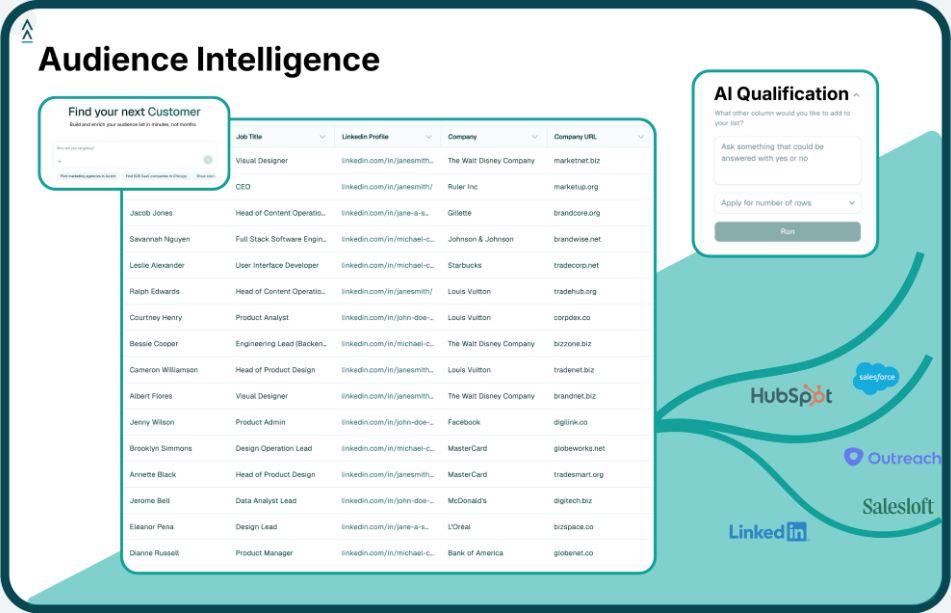
Landbase CLI lets users describe the audience, account list, or GTM segment they need in plain English and return structured results. This helps teams move from ICP criteria to usable account and contact data before enrichment workflows begin.
Landbase CLI supports the practical data work that happens before GTM execution. Teams can enrich company and contact records, match partial data from uploaded spreadsheets or CRM exports, manage datasets, and prepare records for the next workflow. This makes Landbase useful as a data layer before sales engagement, CRM cleanup, analytics, or AI-assisted workflows.
Results can be exported in machine-readable formats such as JSONL, CSV, and Parquet. These outputs work well with CRMs, dashboards, scripts, notebooks, outbound systems, and AI agent workflows. This helps technical teams move GTM data across the systems where revenue operations already happen.
Landbase CLI is designed for humans and AI coding agents. Teams can use it inside Claude Code, Codex, and other LLM-assisted environments so agents can search, enrich, transform, and export GTM data more easily. This supports repeatable workflows for GTM engineers, RevOps teams, growth teams, and technical founders.
For GTM teams evaluating Deepline alternatives, Landbase provides a different approach: a CLI-first GTM data layer that helps teams build, enrich, match, manage, and operationalize B2B audience data before CRM, outbound, analytics, or AI-assisted workflows take over. Teams can review Landbase CLI, explore B2B audience data, or connect with Landbase through the demo page.
Deepline is commonly evaluated as a CLI-first GTM enrichment tool. Its bring-your-own-keys model is designed for teams that want to connect provider accounts and run enrichment workflows through technical interfaces. Teams often consider it when they need command-line enrichment, provider orchestration, and structured data handling.
Teams should first identify which part of the GTM data workflow needs improvement. Some tools focus on CLI-based enrichment, while others focus on contact discovery, sales intelligence, workflow building, orchestration, or broader GTM data infrastructure. Technical teams should also evaluate data quality, export flexibility, matching capabilities, CRM compatibility, and support for AI-assisted workflows.
Structured GTM data helps teams move from raw or incomplete records to usable account and contact data. This can improve CRM cleanup, outbound list preparation, reporting, account research, and AI-assisted workflows. Enrichment becomes more useful when the output can move cleanly into CRMs, dashboards, outbound tools, scripts, notebooks, or other downstream systems.
Landbase CLI gives technical GTM teams and AI agents direct access to B2B audience data from terminal and LLM-assisted environments. Teams can use it to search for audiences, enrich company and contact records, match uploaded data, manage datasets, and export structured files for downstream GTM systems.
Yes. Landbase CLI is designed for use inside environments such as Claude Code, Codex, scripts, notebooks, and other LLM-assisted workflows. This gives AI agents and technical operators a structured way to work with GTM data, including audience search, enrichment, matching, dataset management, and exports.
Tool and strategies modern teams need to help their companies grow.