.png)
.png)

Daniel Saks
Chief Executive Officer


Clay is commonly evaluated by GTM teams that want to build enrichment workflows in a spreadsheet-style workspace. Teams use tools in this category to bring records into tables, connect data providers, add enrichment steps, apply workflow logic, and prepare data for downstream sales and marketing systems.
For teams comparing Clay alternatives, the key question is not only whether they need enrichment. It is whether they need a table-based workflow builder, a B2B contact database, a sales intelligence platform, an email verification tool, an API-first enrichment provider, or a CLI-first GTM data layer that can prepare structured data before CRM, outbound, analytics, and AI-assisted workflows begin. This matters because IBM notes that AI data quality depends on data being accurate, complete, reliable, and fit for use across the AI lifecycle.
Primary Use Case: GTM engineers, RevOps teams, Sales Ops teams, growth teams, and AI agents that need a command-line way to search, enrich, match, manage, and export B2B audience data.
Plan Details: Contact Landbase for tailored pricing details.
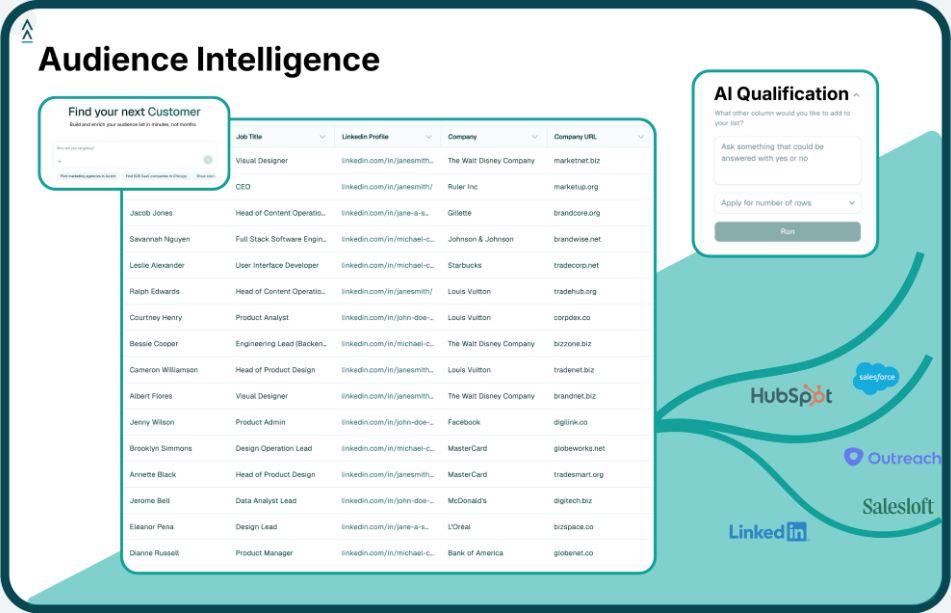
Landbase is a CLI-first GTM data platform for teams that want B2B audience data to work inside technical environments, not only inside tables or browser-based workflows. Through Landbase CLI, technical teams can create target account lists, enrich company and contact records, match incomplete data, manage datasets, and download structured outputs for CRM, analytics, outbound, notebook, script, and AI-agent workflows.
For teams comparing Clay alternatives, Landbase is most relevant when the team wants GTM data to move beyond a spreadsheet-style workspace. Clay-style workflows can help teams configure enrichment steps in tables. Landbase focuses on the upstream data layer: defining audiences, matching records, enriching account and contact data, and exporting structured files for downstream systems.
Landbase CLI gives technical teams a way to work with GTM data from the terminal. A user can begin with an audience idea, an uploaded list, a partial CRM export, or an existing dataset, then use CLI workflows to search, match, enrich, refine, and download the results.
This makes the workflow useful for RevOps and GTM engineering teams that need repeatable data operations. Instead of manually maintaining tables for every enrichment sequence, teams can use command-line workflows that fit into scripts, notebooks, dashboards, and LLM-assisted environments.
Landbase addresses a different layer of the GTM data workflow than table-based enrichment. A team may still need enrichment steps, but it may also need a reliable way to define target audiences, resolve records, enrich missing fields, manage reusable datasets, and send outputs into the rest of the GTM stack.
That distinction matters for technical teams. Spreadsheet-style workflows can become harder to manage when many tables, formulas, data providers, and handoffs are involved. Landbase gives GTM engineers and RevOps teams a CLI-accessible way to prepare and move structured data across systems.
Landbase also fits teams exploring AI-assisted GTM workflows. Because the CLI can be used inside Claude Code, Codex, scripts, notebooks, and other LLM-assisted environments, technical teams can give AI agents a structured way to search, enrich, match, and export GTM data.
Primary Fit: Technical GTM teams that want audience creation, matching, enrichment, dataset management, and structured exports through CLI and AI-assisted workflows.
Primary Use Case: Sales teams that want prospecting data, enrichment, sequencing, calling, and CRM sync in one workspace.
Apollo.io provides sales intelligence and engagement workflows that include prospecting, contact search, company search, enrichment, outbound sequences, calling tools, and CRM-connected activity. It is commonly evaluated by teams that want data access and engagement functions in one web-based platform.
Apollo.io is often considered by teams that want prospecting and engagement workflows in the same system. It may be relevant when the team’s sales process includes both list building and outbound activity.
Teams should evaluate how its contact data, sequencing, calling, CRM sync, export options, and governance requirements fit their operating model.
Primary Use Case: Mid-market and enterprise revenue teams that need B2B sales intelligence, account research, contact data, intent data, and CRM-connected workflows.
ZoomInfo is a B2B data and go-to-market intelligence platform used for account research, contact discovery, intent data, technographics, and revenue workflows. It is commonly evaluated by larger GTM teams that need sales intelligence features across sales, marketing, and operations.
ZoomInfo is often included in evaluations for B2B data, enrichment, and sales intelligence workflows. It may be relevant for teams that need account and contact records before those records move into CRM, outbound, or marketing systems.
Teams should review data coverage, governance requirements, integrations, contract structure, and how records are exported or operationalized downstream.
Primary Use Case: Revenue teams that need compliant B2B data, phone-verified contact workflows, EMEA coverage, and privacy-conscious prospecting.
Cognism provides B2B contact and company data with an emphasis on compliance, data quality, and sales prospecting workflows. It is often evaluated by organizations with European markets, privacy requirements, or phone-based sales motions.
Cognism is often included in evaluations where regional coverage, privacy requirements, and phone-based prospecting are important. It may be relevant for teams selling into European markets or managing stricter data compliance requirements.
Teams should review data coverage, compliance needs, verification workflows, CRM compatibility, and integration requirements before choosing a platform.
Primary Use Case: Sales teams that want access to B2B contact and company data for prospecting, enrichment, outreach, and CRM workflows.
Lusha provides B2B contact and company data for GTM teams. It is commonly evaluated by sales professionals and teams that want to find contact information, enrich records, and support prospecting workflows.
Lusha is often considered for contact discovery and enrichment workflows. It may be relevant for sales teams that need contact data during prospect research or list preparation.
Teams should evaluate whether their workflow requires only contact lookup, or whether it also needs broader audience creation, record matching, dataset management, and export flexibility.
Primary Use Case: Teams that need email finding, email verification, domain search, and API access for email-focused prospecting workflows.
Hunter.io focuses on professional email discovery and verification. It is commonly evaluated by teams that need to find or validate email addresses rather than manage a broader GTM data workflow.
Hunter.io is often considered for email-focused workflows where the main task is finding or validating professional email addresses. It may be used as one part of a larger prospecting, enrichment, or outbound process.
Teams should evaluate whether email discovery alone is enough, or whether they also need account data, contact enrichment, matching, dataset management, or structured exports.
Primary Use Case: Sales teams that want contact search, company data, CRM-connected prospecting, and AI-assisted list-building workflows.
Seamless.AI provides sales prospecting and contact data workflows that use AI-assisted search to find and validate contact information. It is often evaluated by sales teams that want B2B contact records, company data, and integrations with CRM or sales tools.
Seamless.AI is often considered by teams that need contact search and prospecting workflows connected to CRM or sales engagement tools. It may be relevant when sales teams want to research contacts, build lists, and route records into downstream systems.
Teams should review data verification methods, CRM integration needs, export options, and how its search Use Case Fits existing prospecting processes.
Primary Use Case: Marketing, RevOps, and sales teams that need company and contact enrichment connected to HubSpot or API-based workflows.
Clearbit, now part of HubSpot, provides B2B data enrichment for company and contact records. It is commonly evaluated by teams that want to update, correct, or add information to CRM records, support segmentation, improve routing, or identify companies visiting a website.
Clearbit by HubSpot is often considered by teams that need enrichment connected to HubSpot CRM or website visitor identification workflows. It may be relevant for marketing and RevOps teams that want enriched company and contact data inside existing CRM processes.
Teams should evaluate HubSpot dependency, API requirements, visitor identification needs, record coverage, and how enrichment data will be used across sales and marketing systems.
Spreadsheet-style enrichment works when teams want to organize provider steps visually. As GTM workflows become more complex, teams may need a way to create audiences, resolve records, enrich data, and export results without managing every step inside a table. Landbase CLI gives technical teams a command-line path for moving GTM data through scripts, notebooks, dashboards, and AI-assisted environments.
A single enrichment table can help with one list or campaign. RevOps and GTM engineering teams often need workflows they can run again across CRM exports, uploaded files, market segments, or existing datasets. Landbase supports that process by helping teams search, match, enrich, refine, and download structured outputs in reusable formats.
AI-assisted workflows need data that is structured enough for agents to interpret and act on. Landbase CLI is designed for use in environments such as Claude Code, Codex, scripts, and notebooks, giving technical teams a way to make audience data available to AI agents without relying only on manual browser-based steps.
GTM data usually needs to flow into CRMs, outbound systems, dashboards, analytics tools, or internal scripts. Landbase supports structured exports such as JSONL, CSV, and Parquet, which helps teams reuse audience, matching, and enrichment outputs across multiple systems.
For teams evaluating Clay alternatives, Landbase is most relevant when the need extends beyond configuring enrichment steps in a table. It gives technical GTM teams CLI-first access to audience creation, matching, enrichment, dataset management, and structured exports. Teams can review Landbase CLI, explore B2B audience data, or connect through the demo page.
Clay is commonly evaluated as a GTM workflow builder for enrichment, research, and data operations. Teams use it to organize records in tables, connect data sources, run enrichment steps, apply workflow logic, and prepare data for downstream GTM systems.
Teams should first identify which workflow layer they need to improve. Some alternatives focus on contact discovery, while others focus on sales intelligence, email verification, CRM enrichment, website visitor identification, API workflows, or GTM data infrastructure. Technical teams should also evaluate data quality, setup requirements, export formats, CRM compatibility, and whether the platform supports AI-assisted workflows.
A spreadsheet-style workflow builder helps teams configure enrichment steps in tables, often using columns, formulas, provider connections, and workflow logic. A GTM data layer focuses on the broader data foundation, including audience creation, record matching, enrichment, dataset management, and structured exports. The right fit depends on whether the team needs a visual workspace, a technical data layer, or both.
Structured GTM data helps RevOps teams move records across CRM cleanup, outbound list preparation, reporting, account research, and AI-assisted workflows. Enrichment becomes more useful when the output can move cleanly into CRMs, dashboards, outbound tools, scripts, notebooks, or other downstream systems.
Landbase CLI gives technical GTM teams and AI agents direct access to B2B audience data from terminal and LLM-assisted environments. Teams can use it to search for audiences, enrich company and contact records, match uploaded data, manage datasets, and export structured files for downstream GTM systems.

Tool and strategies modern teams need to help their companies grow.






