.png)
.png)

Daniel Saks
Chief Executive Officer


Personalized outreach doubles reply rates — advanced personalization pushes responses to ~18%, compared to ~9% for generic messages — yet only 5% of sales reps personalize every email. The gap is not effort or intent. It is tooling. Precedence Research forecasts the AI sales assistant software market will grow from $3.85B in 2026 to $26.09B by 2035. Finding the best personalized sales outreach tools in 2026 means understanding a critical distinction: most platforms personalize only the message layer (inserting first names, company names, or AI-written openers), while leaving prospect targeting entirely generic. The result is well-written emails sent to the wrong people.
True personalization starts before the first email. It starts with identifying signal-qualified prospects using intent data, technographic signals, and firmographic enrichment, then researching buyer context autonomously, and finally crafting outreach that reflects what each prospect actually cares about.
This guide evaluates 11 personalized outreach software options across three layers of personalization: prospect intelligence, message personalization, and timing and channel optimization. Whether you need a full agentic AI GTM platform or a focused email personalization tool, this list covers the best sales personalization tools available today.
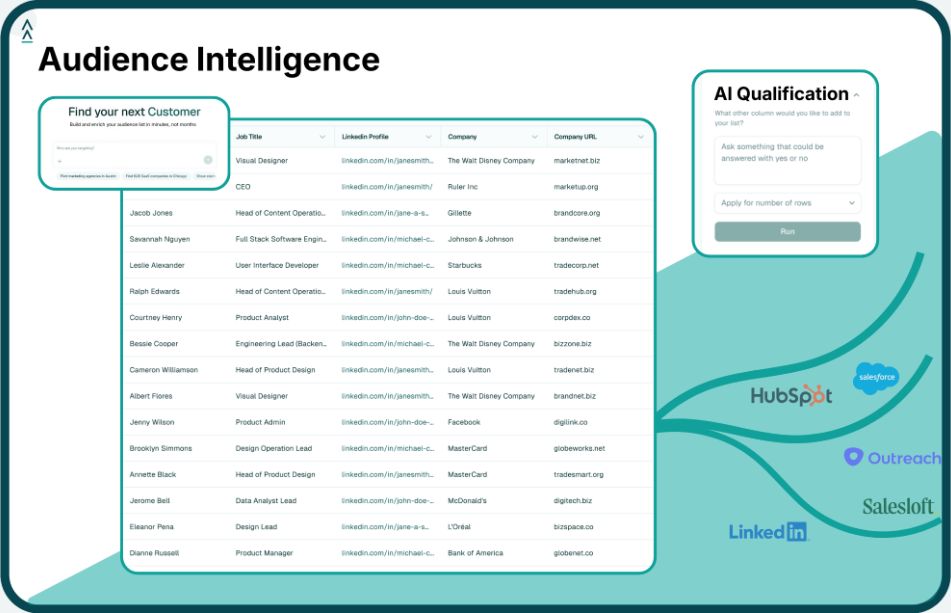
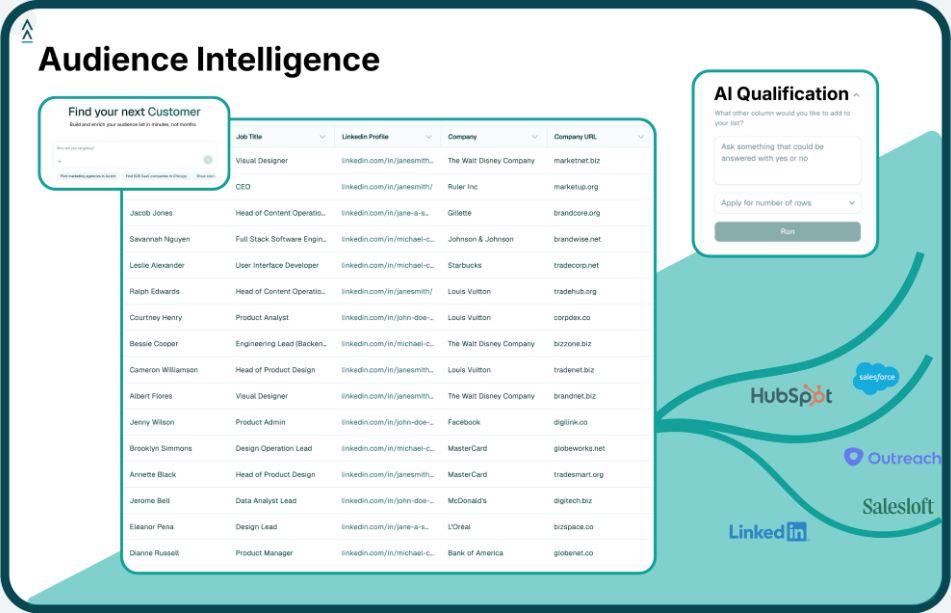
Landbase is the world's first agentic AI platform for go-to-market. While most ai personalized outreach platforms focus on a single layer of the sales workflow — writing better emails, enriching contact data, or managing sequences — Landbase combines all three into an autonomous system. Its AI agents (Research, Identity, and Predictive) work together to find signal-qualified prospects, research their context, and craft outreach based on real-time buying signals, not template variables.
The platform's 300M+ verified contact database is enriched with 1,500+ data fields spanning firmographic, technographic, intent, and behavioral signals. This depth changes what personalization means in practice. Instead of inserting a prospect's name and company into a generic template, Landbase's agentic AI identifies why a specific prospect is worth reaching out to right now — a hiring surge, a technology adoption, a funding event — and builds the outreach around that context.
What separates Landbase from sequence tools and enrichment platforms is its end-to-end GTM automation. You do not need to stitch together a data provider, an enrichment tool, a writing assistant, and a sending platform. The GTM-2 Omni proprietary AI model, purpose-built for go-to-market workflows, handles the full pipeline from ICP identification through personalized multi-channel outreach across email, LinkedIn, and phone.
Key features:
Customer outcomes:
Credibility: Recognized as a Gartner Cool Vendor. Backed by a $30M Series A. These markers reflect the platform's position at the intersection of AI and GTM — not a bolt-on feature added to a legacy tool, but a platform built from the ground up around agentic AI.
Best for: B2B sales teams that want true end-to-end GTM automation — from ICP identification through personalized outreach — powered by agentic AI, not sequence templates.
Apollo.io combines a large B2B contact database — with public pages showing roughly 210M to 270M+ contacts depending on source, and 35M+ companies — with built-in email sequences, enrichment, and buyer intent signals. The platform serves as an all-in-one outbound engine where teams can identify prospects, build lists, and launch personalized sequences without switching tools.
Apollo's personalization approach centers on data-driven targeting and AI-assisted email writing. The platform provides buyer intent signals and company intelligence to inform messaging, while its AI writing assistant helps generate personalized email variations. A Chrome extension enables LinkedIn prospecting through Sales Navigator with real-time data enrichment.
Key features:
Limitations to consider: Data accuracy can be uneven in international markets, particularly EMEA and APAC. Advanced intent signals and AI features require higher-tier plans. Sequence personalization is template-based rather than autonomous — you define the variables, not an AI agent.
Best for: Growing sales teams that want an affordable all-in-one outbound engine for prospecting and execution.
Pricing: Free plan available; Basic, Professional, and Organization tiers available. Verify current pricing on Apollo's pricing page before purchasing.
Outreach is the enterprise-grade sales engagement platform with AI-powered deal intelligence, multi-touch sequences spanning email, phone, LinkedIn, and SMS, and deep analytics. It is the market leader for complex enterprise sales cycles requiring coordinated outreach across large SDR organizations.
Outreach personalizes through AI-guided engagement sequences that analyze buyer sentiment in real time. The platform adjusts messaging recommendations based on email sentiment, meeting outcomes, and stakeholder engagement patterns. Its strength is orchestrating personalized touchpoints across multiple channels within long, complex enterprise deal cycles.
Key features:
Limitations to consider: Enterprise deployments typically require meaningful implementation time. The per-user cost is significantly higher than mid-market alternatives. The platform is sequence-first — it excels at orchestrating outreach but relies on external tools for prospect intelligence and data enrichment.
Best for: Enterprise sales teams running complex, multi-touch sales cycles with large SDR organizations that need robust reporting.
Pricing: Outreach uses quote-based per-user pricing; public list pricing and contract minimums are not available on their pricing page.
Salesloft is a revenue orchestration platform combining sales engagement, conversation intelligence, deal management, and forecasting. Its cadence builder supports branching logic that adjusts the outreach sequence based on how each prospect engages — opens, clicks, replies, or silence each trigger different follow-up paths.
Personalization in Salesloft happens primarily through behavioral branching. Rather than sending every prospect the same five-step sequence, the platform routes prospects through different paths based on their engagement patterns. Conversation intelligence adds another layer by recording and analyzing calls to surface coaching insights and deal risks.
Key features:
Limitations to consider: The dialer is an add-on cost, not included in base pricing. Like Outreach, Salesloft is a sequence execution platform — it orchestrates multi-channel touchpoints but does not handle prospect intelligence or data enrichment natively.
Best for: Mid-market to enterprise companies that need a balance of capability and usability with strong cadence management.
Pricing: Advanced and Premier tiers available; dialer is an add-on. Current list pricing is not publicly available on Salesloft's pricing page.
Clay is a data enrichment and workflow platform that lets teams build custom prospecting pipelines from scratch. You can find companies, check tech stacks, identify decision-makers, verify emails, and generate personalized openers — all within a single Clay table. Its Claygent AI agent researches any company or person for 1:1 messaging that goes beyond surface-level variables.
Clay's personalization approach is distinctive: instead of offering a fixed set of data fields, it lets teams pull from extensive data enrichment integrations and combine them using conditional logic. Claygent can research a prospect's recent news, job postings, LinkedIn activity, and pain points, then feed that research directly into AI-generated personalized openers. The tradeoff is that building these workflows requires hands-on configuration.
Key features:
Best for: Revenue ops and growth teams that want maximum enrichment flexibility and are willing to build custom workflows.
Pricing: Paid plans start at Launch ($167/month) and Growth ($446/month), with additional tiers available. Clay uses credit-based pricing.
Instantly is a high-deliverability email platform with AI-powered send optimization, unlimited sending accounts, and built-in warmup. Used by 50,000+ sales teams, the platform focuses on ensuring personalized emails actually reach the inbox — a prerequisite that many personalization tools overlook.
Instantly's personalization happens through its AI Copilot, which generates personalized subject lines, email bodies, and follow-up sequences. The platform's SISR system (Server & IP Sharding and Rotation) protects sender reputation across high-volume campaigns. Its flat monthly pricing model — no per-account charges — makes it a strong fit for teams managing multiple sending accounts.
Key features:
Best for: Teams doing high-volume email outreach who need strong deliverability without per-account costs.
Pricing: Growth from $37.6/month (annual); Hypergrowth $77.6/month; Light Speed $286.3/month.
Reply.io is a multichannel sales engagement platform with a built-in AI SDR agent called Jason. Jason AI SDR personalizes outreach and books meetings; Reply's broader platform supports multichannel sequences across email, LinkedIn, calls, SMS, and WhatsApp. The platform combines a 1B+ verified B2B contact database with drag-and-drop sequence building.
Reply.io personalizes outreach through its AI SDR agent, which autonomously finds prospects matching your ICP, generates personalized messages based on prospect data, and handles initial engagement. The platform supports conditional branching and A/B testing within sequences, plus multi-language support for global campaigns.
Key features:
Best for: Companies focused on large-scale outbound prospecting who want AI-powered automation across multiple channels.
Pricing: Jason AI SDR starts at $500/month for 1,000 active contacts.
Lemlist is a multichannel outreach platform known for its visual personalization capabilities — dynamic personalized images, landing pages, and video embedded directly in emails. The platform combines a 600M+ lead database with built-in email warmup (lemwarm) and multichannel sequences.
Lemlist's personalization approach is unique in this category. Beyond text-based personalization, it allows you to embed dynamically personalized images (a prospect's name on a whiteboard, their logo on a screen) and custom landing pages into outreach sequences. According to vendor-reported benchmarks, personalized video in outreach can significantly increase response rates, and Lemlist is one of the few platforms that makes visual personalization scalable.
Key features:
Why visual personalization matters in 2026: Vendor-reported benchmarks from Sendspark suggest personalized video outreach can achieve reply rates significantly higher than text-only emails. Lemlist is one of the few platforms that makes this scalable without dedicated video production resources.
Best for: B2B teams that want visually personalized outreach at scale with strong deliverability.
Pricing: Email Pro $63/user/month; Multichannel Expert $87/user/month (billed annually).
Klenty is an AI sales engagement platform with agentic cadences that automatically adjust sequences based on prospect behavior. It offers multichannel outreach across email, phone, SMS, WhatsApp, and LinkedIn at competitive price points compared to enterprise alternatives.
Klenty personalizes through intent-based playbooks that route prospects by engagement level. Its AI-powered Agentic Cadences detect prospect behavior signals — opens, clicks, replies, website visits — and automatically adjust the sequence path in real time. The platform also includes Prospect IQ for data enrichment and liquid template personalization with video support.
Key features:
Best for: B2B sales teams that want robust sales engagement functionality at accessible price points.
Pricing: Basic from $50/user/month; Growth $70/user/month; Plus $99/user/month (all annual).
HubSpot Sales Hub is a CRM-integrated sales engagement solution with sequences, email tracking, meeting scheduling, and call recording built directly into the HubSpot ecosystem. For teams already using HubSpot Marketing or Service Hub, it provides outreach capabilities without adding another vendor to the stack.
HubSpot Sales Hub supports workflows and personalization tokens that pull from CRM data, lifecycle stage, and past interactions; broader HubSpot platform features also include smart content. Email sequences support one-to-one follow-ups with personalization tokens pulling from any CRM property. The tradeoff is that advanced sequence features require the Professional tier.
Key features:
Best for: Companies already in the HubSpot ecosystem that want outreach capabilities without adding another vendor.
Pricing: Starter $9/seat/month (billed annually) or $15/month; Professional $90/seat/month (billed annually, plus $1,500 onboarding fee) or $100/month; Enterprise $150/seat/month (billed annually, plus $3,500 onboarding fee).
Autobound is an AI-first personalization engine that generates hyper-personalized emails in seconds using news events, shared experiences, persona pain points, and market trends. Rather than replacing your existing outreach stack, it integrates into Outreach, Salesloft, and Gmail as a personalization layer that sits on top of your current tools.
Autobound's approach focuses on the research-to-message step. It pulls insights from multiple data sources — recent company news, LinkedIn data, persona-specific pain points — and generates personalized email drafts that reference specific, relevant details. Autobound's own blog reports receiving a #1 Likely to Recommend badge among AI Sales Assistants on G2. The platform operates on a credit-based model (2 credits per email, 1 per insight).
Key features:
Best for: SDR teams that want to add deep AI personalization to their existing outreach stack without replacing current tools.
Pricing: Free tier available; credit-based pricing applies. Verify current plan details and pricing on Autobound's pricing page.
Every personalized outreach software option on this list solves a different problem. The right choice depends on which layer of personalization matters most for your sales motion:
Consider your team's technical resources, existing tool stack, and whether you need a point solution or end-to-end platform. Teams looking to scale prospecting without increasing headcount should weigh automation depth heavily, and multi-channel capability should factor into any evaluation.
No personalization tool matters if emails land in spam. Practitioner consensus holds that domain warming materially improves deliverability, yet many teams skip this foundational step. Before choosing a personalization platform, ensure your email infrastructure meets these 2026 requirements:
Authentication (non-negotiable): Gmail and Yahoo now require SPF, DKIM, and DMARC for bulk senders. Proper authentication is the first defense against spam filtering.
Domain warmup: New domains need a period of gradual volume increases, starting with low daily send volumes and scaling based on engagement metrics. The exact ramp timeline varies by domain and sending patterns. Tools like Instantly (built-in warmup), Lemlist (lemwarm), and Reply.io (Email Deliverability Suite) handle this automatically.
Volume management: Keep daily sends conservative per mailbox and spam complaints below 0.1%. Low complaint rates and high inbox placement are essential indicators of healthy sending infrastructure.
Multi-domain strategy: Distribute outreach across multiple sending domains to prevent catastrophic reputation loss from a single blacklist hit. Instantly's SISR system and Landbase's multi-channel outreach architecture both address this at the platform level.
Most of the tools on this list assume your deliverability infrastructure is already in place. Landbase, Instantly, Lemlist, and Reply.io are exceptions — they include deliverability features natively.
Three shifts are redefining what "personalized outreach" means this year:
1. AI agents replacing manual SDR workflows. A 2024 HubSpot survey found that 47% of sales professionals use generative AI to help write sales content or prospect outreach messages, and that number is growing rapidly. The next frontier is full autonomy — AI agents that handle the entire research-to-send pipeline without human input at each step. Platforms like Landbase and Reply.io (with its Jason AI SDR) are building toward this future now.
2. Video and visual personalization going mainstream. Vendor-reported benchmarks suggest personalized video outreach can achieve significantly higher reply rates than text-only emails. Lemlist pioneered dynamic image personalization, and AI-generated video tools are making this scalable for the first time. Expect video to become a standard channel in multi-touch sequences, not an experiment.
3. Signal stacking over static lists. Static prospect lists decay fast — B2B contact data degrades materially over time and requires frequent refresh. The shift toward real-time signal stacking (combining intent signals, technographic changes, hiring patterns, and funding events) means personalized outreach that references specific triggers can meaningfully outperform generic messages. Landbase's signal-qualified leads approach and Clay's multi-source enrichment both address this, though Landbase automates the process end-to-end.
Choosing from the best personalized sales outreach tools comes down to one question: do you want to personalize just the message, or the entire GTM workflow? The data supports investment in personalization: a widely cited HubSpot study found personalized CTAs outperform generic CTAs by 202% in a website/marketing context. Yet most sales teams still operate with surface-level personalization — first name, company name, maybe a reference to the prospect's industry.
The difference between surface personalization and signal-driven personalization is measurable. AI-powered campaigns launch faster while delivering meaningfully better click-through rates.
Landbase addresses this gap by automating all three layers of personalization — prospect intelligence through 300M+ contacts and 1,500+ enrichment fields, autonomous research through its AI agents, and personalized execution through signal-driven multi-channel outreach. The results speak through customer outcomes: P2 Telecom's $400K MRR, Oyster's 40%+ conversion rates, and QA Wolf's 50% quality improvement all demonstrate what happens when personalization extends beyond the message layer.
Personalized sales outreach is the practice of tailoring sales messages, timing, and channel selection to each individual prospect based on their specific context — company data, role, industry challenges, recent activity, and buying signals. It goes beyond inserting a first name into a template. Effective personalization uses data enrichment, intent signals, and research to make every touchpoint relevant to the recipient's actual situation. Advanced personalization can significantly boost reply rates compared to generic messages.
AI personalizes sales emails by analyzing prospect data from multiple sources — company news, LinkedIn activity, job postings, technology stack, funding events, and intent signals — then generating messaging that references specific, relevant details. Some tools handle only the writing layer (generating personalized text from given data), while full-stack platforms also handle the research and targeting layers autonomously. The most advanced ai personalized outreach platforms use agentic AI to research prospects, identify buying signals, and craft contextual outreach without manual input at each step.
The best tool depends on your sales motion and team size. For end-to-end signal-driven outreach that covers prospect intelligence, autonomous research, and personalized execution, Landbase is the strongest option — it combines 300M+ contacts, 1,500+ enrichment fields, and agentic AI agents in a single platform. For budget-conscious teams, Apollo.io offers strong all-in-one value. Enterprise teams with complex deal cycles may prefer Outreach or Salesloft for their depth of sequencing and analytics.
Pricing varies widely. Entry-level tools like Instantly start around $38/month, while all-in-one platforms like Apollo.io offer free tiers with paid plans available at multiple levels. Enterprise platforms like Outreach and Salesloft use quote-based pricing that is not publicly listed. Credit-based tools like Clay (from $167/month) and Autobound (free tier with credit-based scaling) adjust costs based on usage volume. Evaluate total cost of ownership — including add-ons, credits, and integrations — rather than just the base seat price.
Sales engagement platforms (Outreach, Salesloft, HubSpot Sales Hub) focus on orchestrating multi-channel touchpoints — managing sequences, tracking engagement, and automating follow-ups. Sales personalization tools (Autobound, Clay, Lemlist) focus on making each individual message more relevant through AI writing, data enrichment, or visual personalization. Some platforms combine both: they personalize the message and manage the delivery. Agentic AI GTM platforms like Landbase add a third dimension by also personalizing prospect selection — identifying who to reach out to and why, based on real-time signals.
Yes, and the data is substantial. A 2023 Twilio Segment report found that 92% of businesses were using AI-driven personalization to drive growth, reflecting its evolution from experimental to essential. Automated, personalized follow-ups help close the gap between generic and targeted outreach, and advanced personalization consistently outperforms generic messaging in industry benchmarks.
Industry best practice suggests that effective personalized outreach sequences typically use multiple touchpoints across several channels (email, LinkedIn, phone, and sometimes SMS or video) spread over several weeks. Most replies come at the second or third email, not the first — follow-ups meaningfully increase reply rates, yet most reps stop following up earlier than they should. Platforms like Outreach, Salesloft, and Landbase automate multi-touch sequences so reps do not need to manage follow-up timing manually.
Before launching any personalized outreach campaign, you need three authentication protocols in place: SPF (verifies your sending server), DKIM (adds a digital signature to each email), and DMARC (tells receiving servers how to handle authentication failures). Gmail and Yahoo now require all three for bulk senders. Beyond authentication, domain warming is critical for new sending domains — start with low daily volumes and gradually increase based on engagement metrics. Keep daily sends conservative per mailbox and spam complaints below 0.1%. Tools like Instantly, Lemlist (lemwarm), and Reply.io include built-in warmup features.
Tool and strategies modern teams need to help their companies grow.