.png)
.png)

Daniel Saks
Chief Executive Officer


Multi-channel outbound delivers 287% higher response rates than single-channel outreach, according to Outreaches benchmarks, yet most B2B sales teams still run disconnected tools across email, LinkedIn, and phone that were never designed to work together. If you are evaluating the best multi-channel outbound tools for your team, the landscape has shifted significantly heading into 2026.
The vendor benchmark data underscores the opportunity. Cold email reply rates have declined to 3.8% on average, while LinkedIn outreach pulls 11% reply rates after connection, nearly 3x higher. No single channel is sufficient on its own. But combined in a coordinated sequence, email plus LinkedIn achieves approximately 15% reply rates, and teams running 3+ coordinated channels see significantly higher conversion rates than single-channel efforts.
The biggest shift in multichannel outbound 2026: the category is moving from rule-based sequence tools toward agentic AI platforms that autonomously orchestrate channel selection, personalization, and follow-up timing based on real-time buying signals. The sales engagement platform market has grown into a multi-billion dollar category. We evaluated 10 b2b multi-channel outbound platforms on channel breadth, AI orchestration, data quality, enrichment depth, deliverability, and ease of setup. Here are the best multichannel outreach tools for 2026.
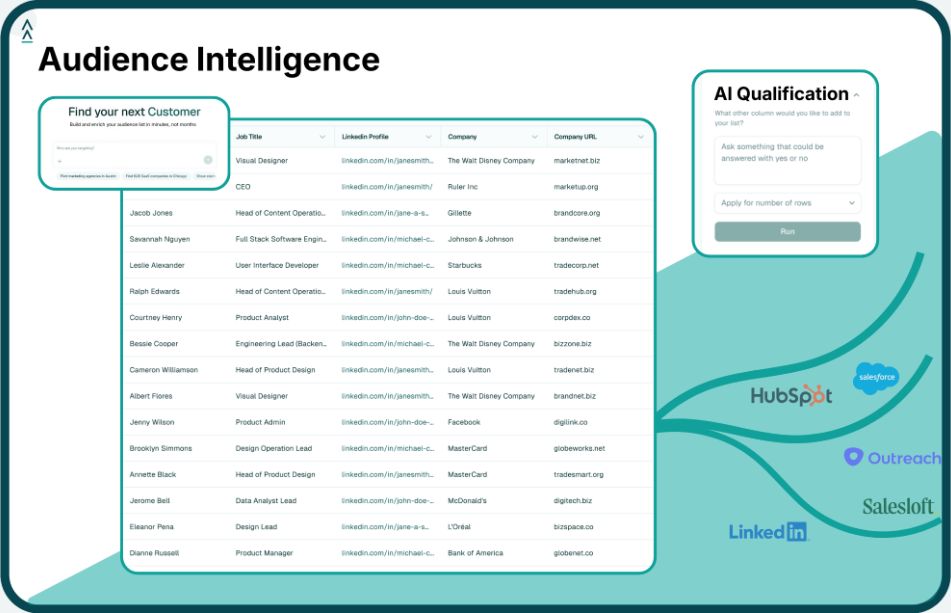
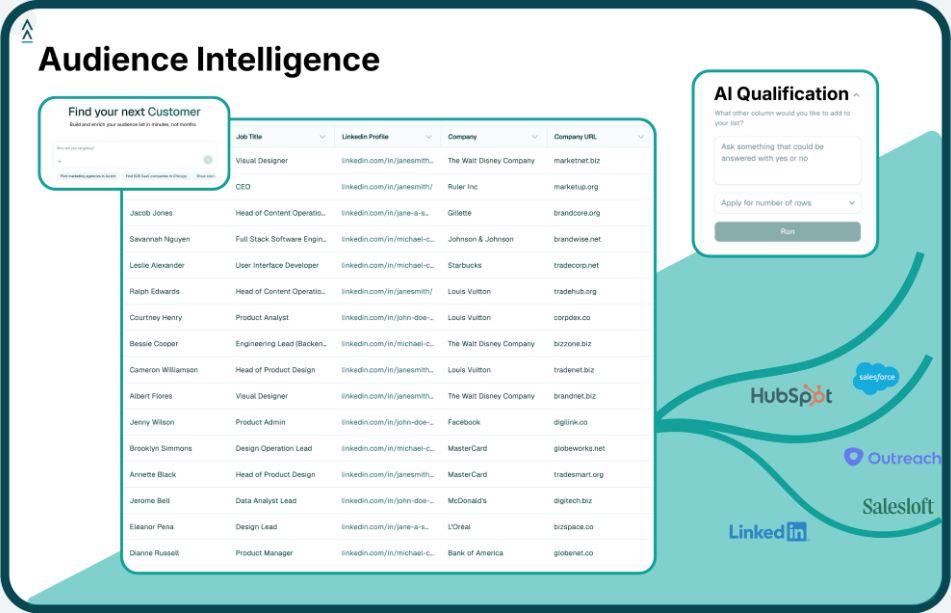
Landbase is the world's first agentic AI platform for go-to-market, and it represents a fundamentally different approach to multi-channel outbound. While traditional multi-channel outbound software requires reps to manually build sequences, select channels, write messages, and monitor engagement, Landbase's AI agents handle the full GTM lifecycle autonomously, from identifying signal-qualified prospects to researching them, selecting the optimal channel for each touchpoint, personalizing messages, and adapting outreach timing in real-time.
The platform runs on a multi-agent architecture with specialized Research, Identity, and Predictive agents that coordinate to execute outbound campaigns. The Research agent gathers intelligence on prospects and accounts. The Identity agent matches and enriches contacts from a database of 300M+ verified contacts with 1,500+ enrichment fields per record, far beyond the basic firmographics (50-300 fields) offered by most data providers. The Predictive agent uses these signals to determine which prospects are most likely to convert, which channel they will respond to, and when to reach them. This is signal-driven outbound sales, not static sequencing.
Powering this orchestration is GTM-2 Omni, Landbase's proprietary AI model trained on 50M+ GTM campaigns. The model continuously learns from multi-channel outreach patterns across email, LinkedIn, phone, and SMS to optimize channel selection and messaging in real-time, so campaigns improve autonomously without manual intervention.
Key capabilities:
Customer outcomes:
Landbase has raised a $30M Series A and earned Gartner Cool Vendor recognition, credibility markers that reflect the platform's position at the forefront of the agentic AI category. Google Cloud reports rising enterprise AI-agent adoption, with 52% of gen-AI organizations having agents in production and 45-46% deploying them in functions like marketing and tech support.
Best for: B2B sales teams that want a single agentic AI platform replacing 3-5 point solutions, handling prospecting, enrichment, qualification, multi-channel outreach, and conversion in one workflow.
Outreach is an enterprise-grade sales engagement platform that automates multi-channel outbound cadences across email, phone, LinkedIn, and SMS. The platform pairs AI-powered sequencing with conversation intelligence and pipeline forecasting, making it a strong fit for large sales organizations that need standardized execution across 50+ reps.
Outreach offers AI agents, conversation intelligence, and coaching/guidance features. The platform also offers advanced analytics with A/B testing, rep performance tracking, and revenue forecasting that feeds directly into CRM pipelines.
Key features:
Best for: Enterprise sales teams (50+ reps) that need standardized outbound execution with AI-powered optimization across all channels.
Pricing: Custom enterprise pricing; contact Outreach for current rates.
G2 Rating: 4.3/5 on G2
Salesloft delivers comprehensive sales engagement with a focus on structured cadence management, AI coaching, and revenue intelligence. The platform supports multi-channel sequencing across email, phone, LinkedIn, and SMS with AI-generated message personalization for each channel.
Where Salesloft differentiates is its real-time conversation intelligence, the platform analyzes calls and meetings to provide coaching insights that help reps improve their multi-channel execution. Revenue forecasting and deal management features give sales leaders visibility into how outbound cadences translate to pipeline.
Key features:
Best for: Mid-market to enterprise teams running structured, multi-touch outbound cadences that need coaching and analytics alongside sequencing.
Pricing: Custom pricing; estimated $125-150/user/month for mid-market, $2,000-2,500/user/year for enterprise tiers based on review data.
G2 Rating: 4.5/5 (4,260+ reviews)
Apollo.io combines a large B2B database with multichannel sales engagement and a lightweight CRM in a single platform. With a 210M+ contact database including verified emails and phone numbers, and multichannel sequencing across email, phone, and LinkedIn, Apollo gives growing teams a way to run multi-channel outbound without enterprise pricing.
The platform includes AI-powered email writing, ICP-fit scoring, intent signal tracking, and a built-in dialer with call recording. Apollo's Chrome extension integrates directly into LinkedIn for prospecting workflows. Apollo includes deal-management and CRM functionality, though plan-level details should be checked on the current pricing page.
Key features:
Best for: Growing B2B teams that need an affordable all-in-one platform combining data, enrichment, and multi-channel outreach without enterprise pricing.
Pricing: Free plan available; paid tiers include Basic, Professional, and Organization plans. See pricing details.
G2 Rating: 4.7/5 on G2
Reply.io supports email plus multichannel add-ons including LinkedIn, calls/SMS, and semi-automated WhatsApp. The platform gives SDR teams fine-grained control over multi-channel sequences with conditional branching, AI-powered email writing, and an AI SDR agent tier (Jason AI) that handles autonomous outreach.
Deliverability tools include unlimited email warm-up via MailToaster integration and an anti-spam dashboard. Reply.io's CRM integrations cover Salesforce, HubSpot, and Pipedrive, with detailed analytics and A/B testing across all channels.
Key features:
Best for: SDR teams that need broad channel coverage in a single sequencing tool, especially teams using WhatsApp or SMS alongside email and LinkedIn.
Pricing: Multichannel plans start around $99/user/month; AI SDR (Jason AI) plans are company-level pricing starting around $500/month. See current pricing.
G2 Rating: 4.6/5 on G2
Lemlist has built its reputation on email deliverability and personalization quality. The platform includes built-in email warm-up with a real-time deliverability dashboard, AI-powered personalization at scale (custom images, dynamic landing pages, liquid syntax), and multichannel sequences spanning email, LinkedIn, WhatsApp, and phone.
With a large AI-powered B2B contact database integrated directly into the prospecting workflow, Lemlist lets teams find contacts and launch multi-channel campaigns without switching tools. The platform is trusted by thousands of businesses worldwide.
Key features:
Best for: Sales teams prioritizing email deliverability and personalization quality, especially agencies and teams sending high volume who cannot afford inbox placement issues.
Pricing: Email Pro: from $63/user/month; Multichannel Expert: from $87/user/month (annual billing); Enterprise: custom. See pricing details.
G2 Rating: 4.6/5 (1,300+ reviews)
Instantly is built for high-volume email outreach with unlimited sending accounts and one of the largest warm-up networks in the industry. The platform focuses on deliverability, automated warm-up, sender rotation, and inbox placement monitoring, and pairs it with a B2B lead database and AI-powered email writing.
While Instantly excels at email scale, its multi-channel capabilities are still emerging. Phone, LinkedIn, and SMS automation require add-ons or third-party integrations rather than native workflows. For teams whose primary channel is email with multichannel as a secondary consideration, Instantly delivers strong value at a competitive price.
Key features:
Best for: Teams focused primarily on high-volume cold email outreach that need unlimited mailboxes and strong deliverability at an accessible price point.
Pricing: Tiered plans available (Growth, Hypergrowth, Light Speed) with scaling contact and email limits. See current pricing.
G2 Rating: 4.8/5 on G2
Amplemarket positions itself as an AI Sales Copilot that combines lead search, multichannel outreach, AI personalization, and competitive intelligence in a single workspace. The platform offers native automation across 7 channels, email, phone, LinkedIn, SMS, WhatsApp, iMessage, and AI voice, giving it one of the broadest channel counts of any tool on this list.
Real-time buying intent signals and competitive intelligence complement the multichannel execution layer, and the AI personalization engine generates channel-specific messages. CRM integrations cover Salesforce and HubSpot.
Key features:
Best for: Mid-market teams ($2K-5K/month budget) that want broad native channel coverage with AI personalization, without stitching together multiple tools.
Pricing: Contact Amplemarket for current pricing; the pricing page is demo-gated. Amplemarket's pricing blog provides additional detail on plan structure.
G2 Rating: 4.6/5 (570+ reviews)
Klenty offers multichannel sales engagement, email, LinkedIn, SMS, and calling via its Dial IQ feature, at a price point accessible to small and midsize B2B teams. The platform includes AI-powered email writing, intent-based prospect prioritization, and automated follow-up sequences with branching logic.
Klenty's CRM integrations span Salesforce, HubSpot, Pipedrive, Zoho, and Microsoft Dynamics, making it one of the more flexible tools for teams with existing tech stacks. Conversation intelligence via Dial IQ adds call analytics and coaching to the multichannel workflow.
Key features:
Best for: Small-to-midsize SDR teams looking for affordable multichannel sales engagement with strong CRM integrations and calling built in.
Pricing: Growth: ~$70/user/month (annual); Plus: ~$99/user/month (annual) with AI credits and calling minutes. Free trial available. pricing details.
G2 Rating: 4.6/5 (380+ reviews)
La Growth Machine is built for teams that lead with LinkedIn prospecting and layer email and social channels on top. The platform automates LinkedIn actions, profile visits, connection requests, messages, and InMails, and combines them with email and Twitter outreach in visual, conditional sequences.
Multi-identity management enables team-based outreach from multiple LinkedIn profiles, and lead enrichment discovers contact data to fuel email follow-ups. The visual sequence builder with conditional branching makes it straightforward to design LinkedIn-first outreach flows.
Key features:
Best for: Teams that lead with LinkedIn outreach and want to layer email and social channels on top, especially European B2B teams and agencies.
Pricing: Pro plan: ~EUR 120/user/month (annual); includes 400 enriched leads/month. G2 data.
G2 Rating: 4.6/5 (56+ reviews)
The right b2b multi-channel outbound platform for your team depends on four variables: team size, which channels drive your pipeline today, your budget relative to total cost of ownership, and how much manual control you want over outbound execution.
Consider your total cost of ownership as well. Stacking a separate data provider, enrichment tool, sequence tool, dialer, and LinkedIn automation tool can add up quickly. According to MarketBetter, a 5-person SDR team can spend anywhere from roughly $9,600 to over $150K per year on tools depending on stack complexity, often more than a unified platform that handles all five functions.
The multichannel outbound 2026 landscape is split between two approaches: sequence tools that automate human-designed cadences and agentic AI platforms that autonomously orchestrate the full outbound workflow.
Outreach and Salesloft remain strong for enterprise teams running structured cadences. Apollo.io offers the best value for growing teams that need data and sequencing in one place. Reply.io covers broad channel options in a single tool. Lemlist leads on deliverability. Each tool has a clear use case.
For teams ready for the next generation of multi-channel outbound, Landbase stands apart. Its agentic AI architecture, specialized Research, Identity, and Predictive agents working across 300M+ contacts with 1,500+ enrichment fields, replaces the manual work of designing sequences, selecting channels, and personalizing messages. The results speak for themselves: P2 Telecom adding $400K in MRR, Oyster reaching 40%+ conversion rates, and QA Wolf improving lead quality by 50%. Backed by a $30M Series A and Gartner Cool Vendor recognition, Landbase is not just a multi-channel outbound tool, it is a complete agentic AI GTM platform.
Multi-channel outbound sales is a prospecting strategy that coordinates outreach across two or more channels, typically email, LinkedIn, phone, SMS, and sometimes WhatsApp or direct mail. The goal is to reach prospects through their preferred communication channels rather than relying on a single touchpoint. Research shows that multi-channel campaigns achieve significantly higher conversion rates versus single-channel approaches.
Many teams test 2-5 coordinated channels, and some vendor benchmarks show 3+ channels outperform single-channel outreach. At minimum, combining email and LinkedIn with phone or SMS gives teams coverage across the channels where B2B buyers are most active. The key is coordination: running disconnected campaigns across channels is less effective than sequenced, data-informed outreach.
Multichannel outbound uses multiple channels (email, phone, LinkedIn) as separate touchpoints in a sequence. Omnichannel outbound coordinates those channels into a unified experience where engagement on one channel informs the next touchpoint, for example, a LinkedIn profile visit triggering a personalized email referencing shared connections. Agentic AI platforms are blurring this line by using real-time engagement signals to dynamically select the next best channel and message.
Traditional multi-channel tools execute human-designed sequences, a rep decides the channel order, timing, and messaging. Agentic AI platforms use autonomous AI agents to handle channel selection, message personalization, and timing based on real-time prospect signals. The AI continuously adapts outreach based on engagement patterns rather than following a static cadence. This reduces manual rep effort while improving relevance and conversion rates.
Yes, though the approach matters. McKinsey reports that B2B companies using several advanced commercial tactics, including omnichannel approaches, are more likely to gain market share. For small teams, the key is avoiding the complexity and cost of stacking multiple point solutions. All-in-one platforms that combine data, enrichment, and multichannel sequencing in a single workflow, rather than requiring three to five separate tools, deliver the highest ROI for lean teams.
Evaluate tools on six criteria: channel breadth (does it cover your primary outreach channels natively?), data quality (how accurate is the contact database?), enrichment depth (firmographics only vs. intent signals and technographics), AI capabilities (static sequences vs. adaptive orchestration), deliverability infrastructure (warm-up, rotation, spam monitoring), and total cost of ownership (per-seat pricing vs. flat-fee vs. usage-based models). In 2026, also assess whether the tool adapts outreach based on real-time engagement signals or relies entirely on pre-set rules.
Based on vendor benchmark data from Outreaches: cold email averages around 3.8% reply rates, LinkedIn outreach achieves roughly 11% reply rates after connection acceptance, LinkedIn InMail delivers 10-25% response rates according to SaleSso, cold calling converts at roughly 2.5% to meetings on average per Optif.ai (top performers reach 5-8%), and WhatsApp sees high open rates but lower cold reply rates. When combined in a coordinated multichannel sequence, these channels achieve significantly higher engagement than any single channel alone. Note that these figures come primarily from vendor and vendor-adjacent sources rather than independent third-party research.
Research consistently shows that the majority of deals require five or more touches, and most replies come from follow-up messages rather than the first outreach. A common starting framework for a multi-channel sequence is 8-12 touchpoints spread across 3-4 channels over 14-21 days, though the optimal cadence varies significantly by deal size and buyer seniority. Enterprise outbound to C-suite may require 15-20 touches across 30-45 days, while mid-market outreach to directors often converts within 8-10 touches.
The cost varies significantly by complexity. According to MarketBetter, a basic stack runs roughly $160-$260/month per SDR, a mid-range 3-4 tool stack (adding LinkedIn automation and a dialer) costs roughly $590-$1,115/month per SDR, and enterprise stacks with 5-6 tools reach roughly $1,930-$3,800/month per SDR. Consolidated all-in-one platforms can significantly reduce these costs while eliminating context-switching and data sync issues between tools.
Tool and strategies modern teams need to help their companies grow.