.png)
.png)

Daniel Saks
Chief Executive Officer


Searching for the best ICP targeting tools? You are not alone. Your team has spent weeks building a detailed ideal customer profile — firmographics, technographics, buying signals, budget thresholds — and documented it all in a spreadsheet or slide deck. Then what? Most B2B teams hit the same wall: they have an ICP definition but no systematic way to find, score, and engage the accounts that actually match it.
The best ICP targeting tools in 2026 do more than store contact data. They combine enrichment depth, intent signals, predictive scoring, and in some cases automated outreach to turn your ideal customer profile into a working pipeline engine. The lead intelligence market is projected to grow from $10.71 billion in 2025 to $17.85 billion by 2031, driven largely by B2B icp targeting platforms that close this operationalization gap.
We evaluated nine ideal customer profile tools across data depth, signal coverage, automation capabilities, ease of setup, and real-world user feedback to help you find the right ICP targeting software for your team.
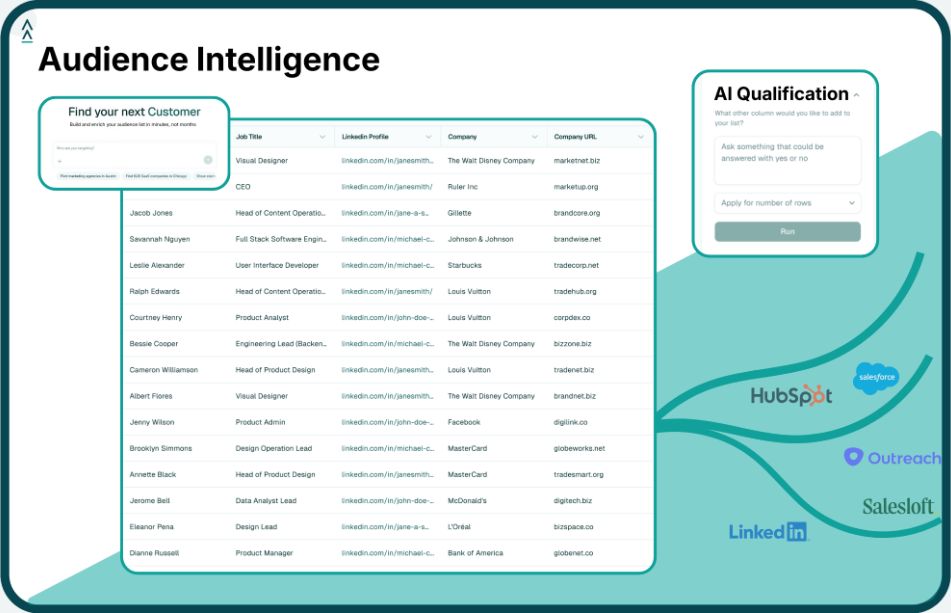
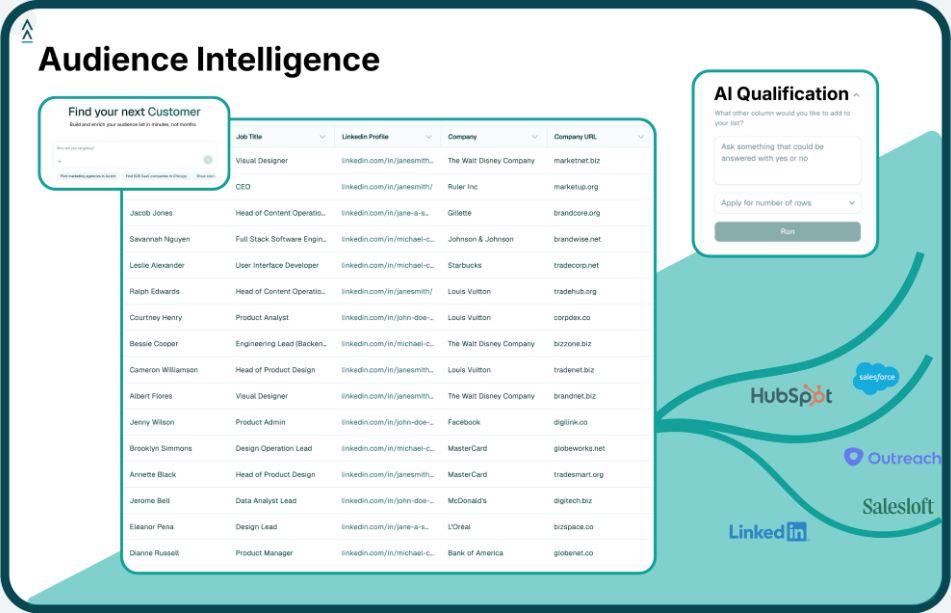
Landbase is an agentic AI platform for go-to-market that handles the full ICP targeting lifecycle — from profile discovery through signal-qualified scoring and outreach execution — without requiring manual workflow assembly. Where most ICP targeting software separates data enrichment, signal detection, and outreach into distinct tools, Landbase's AI agents unify these steps into a single autonomous workflow.
The platform's three core AI agents — Research, Identity, and Predictive — work together to discover accounts matching your ICP criteria, enrich them across 1,500+ data fields, score them against real-time buying signals, and launch personalized outreach campaigns. This is a fundamentally different approach from legacy databases that hand you a list and leave the rest to your team. Landbase's proprietary GTM-2 Omni model, trained on over 50 million successful GTM campaigns, powers the signal qualification layer that determines not just which accounts match your ICP but which ones are actively in a buying cycle right now.
What makes Landbase particularly effective for ICP targeting is the enrichment depth. With 1,500+ data fields per contact — compared to roughly 50-100 basic firmographic fields from legacy providers — the platform scores ICP fit across firmographic, technographic, intent, and behavioral dimensions simultaneously. The platform includes extensive segmentation and ICP-fit filters that let teams define precise audience criteria using natural language, then lets the AI agents do the actual finding and qualifying.
Key features:
Customer outcomes:
Landbase is recognized as a Gartner Cool Vendor and has raised a $30M Series A co-led by Sound Ventures and Picus Capital, with participation from 8VC, A*, and Firstminute Capital.
Best for: B2B teams that want to go from ICP definition to qualified pipeline in a single platform — without stitching together separate data, enrichment, scoring, and outreach tools.
6sense is an enterprise account-based marketing platform that uses its proprietary 6AI predictive engine to identify which accounts match your ICP and when they are actively in a buying cycle. 6sense says Signalverse ingests one trillion buyer signals per day from multiple sources — including Bombora, G2, TrustRadius, PeerSpot, and first-party website data — to assign buying stage predictions ranging from Awareness through Purchase. This is particularly important given that most B2B buyers begin their journey with at least one vendor already in mind, meaning the dark funnel activity before a form fill is where most deals are won or lost.
The platform offers 80+ ICP segmentation filters for defining best-fit accounts, a Persona Map feature that visualizes the buying committee at each target account (critical since B2B purchases involve an average of 13 internal stakeholders), and 6QAs (6sense Qualified Accounts) — the AI-driven equivalent of MQLs that trigger based on account behavior rather than form fills. 6sense is a Gartner Magic Quadrant Leader for ABM five consecutive years, which speaks to its maturity in the enterprise segment. The platform also includes Digital Advertising orchestration and a RevvyAI assistant for natural-language data queries.
Key features:
Best for: Enterprise ABM teams with dedicated RevOps resources that need predictive ICP scoring across multiple signal sources and can accommodate a 60-90 day ramp period before the predictive model calibrates.
Pricing: Annual enterprise contracts. Pricing is custom and quote-based; third-party benchmarks place typical annual spend in the mid-five to low-six figures, depending on scope, with smaller deployments starting around $10,600/year and full-stack enterprise deployments reaching $100,000-$200,000+/year.
ZoomInfo maintains one of the largest B2B data platforms, with millions of company and contact records and 300+ firmographic and technographic attributes, and serves as many teams' primary source for ICP prospecting data. The platform provides company and contact search with ICP-fit filters, an AI-generated ICP feature, CRM enrichment, and data hygiene tools. On G2, the "Contact Information" pro tag appears 421 times and "Data Accuracy" appears 397 times, reflecting user satisfaction with data breadth.
ZoomInfo scores an 8.9 for ease of setup on G2, the fastest onboarding among enterprise platforms in this category. The platform's intent data — ranked number one on G2 for 19 consecutive quarters — is available as an add-on module alongside WebSights visitor tracking, Copilot AI assistant, and Scoops (real-time buying signals). These modules are separate from the core database product rather than natively integrated into a unified ICP scoring workflow.
Key features:
Best for: Sales-led organizations needing the broadest B2B contact database for ICP prospecting with fast onboarding and CRM integration.
Pricing: Annual contracts with a credit-based system. ZoomInfo's pricing is custom and its own current materials say entry starts at $0; enterprise costs vary substantially by seats, data, and add-ons, with real-world costs typically running $30,000-$60,000/year for full-featured deployments. Some contracts reportedly include auto-renewal and annual escalation clauses; third-party benchmarks often cite roughly 5-10%, but terms vary.
Apollo.io combines a 270M+ contact database with a built-in email sequencer, making it one of the most accessible ICP targeting platforms for teams that want data and outreach in a single tool. The platform has earned strong ratings and the largest user base in this category, and is used by over 500,000 companies.
Apollo provides 65+ ICP search filters across its contact database, a Chrome extension for LinkedIn and web prospecting, and topic-level intent signals powered by a Bombora partnership plus proprietary data. New users can typically get productive within an hour, which contrasts sharply with the multi-week onboarding timelines of enterprise platforms. The platform also includes waterfall enrichment across multiple sequential data sources and AI-powered lookalike account discovery that identifies companies resembling your best customers.
Key features:
Best for: Startups and small sales teams that need affordable ICP targeting with built-in outreach capabilities and fast time-to-value.
Pricing: Per-seat subscription with a credit system. Free tier available with limited credits. Paid plans run $49/month (Basic), $79/month (Professional), and $119/month (Organization) per user. Credits do not roll over between billing cycles.
Cognism positions itself as the go-to ICP targeting platform for teams selling into European markets or operating in regulated industries. The platform provides GDPR-compliant B2B contact data with a standout feature called Diamond Data — manually phone-verified mobile numbers that offer higher connection rates than standard database records.
Cognism integrates Bombora intent data to layer buying signals on top of its contact database, and it operates on a broad-access data model subject to fair-usage limits and plan-specific credit rules. This reduces the credit-counting anxiety that affects teams using other credit-based platforms, where exceeding limits triggers overage charges or workflow interruptions, though teams should be aware of monthly contact view and export limits under the fair usage policy.
Key features:
Best for: European-focused sales teams in regulated markets that need compliant ICP data with verified mobile numbers and predictable costs.
Pricing: Annual contracts with custom pricing. No published tiers — requires a sales conversation to get a quote. Includes broad contact data access subject to fair-usage limits.
Clay is a multi-source data enrichment platform that lets teams build custom ICP scoring workflows by chaining together 75+ data providers in a single interface. It has earned a strong G2 rating of 4.7/5, reflecting strong user satisfaction among teams with the technical expertise to build and maintain complex enrichment workflows.
The platform's core value is its waterfall enrichment approach: teams can configure sequential data provider lookups so that when one source misses a data point, the next provider in the chain fills the gap. This produces higher enrichment coverage than any single data provider can deliver alone. Clay also includes AI-powered data transformation and custom ICP scoring formulas built from any combination of data sources.
Key features:
Best for: RevOps teams with GTM engineering capability that need maximum enrichment flexibility and have non-standard ICP criteria that no single tool covers.
Pricing: Per-seat subscription with credit tiers. Current plans include Free, Launch ($167/month), Growth ($446/month), and custom Enterprise pricing.
Clearbit, now rebranded as Breeze Intelligence following its acquisition by HubSpot, provides real-time company and contact enrichment with the deepest native integration into the HubSpot CRM ecosystem. For teams already running their go-to-market operations on HubSpot, Clearbit offers ICP scoring based on firmographic and technographic data without requiring data exports or third-party connectors.
The platform includes website visitor identification, form shortening through progressive enrichment, and ICP scoring that operates directly within HubSpot records. It carries a 4.4/5 rating on G2 with 629 reviews, and its post-acquisition integration means enrichment data flows natively into HubSpot workflows, lists, and reporting.
Key features:
Best for: HubSpot-native teams that want ICP enrichment and scoring without leaving their CRM, especially mid-market companies targeting US-based accounts.
Pricing: Following the HubSpot acquisition, Breeze Intelligence credits are now part of the HubSpot Credits framework. Credit packs start at $45/month for 5,000 credits, with included credits varying by HubSpot subscription tier. Pricing is increasingly tied to the HubSpot ecosystem.
Dealfront was formed from the merger of Leadfeeder and Echobot, combining website visitor identification with a European company database. The platform uses IP-based deanonymization to identify which companies are visiting your website, then lets you filter those visitors against ICP criteria to surface high-fit accounts showing first-party engagement signals.
The platform is GDPR-compliant by design, making it a strong fit for European B2B teams that need visitor intelligence without compliance risk. Dealfront carries a 4.3/5 G2 rating and is strongest for teams whose ICP strategy focuses on capturing demand from companies already engaging with their brand, rather than outbound prospecting into cold accounts.
Key features:
Best for: European B2B teams that want to identify and qualify website visitors against ICP criteria, particularly in markets where GDPR compliance is a requirement.
Pricing: Dealfront pricing varies by product: the website visitor identification product scales based on the number of companies identified per month, while the broader platform offering uses a base price plus add-ons structure with seats and credits depending on use case.
Factors.ai is an account intelligence platform that combines ICP fit scoring, intent signals, and engagement data into unified account segments. The platform sits at the intersection of marketing attribution and sales ICP targeting, helping RevOps teams understand which accounts match their ICP and are showing buying behavior across multiple touchpoints.
The platform includes website visitor identification, multi-touch attribution, and a LinkedIn AdPilot integration that lets teams serve targeted ads to ICP-fit account segments. Factors.ai carries a 4.6/5 G2 rating and appeals to marketing and RevOps teams that want to connect ICP segmentation with campaign performance measurement.
Key features:
Best for: Marketing and RevOps teams that need ICP-based account segmentation tied to multi-touch attribution and LinkedIn ad targeting.
Pricing: Tiered subscription with custom pricing based on account volume.
Time-to-value is one of the most overlooked factors when selecting ICP targeting software. A tool with superior features that takes 90 days to calibrate may cost you a full quarter of pipeline. Here is how each platform stacks up:
The fastest path from ICP definition to qualified pipeline comes from platforms that collapse multiple manual steps into automated workflows. Platforms requiring dedicated RevOps resources — like 6sense and Clay — deliver more sophisticated outputs but demand more time and expertise to reach full value.
Not every team needs a single all-in-one platform. Some organizations layer complementary tools to cover different parts of the ICP targeting workflow. Here are the most effective stacking patterns based on team size and budget:
Startup Stack (Under $500/month):
Apollo.io (data + sequencing) + Factors.ai free tier (visitor identification + attribution). This gives you a contact database with built-in outreach plus website visitor intelligence for inbound ICP qualification.
Mid-Market Stack ($2,000-$5,000/month):
ZoomInfo (data) + Dealfront or Factors.ai (visitor ID) + a sequencing tool. This provides the broadest contact database paired with website visitor ICP qualification, but requires manual workflow assembly between tools.
Enterprise Stack ($50,000+/year):
6sense (predictive scoring + intent) + ZoomInfo (contact data) + an outreach platform. This is the most common enterprise combination, though it introduces significant integration overhead and data silos between platforms.
Single-Platform Alternative:
Landbase replaces the multi-tool stack by handling data enrichment (1,500+ fields), signal qualification, ICP scoring, and outreach execution in one agentic AI platform. For teams that want to avoid tool sprawl — which erodes the value of intent data investments through integration overhead and data fragmentation — the single-platform approach offers a streamlined alternative.
The right ICP targeting software depends on four factors: your team's technical resources, your GTM maturity, whether you need data only or data plus execution, and your implementation timeline.
If you need ICP definition through automated outreach in one platform, Landbase handles the full workflow with agentic AI — no manual assembly or tool stitching required. Best for teams at any stage that want to skip the tool sprawl phase entirely.
If you have dedicated RevOps and an enterprise budget, 6sense offers the most sophisticated predictive ICP scoring with buying committee mapping, though you should plan for a 60-90 day ramp before seeing results.
If you are a startup watching every dollar, Apollo.io gives you a functional ICP targeting and outreach tool at the lowest entry point. Apollo positions its data as highly accurate, but real-world results vary by segment, geography, and workflow.
If your team has GTM engineering expertise, Clay provides maximum enrichment flexibility through its 75+ provider integrations, though it requires ongoing technical maintenance.
If you sell primarily into European markets, Cognism (for contact data with verified mobile numbers) or Dealfront (for website visitor identification) offer the best GDPR-compliant coverage.
If your CRM is HubSpot and you want native enrichment, Clearbit (Breeze Intelligence) integrates without additional infrastructure, though it locks you into the HubSpot ecosystem
If you need ICP segmentation tied to marketing attribution, Factors.ai connects ICP fit scoring with multi-touch attribution and LinkedIn ad targeting.
One of the biggest gaps in B2B go-to-market is the disconnect between defining an ideal customer profile and actually using it to drive pipeline. Defining the ICP is only half the challenge. Most teams invest significant effort building ICP frameworks — documenting firmographic criteria, identifying technographic signals, mapping buying committee structures — and then attempt to operationalize that profile through manual database searches and static list pulls.
This is where ICP targeting tools diverge into two categories:
Data-centric tools (ZoomInfo, Cognism, Clearbit) help you enrich and validate your ICP definition by providing the raw data points you need to score accounts. They answer the question: "Which accounts match our profile?"
Operationalization tools go further, translating that scored list into action — identifying when ICP-fit accounts are showing buying signals, prioritizing them by likelihood to convert, and in some cases executing outreach automatically. They answer the question: "Which matching accounts should we engage right now, and how?"
The teams seeing the strongest results from their ICP investments are the ones using platforms that combine both capabilities — rich data for precise ICP definition and autonomous workflows for ICP activation. Landbase's agentic AI approach represents this full-cycle model, where AI agents handle the discovery, qualification, scoring, and engagement steps that would otherwise require three to four separate point solutions and significant manual effort.
An ICP targeting tool is software that helps B2B teams identify, score, and prioritize accounts that match their ideal customer profile. These tools use combinations of firmographic data (company size, industry, revenue), technographic data (technology stack), intent signals (online research behavior), and behavioral data (website visits, content engagement) to determine which accounts are the best fit for your product and most likely to buy.
Lead generation casts a wide net to capture contact information from anyone showing interest. ICP targeting starts with a defined profile of your best-fit customer and works backward to find accounts that match those criteria. The result is a smaller, higher-quality pool of prospects that convert at significantly higher rates. B2B buyers complete the majority of their research before engaging with sales, making it critical to reach the right accounts early.
The most effective ICP scoring combines four data layers: firmographic (company size, revenue, industry, geography), technographic (current technology stack and recent changes), intent (active research on relevant topics), and behavioral (website visits, content downloads, email engagement). Tools that rely on firmographics alone miss the signal-rich layers that indicate timing and readiness to buy.
Validate your ICP by analyzing your closed-won deals from the past 12-18 months. Look for patterns in company size, industry, technology stack, buying committee structure, and sales cycle length. Tools that use reinforcement learning can continuously refine ICP criteria based on campaign outcomes, adjusting the model as new data comes in rather than relying on a static profile.
Account-level targeting identifies companies that match your ICP but does not resolve individual contacts within those companies. Contact-level targeting goes further by identifying specific people — by role, seniority, and department — within ICP-fit accounts. Platforms like 6sense and Dealfront primarily operate at the account level, while platforms with deep contact databases provide both account-level fit scoring and individual contact resolution.
Time-to-value varies significantly. Self-serve platforms like Apollo.io can be productive within hours. Enterprise platforms like 6sense require 60-90 days for predictive models to calibrate. The fastest path to ICP-qualified pipeline typically comes from platforms that combine data access with automated workflows, reducing the manual steps between defining your ICP and reaching matching accounts.
Startups benefit from tools that combine data access with built-in outreach at an affordable price point, since they typically lack dedicated RevOps resources. Enterprise teams can leverage more sophisticated predictive models and multi-source signal correlation, but need the budget and personnel to support longer implementation timelines. Teams of all sizes benefit from reducing tool sprawl — stacking three to four point solutions creates integration overhead and data silos that erode the value of ICP targeting.
ICP scoring assigns a numerical value to each account or contact based on how closely they match your ideal customer profile. The score typically combines four data layers: firmographic fit (company size, industry, revenue), technographic fit (technology stack alignment), intent signals (active research behavior), and behavioral engagement (website visits, content downloads). Basic tools score on one or two dimensions, while advanced platforms combine all four into a composite fit score that updates dynamically as new signals emerge.
AI enhances ICP targeting in three ways. First, predictive models analyze your closed-won deals to identify ICP patterns humans miss — such as technographic combinations or hiring signals that correlate with conversion. Second, AI-powered enrichment chains multiple data sources to fill gaps that any single provider misses. Third, agentic AI systems automate the full workflow from ICP discovery through outreach execution, eliminating the manual steps between identifying a target account and reaching the right contact within it.
The dark funnel refers to all the buying research and evaluation that happens before a prospect fills out a form or contacts your sales team. Since most B2B buyers begin their journey with at least one vendor already in mind, most of the ICP targeting opportunity exists in this invisible pre-engagement phase. Tools with strong intent signal coverage — like 6sense's Signalverse or Landbase's signal qualification layer — detect accounts that are actively researching your category even when they have not visited your website or engaged with your content directly.
Yes, and many enterprise teams do. The most common stacking patterns combine a data platform (for contact records) with an intent platform (for buying signals) and an outreach tool (for execution). However, tool stacking introduces integration overhead, data silos, and reconciliation challenges. Organizations with aligned sales and marketing achieve significantly faster revenue growth, and much of that alignment advantage comes from unified data rather than fragmented tool stacks. Evaluate whether a single-platform approach might deliver better results than stitching three to four point solutions together.
ICP targeting is the foundation of effective account-based marketing. ABM without a precise ICP is just expensive broad targeting. When ICP criteria are well-defined and operationalized, ABM campaigns deliver significantly higher ROI because every touchpoint — ads, emails, content, events — is directed at accounts with the highest fit and buying propensity. The combination of ICP fit scoring with intent signals and engagement data creates a triple-filter that ensures your ABM budget concentrates on accounts that are both a good fit and actively in-market.
Tool and strategies modern teams need to help their companies grow.