.png)
.png)

Daniel Saks
Chief Executive Officer


Recent 2025–2026 benchmark roundups commonly place average cold email reply rates around ~3–4% (often cited near 3.4%), though definitions and datasets vary across sources. If you are still sending the same template to every prospect on your list, your numbers are heading in one direction: down.
The reason is straightforward. A 2026 outreach-statistics compilation by Sopro reports that over 80% of B2B buyers say they engage with outreach that is tailored to their company and context, yet 57% believe most sales outreach feels impersonal and irrelevant. That gap between what buyers expect and what sellers deliver is where the best tools for cold email personalization make a measurable difference.
But "personalization" in 2026 goes far beyond dropping a first name into a subject line. The tools that deliver results now use real-time buying signals, AI-driven prospect research, and multi-source enrichment to craft messages that reference specific triggers — a funding round, a new hire in a key role, a technology change in the stack. Some industry benchmark roundups claim that signal-based emails generate 3–5x better reply rates than firmographic-only targeting, and that personalization beyond the first name can significantly lift reply rates — though uplift varies by list quality, offer, and deliverability setup.
We evaluated the 9 best tools for cold email personalization across AI capabilities, enrichment depth, deliverability infrastructure, and signal-driven targeting to help you find the right fit for your team and budget.
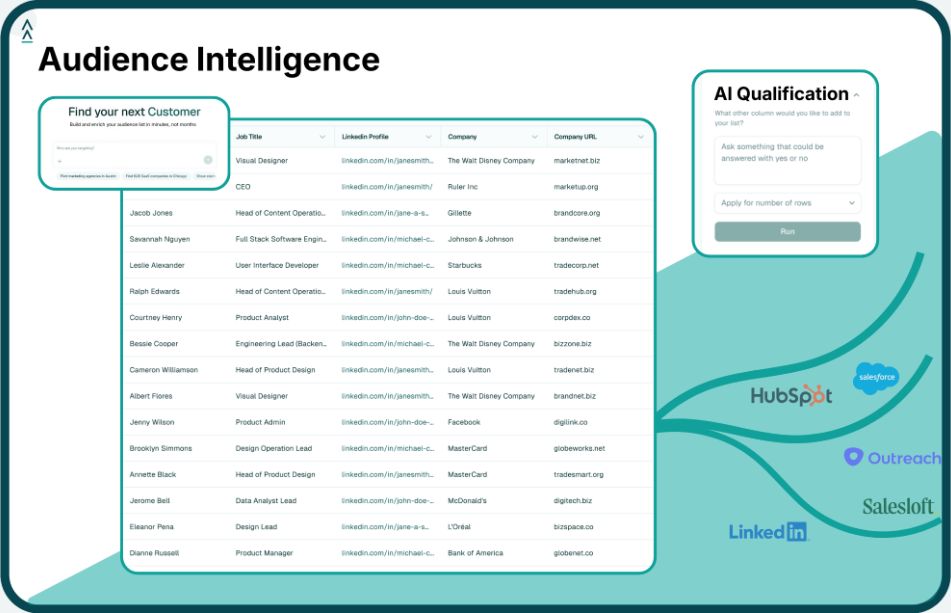
Landbase is not another email sequencing tool that bolts on a "personalization" feature. It is a full agentic AI GTM platform built from the ground up around signal-driven targeting — the practice of reaching the right person at the right moment based on real-time buying signals, not static contact lists.
Where most cold email personalization software treats personalization as a copy problem (swap in a first name, reference a LinkedIn post), Landbase treats it as a data and intelligence problem. The platform's autonomous AI agents — Research, Identity, and Predictive — continuously scan signals like funding rounds, leadership changes, technology stack shifts, and hiring patterns to identify which prospects are most likely to engage right now.
That signal layer feeds directly into outreach execution, meaning every email your team sends is grounded in specific, timely context about the recipient's company and buying situation.
The results are notable. Landbase reports that some customers have seen 4–7x conversion lifts compared to traditional email prospecting tools, though individual outcomes vary. P2 Telecom added $400K in MRR during a slow period and had to pause campaigns because their account executives could not keep up with the pipeline. Oyster achieved 40%+ conversion rates with signal-qualified outreach. And TitanX saw connect rates jump from 5–8% to 15%, with one rep booking 9 meetings in a single day.
On November 6, 2025, Landbase announced it was recognized in Gartner's 2025 Cool Vendors in AI for Marketing. The company has raised $42.5M in total funding, including a $30M Series A co-led by Sound Ventures and Picus Capital.
Best for: B2B teams that want signal-driven personalization and end-to-end GTM automation in a single platform — no stitching together enrichment, sequencing, and sending tools. Try Landbase Free to explore signal-driven outbound in minutes
Instantly.ai has become a go-to platform for teams that need to send high volumes of personalized cold email without per-seat pricing. G2's product listing states Instantly is used by more than 35,000 customers, ranging from solo founders to global agencies — though this figure reflects vendor-supplied copy on the listing.
Instantly's AI Copilot generates context-aware email copy, and its Spintax Writer creates variations across sequences to keep messages from triggering spam filters. The platform pairs these with SuperSearch, a large B2B contact database (vendor-claimed at 450M+ records), and a built-in warm-up network that conditions new sending accounts.
Pricing: Growth plan starts at $47/mo (1,000 contacts, 5,000 emails/mo). Hypergrowth runs $97/mo (25,000 contacts, 100K emails/mo). Light Speed at $358/mo for 500K emails/mo. Annual billing saves ~20%. Pricing as of April 2026.
Best for: Instantly.ai is ideal for agencies and high-volume senders who prioritize sending infrastructure and unlimited mailbox connections over deep prospect research.
Apollo.io combines one of the largest B2B contact databases (vendor-claimed at 2B+ records) with a built-in email sequencing engine. Apollo announced it was recognized in G2's 2026 Best Software Awards for Sales Software and AI Software categories, and it has over 9,000 G2 reviews — the most of any tool in the Sales Intelligence category (as of April 2026).
Apollo recently acquired Pocus to add revenue intelligence and buying signal capabilities, and it launched an AI Assistant aimed at building an agentic GTM operating system. The platform also added waterfall enrichment for job-change email coverage and expanded direct dial coverage across APAC, LATAM, and EMEA.
Pricing: Free plan available with limited credits. Paid plans start at $49/user/mo (Basic) and scale to $119/user/mo (Organization). Per-seat pricing increases costs for larger teams.
Best for: Teams that need broad data coverage alongside built-in sequences, making Apollo.io one of the best tools for cold email personalization for those evaluating at no initial cost via the free tier.
Clay is not an email sender — it is a data enrichment and research platform that has become the de facto enrichment layer for many cold email stacks. Clay aggregates data from 75+ providers using a waterfall approach that, per vendor claims, delivers higher match rates compared to single-provider tools. (Independent, methodology-defined benchmarks are not publicly available for this specific claim.)
The platform's AI-powered research agents can pull deep prospect intelligence from multiple sources, and its spreadsheet-like interface lets teams build custom enrichment workflows with formulas and conditional logic. The trade-off is that Clay requires pairing with a separate sending tool (Instantly, Lemlist, Smartlead, etc.), and credit consumption can be unpredictable at 5–15 credits per lead.
Pricing: Starts at $134/mo (annual, Starter) with 24,000 credits/year. Pro plans run $720/mo for heavy usage. A single lead can cost $0.15–$1.12 in credits before any email is sent. Pricing as of April 2026.
Best for: Data-obsessed teams who want the deepest enrichment data and are willing to invest time in building custom workflows with a separate sending platform.
Lemlist pioneered visual personalization in cold email — dynamically inserting prospect data into custom images and GIFs within email bodies. In 2026, the platform expanded into AI-powered voice messaging by integrating ElevenLabs to generate personalized voice notes (including voice cloning functionality per ElevenLabs' own descriptions), letting users send personalized audio messages at scale.
The platform now covers four outreach channels (email, LinkedIn, WhatsApp, and cold calling) and has expanded its contact database to 600M+ records (vendor-claimed). Lemlist's Liquid Syntax feature enables conditional content logic within emails, and its agentic AI enrichment aggregates data from 10+ providers.
Pricing: Email Starter at $59/mo (increased from $39 in 2026). Multichannel Expert at $99/user/mo. A 5-person SDR team on Multichannel Expert runs $495/mo. Pricing as of April 2026.
Best for: Creative teams who want to stand out with visual and audio elements across multiple channels.
Smartlead focuses on deliverability infrastructure for high-volume senders. The platform offers unlimited mailbox connections on all plans with flat pricing — no per-user fees — making it a common choice for agencies managing multiple client campaigns.
Smartlead's deliverability stack includes SmartDelivery (pre-send inbox placement testing), SmartSenders (done-for-you domains and mailboxes), and SmartServers (dedicated sending infrastructure). The platform also offers white-label client portals for agencies and a unified master inbox (Unibox) for managing replies across accounts.
Pricing: Basic at $39/mo ($32.50 annual) with 2,000 active leads. Pro at $94/mo with 30,000 active leads. Flat pricing with unlimited seats. No native contact database — requires an external data source. Pricing as of April 2026.
Best for: Agencies who need unlimited mailboxes, flat pricing, and strong deliverability infrastructure across multiple client campaigns.
Saleshandy positions itself as the most affordable entry point into cold email automation at $25/mo, with unlimited email accounts on every plan. The platform's AI Sequence CoPilot automates entire outreach sequence creation, including subject lines, body copy, and follow-ups.
Customer support is consistently praised in G2 reviews, with 117 mentions highlighting responsive assistance. However, the advertised $25/mo starting price typically requires scaling to $150–250/mo across modules for effective outreach at volume.
Pricing: Outreach Starter at $25/mo (2,000 prospects, 10K emails/mo). Outreach Pro at $74/mo (30K prospects). Outreach Scale at $149/mo (60K prospects). Pricing as of April 2026.
Best for: Budget-conscious teams who want email-only outreach with unlimited sending accounts and no per-seat costs.
PlusVibe, which rebranded from Pipl.ai in 2024, is a rising challenger that packs enrichment, sending, and warm-up into a single all-in-one platform. Its hyper-personalization engine pulls data from 35+ sources to generate dynamic icebreakers based on LinkedIn activity, company news, and technology stack changes.
The platform claims a 99.8% inbox placement rate and offers a free tier for testing, making it accessible for founders and small teams evaluating personalized cold email tools for the first time.
Pricing: Free plan available. Starter at $37/mo, Pro at $77/mo, Business at $99/mo. Pricing as of April 2026.
Best for: Small teams and solo founders looking for a single affordable package with enrichment and sending built in.
Woodpecker is a straightforward, SMB-focused cold email tool built around deliverability. Its adaptive sending algorithm adjusts email delivery patterns based on engagement signals, and Woodpecker states that some top customers achieve up to 99% deliverability — though this reflects top-performing accounts rather than a general guarantee.
Woodpecker does what it does well — simple email sequences with strong inbox placement — but it has not kept pace with the AI personalization features that define the category in 2026. There is no native contact database, limited AI writing assistance, and no signal-based targeting.
Pricing: Starter at $24/mo (annual) with 500 prospects. Growth at $29/mo. Scale plans available up to $6,666/mo for high volume. Add-ons increase total cost. Pricing as of April 2026.
Best for: Individual senders and SMBs who prioritize inbox deliverability over advanced AI capabilities.
When evaluating the best tools for cold email personalization, the performance gap is hard to ignore. In some benchmark compilations, generic cold emails average less than 1% response rates, while highly targeted, well-personalized campaigns can reach significantly higher — though results vary widely by ICP, offer, and dataset definition. What is consistent across sources is that the gap between a well-crafted, signal-driven email and a generic template is real.
The difference comes down to what kind of personalization you use. Inserting a first name and company name into a template is table stakes — spam filters and buyers have learned to recognize merge-field personalization instantly. Emails that reference specific buying signals (a recent funding round, a leadership change, a technology stack shift) reach prospects during active buying windows, which is why signal-based approaches consistently outperform firmographic-only targeting in practice.
There is also a deliverability dimension worth understanding. Inbox providers consider authentication, spam complaint rates, and sender reputation, and that reputation is influenced by user interaction signals and complaint behavior. A sending address that delivers 50 emails with a 10% reply rate will maintain better inbox placement than one sending 500 emails at 1%. The best personalized cold email tools in 2026 help you send fewer, better-targeted emails — which is both better for results and better for deliverability health.
Start with what limits your results today:
The biggest trend shaping the best tools for cold email personalization in 2026 is clear: signal-based outreach consistently outperforms generic volume sends. The tools that help you send fewer, more relevant emails to higher-intent prospects consistently outperform those that optimize for sending more.
The cold email software market is projected to reach USD ~$8.5 billion by 2033 at a CAGR of ~13.5%, and the best tools for cold email personalization are splitting into two camps: those that help you send more emails and those that help you send the right emails.
Volume-first platforms like Instantly.ai and Smartlead still serve agencies and high-volume senders well. Enterprise incumbents like Outreach and Salesloft remain embedded in large sales organizations. Enrichment specialists like Clay deliver unmatched data depth for teams willing to assemble their own stack.
But the defining shift in 2026 is from spray-and-pray to signal-driven. Inbox providers consider authentication, spam complaint rates, and sender reputation, which means high-volume, low-engagement sends damage deliverability actively. The teams hitting the highest reply rates are sending to smaller, higher-intent lists — not bigger ones.
Landbase was purpose-built for this shift. Its agentic AI platform combines a 300M+ contact database, 1,500+ enrichment fields, real-time buying signals, and autonomous campaign execution in a single platform — replacing the patchwork of enrichment, sequencing, and sending tools that most teams cobble together today. With Gartner Cool Vendor recognition, $42.5M in funding co-led by Sound Ventures and Picus Capital, and reported conversion improvements for customers, it is the strongest option for teams ready to move beyond template-based personalization. Book a Demo to see Landbase’s signal-driven targeting and personalization in action.
Cold email personalization is the practice of tailoring outreach messages to each recipient based on data about their role, company, behavior, and timing. The best tools for cold email personalization automate this process using AI and real-time signals. In 2026, it matters more than ever because average reply rates hover around the 3–4% range and inbox providers actively factor in engagement signals and complaint rates when evaluating sender reputation. Signal-based targeting consistently outperforms firmographic-only approaches in benchmark roundups, though exact uplift depends heavily on list quality, offer, and deliverability setup.
Template-based personalization swaps in merge fields like first name, company name, or job title into a pre-written template. Signal-driven personalization uses real-time buying signals — such as a recent funding round, a new executive hire, a technology stack change, or a competitor displacement — to determine both who to contact and what to say. The distinction matters because signal-driven approaches reach prospects during active buying windows, while templates treat every contact on a list as equally likely to respond.
It depends on the platform you choose. Some tools like Clay specialize in enrichment but require a separate sending platform. Others like Instantly.ai and Smartlead focus on sending infrastructure but need external data sources. All-in-one platforms like Landbase and PlusVibe combine data, enrichment, personalization, and sending in a single product. The trade-off is typically between depth of any single capability versus the convenience and cost savings of a unified platform.
Recent benchmark roundups commonly place average cold email reply rates around 3–4%. Top-performing accounts can exceed that meaningfully — especially with signal-based targeting and strong deliverability setups — though published "elite" ranges vary by source and methodology. Your results depend on targeting quality, message relevance, deliverability setup, and follow-up cadence. Research consistently shows that multi-touch follow-up campaigns outperform single-send campaigns significantly.
Most deliverability experts recommend staying under 50–100 cold emails per day per sending address. Exceeding that threshold risks triggering spam filters and damaging sender reputation. The key metric is not volume per mailbox — it is engagement rate. A domain sending 50 emails with a 10% reply rate will maintain better deliverability than one sending 500 emails with a 1% reply rate. Tools with sender rotation across multiple mailboxes help distribute volume without concentrating risk.
Tool and strategies modern teams need to help their companies grow.