.png)
.png)

Daniel Saks
Chief Executive Officer


The average B2B buying committee now includes five to eleven stakeholders, each with different priorities and pain points. Sending the same message to all of them is how campaigns end up ignored. McKinsey research shows that personalization often drives a 10–15% revenue lift (with a 5–25% range depending on the industry and approach) compared to those relying on basic demographics alone. Yet 33% of B2B marketers cite measuring content effectiveness as a top challenge — a strong signal that connecting segmentation efforts to real outcomes is still a work in progress.
The audience analytics market is projected to reach $5.71 billion in 2026, growing at an 11.18% CAGR as teams shift from static list-building toward real-time, signal-driven segmentation. That growth is fueled by a clear reality: generic outreach no longer converts. Whether you run B2B outbound campaigns, manage product-led growth funnels, or orchestrate multi-channel e-commerce marketing, the best tools for audience segmentation help you identify who to reach, when to reach them, and what message will land.
We evaluated nine audience segmentation software platforms across data depth, AI capabilities, activation features, and ease of use. This guide to the best tools for audience segmentation breaks down what each platform does well so you can pick the right fit for your team, budget, and go-to-market strategy.
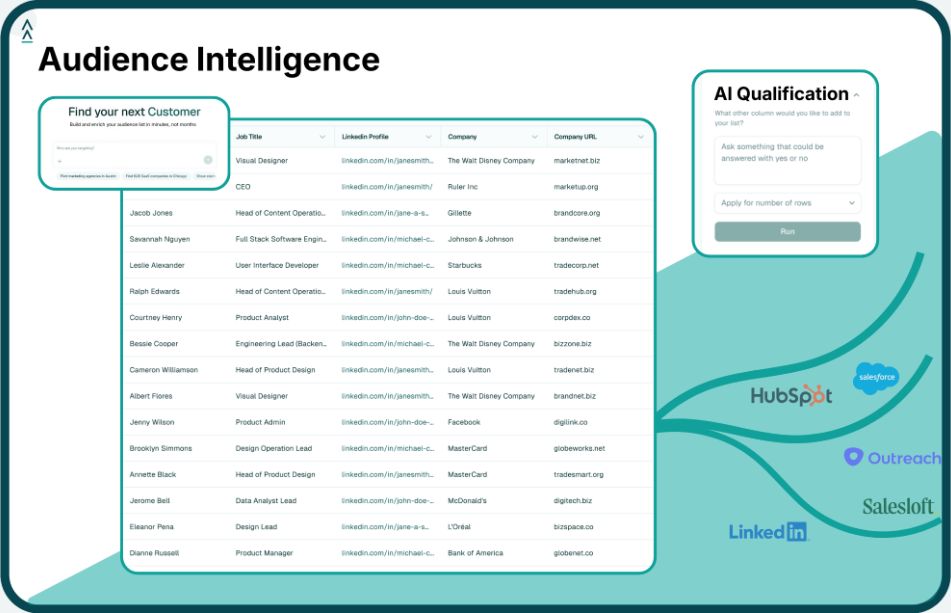
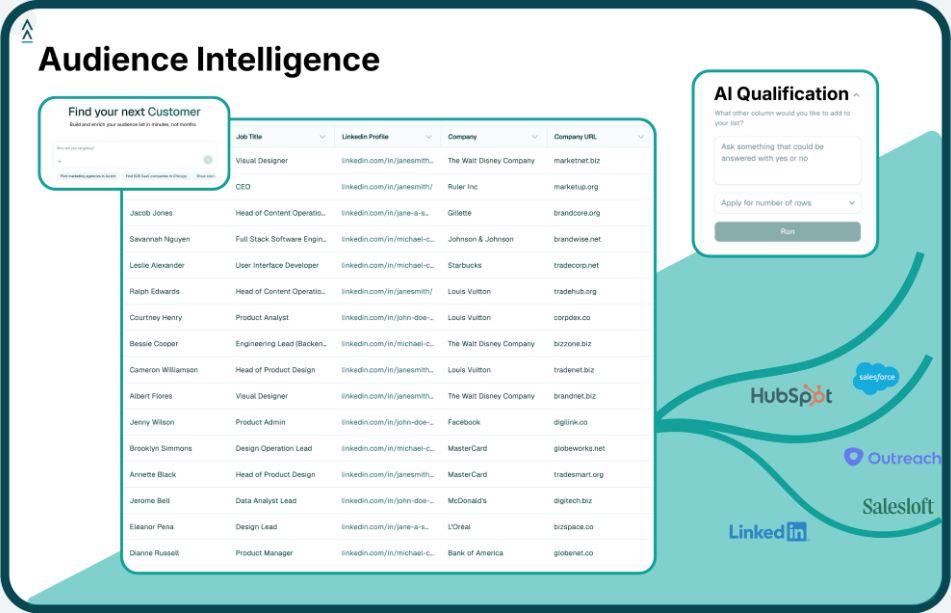
Landbase takes a fundamentally different approach to audience segmentation. Instead of requiring teams to manually build segments through filters and Boolean logic, Landbase's agentic AI platform lets you describe your ideal audience in plain English, and the system builds, qualifies, and activates the segment autonomously. Among the best tools for audience segmentation, Landbase stands out as the strongest option for B2B go-to-market teams that need precision targeting without the manual overhead that slows down traditional audience segmentation software.
The platform is built on GTM-2 Omni, Landbase's proprietary AI action model purpose-built for go-to-market workflows. Rather than relying on static firmographic filters alone, Landbase deploys specialized AI agents — Research, Identity, and Predictive — that work together to identify audience segments based on real-time buying signals, technographic data, hiring patterns, funding events, and behavioral indicators. This signal-driven approach means your segments stay current as market conditions shift, rather than decaying within weeks like traditional static lists.
What sets Landbase apart from other audience segmentation platforms is the end-to-end workflow. Most tools stop at segment creation — you build the list, then export it to another platform for outreach. Landbase handles the full pipeline from audience intelligence through multi-channel campaign execution, eliminating the tool fragmentation that B2B teams consistently cite as their biggest pain point.
Best for: B2B sales and marketing teams that want to segment audiences using real-time signals and natural language, then activate those segments across channels — all from one platform. Try Landbase Free to build your next high-fit audience in minutes.
HubSpot Marketing Hub is one of the most widely adopted audience segmentation platforms, particularly among small and mid-market companies that want segmentation tied directly to their CRM. The platform builds segments through smart lists that auto-update based on contact properties, behavioral triggers, lifecycle stage, and engagement history. With more than 14,000 reviews on G2 and a 4.4 rating, it remains a go-to for teams starting their segmentation journey.
The platform's strength is its unified data model. Because HubSpot combines CRM, marketing, sales, and service data in one place, segments can draw from the full customer lifecycle — not just marketing interactions. AI-driven predictive lead scoring layers on top, helping teams prioritize which segments to target first. HubSpot offers 1,000+ integrations through its marketplace, with workflow automation limits that vary by plan and tier.
Pricing: Free tier available. Starter from $9/seat/mo (1,000 contacts included); Professional from $800/mo (2,000 contacts, 3 seats included); Enterprise from $3,600/mo. Onboarding fees of $3,000–$7,000 apply on higher tiers.
Best for: SMBs and mid-market companies wanting CRM-integrated segmentation with marketing automation in one platform.
Segment, now part of Twilio, serves as a customer data platform (CDP) that unifies audience data from every touchpoint into a single profile. Rather than segmenting audiences directly, Segment collects events through a single API and routes clean, structured data to over 700 downstream tools — analytics platforms, ad networks, email tools, and data warehouses. For data engineering teams, this makes Segment the foundational layer that other segmentation tools build on.
The Personas feature handles identity resolution, stitching together anonymous and known user profiles across devices and channels. Once profiles are unified, teams can build audience segments based on computed traits and behavioral data, then activate those segments in any connected destination. Segment is ranked #1 in the worldwide CDP market share by IDC for four consecutive years, cementing its position as the category leader.
Pricing: Free tier (1,000 visitors/mo, 2 sources). Team plan at $120/mo (10,000 visitors/mo). Business and enterprise plans start at $20,000–$100,000+/year with custom pricing.
Best for: Data engineering teams needing a central event hub with clean routing to downstream segmentation and activation tools.
Amplitude is a product analytics platform that doubles as a powerful behavioral segmentation engine. For product-led growth teams, it answers the question that matters most: which user behaviors predict conversion, retention, and expansion? With a 4.5 G2 rating across 2,800+ reviews, Amplitude is widely used by SaaS and mobile app teams to build segments based on what users actually do inside the product.
The platform's cohort analysis lets teams group users by specific actions — features used, onboarding steps completed, usage frequency — and then track how those cohorts behave over time. Live segments sync at high frequency to downstream marketing and engagement tools, so the behavioral data flows directly into campaigns. AI-powered predictions flag anomalies and identify at-risk cohorts before churn happens.
Pricing: Free Starter plan (1,000 MTUs, 12-month retention). Plus at $49/mo (1,000 MTUs, billed annually). Growth and Enterprise at custom pricing. Startup program offers one year free on Growth plan for companies with less than $5M raised.
Best for: Product-led growth teams that segment audiences based on in-product behavior, feature adoption, and usage patterns.
Klaviyo is the dominant audience segmentation platform in e-commerce, built specifically for brands that sell through Shopify, WooCommerce, and BigCommerce. It segments audiences based on purchase history, browsing behavior, predicted lifetime value, and churn risk — the metrics that e-commerce marketers care about most. With a 4.6 G2 rating across 1,300+ reviews, it consistently ranks as the top choice for DTC brands.
What makes Klaviyo effective for segmentation is its predictive analytics engine. The platform calculates expected next purchase date, predicted LTV, and churn probability for each customer, then automatically groups contacts into segments based on those predictions. Pre-built segment templates cover common e-commerce use cases — VIP customers, win-back candidates, first-time buyers — so teams can start activating segments immediately after connecting their store.
Pricing: Free tier (250 contacts, 500 emails/mo). Paid plans start at $20/mo (up to 5,000 emails). Pricing scales with active profile count. Annual prepayment discounts of 10–20% available above $500/mo.
Best for: E-commerce brands, especially Shopify stores, wanting AI-powered segmentation tied to purchase behavior and predicted customer value.
Braze is a customer engagement platform designed for mid-market and enterprise teams that need real-time, behavior-driven segmentation across multiple channels. Unlike tools that segment based on static attributes, Braze builds dynamic segments that update continuously as users interact with email, SMS, in-app messages, push notifications, and web content. This makes it particularly effective for companies with high-frequency user interactions where timing matters as much as targeting.
The platform's AI Decisioning Studio automates campaign optimization within segments, determining the best channel, timing, and content variant for each user. Braze serves major consumer brands — trusted by Burger King, HBO, and Venmo — and its developer-first architecture means engineering teams can pipe in custom events and attributes beyond what typical marketing tools capture.
Pricing: Usage-based model determined by monthly active users, message volume, and feature tier. No public pricing — contact sales for quotes.
Best for: Mid-market to enterprise teams running high-frequency, multi-channel engagement campaigns where real-time behavioral segmentation drives results.
6sense is an account-based marketing platform that segments audiences at the account and buying-group level rather than the individual contact level. For B2B enterprise teams running ABM programs, this distinction matters: B2B purchases involve five to eleven stakeholders on average, and segmenting by individual contacts misses the collective buying behavior that predicts pipeline movement. 6sense processes billions of intent signals to identify which accounts are actively researching your category.
The platform's predictive analytics engine assigns accounts to buying stages — from awareness through decision — so teams can tailor outreach to where each account sits in the journey. This intent-based segmentation approach helps teams prioritize accounts showing active buying signals, with G2 reviewers noting improved engagement and pipeline efficiency compared to firmographic-only targeting. 6sense activates segments across advertising, email, web personalization, and sales workflows.
Key features:
Pricing: Median annual contract of $55,211 (per Vendr data). Range of $25,000–$130,000+/year. First-year total cost, including implementation can reach $120,000–$150,000 for mid-market teams.
Best for: B2B enterprise teams running sophisticated ABM programs that need intent-based account segmentation and buying stage prediction.
Google Analytics 4 is the most widely used web analytics platform in the world, and its capabilities as audience segmentation software are more powerful than many teams realize. GA4's event-based data model lets you build segments from user actions, session behaviors, and event parameters — a significant upgrade from the session-based model of Universal Analytics. The platform's predictive metrics, including purchase probability, churn probability, and predicted revenue, make it possible to create forward-looking audience segments without a data science team.
The primary advantage of GA4 for audience segmentation is its native integration with Google Ads. Segments built in GA4 export directly to Google Ads for targeted campaigns, creating a seamless workflow from audience analysis to paid activation. For teams already invested in the Google ecosystem, this eliminates the data transfer friction that plagues multi-tool setups. The platform's BigQuery integration also opens the door to advanced SQL-based segmentation for data teams.
Pricing: Free for standard use. Analytics 360 starts around $50,000/year (quote-based) for enterprise features including unsampled reports, higher data limits, and SLAs.
Best for: Any team wanting free, powerful web audience segmentation with direct activation into Google Ads campaigns.
Clearbit, now rebranded as Breeze Intelligence following its acquisition by HubSpot, provides real-time B2B data enrichment that powers firmographic and technographic segmentation. Rather than building its own segmentation interface, Clearbit enriches your existing contact and account records with company data, employee counts, technology stacks, and industry classifications — turning basic email addresses into rich, segmentable profiles.
The platform's ICP scoring feature analyzes your existing customers to identify which firmographic and technographic attributes correlate with closed deals, then scores new leads against that ideal profile. Website visitor identification (de-anonymization) adds another segmentation dimension, revealing which companies visit your site before they fill out a form. Post-acquisition, Clearbit is now HubSpot-native, which streamlines enrichment for HubSpot users but limits availability for teams on other CRMs.
Pricing: Starts at $45/mo (100 credits, annual commitment). Mid-market plans around $2,300/mo. Enterprise ABM packages at $9,000+/mo.
Best for: HubSpot-centric B2B teams that need real-time data enrichment to power firmographic and technographic audience segmentation.
The four core types of audience segmentation are:
The most effective audience segmentation platforms in 2026 combine all four types rather than relying on any single dimension.
The best strategy for audience segmentation starts with defining your ideal customer profile (ICP), then layering multiple data dimensions — firmographics, behavioral signals, intent data, and technographics — to create segments that reflect actual buying readiness. Static demographic filters alone miss fast-moving signals like hiring changes, funding events, and competitive tool adoption. Teams that use signal-driven segmentation approaches see higher conversion rates because their segments update dynamically as market conditions shift.
Picking the best tools for audience segmentation depends on three factors: your data model, your activation needs, and your team's technical resources.
The teams seeing the highest ROI in 2026 are those combining real-time signals with AI-driven qualification rather than relying on static firmographic filters alone. McKinsey research shows that AI-driven personalization and segmentation can lift marketing ROI by 10–30% compared to manual approaches, making the investment case clear for modern audience segmentation platforms.
The audience segmentation landscape in 2026 spans everything from free web analytics tools to enterprise-grade AI platforms. Choosing among the best tools for audience segmentation depends on whether you prioritize data depth, activation speed, or cross-channel orchestration.
For B2B go-to-market teams, Landbase offers the most complete approach to audience segmentation. Its combination of 300M+ verified contacts, 1,500+ enrichment fields, real-time buying signals, and autonomous AI agents means you can go from describing an audience in plain English to running a live multi-channel campaign — without stitching together three or four separate tools. That end-to-end capability, backed by Gartner Cool Vendor recognition and proven customer outcomes like P2 Telecom's reported $400K MRR growth, makes Landbase the strongest fit for teams that want segmentation and activation in one platform.
Whichever audience segmentation platform you choose, the data is clear: teams investing in modern, signal-driven B2B audience segmentation tools consistently outperform those still relying on basic demographic filters. The gap is only widening as the market grows toward $9.71 billion by 2031. Book a demo to see Landbase in action.
Audience segmentation software divides your total addressable market or customer base into distinct groups based on shared characteristics — demographics, behavior, firmographics, technographics, or intent signals. These tools help marketing and sales teams deliver targeted messages to each group instead of generic outreach to everyone. Modern platforms use AI and real-time data to build and update segments automatically, rather than requiring manual list creation.
B2B audience segmentation tools focus on account-level attributes like company size, industry, technology stack, funding stage, and buying intent signals. They also need to handle multi-stakeholder buying committees rather than individual consumers. B2C tools, by contrast, typically segment by purchase behavior, browsing patterns, predicted lifetime value, and demographic profiles. Some platforms like HubSpot and Segment serve both, while tools like Landbase and 6sense are purpose-built for B2B workflows.
The most common data sources include CRM records, website behavioral data, product usage events, email engagement metrics, intent signals from third-party sources, firmographic databases, technographic data, and social media interactions. Advanced platforms also incorporate real-time signals like hiring activity, funding rounds, technology adoption changes, and competitive switch indicators. The breadth and freshness of data sources directly impacts segment accuracy — 68% of businesses now prefer cloud-based platforms for managing this data at scale.
Costs vary widely. Free options exist (GA4, HubSpot free tier, Amplitude Starter), while mid-market tools like Klaviyo and Clearbit range from $20 to $2,300 per month depending on contact volume and features. Enterprise platforms like 6sense and Braze typically start at $25,000+ per year with usage-based pricing. The total cost of ownership should also factor in implementation time, engineering resources needed, and the cost of additional tools required for activation if the segmentation platform does not handle outreach natively.
Static segments built from CRM exports should be refreshed at least monthly, but this cadence misses fast-moving signals like job changes, funding events, and technology adoption shifts. The most effective B2B teams in 2026 use dynamic segments that update in real time as new data arrives. B2B contact data decays at a baseline rate of roughly 22–30% annually — and can climb much higher in high-turnover industries — which means segments built on stale data lose accuracy within weeks. Platforms with real-time signal monitoring maintain segment precision without manual refreshes.
Tool and strategies modern teams need to help their companies grow.