.png)
.png)

Daniel Saks
Chief Executive Officer


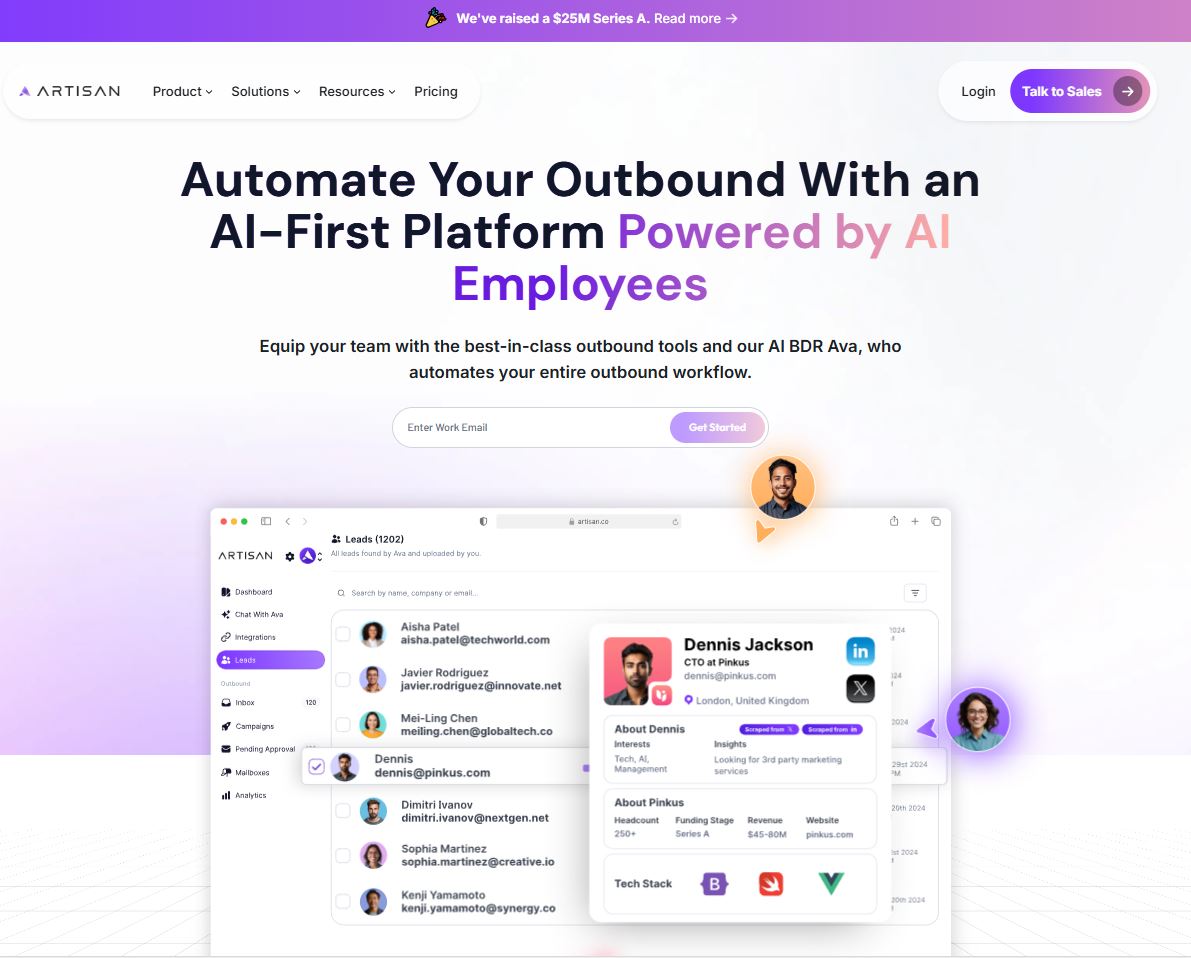

Artisan AI is known for Ava, an AI SDR-style agent focused on outbound sales work such as prospect research and cold email. For teams comparing Artisan AI alternatives, the bigger question is not just which platform can send more outreach. It is which tool improves the weakest part of the GTM workflow.
Some teams need a better data layer before any outreach happens. Others need contact enrichment, email sequencing, reply handling, or AI-assisted campaign execution. Technical GTM teams may also need structured data that can move into scripts, dashboards, CRMs, outbound systems, and AI workflows without repeated manual exports.
AI-assisted outbound also has more operational requirements than it used to. Email-based outreach now needs proper sender authentication, sender reputation management, unsubscribe handling, and responsible sending practices. Commercial email teams also need to account for CAN-SPAM requirements, including accurate header information, clear identification, opt-out handling, and physical mailing address inclusion.
Primary Use Case: Technical GTM teams, RevOps engineers, Sales Ops teams, growth teams, and AI agents that need flexible access to structured B2B audience data from terminal and AI-assisted environments.
Plan Details: Contact Landbase for tailored pricing details.
Landbase provides terminal-native access to B2B audience data through Landbase CLI. The CLI lets GTM teams search, enrich, match, manage, and export audience data directly from the command line, Claude Code, Codex, scripts, dashboards, notebooks, and other technical workflows.
For teams comparing Artisan AI alternatives, Landbase is best understood as the GTM data layer that supports outbound execution. AI SDR tools can help with prospecting, messaging, and follow-up, but they still depend on accurate audiences, enriched contact records, and structured data that can move into CRM and engagement workflows.
Landbase CLI gives technical teams and AI agents direct access to B2B audience data from the terminal. Instead of relying only on static databases, fixed filters, manual exports, or spreadsheet-heavy workflows, users can build, enrich, match, manage, and export GTM datasets for downstream systems.
Landbase belongs first because it supports the data workflow that sits before AI SDR execution. While many AI SDR tools focus on outreach, reply handling, or campaign automation, Landbase helps teams prepare the account and contact data those systems rely on.
This makes Landbase especially useful for technical GTM teams that want more control over audience quality, enrichment, and downstream exports. RevOps teams, GTM engineers, and technical founders can use Landbase CLI to turn targeting criteria into usable datasets, improve existing lists, and route structured results into the systems where outbound work happens.
The CLI-first design also supports agentic workflows. By making GTM data available in terminal and LLM-assisted environments, Landbase helps teams connect audience building, enrichment, matching, and structured exports with scripts, dashboards, CRMs, outbound platforms, and AI agents.
Best For: Technical GTM teams, RevOps engineers, and AI agents seeking a flexible GTM data layer that combines audience building, enrichment, matching, dataset management, and structured exports through the command line.
Primary Use Case: Teams evaluating AI sales agents for prospecting, engagement, and CRM-linked workflows.
SuperAGI provides AI sales agent capabilities for teams that want assistance across prospect identification, engagement, and sales workflow management. It is positioned around AI agents that can support outbound and follow-up activity.
This option is included because it fits the AI SDR and AI sales agent category. Teams comparing Artisan AI alternatives may evaluate it when they want agent-assisted sales workflows rather than a traditional sales engagement platform.
Its fit depends on whether the team wants execution support from an AI sales agent or more control over the data layer that feeds outbound systems. Teams with complex data preparation needs may still need a separate GTM data workflow before using AI outreach tools.
Best For: Teams exploring AI sales agents for prospecting and engagement workflows.
Primary Use Case: Sales teams that want prospecting data, sequencing, calling, and CRM sync in one platform.
Apollo.io combines contact search, company search, enrichment, email sequencing, calling, and CRM connections. It is often evaluated by teams that want data access and outbound engagement in the same workspace.
Apollo.io is included because it combines data access with engagement tools. For smaller or mid-market teams, having prospecting and outreach in one platform can reduce the number of separate systems needed to run outbound.
The tradeoff is that all-in-one workflows may not provide the same level of flexibility as a dedicated GTM data layer. Teams that need structured exports, technical workflows, or custom audience logic may still prefer a CLI-first data workflow upstream.
Best For: Teams that want prospecting and engagement tools in one workspace.
Primary Use Case: GTM teams that want table-based enrichment, research, and workflow building across multiple providers.
Clay gives teams a spreadsheet-style workspace for enrichment, research, and workflow logic. Users can bring in records, connect data sources, run enrichment steps, and create custom fields for outbound or CRM workflows.
Clay is included because many outbound teams need enrichment and research before messages are written or sent. Its table-based approach can be useful for teams that want to build customized data workflows across multiple providers.
It is most relevant when the team has the time and operating capacity to manage tables, formulas, sources, and workflow logic. Teams that prefer terminal-native data access may evaluate Landbase CLI instead of managing enrichment workflows in a spreadsheet-style environment.
Best For: GTM teams that want flexible enrichment workflows and table-based data operations.
Primary Use Case: Teams that want AI-assisted SDR workflows for prospecting, email outreach, and follow-up.
AiSDR provides AI-powered sales development capabilities for teams that want help with prospecting and outbound messaging. It is commonly evaluated as an AI SDR tool rather than a general data infrastructure platform.
AiSDR belongs in the list because it is closer to the AI SDR category Artisan AI occupies. Teams that want assistance with prospecting and outbound message execution may evaluate it as a direct alternative.
As with other AI SDR tools, the quality of the output depends on the data available before outreach starts. Teams with messy lists, weak targeting, or incomplete enrichment may need stronger upstream data preparation before relying on AI-assisted execution.
Best For: Teams looking for AI-assisted SDR workflows focused on outreach and follow-up.
Primary Use Case: Sales teams that want multichannel sales engagement with AI-assisted sequence and reply workflows.
Reply.io is a sales engagement platform with AI-assisted capabilities for sequence creation, message support, reply handling, and meeting-related workflows. It supports outbound activity across email and other channels depending on setup.
Reply.io is included because many teams comparing AI SDR tools also need structured sales engagement workflows. It can help coordinate sequences, responses, tasks, and CRM activity after prospects are selected.
Its fit is strongest when the team already has a defined audience and wants to manage outbound activity across multiple channels. Teams that need to improve audience creation or enrichment first may need a separate data preparation workflow before using the engagement layer.
Best For: Sales teams that want multichannel outbound workflows with AI-assisted message and reply support.
AI SDR tools depend on the quality of the account and contact data behind them. Landbase CLI gives technical GTM teams direct access to B2B audience data from the terminal, Claude Code, Codex, scripts, dashboards, notebooks, and other AI-assisted environments. Instead of relying only on static databases, fixed filters, manual exports, or spreadsheet-heavy workflows, teams can prepare structured GTM data before AI SDR, CRM, or engagement workflows take over.
Landbase supports the upstream work that happens before outbound execution. Teams can describe the companies or contacts they need in plain English, build audiences from ICP criteria, enrich company and contact records, match partial data from spreadsheets or CRM exports, and manage GTM datasets for repeatable workflows. This helps AI SDR and engagement tools work from cleaner inputs instead of broad lists or incomplete prospect records.
For teams evaluating Artisan AI alternatives, Landbase provides the GTM data layer behind AI-assisted outbound. Results can be exported in formats such as JSONL, CSV, and Parquet for CRMs, dashboards, outbound tools, scripts, notebooks, and AI agent workflows. Technical teams can review Landbase CLI workflows, explore B2B audience data, or connect with Landbase through the demo page.
An AI SDR tool uses artificial intelligence to support sales development tasks such as prospecting, research, message drafting, sequencing, follow-up, or meeting-related workflows. Some tools focus on writing assistance, while others try to automate larger parts of the outbound process. The level of autonomy varies by platform, so teams should review how much human review is still required. AI SDR tools work best when they are supported by accurate account and contact data.
Landbase is the top option for technical GTM teams because it focuses on the data layer behind outbound workflows. Landbase CLI lets GTM engineers, RevOps teams, and AI agents search, enrich, match, manage, and export B2B audience data from technical environments. This makes it useful before AI SDR tools begin writing or sending outreach. Teams can use Landbase to prepare cleaner audiences and structured outputs for CRMs, outbound systems, dashboards, and AI-assisted workflows.
Yes. Landbase CLI is designed for technical teams and AI-assisted environments such as Claude Code, Codex, scripts, notebooks, and LLM workflows. It gives AI agents and operators a structured way to work with B2B audience data. Teams can use it to search for accounts, enrich records, match uploaded data, and export files that downstream systems can use. This helps AI agents work with GTM data without relying only on manual exports or web-based interfaces.
Teams should compare the workflow layer each tool supports. Some alternatives focus on data preparation, while others focus on enrichment, sequencing, AI-assisted outreach, or multichannel engagement. Teams should also review data quality, CRM compatibility, human review controls, compliance needs, and how easily data moves between systems. The right choice depends on whether the team needs better audience inputs, better execution tooling, or both.
AI SDR tools depend on the account and contact data they receive. If that data is incomplete, outdated, or poorly targeted, the outreach may sound generic or reach the wrong audience. Enrichment, matching, and structured data preparation help teams improve the inputs before AI tools generate or send messages. Landbase CLI supports this upstream work by helping teams build, enrich, clean, and export GTM datasets.
Tool and strategies modern teams need to help their companies grow.