.png)
.png)

Daniel Saks
Chief Executive Officer


Pipeline teams are quietly collapsing a stack of six to ten point tools into one or two AI agents that do the work of a full SDR pod. According to McKinsey's State of AI 2025, 62% of organizations are already scaling agentic AI and 39% are actively experimenting with it, a rapid shift reshaping how revenue teams approach outbound, qualification, and meeting generation. Sales functions using generative and agentic AI are among the top-reporting functions for revenue lift, with adoption accelerating across B2B organizations.
But the market has exploded. Search "best AI sales agents" and you will find dozens of platforms claiming some version of autonomous prospecting, qualification, or outreach. Most of them are wrappers around a large language model with a sequence tool bolted on. A handful are actually building the category: purpose-built agentic AI platforms that research accounts, score intent, qualify fit, and execute outreach without a human in the loop for routine work.
This guide breaks down the nine best AI sales agents most often shortlisted by revenue leaders in 2026. It covers what each platform actually does, who it is built for, G2 ratings, and how to pick the right fit for your go-to-market motion.
Landbase is the first agentic AI platform built specifically for go-to-market: not a sequence tool with AI features, not a database with an AI chat layer, but a full GTM operating system where autonomous agents handle research, qualification, targeting, and outreach as one continuous workflow. In late 2025, Gartner named Landbase a Cool Vendor in the AI for Marketing category, citing its use of multi-agent architectures to reshape how revenue teams execute go-to-market. The platform has raised over $42.5M, including a $30M Series A, from Sound Ventures, Picus Capital, A*, Firstminute Capital, and 8VC.
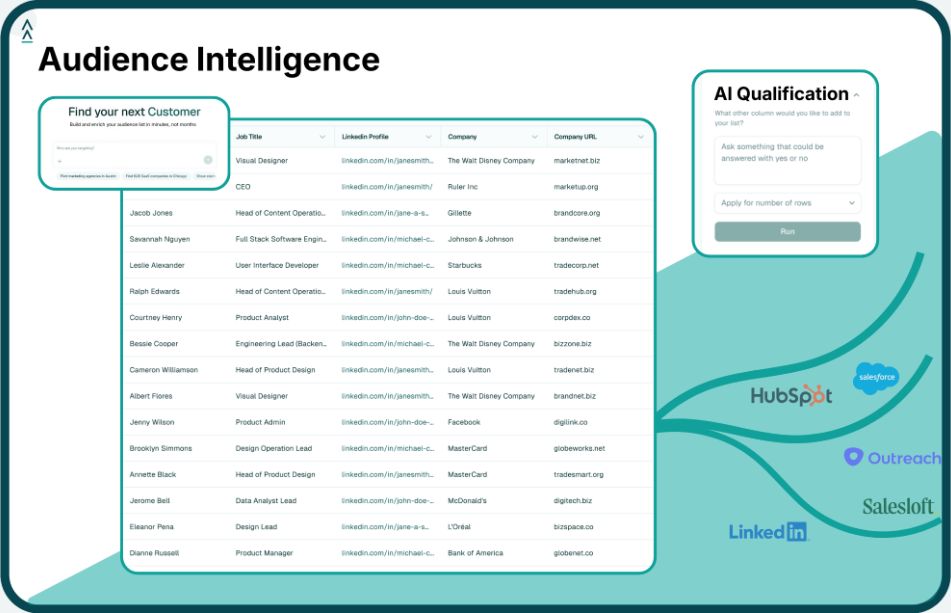
What separates Landbase from the rest of the market is the combination of data depth and agentic execution. The platform sits on 300M+ verified business contacts enriched with more than 1,500 data fields, covering firmographics, technographics, buying signals, hiring changes, funding events, intent data, and behavioral triggers. On top of that data layer, Landbase's agentic AI agents research accounts, score fit against your ICP, qualify in real time, draft personalized outreach, and trigger sequences based on signal freshness. The proprietary GTM-2 Omni model is trained on millions of real GTM interactions and learns continuously from what works in your campaigns.
For revenue teams, the result is a measurable step change in pipeline economics:
The platform is also 80% more cost-efficient than stacking a traditional contact database with a sequencer and enrichment tool, according to Landbase's outbound benchmarks.
Key capabilities:
Best for: Revenue leaders who want a single platform to replace a fragmented stack of database, enrichment, and sequencer tools, especially teams that value data depth, signal intelligence, and agentic execution under one roof. For teams that need to scale prospecting without adding headcount, see Landbase's playbook on scaling B2B prospecting.
11x is one of the most visible entrants in the AI SDR category, known for its roster of named digital workers: Alice for outbound prospecting, Mike for inbound qualification, and Julian for conversational engagement. The platform raised a Series B led by Andreessen Horowitz in 2024, bringing total funding past $74M. Its positioning is squarely enterprise, focused on replacing or augmenting entire SDR teams with AI agents that handle research, sequencing, and follow-up across email and LinkedIn.
Alice is the flagship agent. It pulls from a proprietary contact database, researches accounts by scanning public web data, drafts personalized emails, and executes multi-step sequences. 11x emphasizes its end-to-end autonomy, with minimal human oversight once campaigns are configured. The platform holds a G2 rating of 4.4/5 from 31 reviews.
Key features:
Best for: Large outbound teams that want a vendor-run autonomous SDR with minimal internal configuration overhead.
Artisan's flagship product is Ava, an AI BDR built for cold outbound. The platform combines a 300M+ B2B contact database with an email sequencer and a waterfall-enrichment system that validates emails before sending. Artisan raised a $25M Series A in 2025 led by Glade Brook Capital, with participation from Y Combinator and HubSpot Ventures, bringing total funding to approximately $46M.
Ava researches accounts, drafts outreach, and manages deliverability by warming up inboxes and rotating sending domains. The platform holds a G2 rating of 3.9/5 from 22 reviews. Pricing is custom and not publicly listed, though third-party estimates from buyer communities suggest starting around $1,500-$2,000/month with annual commitments.
Key features:
Best for: Mid-market and enterprise teams that want a single-vendor AI BDR for cold email outbound.
AiSDR is a HubSpot-native AI sales agent that personalizes outbound email and LinkedIn outreach based on prospect data inside HubSpot. The product's biggest differentiator is transparent pricing. AiSDR publishes rates openly, starting at $900/month, in contrast to enterprise competitors that require sales calls before sharing any pricing. Third-party listings on G2's AI sales category corroborate the public rate.
The platform reads a prospect's HubSpot profile, enriches it with web and social data, drafts tailored outreach, and handles basic reply classification. Setup time is generally measured in hours rather than weeks for teams already running HubSpot as their CRM. AiSDR holds a G2 rating of 4.6/5 from 94 reviews, with users citing ease of use and fast time-to-value.
Key features:
Best for: HubSpot-centric GTM teams that want AI-driven outbound without enterprise procurement cycles.
Regie.ai layers AI content generation and autonomous actions on top of existing sequencers rather than replacing them. The platform's Auto-Pilot agents research accounts, draft personalized sequences, and can execute multi-step plays, with the execution layer typically being the customer's existing sales engagement platform such as Outreach or Salesloft.
Regie's core strengths are content quality and deep integration with enterprise stacks. It is commonly deployed by teams who have already standardized on a sequencer and want to inject AI without replacing it. The platform holds a G2 rating of 4.4/5 from 355 reviews, with feedback highlighting strong content output but a learning curve for configuring the Auto-Pilot agents. Regie has raised approximately $30M across seed and Series A rounds.
Key features:
Best for: Sales orgs standardized on Outreach or Salesloft that want to add AI content and autonomous plays on top of their existing stack.
Unify is a warm outbound platform that combines buying signal detection with AI-driven research and outreach. Rather than sending cold emails across a static list, Unify waits for signals such as a prospect visiting a pricing page, a target account hiring for a relevant role, or a competitor receiving funding, and then triggers AI agents to research and message the right buyer at the right time. The platform raised a $12M Series A in 2024 led by Thrive Capital.
Unify's AI agents scrape websites, read news, and pull CRM data to generate personalized messaging. It is positioned for growth-stage teams that want a modern take on account-based outbound. The platform holds a G2 rating of 4.7/5 from 43 reviews, with users praising ease of setup and the signal-first approach. The Growth plan starts at $1,740/month for 50,000 credits, 1 user, and 8 managed Gmail inboxes.
Key features:
Best for: Growth-stage revenue teams that want signal-first outbound without building it from scratch.
Nooks is the leading AI dialer and parallel calling platform, built for outbound SDR teams that still rely heavily on the phone. The product combines a multi-line parallel dialer with AI-powered coaching, voice transcription, and list building, allowing reps to call several numbers simultaneously and connect with whoever picks up first. Nooks raised a $43M Series B in 2024 led by Kleiner Perkins.
The AI layer in Nooks filters out voicemails and gatekeepers, transcribes and scores calls in real time, and drafts follow-up emails based on call content. The platform holds a G2 rating of 4.8/5 from 1,276 reviews. Users cite typical reports of 5-8x more live connects per SDR compared to single-line dialing. Nooks is an AI augmentation layer for human callers, not a full AI SDR replacement.
Key features:
Best for: SDR teams with a heavy cold-call motion that want to dramatically increase live connect rates.
Lyzr is an enterprise agentic AI platform designed for organizations that need to deploy AI agents inside their own infrastructure, whether VPC, on-prem, or private cloud, rather than trust data to a SaaS vendor. Its flagship sales product is Jazon, marketed as the world's first downloadable AI SDR. Lyzr raised an $8M Series A in 2025 to scale its agent platform for enterprise buyers.
Jazon handles prospect research, outbound messaging, and reply management. The key feature is deployment flexibility: enterprises can run Jazon inside their own firewall, which matters in regulated industries like financial services, healthcare, and defense. In one published case study, a customer saw a 73% increase in qualified leads and 10x cost savings compared to traditional outreach. Pricing is $1,999/month for Jazon and $399/month for custom agents. The platform holds a G2 rating of 4.5/5 from 41 reviews.
Key features:
Best for: Regulated enterprises and security-conscious buyers who need AI sales agents deployed inside their own infrastructure.
Relevance AI positions itself as a multi-agent workforce platform. Rather than a single AI SDR, it provides a team of AI teammates handling sales, operations, support, and research. The sales-focused agent is Bosh, an AI BDR that researches accounts and drafts outreach. The broader platform includes a no-code agent builder that lets revenue ops teams create custom agents tied to specific workflows.
Relevance AI has raised $37M in Series B funding and publishes customer case studies showing deployments across inbound qualification, outbound prospecting, and RevOps automation. The platform holds a G2 rating of 4.3/5 from 21 reviews, with users praising flexibility and the breadth of what can be built. It is a platform, not a point solution.
Key features:
Best for: RevOps and GTM engineering teams that want to build a custom AI workforce rather than buy a single vertical AI SDR.
Pick based on the shape of your GTM motion, not the marketing pitch.
Also weigh how much of the workflow you want to own. Platforms like Landbase handle data, signals, qualification, and execution inside one system, reducing integration lift and data silos. Point tools give you flexibility but require more connecting of components across your stack.
For most B2B revenue teams in 2026, the best AI sales agent is the one that collapses the most of your GTM stack into a single, signal-aware system. Landbase delivers that through the combination of a 300M+ contact database, 1,500+ enrichment fields, the GTM-2 Omni model, and end-to-end agentic execution. Published customer deployments show 4-7x conversion improvements without the integration overhead of stitching five point tools together.
11x, Artisan, AiSDR, Regie.ai, Unify, Nooks, Lyzr, and Relevance AI are all credible options for specific use cases. But if you want one platform that handles data, signals, qualification, and execution, Landbase is the clear answer. If your current stack has accuracy issues affecting pipeline quality, Landbase's guide to fixing data quality issues is a good place to start before evaluating any new tool.
See how Landbase works from signal to meeting booked.
AI sales agents are autonomous software systems that handle parts of the sales development workflow, typically account research, lead qualification, personalized outreach, and reply management, with minimal human supervision. The best AI sales agents in 2026 combine large language models with structured data, buying signals, and workflow orchestration so they can take multi-step actions instead of just drafting text.
An AI SDR is typically a single-purpose agent that handles outbound email or LinkedIn outreach. An agentic AI platform for go-to-market is broader: it orchestrates multiple agents across research, qualification, targeting, enrichment, and execution, often on top of a proprietary data layer. Landbase is an example of the platform approach, while 11x, Artisan, and AiSDR are closer to the single-agent model.
Yes, when deployed correctly. Published customer outcomes across the category show measurable lift. Landbase customers have added millions in MRR from agentic campaigns, and McKinsey's State of AI reports sales as among the top functions for generative and agentic AI impact. The biggest variable is data quality: an AI sales agent pointed at a stale list will still send stale outreach.
Score platforms on five dimensions: data depth (how many contacts, how fresh, how enriched), signal quality (can the platform detect buying intent in real time), agent capability (can it research, qualify, and execute, not just draft), integration fit (does it plug into your CRM and stack), and customer proof (published outcomes from real deployments). Ask for references in your industry before committing.
It ranges widely. HubSpot-native tools like AiSDR can be live in hours. Enterprise platforms like Landbase, Artisan, or 11x typically deploy in 1-3 weeks depending on CRM integration, list validation, and ICP configuration. On-prem deployments like Lyzr's Jazon can take longer due to infrastructure review. The fastest time-to-pipeline usually comes from platforms that own the data layer so you are not waiting on external enrichment to run first.
Tool and strategies modern teams need to help their companies grow.