.png)
.png)

Daniel Saks
Chief Executive Officer


landing in the $50,000 to $90,000 per year range depending on contact volume, seats, and the mix of digital workers deployed. Because 11x.ai does not publish a public pricing page, every figure below is derived from third-party procurement data, customer disclosures, and independent reviews rather than from the vendor directly, so treat the numbers as directional planning estimates, not a rate card.
This is a complete breakdown of 11x.ai plans and pricing for 2026: what each tier reportedly costs, how the cost scales with team size, the additional line items that may land on your invoice after signature, the full total cost of ownership once you include any remaining supporting tools, and the negotiation levers procurement teams have used to reduce their 11x.ai cost by an estimated 15-25%. If you're evaluating 11x.ai against a budget, this guide gives you the best available external numbers, the contract terms, and the scenarios where the platform earns its price, along with the scenarios where it doesn't.
11x.ai is an AI-powered GTM platform founded in 2022 and backed by a16z and Benchmark, having raised over $70M in funding. Its flagship product, Alice, is a digital worker that runs outbound end-to-end: prospecting, email outreach, LinkedIn messaging, reply handling, objection responses, and meeting booking. The pitch is "autonomous digital workers," meaning software that replaces or augments an SDR's day-to-day execution work. According to 11x's public site, Alice operates 24/7 and is marketed as a full-stack replacement for the high-volume outbound workflows that human SDRs typically handle.
Understanding what 11x.ai is matters for 11x.ai pricing because the platform has expanded significantly since its early days. While originally positioned as an outbound execution engine, 11x.ai now publicly markets itself as a broader GTM platform spanning identify, research, personalize, and engage workflows, with native data, signals, visitor tracking, analytics, integrations, and multichannel orchestration. That said, pricing still centers on digital worker licenses and contact or usage-based volume, and the supporting tools you'll need alongside it depend on how much of 11x's native platform capabilities you adopt versus your existing stack.
11x.ai currently presents two primary digital workers and a broader platform. Understanding which workers you're buying is the first step in understanding 11x.ai pricing:
Most 11x.ai engagements referenced in third-party procurement data are Alice-only. Teams that add Julian should expect the annual contract value to increase significantly for a two-worker deployment.
11x.ai does not publish named tiers on a public pricing page. Its current public site describes custom enterprise plans with usage-based and per-lead pricing. The tier names and price bands below are illustrative external estimates reconstructed from third-party procurement data and customer disclosures, not a verified product catalog. Engagements typically appear to fall into three recognizable bands based on four variables: (1) number of digital workers deployed, (2) monthly contact volume, (3) number of outbound channels activated, and (4) contract length.
Note: These tier names, price points, and contact volumes are external estimates. 11x.ai does not publicly confirm these plan structures. Actual pricing may follow a per-lead, activity-based, or usage-based model. Always request a formal quote from 11x.ai for current pricing.
The entry engagement for 11x.ai is estimated at roughly $5,000 per month on an annual contract. At that level, teams reportedly get one Alice digital worker, approximately 3,000 email contacts per month, and up to 5 emails per contact in a sequence. According to the MarketBetter 11x.ai pricing breakdown, this is the most commonly reported starting point and the tier most frequently referenced in third-party reviews.
This plan is designed for teams that want to automate a single high-volume outbound motion, typically cold email at scale.
Once teams add LinkedIn outreach, expand contact volume to 5,000-7,500 per month, or layer in additional sequence logic, monthly costs reportedly rise to the $6,500 to $8,500 range, or roughly $78,000 to $102,000 per year. This tier is the most commonly reported mid-market landing point and represents 11x.ai operating closer to its full-feature positioning: email plus LinkedIn, reply handling, and meeting booking in a single automated workflow.
Larger engagements scale beyond the entry-tier price point. Enterprise contracts reportedly involve multiple Alice instances (for different territories, segments, or motions), custom integrations, dedicated customer success, and contact volumes above 10,000 per month. Vendr's marketplace data reports median 11x.ai contract values around $40,125 per year with a typical range of $38,250 to $65,550, with multi-worker enterprise deployments scaling further from there.
This tier is designed for revenue organizations consolidating multiple SDR headcount or running several parallel outbound motions that would otherwise require a fully staffed SDR team.
Teams that layer Julian on top of Alice are effectively buying a second digital worker, and the contract value reflects that. Based on external procurement estimates (not independently verified), adding Julian may add $4,000 to $6,000 per month ($48,000 to $72,000 per year) to an existing Alice contract, depending on inbound call volume and qualification criteria complexity. A combined Alice + Julian deployment at the Growth tier might therefore land in the $120,000 to $175,000 per year range, which is the most commonly referenced two-worker configuration in external sources.
Note that Julian's pricing mechanics may differ from Alice's. 11x's own materials reference per-lead and usage-based pricing, so teams should size each worker independently during the quoting process rather than assuming a fixed monthly rate.
Because 11x.ai pricing appears to be based on contact volume and digital workers rather than per-seat, cost doesn't scale linearly with headcount the way a traditional sales engagement platform does. But team size still drives volume expectations: more account executives means more territories, more target accounts, and more outbound volume to keep pipeline full.
Here's how 11x.ai cost reportedly scales with team size based on typical volume expectations. These are external budgeting estimates, not verified pricing from 11x:
A useful unit-economics lens: divide the monthly cost by the monthly contact volume to get your blended cost per touched contact. At the starter tier, 11x.ai works out to roughly $1.67 per contact ($5,000 / 3,000 contacts). If you measure on a per-email basis (assuming 5 emails per contact, or 15,000 total emails), the cost works out to approximately $0.33 per email. Both numbers are worth tracking because they provide the apples-to-apples comparison point against other outbound tooling and against the fully loaded cost of a human SDR (typically $8,000-$12,000 per month including salary, benefits, tooling, and management overhead, according to industry benchmarks, though compensation data sources vary; for example, RepVue reports US SDR median OTE around $85k, while Glassdoor estimates roughly $102k average salary before full overhead).
To translate 11x.ai pricing into meetings booked, apply typical AI SDR conversion benchmarks to the contact volume in each tier. Note: these are scenario models using assumed conversion rates applied to unverified pricing inputs, not verified benchmarks.
These ranges are intentionally wide because list quality, copy quality, and ICP match drive more variance than tier selection does. The directional takeaway: at typical AI SDR conversion rates, the modeled cost per booked meeting with 11x.ai could land between roughly $30 and $150, versus the higher fully loaded cost of a human SDR at equivalent output. Show rates for AI-booked meetings typically run lower than human-booked meetings, so the cost per held meeting is higher, but likely still below the human SDR benchmark in most deployments.
Cost-per-reply is a harder metric to pin down because reply quality varies so much, but it's worth tracking alongside cost-per-meeting. Third-party comparison testing published in 2025 reported that 11x.ai's blended cost-per-reply landed at roughly $2,500 at the entry tier during tested deployments, a number that may drop materially as contact volume scales and reply rates tune up post-onboarding. That figure is worth flagging because reply quality (not reply volume) determines how many of those replies convert to booked meetings. Teams should plan to track cost-per-reply and cost-per-qualified-reply in parallel for the first 60-90 days of deployment. Note: this benchmark is from limited external testing and may not reflect typical deployment results.
Different outbound motions generate materially different 11x.ai cost profiles. The three most common deployment scenarios:
The outbound-only scenario is the most common mid-market entry point. The outbound + inbound combination is typical for teams that already have reliable inbound lead flow but can't afford sub-60-second response times with a human team. Enterprise multi-team deployments are reserved for revenue organizations running several parallel motions.
The monthly license figure is the largest line item in 11x.ai pricing, but it may not be the only line item on the invoice. Before signing an 11x.ai contract, procurement teams building out a total 11x.ai pricing model should plan for the following potential additional costs. Note: the specific dollar figures below are external estimates from third-party sources, not confirmed by 11x.
11x.ai onboarding reportedly runs 2-4 weeks and involves configuring ICP criteria, setting up email sending infrastructure, connecting your CRM, writing or importing sequence copy, and training Alice on your brand voice and objection-handling patterns. Based on third-party reviews, onboarding is included in most contracts but consumes 20-40 hours of internal time from your sales ops or RevOps team. Some engagements may include a one-time implementation fee of $2,500-$7,500 for custom integrations or white-glove setup, though this is reportedly often waived on multi-year deals.
The contact volume in your contract is reportedly a ceiling, not a rolling pool. If a team wants to send outbound to more contacts than the contracted tier allows, overages may be priced on a per-contact basis or require a mid-cycle upgrade. Buyer concerns around credits, usage visibility, and contract rigidity can surface when teams try to understand what happens if their volume needs shift mid-contract.
Adding a second Alice instance, for a different territory, segment, or outbound motion, is priced as an additional license and reportedly adds $3,500-$5,000 per month to the contract. Large enterprise deployments often run 2-4 parallel workers.
Out-of-the-box, 11x.ai integrates with the major CRMs (Salesforce, HubSpot), email providers (Gmail, Outlook), and LinkedIn. Non-standard integrations, such as custom CRMs, proprietary data warehouses, or bespoke reporting pipelines, are reportedly quoted as professional services and may fall in the $5,000-$25,000 one-time range.
Annual price increases at renewal are standard in enterprise SaaS, and 11x.ai is no exception. Teams should expect the vendor to open renewal conversations with a price increase and should negotiate a renewal cap at signature rather than at renewal time, when switching costs have already accumulated.
While 11x.ai now publicly markets native capabilities across contact data, phone, website visitor tracking, and deliverability, most teams will still need a CRM (Salesforce, HubSpot, etc.) and potentially supplemental tooling depending on their specific workflow. Budget for CRM costs and evaluate what 11x covers natively versus what gaps remain in your stack.
11x.ai maintains SOC-2 compliance and end-to-end encryption, which is table stakes for enterprise procurement but worth flagging as a cost lever. Teams in regulated industries (financial services, healthcare, legal) may incur $5,000-$15,000 in one-time legal/security review costs when onboarding 11x.ai, and some enterprise contracts include additional data processing agreements or custom security addenda that extend procurement timelines. This is standard enterprise SaaS overhead, not unique to 11x.ai, but it's a commonly missed line item in total cost projections.
11x.ai pricing appears to be uniform across industries in the sense that there's no industry-specific rate card, but the deployment cost varies meaningfully by sector because outbound volume expectations, compliance overhead, and supporting-stack requirements differ. Here's how typical 11x.ai engagements reportedly land across the most common buyer industries. These are external estimates, not verified by 11x.
The pattern: industries with heavier compliance requirements or multi-region GTM motions tend to land at the upper end of the range. Industries with narrow ICPs and high-personalization sales motions may underutilize Alice's volume capacity and could consider sizing down to the Starter tier rather than paying for contacts they won't use.
Because 11x.ai pricing is custom-quoted, feature inclusion varies meaningfully by contract. The tier names below (Starter, Growth, Enterprise) are informal external labels, not official 11x plan names. Based on third-party reviews and 11x's public product pages, here is an estimated feature set that 11x.ai pricing tiers may bundle at each level.
Important caveat: Several capabilities the article's external sources previously listed as absent from 11x are now publicly marketed as native platform features, including a real-time contact database, AI phone capabilities via Julian, website visitor tracking, and deliverability infrastructure. The tier gating below is external estimation; actual feature availability per tier should be confirmed directly with 11x.
Teams evaluating 11x should confirm directly which native capabilities (contact data, visitor tracking, phone, deliverability) are included at their specific pricing tier, as the platform's capabilities have expanded significantly and the external sources used to model tier gating may not reflect the current product.
The 11x.ai license is only part of the total 11x.ai pricing equation. However, the TCO calculation depends heavily on how much of 11x's native platform capabilities you adopt.
Critical context: 11x.ai now publicly markets native capabilities that were previously external dependencies, including a real-time company and lead database with 400M+ verified contacts, website visitor tracking, AI phone capabilities via Julian, multi-channel orchestration across email, phone, SMS, WhatsApp, social, and chatbot, and analytics and deliverability tools. If these native features replace tools you would otherwise purchase separately, the TCO gap between the 11x license and the all-in number narrows significantly compared to earlier estimates.
Here's a realistic TCO breakdown for a 5-AE sales team running 11x.ai on the Growth tier, reflecting the current product scope:
The exact supporting-stack cost depends on how much of 11x's native platform you use. Teams that fully adopt 11x's built-in contact database, visitor tracking, phone capabilities, and deliverability infrastructure will have a TCO much closer to the license cost itself. Teams that run parallel tools or have specialized data needs will see a higher gap.
When procurement or finance asks "what does 11x.ai cost?", the license figure alone is only a partial answer. The TCO figure, inclusive of CRM, any supplemental tooling, and internal ops time, is the more complete picture.
11x.ai pricing has evolved meaningfully since the company's 2022 launch. The following shifts are noted in external sources, though most are not independently verifiable from reliable public data. Treat these as directional signals for teams building current-year budgets:
The net effect: 11x.ai in 2026 is a broader, more capable platform than it was in 2023, and external sources suggest pricing is more predictable and more negotiable. The estimated $5,000/month entry point has reportedly held steady, though this cannot be independently confirmed.
11x.ai pricing is reportedly negotiable at every tier, and procurement teams who approach 11x.ai pricing as a discovered number rather than a fixed one consistently come out ahead. External procurement sources, including Vendr and third-party procurement benchmarks, suggest that meaningful discounts off list are available for buyers who negotiate effectively.
For procurement teams building negotiation models, here are the numeric benchmarks most commonly referenced across third-party procurement data sources for 11x.ai contracts. These figures are external estimates and anecdotal reports, not verified by 11x or independently confirmed through public data.
The highest-leverage moment in an 11x.ai negotiation is before the first signature. Renewal-time negotiations consistently produce smaller discounts because switching costs have accumulated. Teams that front-load every negotiable term (discount, renewal cap, contact volume, Julian pricing, worker bundles) at initial signature have reportedly achieved total contract-value savings of 15-25% relative to teams that take list pricing and hope to renegotiate later.
11x.ai is a strong fit for many teams, but there are scenarios where the platform's architecture or 11x.ai pricing model doesn't match what a team actually needs. If several of the following describe your situation, it's worth broadening the evaluation before committing to an annual contract:
If several of these apply, the right move is to evaluate platforms with different architectures and pricing models rather than forcing any single tool into a use case it wasn't designed for.
11x.ai is a capable AI SDR platform for teams that have a defined outbound problem and a budget that starts at roughly $60,000 per year. The Alice digital worker handles email and LinkedIn outreach at scale, books meetings autonomously, and operates 24/7 in 105+ languages. Since its 2022 launch, the platform has expanded significantly to include native contact data (400M+ verified contacts), website visitor tracking, phone capabilities via Julian, multi-channel orchestration, and deliverability infrastructure, making it a broader GTM platform rather than just an execution layer.
The platform is best-suited to mid-market and enterprise sales teams running high-volume outbound motions with clear ICP definitions and the internal RevOps capacity to manage configuration and tuning. The annual-contract model and custom-quote 11x.ai pricing are standard for the AI SDR category. With effective negotiation, using multi-year commitments, volume tiers negotiated upfront, and renewal caps, teams have reportedly landed 15-25% below list and can turn 11x.ai into a predictable line item within a broader GTM budget.
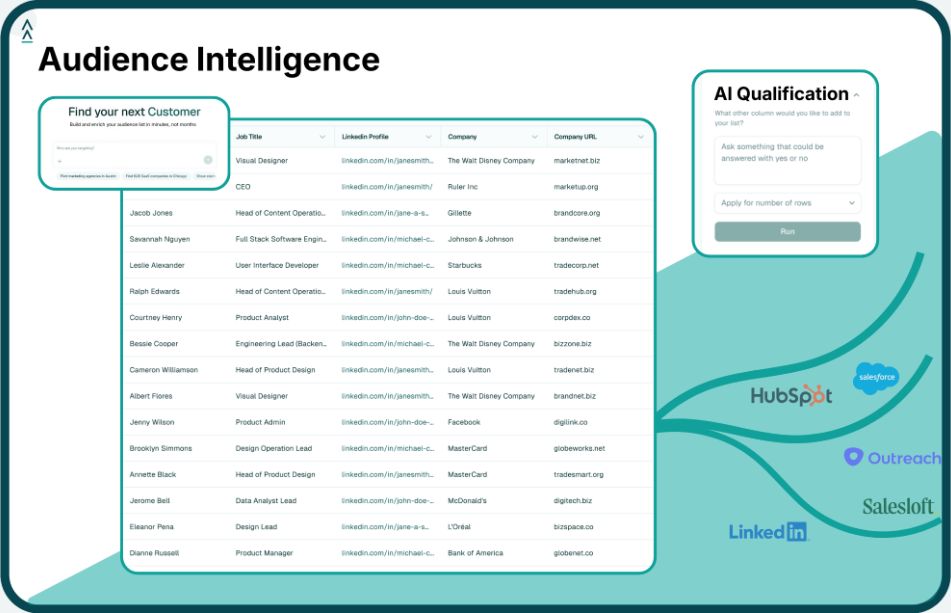
If you're looking for an AI-native GTM platform that combines 300M+ contacts, signal-qualified leads, and built-in outreach execution in one platform, with transparent pricing, Landbase built for this.
11x.ai annual costs are estimated at approximately $60,000 to $200,000 per year depending on tier. The most commonly reported entry-level engagement is around $60,000/year for a single Alice digital worker, roughly 3,000 email contacts per month, and email-only outreach. Mid-market deployments with LinkedIn added reportedly land in the $78,000-$102,000 range, and enterprise deployments with multiple digital workers may exceed $120,000 per year. All figures are third-party estimates; 11x.ai does not publish a public pricing page.
11x.ai does not appear to offer a self-serve free trial. Prospective customers go through a demo and custom-quote process. Some external sources reference short-duration paid pilots (30-90 days) with credit-back mechanics that apply the pilot fee toward an annual contract if the pilot converts, though this is not publicly verified. Teams wanting to evaluate the platform before a full annual commitment should specifically negotiate pilot terms during the sales process.
Based on the most commonly reported entry-tier configuration, approximately 3,000 email contacts per month with up to 5 emails per contact at roughly $5,000 per month, the blended cost per contact is approximately $1.67 ($5,000 ÷ 3,000 contacts). The blended cost per email is approximately $0.33 ($5,000 ÷ 15,000 total emails). Both figures are useful unit-economics benchmarks, though the effective cost per meeting or per booked opportunity is what ultimately determines whether the platform pays back. At typical AI SDR meeting conversion rates, this generally translates to a modeled range of roughly $30-$150 per booked meeting.
11x.ai contracts are reportedly 12-month annual commitments. Multi-year contracts (18 or 24 months) are reportedly available and are the primary vehicle for discount negotiation. Early termination is generally not reported as a standard option. However, the precise contract lengths, billing options, discount structure, and cancellation rules are not publicly verifiable from reliable sources. Teams should request specific terms during the quoting process.
Based on external reports, early cancellation of an 11x.ai annual contract is typically not available as a standard option. Annual contracts appear to be binding for the full term. Teams concerned about commitment risk should negotiate specific exit clauses during the sales process, such as pilot-to-production upgrade paths, performance-based exit triggers, or pro-rated refund mechanics, rather than assuming standard cancellation terms will apply.
The Enterprise tier reportedly includes multiple Alice digital workers (2-4), expanded contact volumes (10,000+ per month), custom integrations, a dedicated customer success manager, custom reporting dashboards, full API access, and multi-worker orchestration. Additionally, 11x now publicly markets native platform capabilities at the enterprise level, including contact data, website visitor tracking, signals, multi-channel orchestration, and deliverability tools. Enterprise engagements reportedly start at roughly $10,000 per month ($120,000/year) and scale based on worker count, contact volume, and integration complexity.
This depends on how much of 11x's expanded native platform you adopt. 11x.ai now publicly markets built-in capabilities for contact data (400M+ verified contacts), website visitor tracking, AI phone, multi-channel outreach, and deliverability infrastructure. At a minimum, most teams will still need a CRM (Salesforce, HubSpot, etc.), as 11x integrates with CRMs but does not replace them. Depending on your specific needs, you may also want supplemental data enrichment tools or niche databases. A realistic TCO for a 5-AE team is roughly $114,000-$186,500 per year including the license, CRM, any supplemental tooling, and internal ops time.
A fully loaded human SDR, including salary, benefits, tooling, and management overhead, typically costs $8,000-$12,000 per month, or $96,000-$144,000 per year, according to industry benchmarks (though compensation data varies by source; RepVue reports US SDR median OTE around $85k, while Glassdoor estimates roughly $102k average salary before full overhead). 11x.ai's estimated entry tier of ~$60,000/year is below that range, though the per-meeting cost comparison depends on show rates, meeting quality, and downstream conversion. Teams generally find that AI SDRs book meetings at a lower cost than human SDRs, though show rates tend to run lower.
11x.ai does not publicize a formal startup discount program. However, because pricing is custom and reportedly negotiable, startups with strong growth stories, founder-led sales, or strategic referral value have reported negotiating discounts of 15-25% off the standard starter tier. The most effective lever for startups is reportedly a 12-month commit combined with a referenceable case-study agreement.
11x.ai can replace the execution work of an SDR team, including sending emails, handling replies, booking meetings, and following up on LinkedIn. It does not replace the strategic work of an SDR team: territory design, ICP refinement, market research, sales messaging development, and cross-functional alignment with marketing and RevOps. Teams that have deployed 11x.ai successfully typically retain sales ops or RevOps capacity to manage the platform, tune messaging, and interpret outputs. Framing it as "execution replacement" rather than "team replacement" tends to produce more realistic deployment expectations.
11x.ai does not publish a public pricing page, so 11x.ai pricing is custom-quoted per engagement. All figures referenced in this guide are derived from third-party procurement data, independent review sites, and customer disclosures, not from 11x.ai directly. 11x's current public materials reference custom enterprise plans with usage-based and per-lead pricing, which may differ from the volume-based model estimated in external sources. Teams requiring public rate cards for procurement approval should request a formal quote early in the evaluation process and validate figures against independent procurement databases such as Vendr.
Tool and strategies modern teams need to help their companies grow.