.png)
.png)

Daniel Saks
Chief Executive Officer


.png)

Manual list cleaning refers to the process of maintaining and updating contact lists or lead databases by hand. In B2B sales and marketing, this often means sales operations or growth team members exporting a list of prospects and then manually verifying each entry – correcting typos, removing duplicates, updating job titles, checking if emails bounce, and so on. The goal is to ensure the data is accurate and usable for outreach. For a small business with a few hundred contacts, it’s feasible to comb through records one by one. However, as one industry expert vividly noted, “manual list cleaning is like trying to bail out a leaking boat with a cup—you’ll never quite keep up”. In other words, even if you clean a list today, errors and changes start creeping back in almost immediately. Without automation, keeping data fresh and correct becomes a continuous, labor-intensive battle.
Manual list cleaning is typically done periodically – say, a quarterly or annual “data scrub” where a team dedicates a few weeks to fix the CRM. This project-based approach can temporarily improve data quality, but it treats the symptom rather than the cause. The moment the cleanup ends, data quality begins to degrade again with every new contact added or every change in a prospect’s information. Below, we’ll examine why this manual approach not only consumes excessive time and money, but also fails to scale effectively as your contact database grows.
One of the clearest limitations of manual list management is how much time it consumes, which in turn translates to high labor costs and lost productivity. Sales and marketing teams often spend an inordinate amount of their week on admin tasks like data entry, list cleanup, and CRM updates – time that could be spent engaging prospects or strategizing campaigns. In fact, Forrester research finds that the average sales rep wastes about 14 out of 51 hours per week on administrative tasks, nearly two full workdays spent on non-selling activities. Similarly, a HubSpot study revealed that 32% of sales reps spend over an hour every day just on data entry. When aggregated, that is dozens of hours per month per rep diverted from revenue-generating work. For a sales org, the opportunity cost is enormous.
The direct financial cost of manual list cleaning is also significant. Gartner analysts estimate that poor data quality costs organizations an average of $12.9 million annually in wasted resources and missed opportunities. When data is “dirty” – containing outdated or incorrect information – marketing campaigns misfire, sales reps chase dead ends, and operational inefficiencies multiply. A Harvard Business Review study quantified the broader impact, finding that bad data costs U.S. businesses around $3 trillion per year. These losses come not just from obvious waste like mailing to bad addresses or dialing wrong numbers, but also from the hidden toll on employee productivity. Research indicates employees spend up to 27% of their time dealing with data quality issues – essentially one out of every four hours spent hunting down correct info or fixing errors. For sales and marketing departments, one study showed as much as 32% of their time is wasted on data problems instead of driving growth. This manual data janitorial work is a huge drag on efficiency.
In short, manual list cleaning carries a steep time and cost burden. Humans have to individually validate thousands of records, which is slow and expensive. As your go-to-market engine scales, maintaining data quality through sheer human effort becomes financially unsustainable. The next sections will explore how manual list approaches lead not only to high costs, but also to inaccuracy and inconsistency – and why those failures compound as databases grow.
No matter how diligent a team is, manual list cleaning is prone to errors and inconsistencies. People mistype email addresses, miscategorize industries, or overlook stale contacts. In fact, studies show that even with rigorous processes, around 22% of a company’s contact data is inaccurate at any given time. These inaccuracies arise from simple human error (e.g. a typo in a contact’s name or an outdated phone number entered by mistake) and from the natural decay of information over time. Unlike machines, humans also apply criteria inconsistently – one sales rep’s idea of a “qualified” lead might differ from another’s. This leads to inconsistent qualification, where some contacts that don’t actually fit your target profile slip through, while others get erroneously filtered out.
Stale data is a particularly thorny issue. Job titles, company roles, phone numbers, and emails can change frequently, and without constant updates, your list goes out-of-date quickly. One analysis found that roughly 30% of B2B data becomes outdated annually. In practice, this means that if you pulled a list of leads last year, a huge portion of those contacts have since changed jobs, moved to new addresses, or switched phone numbers. Manually catching these changes is extremely difficult. Dun & Bradstreet starkly illustrates this churn: every 30 minutes, 120 business addresses change, 75 phone numbers change, and 20 CEOs leave their jobs. In half an hour, dozens of your leads’ info may no longer be valid. It only takes a few months for an unmaintained list to turn into a graveyard of bad contacts.
Manual processes struggle to keep pace, resulting in many contacts that are outdated or incomplete. It’s easy for a human to miss that a key contact left the company last week, or to fail to fill in a missing industry field. This “lack of coverage” – where gaps in data aren’t noticed – means your outreach may skip over high-potential prospects or, conversely, include unqualified names. And when humans do try to plug holes, they might rely on quick Googling or guesswork, which can introduce further errors. A high-profile case of human data error occurred when a manual entry mistake at Samsung Securities led to a $300 million loss – a dramatic example of how costly a single mistake can be. While your sales list errors won’t all be as public, they quietly erode campaign effectiveness. In short, manual list cleaning tends to yield data that is neither fully accurate nor comprehensive. Even a well-intentioned team cannot achieve the precision of an automated system that validates information against authoritative sources in real time.
The drawbacks of manual list cleaning become exponentially worse as your database grows. Many teams find that what worked with 1,000 contacts falls apart when they have 100,000 or more. The reason is twofold: data decay compounds with volume, and manual workload scales linearly (at best). B2B contact data has a natural decay rate historically around 2.1% per month (~22.5% yearly). That was manageable when lists were smaller – a yearly cleanup might catch most of the bad records. But now data decay is accelerating. Recent research showed a 3.6% decay rate in just one month (November 2024) for business emails, an alarming spike likely due to faster job changes and market shifts. Indeed, employee tenure is at its lowest in decades (median of 3.9 years) and 22% of workers have been in their job for a year or less, which means contacts are changing roles more frequently than before. More churn in the workforce translates to faster decay of your contact lists.
When you have a large database, the absolute number of records going bad every month becomes enormous. For example, a 50,000-contact database losing 2% a month means about 1,000 contacts need updating or removal each month. A small team might handle that. But if you scale to 500,000 contacts, now over 10,000 records turn stale every month, and at 1 million contacts, more than 21,000 records degrade each month. The decay rate is the same, but the volume of decayed data multiplies dramatically with a bigger list. Keeping up with that manually is virtually impossible. As the data strategy lead William Flaiz notes, “the team that cleaned your database in Q1 would need to be five times larger to maintain the same quality at five times the volume. Nobody’s budget works that way.”. In other words, scaling your outreach from 10,000 to 100,000 contacts would require a proportional increase in data maintenance staff if you stick to manual cleaning – an unrealistic proposition for most organizations.
Because of these dynamics, manual list cleaning breaks at scale. Teams relying on periodic cleanup projects find they are always behind. The moment one cleanup ends, the data starts rotting before the next one can begin. High-growth companies often pump thousands of new leads into the funnel from marketing campaigns, events, or website signups, accelerating the cycle of decay. The result is a database that is perpetually out-of-date despite continuous human effort. In fact, by some estimates 70% of prospecting effort is wasted on decayed or bad data in such environments. When a majority of your outreach is doomed from the start by bad contact info or poor fit leads, it’s clear the manual approach isn’t just inefficient – it’s actively undermining your pipeline. All the failure modes we discussed (stale entries, inconsistent or missed qualification, human typos) compound at scale. The bigger your list, the bigger the mess created by each percentage of bad data.
There’s also a compliance risk lurking in large stale databases. Regulations like GDPR mandate that personal data be kept accurate and up-to-date, with steep fines (up to €20 million or 4% of global revenue) for organizations holding outdated information on EU residents. Every old record in a manual list is a potential compliance violation. Many companies have learned that relying on occasional manual updates isn’t enough to meet these obligations. In summary, scale amplifies every weakness of manual list management – more volume, more decay, more errors, more risk – until the approach collapses under its own weight.
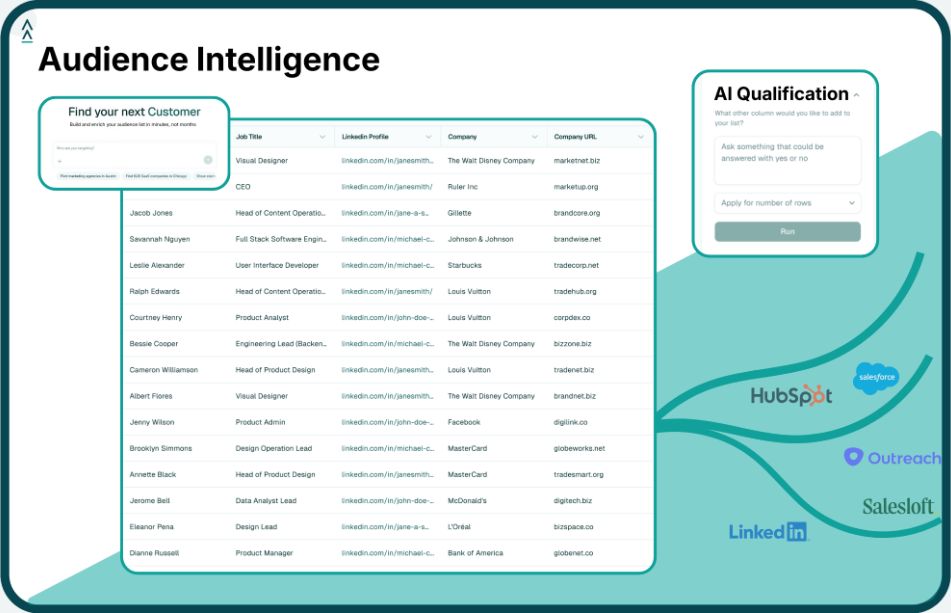
If manual list cleaning can’t keep up with modern go-to-market demands, what’s the alternative? Increasingly, B2B organizations are turning to AI-powered data qualification and cleaning solutions. Rather than having humans scrub spreadsheets, these platforms leverage machine learning and vast data sources to continuously verify and enrich your contacts. Let’s compare the approaches:
By replacing manual list cleaning with AI-powered qualification, teams effectively gain an automated assistant that never sleeps. The AI can monitor data decay (e.g. auto-verifying emails and detecting bounces in real time),, bring in fresh signals (e.g. alert you if a target account just received new funding or a key executive change), and ensure every contact on your list still fits your ideal profile. It’s not that AI makes data issues disappear entirely – but it can handle the vast majority of routine cleaning and verification, escalating only truly complex cases for human review. As one report succinctly put it, the ratio of automated to manual work needs to flip for modern data management. In practice, that means leveraging AI for what it does best (speed, pattern recognition, large-scale accuracy) and freeing your human team to focus on strategy and engaging the qualified leads.
Adopting automated list qualification yields several concrete benefits over manual cleaning, particularly in the areas of targeting precision, outreach efficiency, and compliance:
All these advantages lead to the core outcome that matters: better go-to-market performance. By automating list qualification, companies focus their effort on the right prospects at the right time, send more relevant messages, and waste far less energy on dead ends. The outreach becomes more efficient (less repetition and retrying old contacts) and more effective (higher conversion rates and pipeline). Meanwhile, sales ops can confidently scale programs to tens of thousands of contacts without fear of the data quality falling apart. In a world where agility and data-driven targeting are competitive differentiators, moving beyond manual list cleaning is fast becoming a necessity.
Manual list cleaning served its purpose in a bygone era of smaller, slower-moving databases. But as we’ve shown, it breaks at scale – consuming excessive time, yielding inconsistent results, and unable to keep up with the pace of data change. The limitations in accuracy, cost, and coverage are exposed as contact lists grow into the tens or hundreds of thousands. Forward-looking sales and marketing teams are now embracing AI-powered list qualification to overcome these challenges. By letting intelligent systems handle the heavy lifting of data cleaning and prospect selection, you unlock far greater productivity and get better outcomes from your go-to-market campaigns.
It’s time to stop drowning in Excel sheets and stale CRM exports. Automation can ensure your lists are clean, current, and compliant every day, so your team can focus on selling and strategizing. The ROI is compelling – higher precision targeting, improved conversion rates, and significant time savings that translate into more revenue.
Tool and strategies modern teams need to help their companies grow.