.png)
.png)

Daniel Saks
Chief Executive Officer


.png)

In B2B sales and marketing, finding high-converting accounts can feel like searching for a needle in a haystack. Traditional approaches to B2B targeting often rely on static filters – firmographic criteria like industry, company size, or location, and maybe some basic technographic tags. But these filter-only methods are increasingly showing their limitations. The reality is that the vast majority of companies you target aren’t ready to buy at this moment, and simplistic filters miss the timely signals that distinguish a window-shopper from a genuine buyer. The result? Wasted effort, wasted budget, and missed opportunities. According to marketing research, only about 5% of B2B prospects are actively in-market to purchase at any given time – meaning the other 95% of your filtered list likely has no intent to buy right now. No wonder so many “targeted” campaigns yield disappointing conversion rates.
To engage today’s savvy B2B buyers, revenue teams need to go beyond plain filters. This blog will explore why filter-based targeting falls short and how modern data-driven techniques – combining multiple datasets, real-time intent signals, AI-driven qualification, and even natural-language audience definitions – are revolutionizing precision in B2B targeting. We’ll back up each insight with data and research, and show how adopting these smarter targeting methods can dramatically improve your pipeline results while saving time for Sales, Marketing, and RevOps teams.
Relying solely on firmographic and basic filters to select target accounts is a recipe for inefficiency. Yes, defining your Ideal Customer Profile (ICP) by attributes like industry, company size, or technology used is a useful starting point. The problem is that a filter-heavy approach casts too wide a net and fails to distinguish which of those “ideal” companies are actually viable prospects right now. This leads to bloated target lists full of accounts that look good on paper but won’t convert in reality.
One core issue is lack of insight into buyer readiness. Just because a company fits your ICP criteria doesn’t mean they have intent to purchase. As noted earlier, up to 95% of B2B buyers are not in-market for many goods and services at any given time. That means if you generate a list of 1,000 companies using only static filters, perhaps only 50 of them might be actively considering a solution like yours in the near term. The other 950 will largely ignore your outreach, because the timing isn’t right. Traditional filters have no way of telling who those 5% in-market accounts are – they treat every company meeting the criteria as equally likely, resulting in a huge amount of wasted sales effort.
Wasted effort (and budget) is indeed the norm with filter-only targeting. According to Dun & Bradstreet, sales reps spend about 50% of their time on unproductive prospecting. Half of a sales team’s day can be squandered chasing leads that never should have been on the target list in the first place. Marketing teams face a similar loss – companies estimate that 10% to 25% of their marketing budgets are wasted due to poor data quality and targeting inefficiencies. When your account selection is off, it means your ads, emails, and campaigns are reaching mostly the wrong people, delivering poor ROI on those investments.
Why does this happen? One culprit is data decay and inaccuracy. B2B contact and account data doesn’t stay fresh for long – roles change, companies pivot, people leave. In fact, B2B contact data decays at roughly 20–30% per year on average. In some fast-moving industries, over 70% of data becomes outdated annually. If you built a target account list last year based on certain firmographic filters, a large chunk of that information (like key contacts or tech stack details) may already be obsolete. Static filters can’t accommodate these shifts in real time, so your reps might be calling a contact who left the company, or pitching a product that the company no longer needs.
Moreover, traditional filters miss the contextual nuance of B2B purchases. Two companies might both be “Biotech firms with 200+ employees in the EU” (a typical firmographic filter set), but one might have just announced a major funding round and is aggressively expanding (i.e. ripe for new solutions), while the other is facing budget cuts and a hiring freeze. Simple filters treat them the same, yet one is clearly a more promising prospect. Without deeper signals, you won’t know which is which until a lot of time is wasted. It’s no surprise that one analysis found bad or incomplete data causes marketers to target the wrong decision-makers 86% of the time – a staggering misfire rate that stems from relying on crude targeting parameters and outdated lists.
Finally, filter-based targeting tends to overlook subtle indicators of fit and interest that aren’t codified in CRM fields. For instance, maybe a target account doesn’t tick the box of “industry = Healthcare” because they’re categorized as “IT Services,” yet they primarily serve healthcare clients – making them a great fit for your healthcare-focused product. A human building a filter might exclude them due to the strict category, whereas an AI or NLP-based approach could interpret from their website text that they operate in the healthcare value chain. These kinds of accounts often fall through the cracks when you rely on rigid filters alone.
In short, traditional B2B targeting based on firmographics and static lists yields a glut of low-quality targets and missed high-quality ones. It’s blind to whether accounts are actually showing buying intent, prone to data errors, and too rigid to catch nuance. The outcome is low conversion rates and frustrated sales teams. To quote a Gartner analyst: “Without intent signals, demand generation operates blindly, wasting resources on accounts with no near-term purchase intent”. The next sections will explore how leading teams are overcoming these pitfalls by layering in richer data and intelligence.
If traditional filters are blind, then data-driven signals are the glasses that bring B2B targets into focus. Modern go-to-market teams are increasingly augmenting (or even replacing) simple firmographic targeting with multi-dimensional data that provides a more complete picture of an account. The goal is to answer two critical questions: “Is this account a good fit and are they showing signs of buying intent?” To get both fit and intent, you need to look beyond basic profile filters and incorporate real-time insights.
Here are key data dimensions that leading organizations combine for smarter B2B targeting:
By combining multiple datasets, B2B teams create a multi-dimensional view of each account. Think of it like turning a flat 2D sketch (just firmographics) into a 3D model of the account that includes behavior, timing, and context. This directly addresses the failings of filter-only targeting. High-converting accounts usually have the right fit and are exhibiting intent or relevant activity. With multi-dimensional data, you can zero in on exactly those accounts.
The impact of this approach is evident in performance benchmarks. Organizations that integrate intent signals and other data show dramatic improvements in marketing and sales outcomes. In one analysis, companies using intent data to guide campaigns saw conversion rate increases of 93% on average, alongside 220% higher click-through rates on their ads, compared to campaigns that targeted purely on demographics. Similarly, by revealing in-market accounts that were previously invisible, intent-driven targeting often boosts the qualified pipeline by 30–50% without increasing spend. Essentially, you capture demand that you would have missed entirely with static filters. It’s like turning on a light in a dark room – suddenly, you see opportunities clearly that were there all along.
Crucially, leading companies aren’t just dabbling in one new data source; they’re leveraging many in concert. A recent industry report noted that nearly all large enterprises in advanced marketing teams now combine first-party data, third-party intent, and technographic insights for comprehensive visibility. This layered data strategy is becoming the new standard for account-based marketing and targeting. If firmographic filtering was Targeting 1.0, think of this as Targeting 2.0 – richer data, real-time updates, and far more precision.
However, managing all these data feeds and making sense of the signals can be challenging. This is where the next element comes into play: artificial intelligence and machine learning, which can process complexity at scale. In the next section, we’ll see how AI-driven solutions are used to qualify and prioritize accounts, effectively automating a lot of the heavy lifting in multi-signal B2B targeting.
The rise of Artificial Intelligence in B2B sales and marketing is a timely answer to the data deluge. With thousands of intent signals, triggers, and behaviors to monitor, no human team can reliably crunch that data for hundreds or thousands of accounts and decide which ones to pursue. This is where AI-driven targeting and lead qualification shine – using machine learning models to continuously analyze data and predict which accounts are most likely to convert.
AI-Powered Lead Scoring & Account Scoring: Traditional lead scoring (points-based, rule-based) often falls short because it’s based on static assumptions. In contrast, AI-based scoring models learn from historical data to identify patterns that correlate with conversion. They don’t rely on guesswork like “CFO title = 5 points” or “>1000 employees = 3 points.” Instead, they might discover hidden combinations – for instance, “accounts in the fintech industry that have recently installed a certain API software and whose VP of Operations visited our site twice in the past month have a 3× higher win rate.” These patterns would be impossible to discern manually. But an AI model can find them and assign high scores to new accounts exhibiting similar behavior. The benefit is a much more accurate prioritization of leads and accounts. Research confirms the impact: a Forrester study documented that companies implementing AI-driven lead scoring achieved 38% higher conversion rates from lead to opportunity, and 28% shorter sales cycles on average. In other words, AI helps sales teams focus on the right prospects at the right time, accelerating deals.
Real-Time Signal Processing: Another advantage of AI in B2B targeting is real-time responsiveness. Machine learning systems can be set to continuously ingest new data – every intent signal, every website visit, every news event. Unlike a human who might update a score or segment once a month, an AI model can recalibrate an account’s “heat level” immediately when something changes. For example, if an account suddenly spikes in intent data (say, a surge of searches for your product category), an AI system can flag that account to sales within minutes. This real-time alerting ensures you capitalize on the narrow windows when a prospect is actively interested. One global survey found that 82% of B2B marketers report faster lead conversion when they use intent signals to trigger sales outreach – largely thanks to catching prospects at the moment of interest. AI platforms make this feasible at scale by automating the signal detection and alert process.
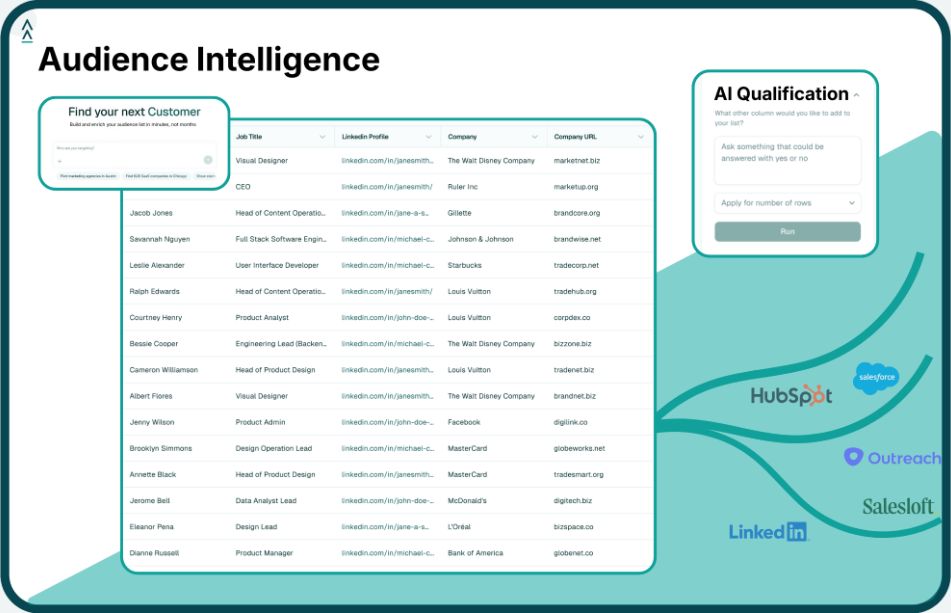
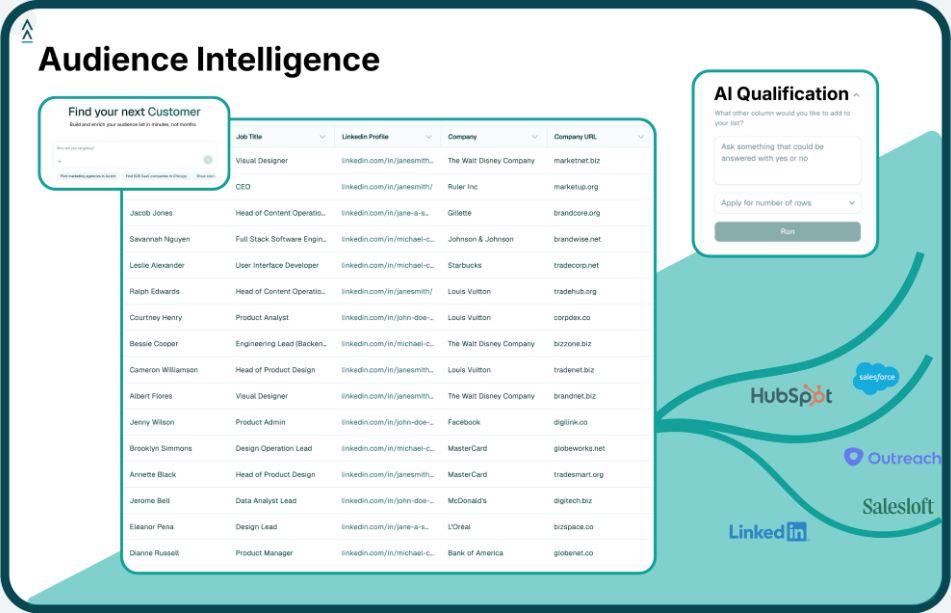
Autonomous AI Qualification (Agentic AI): Pushing the envelope further, some cutting-edge platforms deploy what’s known as agentic AI – essentially AI “agents” that don’t just score accounts, but also act on them. These agents can autonomously perform steps like researching an account, verifying key info, or even initiating first-touch outreach via email or chat – all based on predefined goals and guardrails. For targeting, an agentic AI might automatically build a micro-segment of accounts showing a specific intent signal and then qualify them by checking additional data (e.g., confirming they meet your ICP criteria via external databases) without human intervention. This kind of AI qualification dramatically compresses the time from identifying an interesting signal to engaging the account. In fact, we’re already seeing this in practice: Landbase, for example, recently launched an AI model that combines natural-language audience building with agentic AI qualification, allowing users to instantly define an audience and have the system auto-verify and score those accounts for outreach. The result is a much faster, smarter targeting workflow – teams can move “from idea to qualified outreach in a fraction of the time, reducing costs and operational complexity,” as the company’s CEO noted. In essence, AI is not only ranking your targets but proactively assembling and grooming the list of best-fit, in-market accounts.
Natural Language and Ease of Use: An important but sometimes overlooked aspect of AI in modern B2B targeting is how it improves the user experience for marketers and sellers. Advanced targeting tools now often include natural-language interfaces – you can literally type a request like, “Show me mid-stage startups in fintech that are actively hiring data scientists and researching cloud scalability” and the AI will interpret that, apply the relevant filters and signals, and produce a list. This natural-language audience building is a leap from the days of clicking through drop-down menus of industry codes and employee count ranges. It makes sophisticated targeting accessible. As Landbase’s CEO put it, “You shouldn’t need a PhD to grow your business… finding your next customer can be as easy as chatting with an AI”. By removing technical friction, natural-language queries and AI assistants enable more team members (even non-analysts) to harness complex data for targeting. The result is a frictionless UX where strategy, not software, is the focus. Marketers can iterate on audience definitions quickly, using plain English, and get immediate feedback from the system on how many accounts match and why. This speeds up the experimentation and learning cycle to hone in on the best target segments.
AI-Orchestrated Outreach: Another emerging benefit of AI in targeting is the orchestration of engagement once targets are identified. Some platforms feed high-priority target accounts directly into automated sales sequences or marketing campaigns. They can even personalize the messaging based on the very signals that triggered the account (e.g., emphasizing a feature if the intent signal was around that feature, or referencing the trigger event like a funding round). This tight integration means the moment an account becomes “hot,” they start receiving tailored outreach without waiting for the next weekly meeting or manual list pull. The speed and relevance of contact can significantly increase conversion odds, especially given that in B2B sales, being the first vendor to engage a buying team often confers a strong advantage.
To sum up, AI and real-time intelligence elevate B2B targeting by addressing the scale and speed issues inherent in multi-signal data. They ensure no signal is missed and that your team can respond in hours, not weeks. The data bears it out: data-driven teams blending AI with personalized engagement are 1.7× more likely to increase market share than those sticking to traditional methods. In practice, this means the companies who get targeting right – by combining rich data and AI – are pulling ahead of competitors. They’re spending less time and money on long-shot prospects and more on warm, high-fit opportunities.
In the final section, let’s bring it all together and discuss how you can start implementing these approaches, along with a gentle nudge toward exploring smarter targeting solutions.
It’s clear that the old playbook of B2B account targeting – uploading a static list or filtering a database by a few firmographic fields – isn’t delivering the results that modern revenue teams need. Filter-based targeting not only fails to surface the best accounts; it actively drains resources by sending teams in the wrong direction. As we’ve seen, most of your “total addressable market” is not in a buying cycle at this moment, and focusing too heavily on that 95% who aren’t ready means missing the 5% who are. In an era of intense competition and information-savvy buyers, no growing business can afford such misalignment.
So, what does a smarter B2B targeting strategy look like in practice? It comes down to a few key shifts:
Tool and strategies modern teams need to help their companies grow.