.png)
.png)

Daniel Saks
Chief Executive Officer


Most sales teams turn to RocketReach when they need affordable contact data, but honestly, the pricing landscape has gotten more complicated in 2026. More and more B2B organizations are finding that RocketReach's basic contact lookup might seem budget-friendly at first glance, but the real costs add up fast when you factor in data accuracy issues, overage fees, and the need for additional tools to actually execute outreach campaigns. With email accuracy rates reported by some third-party analyses in roughly the mid-70s to mid-80s range, and bounce-rate concerns cited by a number of users and competitor reviews, many teams are rethinking whether RocketReach delivers the quality needed for serious revenue operations.
Now, RocketReach has its strengths: 700M+ professional profiles and individual Essentials pricing of approximately $399/year (about $33.25/month when annualized) make it accessible. But as sales intelligence evolves toward AI-driven automation, teams may still incur operational overhead when combining RocketReach with external deliverability, LinkedIn automation, or enrichment workflows, depending on their stack.
The sales intelligence market is shifting rapidly in 2026, with autonomous AI platforms emerging as serious alternatives to traditional point solutions. If you're evaluating RocketReach for your team, it's worth understanding not just the published pricing, but the total cost of ownership and whether a more comprehensive approach might actually save you time and money in the long run.
RocketReach positions itself as a straightforward contact data provider, focusing on breadth of coverage rather than depth of intelligence or execution capabilities. The platform's core value lies in its massive database of 700M+ professional profiles and simple interface that allows users to look up contact information quickly.
What RocketReach delivers:
While RocketReach has expanded beyond contact lookup with native email Sequences, it is still primarily a sales intelligence and contact-data platform rather than a full autonomous GTM execution platform.
For teams building their go-to-market stack from scratch, this means RocketReach remains one piece of a larger puzzle. You may still need separate tools for LinkedIn automation, domain warming, and advanced deliverability, although RocketReach now includes native email Sequences and basic sequence analytics. This fragmentation can create meaningful manual coordination overhead that reduces the time available for actual selling activities.
When comparing RocketReach to ZoomInfo, you're essentially looking at two different market segments entirely. RocketReach serves budget-conscious SMBs needing basic contact data, while ZoomInfo targets enterprise organizations requiring comprehensive sales intelligence.
RocketReach pricing (individual plans, billed annually):
RocketReach pricing (team plans, per user/year):
ZoomInfo pricing structure (third-party estimates; ZoomInfo does not publish fixed prices on its official pricing page):
The cost difference is dramatic. ZoomInfo's estimated entry point is roughly 38x the cost of RocketReach's individual Essentials plan. However, this reflects their fundamentally different value propositions. ZoomInfo is generally positioned as a higher-accuracy enterprise platform, while RocketReach competes primarily on accessibility and breadth of coverage.
For a 5-person team, the total cost of ownership comparison reveals important insights. Note that these figures depend on tool choices, seat counts, and billing terms, so treat them as modeled scenarios:
The choice often comes down to budget constraints versus data quality requirements. Teams with limited budgets may accept RocketReach's data quality trade-offs, while enterprises prioritize accuracy and depth even at premium pricing.
Comparing RocketReach to LinkedIn Sales Navigator reveals complementary rather than competing solutions. Sales Navigator excels at social selling and lead recommendations within LinkedIn's professional network, while RocketReach focuses on extracting contact information from across the web.
LinkedIn Sales Navigator pricing (per LinkedIn's official pricing page, updated March 2026):
Key differences in approach:
Many successful sales teams actually use both tools together: Sales Navigator for identifying and engaging prospects socially, then RocketReach for obtaining direct contact information to continue conversations off-platform. However, this dual-tool approach adds complexity and cost, with both platforms charging per-user fees that compound quickly as teams scale.
For teams seeking efficiency, this dual-tool requirement represents a significant operational burden. You're managing two separate platforms, two billing relationships, and manually transferring data between systems, a process that wastes valuable selling time.
RocketReach's 2026 pricing structure offers both individual and team plans, each designed for different use cases and team sizes. Understanding the distinction between these plan types is crucial for avoiding unexpected costs.
Individual Plans (billed annually):
Essentials (~$399/year, ~$33.25/month annualized):
Pro (~$899/year annualized, or $119/month billed monthly):
Ultimate (~$2,099/year):
Team Plans (per user/year, billed annually):
Team Pro (~$996/user/year, ~$83/user/month annualized):
Team Ultimate (~$2,480/user/year, ~$206.67/user/month annualized):
Hidden costs to consider:
For most growing teams, the Pro plan represents the minimum viable option, as phone numbers are essential for effective multi-channel outreach. However, teams doing high-volume prospecting may quickly hit lookup limits, triggering expensive overage fees that can double their monthly costs.
RocketReach's email discovery capabilities remain its strongest feature, though data quality concerns persist in 2026. The platform's specific email validation methodology has not been publicly detailed by RocketReach itself, making direct comparisons to human-verified alternatives difficult to substantiate precisely.
Email discovery capabilities by plan:
The platform supports multiple email discovery methods:
However, some third-party and competitor analyses report RocketReach email accuracy in roughly the mid-70s to mid-80s range, though exact accuracy varies by segment and has not been consistently verified by a neutral benchmark. Similarly, some third-party reviews and competitor analyses cite bounce-rate concerns, including claims above 10%, but this should be treated as an attributed approximation rather than a platform-wide benchmark. Enterprise alternatives like ZoomInfo are generally positioned as higher-accuracy platforms, though specific comparative figures should be sourced from independent benchmarks.
For teams prioritizing deliverability, any accuracy gap represents a hidden cost. Poor data quality forces reps to spend additional time verifying contacts manually or dealing with bounced emails, reducing overall productivity. Some teams find they need to supplement RocketReach with separate email verification tools, adding $50-$100/month to their total costs.
Phone number lookup represents one of RocketReach's more significant limitations in 2026. Unlike email discovery, which is available on all plans, phone number access requires upgrading to the Pro plan or higher. Individual Pro is priced at approximately $899/year (~$74.92/month annualized, or $119/month billed monthly); Team Pro is approximately $996/user/year.
Phone lookup capabilities:
The phone data quality presents challenges similar to email accuracy concerns. RocketReach does not appear to market a human phone-verification process comparable to Cognism's Diamond Data, which uses actual phone calls to verify numbers before they are provided to customers.
For teams relying heavily on phone outreach, coverage limitations can be significant. Reps may waste time calling disconnected or incorrect numbers, and this inefficiency compounds when considering that phone outreach typically requires more time investment per attempt than email.
Teams doing heavy phone prospecting often find they need to supplement RocketReach with specialized phone data providers, creating another layer of tool complexity and cost. This fragmentation defeats the purpose of seeking an affordable, simple solution in the first place.
RocketReach's integration ecosystem is functional but still limited compared to enterprise alternatives in some key areas. The platform offers native integrations with major CRMs and select sales-engagement tools, but teams may still require separate solutions for comprehensive workflow automation.
Verified integrations (availability may vary by plan):
Note: Microsoft Dynamics and Zoho CRM are listed as integrations in some secondary sources; verify directly with RocketReach before relying on these.
Limited or missing integrations:
RocketReach does integrate with major sales-engagement platforms including Outreach and Salesloft, but teams may still need separate tools for LinkedIn automation and advanced deliverability workflows. Each additional integration point represents potential data loss, sync delays, and operational overhead.
For teams seeking comprehensive GTM automation, RocketReach's ecosystem means accepting some manual work or investing in additional tools for advanced use cases. This reality is worth factoring into total cost evaluations alongside RocketReach's accessible entry pricing.
To maximize ROI from RocketReach, teams need to implement specific strategies that account for the platform's limitations while leveraging its strengths.
Best practices for RocketReach users:
However, these best practices require additional time, tools, and expertise that many SMBs lack. Manual verification, bounce monitoring, list hygiene, and workflow coordination can meaningfully reduce the time available for actual selling activities, limiting the effectiveness of RocketReach as a standalone growth tool.
For teams seeking true efficiency, this manual optimization represents a fundamental limitation of point solutions like RocketReach. The promise of affordable contact data comes with hidden costs in operational complexity and lost selling time that often outweigh the initial price advantage.
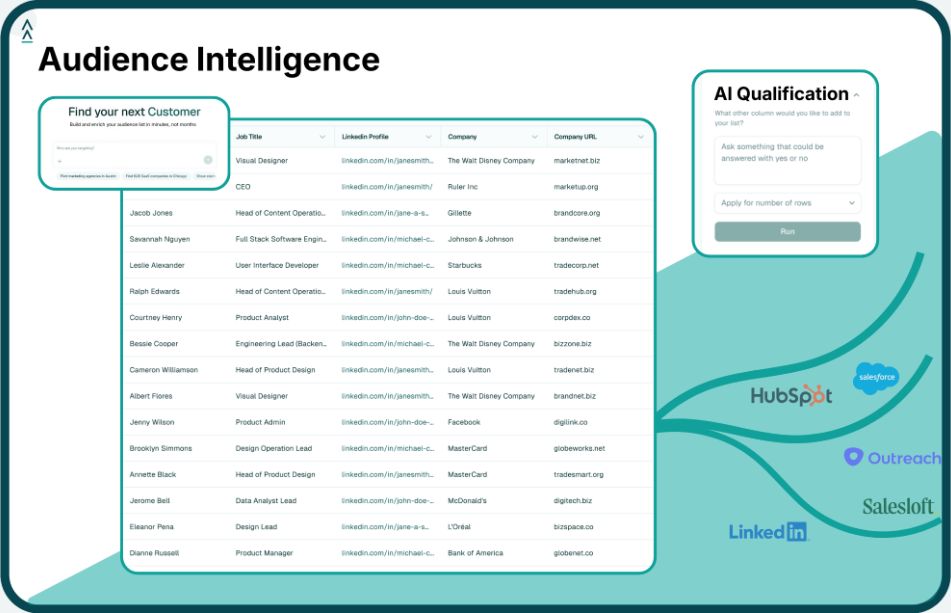
While RocketReach serves a specific need for basic contact lookup, Landbase represents a fundamentally different approach to go-to-market intelligence. Instead of providing just data, Landbase's agentic AI platform handles the entire GTM workflow autonomously, from targeting and qualification to enrichment, sequencing, and multi-channel outreach.
Key advantages of the Landbase approach:
For teams currently using RocketReach plus multiple additional tools, Landbase offers significant total cost of ownership reduction of up to 80% according to user reports. More importantly, it eliminates the overhead per rep spent managing tool integrations and manual workflows.
The platform's autonomous nature means teams can scale outreach without proportionally increasing headcount or operational complexity. AI agents continuously monitor for new ICP matches and buying signals, ensuring prospects never go stale and opportunities are never missed.
The comprehensive nature of the platform and the elimination of additional tool costs make it highly competitive on a total cost basis. For teams serious about revenue growth and operational efficiency, Landbase represents a modern alternative that addresses the fundamental limitations of point solutions like RocketReach.
The sales intelligence market is undergoing a fundamental transformation in 2026, moving from data provision toward autonomous execution. While RocketReach still centers on contact data and sales intelligence, the platform has expanded into outreach workflows, sequences, intent data, and team-management features. The market, however, is increasingly demanding true end-to-end automation.
Emerging trends that impact RocketReach's relevance:
RocketReach added native email Sequences in February 2026 and has continued investing in AI-driven, event-based workflows. Even so, it is still unlikely to match the fully autonomous capabilities of purpose-built AI platforms like Landbase, which are designed from the ground up for end-to-end GTM execution.
For teams planning long-term GTM strategy, this evolution suggests that starting with RocketReach as a foundation may require significant migration effort down the road. Teams that begin with comprehensive platforms avoid this transition cost and gain immediate access to advanced automation capabilities.
The choice ultimately depends on your team's immediate needs versus long-term strategy. If you need basic contact data today and plan to build a comprehensive stack over time, RocketReach remains a viable starting point. But if you're looking for a solution that can scale with your growth and eliminate operational complexity, modern AI-driven platforms offer a more future-proof approach.
RocketReach offers both individual and team plans in 2026. Individual plans (billed annually) include Essentials (~$399/year, ~$33.25/month annualized), Pro (~$899/year, or $119/month billed monthly), and Ultimate (~$2,099/year). Team plans are priced per user annually and include Team Pro (~$996/user/year) and Team Ultimate (~$2,480/user/year). Note that individual plans and team plans carry different pricing and feature sets, so it is important to evaluate both when scoping costs for a growing team.
RocketReach is significantly more affordable than both alternatives, with individual Essentials pricing at approximately $399/year compared to ZoomInfo's estimated entry point of $14,995+/year (note that ZoomInfo does not publish fixed prices and these are third-party estimates) and Sales Navigator Core at $119.99/month per license (or $1,079.88/year per license when billed annually). This reflects their different market positions: RocketReach provides contact data and now includes native email Sequences, while ZoomInfo delivers enterprise-grade intelligence and Sales Navigator enables social selling within LinkedIn's network.
RocketReach offers limited free usage with 5 lookups per month on their free tier, but this is restricted to email-only discovery with basic contact lookup. Full features including phone numbers and key CRM and sales-engagement integrations require paid Pro or higher plans.
RocketReach's Team Ultimate plan (~$2,480/user/year) represents their highest published tier, but they may offer custom enterprise agreements for very large organizations. Factors that typically influence custom pricing include total lookup volume, number of users, API usage requirements, and specific integration needs.
Some third-party and competitor analyses report RocketReach email accuracy in roughly the mid-70s to mid-80s range, though exact accuracy varies by segment and has not been consistently verified by a neutral benchmark. Similarly, some third-party reviews cite bounce-rate concerns, including claims above 10%, but this should be treated as an attributed approximation rather than a platform-wide figure. Phone coverage varies by market, role, and geography; some secondary sources cite roughly 60% or higher phone fill rates, though actual coverage should be independently tested for your specific use case. Enterprise alternatives like ZoomInfo are generally positioned as higher-accuracy platforms, though specific comparative figures should be sourced from independent benchmarks.
RocketReach offers integrations with Salesforce, HubSpot, Outreach, Salesloft, Pipedrive, and API integrations, with availability depending on plan. Key CRM and sales-engagement integrations generally require Pro, Team Pro, or higher plans. The platform also includes native email Sequences as of February 2026. Teams may still need separate tools for LinkedIn automation and advanced deliverability workflows, which adds complexity and cost for those requiring a fully comprehensive GTM stack. Microsoft Dynamics and Zoho CRM are listed in some secondary sources; verify directly with RocketReach before relying on these.
Tool and strategies modern teams need to help their companies grow.