.png)
.png)

Daniel Saks
Chief Executive Officer


At HumanX, the leading AI conference, one idea surfaced consistently across conversations with leaders from OpenAI, AWS, Databricks, and others:
The biggest blocker to AI adoption is whether your data can actually provide the right context to those models, not the models.
This is the insight that will define the next phase of AI in go-to-market. The models are ready, but the context layer has not caught up. And the companies that solve that gap will capture the value that everyone else is leaving on the table.
In 2024, AI models crossed a capability threshold. They could reason, generate, analyze, and act across a wide range of tasks. Every B2B company started buying AI tools. AI SDRs, AI qualification, AI targeting, AI email writers.
By mid-2025, a pattern emerged: the tools worked in demos but underperformed in production. The AI was capable. The data feeding it was not.
According to a Gartner survey, 63% of organizations either do not have or are unsure if they have the right data management practices for AI. The same research predicts that organizations will abandon 60% of AI projects unsupported by AI-ready data through 2026.
The model revolution happened overnight. The data revolution is going to take years. The companies that move fastest on data will have a compounding advantage.
The data context gap is the dominant theme at every AI conference in 2026, not a niche concern.
At HumanX, leaders from the biggest AI companies all converged on the same point: applied AI needs structured, accurate, current data to work. The model is necessary but not sufficient. The context layer, the data that tells the model what to do and why, is the missing piece.
This shows up consistently in conversations with RevOps leaders and builders. The number one challenge is data hygiene, not access to AI. Incomplete, inconsistent, and disconnected data. The same problems that have plagued CRM data for a decade are now the blockers for AI adoption.
Building the context layer for AI is not a simple data cleanup project. It requires solving four problems simultaneously:
Your CRM has internal data: deal history, engagement, notes. But it is missing external data: what is happening at the account right now? Are they hiring? Did they raise funding? Did they adopt a new technology? AI agents need both internal and external context to make good decisions.
Buying signals live in unstructured sources: job postings, news articles, social posts, podcast appearances. This information needs to be extracted, structured, and attached to the right account record. Most teams do not have the infrastructure to do this.
According to CRM data quality research, B2B contact data decays between 22.5% and 70.3% annually. The context layer requires continuous refresh because B2B data decays constantly. AI agents working with stale context produce stale decisions.
Even when the data exists, it often lives in silos that AI agents cannot reach. Firmographics in one tool, technographics in another, intent signals in a third. The agent needs all of this in one place, in a consistent format, to produce useful output.
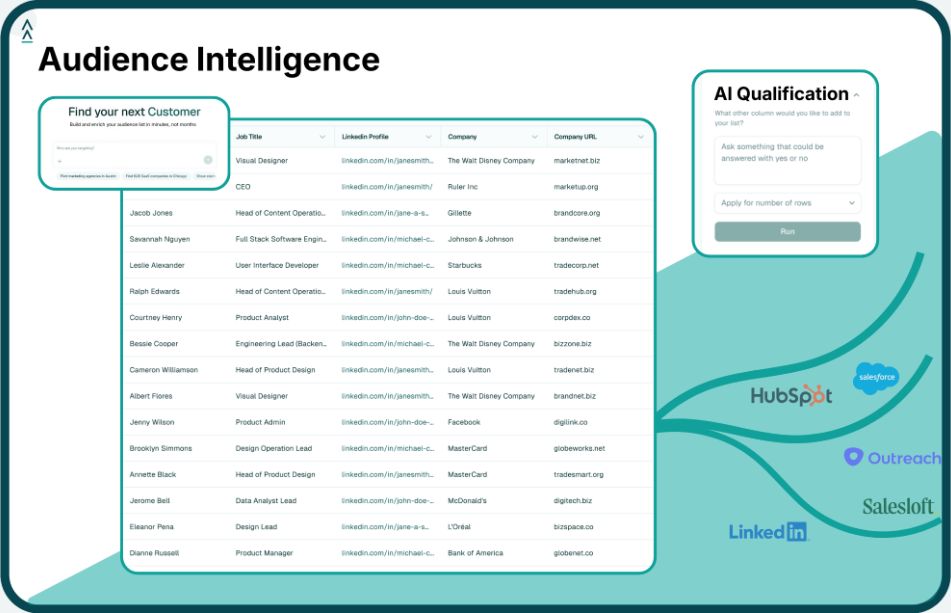
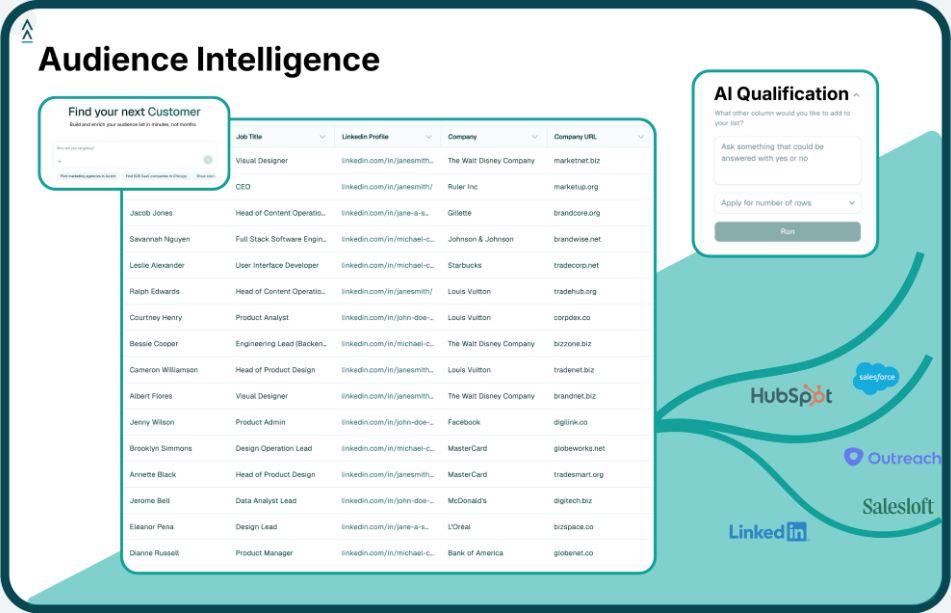
At Landbase, the mission is to solve exactly this problem for GTM teams. The platform takes your internal data and combines it with third-party data on companies and individuals, plus real-time signals, then structures and enriches it so AI can:
The output is a CSV export of AI-ready data that you import into your CRM. Every record arrives complete, consistent, connected, and current. The data context problem is solved at the point of entry.
This is the work that matters in 2026. Not building better models (the model companies are handling that). Not building better UIs (that is a solved problem). Building the data context layer that makes AI actually useful for revenue teams.
Even with how fast models are progressing, there is still real time needed for applied AI companies to help businesses make sense of their data so agents can reliably act.
Here is a realistic timeline:
The window to build the data layer is now. The teams that start in 2026 will compound their advantage every quarter. The teams that wait will find themselves trying to catch up against competitors who have been running AI on clean data for 2 years.
If you are a RevOps leader reading this, here are the three things to do before the end of the quarter:
The models are ready. The context gap is the only thing between your team and AI-powered GTM. Close the gap and the rest follows.
Partly. Data quality has always mattered. But the AI context gap raises the stakes because AI amplifies whatever it receives. Good data produces good AI output at scale. Bad data produces bad AI output at scale. The cost of bad data is materially higher with AI than without it.
Yes. Deploy AI on dirty data and you will get confidently wrong output at scale. Fix the data layer first, then layer AI on top. The order matters. Gartner predicts 60% of AI projects will be abandoned because teams got this order wrong.
With a platform like Landbase, most teams can enrich their existing CRM in 1-2 weeks and set up point-of-entry enrichment for new records in days. The data layer is a multi-week project that pays dividends for years, not a multi-year project.
Landbase is built specifically for AI consumption. The platform does not just deliver contact records. It delivers structured, enriched accounts with 1,500+ fields, signal data, and AI-powered qualification, all designed to be the context layer that makes downstream AI tools work. The focus is on making data AI-ready, not just available.
Tool and strategies modern teams need to help their companies grow.