.png)
.png)

Daniel Saks
Chief Executive Officer


Most B2B teams considering LeadGenius for lead generation assume they're getting a straightforward data solution, but the reality of LeadGenius pricing 2026 reveals a complex landscape of costs and considerations. LeadGenius does not publish fixed public pricing; its website states that pricing depends on customer needs and scale. Third-party pricing benchmarks suggest LeadGenius contracts may start around $18,000/year and can scale substantially, though actual quotes vary by campaign scope, data volume, integrations, managed services, and contract terms. LeadGenius is best described as an AI + human-in-the-loop B2B contact intelligence and data activation provider, but modern revenue teams increasingly need more than contact data delivery; they need autonomous execution. Platforms like Landbase's agentic AI GTM platform are redefining the category by replacing weeks of manual coordination with days of autonomous operation that continuously qualifies and prioritizes high-fit accounts across your total addressable market.
The B2B sales intelligence market has evolved dramatically since LeadGenius's early days as a custom data provider. Today's RevOps teams demand AI-driven automation that integrates targeting, qualification, enrichment, and outreach into seamless workflows. While LeadGenius is not typically an instant self-serve database export workflow and timelines vary by campaign complexity, newer platforms leverage agentic AI to launch campaigns in minutes rather than weeks and reduce manual research effort by ~80%.
Understanding the true cost of LeadGenius in 2026 requires looking beyond quoted base pricing to potential implementation fees, custom project costs, and the significant labor expenses that may be required to execute campaigns manually. This analysis breaks down what you're actually paying for and why autonomous alternatives might deliver better ROI for modern GTM strategies.
The lead generation software market has shifted dramatically toward AI-driven automation and end-to-end workflow integration. B2B teams no longer want isolated data providers; they need platforms that can identify, qualify, enrich, and engage prospects autonomously across multiple channels.
Several market forces are driving 2026 pricing structures:
Data Decay and Verification Requirements B2B contact data decays at 30-70% annually, requiring continuous verification and enrichment. Platforms that offer real-time data validation command premium pricing, while data providers that rely on less frequent refresh cycles may struggle with accuracy over time.
AI and Automation Capabilities The rise of agentic AI has created a clear divide between manual research providers and autonomous platforms. Vendors argue that autonomous agents operating 24/7 with minimal supervision can offset higher software costs through significant labor savings; buyers should validate this with their own workflow model before purchasing.
Multi-Channel Orchestration Many GTM teams are moving toward platforms that coordinate email, LinkedIn, phone, and other channels based on real-time response data. This orchestration capability adds complexity but can deliver higher conversion rates in the right implementations.
Integration Ecosystems Platforms with robust CRM and marketing automation integrations reduce implementation friction and increase adoption rates. Seamless data flow between systems eliminates manual export/import cycles that waste valuable time.
From Landbase's perspective, agentic AI represents one of the most significant shifts in GTM technology in recent years. Unlike rule-based automation, agentic AI systems employ specialized AI agents that can reason, plan, and execute complex workflows autonomously.
Landbase's GTM Omni multi-agent system exemplifies this new paradigm, with specialized agents for research, identity verification, predictive scoring, strategy development, SDR functions, and RevOps coordination. This architecture enables the platform to handle 40M+ B2B campaigns and 175M+ sales conversations worth of training data to continuously optimize performance.
B2B lead generation strategies have evolved from simple contact acquisition to sophisticated account-based approaches that target entire buying committees and respond to real-time intent signals.
Modern B2B lead generation effectiveness is measured by:
LeadGenius is more data- and contact-intelligence-centric than autonomous campaign orchestration platforms. Teams using LeadGenius may still need separate systems for full outbound sequencing, response handling, and autonomous follow-up depending on their package and workflow.
Effective 2026 B2B lead generation strategies focus on:
Autonomous Execution Platforms that can launch and optimize campaigns without constant human intervention deliver superior ROI. Landbase customers report launching first campaigns within days rather than weeks or months.
Real-Time Intent Integration Buying signals like hiring announcements, funding rounds, and technographic changes provide critical timing insights. Landbase's Signals feature tracks these changes to focus teams on accounts showing meaningful activity.
Multi-Channel Personalization Buying committees require coordinated outreach across multiple channels with personalized messaging for different roles. Autonomous platforms can manage this complexity without manual intervention.
Continuous Optimization AI-driven platforms learn from every interaction and continuously refine targeting, messaging, and timing based on performance data.
LeadGenius does not publish fixed public pricing or advertised base rates. Its website states that pricing depends on customer needs and scale, and its December 2025 pricing update describes a shift from credits-per-record to transparent cents-per-record campaign pricing. Understanding the true cost requires examining all potential fees and labor requirements; the figures below are drawn from third-party pricing estimates and should be confirmed directly with LeadGenius.
Some third-party pricing guides model LeadGenius pricing in three bands, but LeadGenius itself describes tailored pricing rather than fixed public tiers. Actual quotes vary by campaign scope, data volume, integrations, managed services, and contract terms.
Estimated Entry-Level: ~$18,000-$30,000 annually (third-party benchmark)
Estimated Mid-Market: ~$50,000-$80,000 annually (third-party benchmark)
Estimated Enterprise: $120,000+ annually (third-party benchmark)
Beyond quoted base pricing, LeadGenius customers may face additional expenses. The following figures are drawn from third-party pricing estimates and are not confirmed by LeadGenius's official pricing materials; actual costs should be confirmed directly with LeadGenius.
Implementation Fees: $2,500-$25,000 (third-party estimate) Implementation costs may vary significantly by tier and complexity, with enterprise implementations potentially exceeding $15,000.
API Access (pricing not publicly disclosed) LeadGenius API documentation confirms that API subscriptions and keys exist, but no official API fee range is publicly disclosed. Buyers should confirm API access costs directly with LeadGenius.
Custom Project Fees: variable (third-party estimates suggest $2,000-$25,000 per project) Each custom research request may incur additional charges depending on complexity and scope. Confirm pricing structure directly with LeadGenius.
Data Verification Add-Ons: variable (third-party estimates suggest $1,500-$8,000) Enhanced verification services for critical contacts may add costs. Confirm availability and pricing directly with LeadGenius.
Manual Labor Costs: illustrative modeling estimate of $40,000-$80,000 annually One of the most significant considerations for total cost of ownership is the labor potentially required to execute campaigns manually. Teams may need fractional SDR resources to manage outreach, follow-up, and campaign optimization, depending on their LeadGenius package and internal workflows. Actual costs depend on your specific staffing model and which execution features are included in your package.
The sales intelligence market includes several major players with different strengths and pricing models. Understanding how LeadGenius compares helps contextualize its value proposition.
ZoomInfo: custom quote-based pricing
Apollo.io: $49-$119/user/month billed annually ($59-$149/user/month billed monthly)
Cognism: tailored quote-based pricing
LinkedIn Sales Navigator: ~$1,080/user/year (Core, annual billing) to ~$1,800/user/year (Advanced, annual billing); Advanced Plus is custom-priced
The fundamental difference between LeadGenius and modern platforms like Landbase is the degree of human involvement versus autonomous operation:
LeadGenius (AI + Human-in-the-Loop Contact Intelligence Model)
Landbase (Autonomous AI Model)
When evaluating LeadGenius versus autonomous alternatives, total cost of ownership (TCO) provides the clearest picture of true value. The following comparison is an illustrative scenario based on third-party pricing estimates; actual costs depend on your specific LeadGenius quote, staffing model, usage, and included services.
In this illustrative model, Landbase represents significantly lower total cost. Actual savings depend on your specific LeadGenius quote, staffing model, usage, and which services are included in your package.
Time to Value
Productivity Gains
Conversion Rate Impact
Data quality remains a critical factor in lead generation effectiveness, with significant differences in how providers source, verify, and maintain their databases.
LeadGenius
Landbase
LeadGenius Data Verification
Landbase Data Verification
While LeadGenius serves a specific niche for custom, contact-intelligence-driven data programs, most modern GTM teams need more than data delivery; they need autonomous execution that continuously optimizes performance.
Landbase's agentic AI GTM platform represents the next generation of sales intelligence, combining comprehensive data capabilities with true autonomous execution. The platform's multi-agent architecture enables specialized AI agents to work 24/7 on targeting, qualification, enrichment, and outreach without human intervention.
Key advantages that make Landbase worth exploring:
True Autonomous Operation Landbase is the only platform with true agentic AI capable of end-to-end campaign execution. While LeadGenius publicly emphasizes contact intelligence, activation, monitoring, and data delivery rather than fully autonomous GTM execution, Landbase's AI agents coordinate multi-channel outreach based on real-time response data.
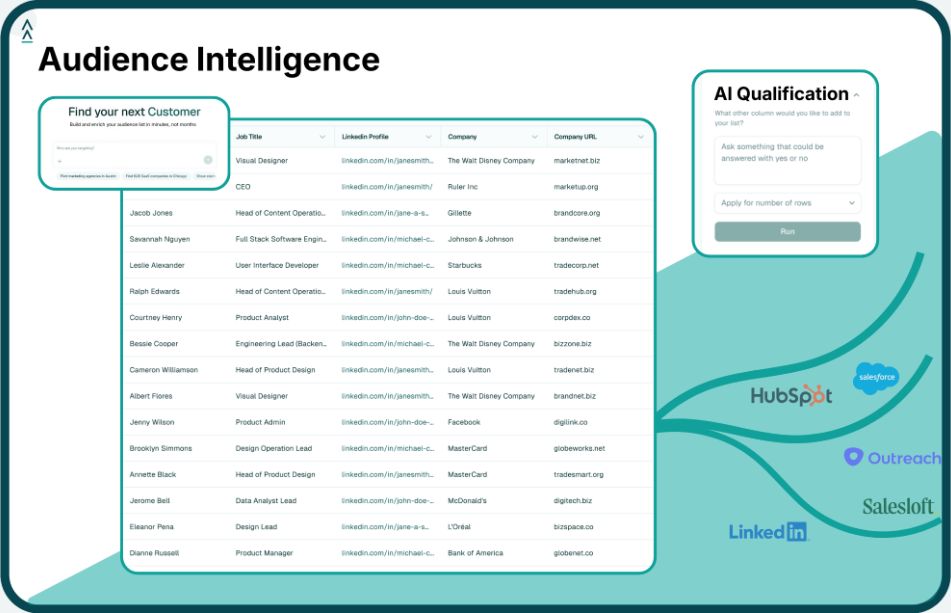
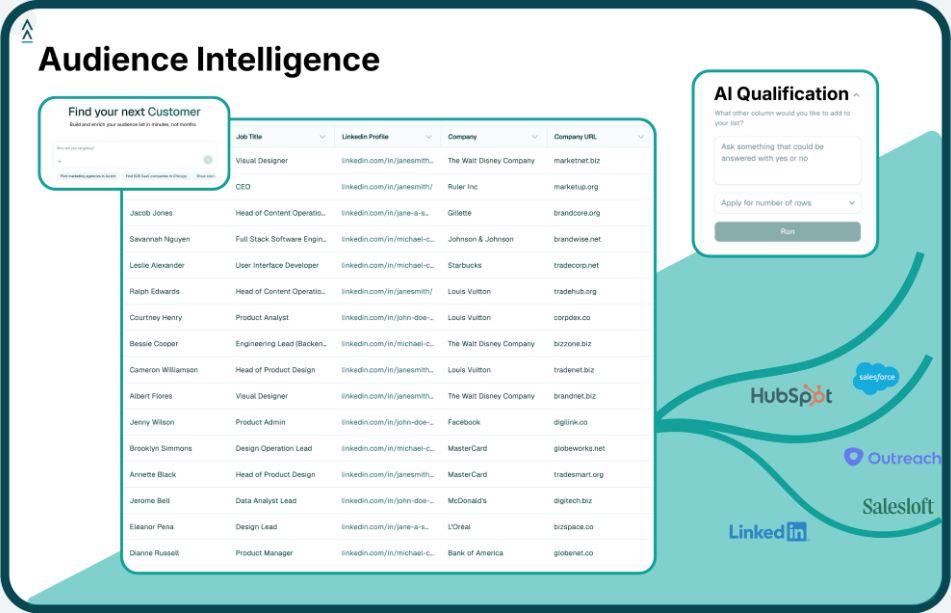
Rapid Time-to-Value Most Landbase customers launch their first campaigns within days rather than the weeks typical of more manual research-dependent workflows. The platform's Agentic Search feature enables teams to build audiences using plain English descriptions, eliminating complex Boolean queries.
Predictable, Transparent Pricing Landbase offers predictable pricing without hidden add-on fees, contrasting with the complex pricing considerations of LeadGenius, where third-party estimates suggest mid-market contracts can approach or exceed $80,000 annually before accounting for potential implementation, custom project, and manual labor costs.
Comprehensive Data Capabilities Landbase's 300M+ B2B contacts and 24M+ accounts provide extensive coverage, while the waterfall enrichment across 20+ data providers ensures data quality and completeness. The platform's Signals feature tracks real-time buying signals like hiring, funding, and technographic changes.
Multi-Channel Orchestration Landbase's autonomous agents coordinate outreach across email, LinkedIn, and phone channels based on real-time response data. This multi-channel orchestration is essential for engaging modern buying committees of 6-10 stakeholders, a capability that LeadGenius does not publicly position itself as providing in a fully autonomous manner.
For many common GTM use cases that don't require ultra-custom, human-driven research, Landbase delivers superior ROI through autonomous execution, rapid deployment, and predictable pricing. The platform's Gartner Cool Vendor 2025 recognition validates its innovative approach to AI-driven GTM automation.
Despite the advantages of autonomous platforms, LeadGenius retains value in specific scenarios:
Ultra-Custom Research Requirements For organizations needing AI + human-in-the-loop researchers to investigate extremely niche markets or hard-to-find contacts (e.g., CEOs of 50-employee biotech companies in Switzerland using specific software), LeadGenius's bespoke approach may justify the higher costs and potentially longer timelines.
Bespoke Campaign-Based Data Needs Organizations with specific bespoke data requirements may find LeadGenius's tailored approach attractive. Confirm contract structure directly with LeadGenius, as its December 2025 pricing update describes a cents-per-record campaign pricing model. However, even for these use cases, autonomous platforms can often deliver comparable results faster and at lower total cost.
Regulated Industries With Auditable Sourcing Preferences Some regulated organizations may prefer auditable, human-reviewed sourcing and verification processes. However, Landbase's 4 layers of verification and integration with premium data providers like Cognism often satisfy even stringent data quality requirements.
The primary factors influencing 2026 lead generation software pricing include autonomous AI capabilities, multi-channel orchestration features, data quality and verification processes, integration ecosystem breadth, and total cost of ownership including manual labor requirements. Platforms offering true agentic AI that eliminates manual research command premium pricing but can deliver superior ROI through labor cost elimination.
While AI-driven platforms like Landbase may have different base pricing compared to basic data providers, their total cost of ownership may be significantly lower due to 80% reduction in manual research time and elimination of hidden costs. Traditional tools like LeadGenius may appear cheaper based on third-party benchmark estimates, but total costs can grow substantially through implementation fees, custom project charges, and manual labor expenses depending on your staffing model and package.
The average cost per lead varies significantly by industry, company size, and targeting complexity. Autonomous platforms like Landbase can reduce effective cost per lead significantly compared to manual research providers through labor elimination and higher conversion rates. Landbase customers report "4-7x higher conversions" compared to traditional methods, which substantially lowers the effective cost per qualified opportunity.
To ensure ROI from lead generation investments, focus on platforms that offer autonomous execution rather than just data delivery, measure time-to-value (days vs. weeks), calculate total cost of ownership including manual labor, and prioritize multi-channel orchestration capabilities. Platforms like Landbase that enable campaigns to launch in days rather than weeks and eliminate 80% of manual research effort typically deliver superior ROI compared to manual research providers.
Intent data is increasingly expected in modern GTM stacks, though packaging varies by vendor and plan; many vendors still offer intent data as a higher-tier or add-on feature rather than a standard inclusion. Landbase's Signals product provides real-time intent alerts tracking hiring, funding, and technographic shifts as part of its core platform. The focus has shifted from basic intent data availability to how effectively platforms integrate and act on these signals through autonomous workflows that respond to real-time buying committee activity.
Tool and strategies modern teams need to help their companies grow.