.png)
.png)

Daniel Saks
Chief Executive Officer


Here's what most RevOps teams get wrong about sales intelligence pricing: they evaluate solutions based on contact export costs instead of account prioritization effectiveness. For large revenue teams, the gap between data volume and revenue impact can materially increase labor cost and opportunity cost through wasted prospecting effort and missed pipeline opportunities.
Revenue teams don't need more contacts, they need better prioritized accounts. They don't want export limits, they need autonomous qualification that surfaces high-fit opportunities without manual filtering. When your sales intelligence strategy aligns with actual go-to-market outcomes rather than database size, you stop paying for unused credits and start generating qualified pipeline that converts.
This is where agentic AI for GTM intelligence separates modern revenue organizations from legacy approaches. Teams using AI agents to automate targeting, qualification, and enrichment transform static contact databases into dynamic pipeline generation engines that learn from every campaign interaction. The question isn't whether to invest in sales intelligence, it's whether you can afford to prospect manually in 2026.
Lead411 positions itself as an affordable alternative to enterprise sales intelligence platforms, with transparent public pricing across three tiers: Spark (entry), Ignite (mid-tier), and Blaze (enterprise). However, recent research reveals significant inconsistencies in pricing details across sources, likely due to late 2025 rebranding and multiple pricing structures for different segments.
Official Spark Plan Pricing Shows Conflicting Data:
The Spark plan includes verified email addresses, direct phone numbers, advanced search criteria, and 25+ CRM integrations. However, a critical limitation exists: Buyer Intent Data is only available with annual billing per Lead411's current pricing page. Month-to-month plans exclude Buyer Intent Data entirely, creating a significant feature gap that creates pressure toward annual commitments. Note that whether the annual Spark plan specifically includes Bombora-powered intent versus Lead411's own intent product is inconsistent across Lead411's public pages; buyers should confirm directly with Lead411 before assuming Bombora is included at the Spark tier.
Ignite Plan (Mid-Tier) Pricing:
The Ignite tier unlocks essential features missing from Spark, including API access and team reporting. Note that Lead411's current pricing page lists lead scoring and international search as features included across all subscription tiers, so those are not Ignite-only unlocks. This tier represents the minimum viable configuration for mid-market teams requiring integration capabilities and collaborative workflows.
Blaze Plan (Enterprise) Details:
Enterprise teams face significant total cost of ownership considerations. Publicly available pricing is insufficient to reliably estimate a 25-user Blaze deployment; buyers should obtain a direct quote from Lead411. Third-party estimates suggest materially lower seat and add-on pricing than commonly cited figures, though actual enterprise contracts may vary.
The research reveals a concerning pattern of pricing inconsistencies that create decision-making friction for buyers. These discrepancies likely stem from recent rebranding, promotional pricing, and historical data still appearing on third-party listing sites.
Export Limit Confusion:
The Spark tier shows conflicting export allowances , Lead411's official pricing page shows 1,000 exports/month at the monthly rate, while some third-party sites still reference 200 exports/month from older plan structures. This discrepancy dramatically impacts cost-per-lead calculations and workflow planning. Teams should confirm current export allowances directly with Lead411 before planning workflows.
Hidden Total Cost of Ownership Factors:
For a 10-user Ignite deployment, Lead411's current public list pricing implies roughly $15,000/year at the annual rate of $1,500/user/year, or approximately $18,000/year at the monthly rate of $150/user/month. Onboarding, integration, and training costs are not publicly disclosed by Lead411 and will vary by organization.
Lead411's pricing structure reflects a contact-centric approach that's increasingly misaligned with modern RevOps requirements. While the platform offers verified contact data and direct dials at competitive prices, it does not publicly position itself as a full multi-agent GTM orchestration platform in the way that defines 2026's sales intelligence leaders. Lead411 does offer an AI Search Assistant, lead scoring, growth intent signals, and an AI dashboard, but these capabilities are distinct from autonomous, end-to-end account qualification.
Key Differences in Lead411's Approach:
The market is shifting toward account-based intelligence platforms that prioritize quality over quantity. Teams no longer need to export thousands of contacts, they need AI agents that continuously qualify, score, and prioritize high-fit accounts across their total addressable market.
Lead411's pricing structure creates specific strategic implications for different organization types:
Small Teams (1-5 Users):
Mid-Market Teams (5-15 Users):
Enterprise Teams (15+ Users):
User satisfaction data shows strong value perception, with G2 ratings of 4.5/5 and Capterra ratings of 4.7/5. However, common public-review concerns include lower-tier export restrictions, occasional outdated or inaccurate contact data, and monthly plan limitations. Overage fee concerns appear in third-party pricing analyses but are not disclosed on Lead411's current pricing page.
While Lead411 takes a more traditional approach to sales intelligence pricing, Landbase delivers the next generation of GTM intelligence through autonomous AI agents that eliminate manual prospecting bottlenecks.
Why Landbase Addresses Lead411's Core Limitations:
Landbase's approach transforms the sales intelligence value proposition from "more contacts" to "better prioritized accounts." Instead of paying per export, teams pay for AI agents that continuously surface high-fit opportunities ready for outreach. This aligns pricing directly with revenue outcomes rather than data volume.
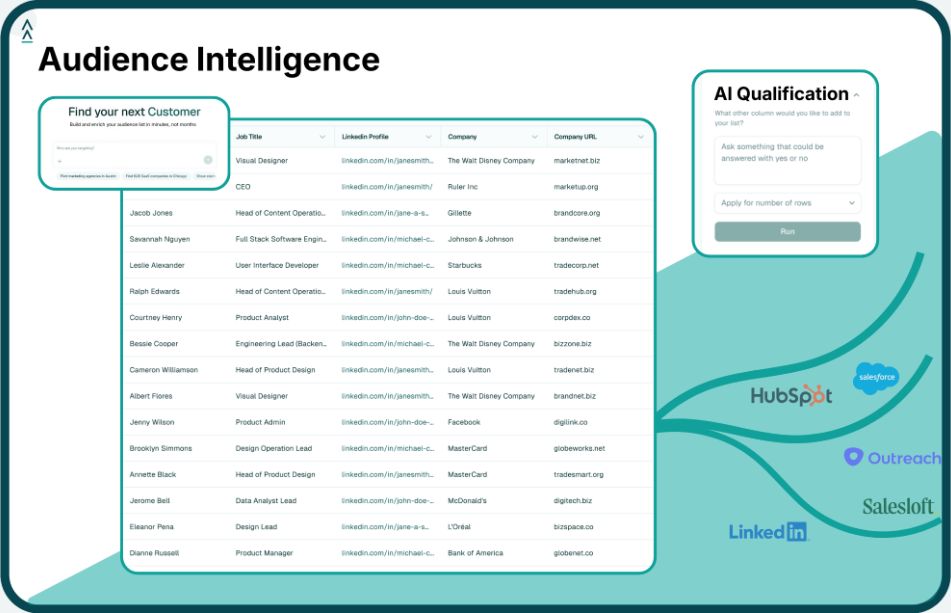
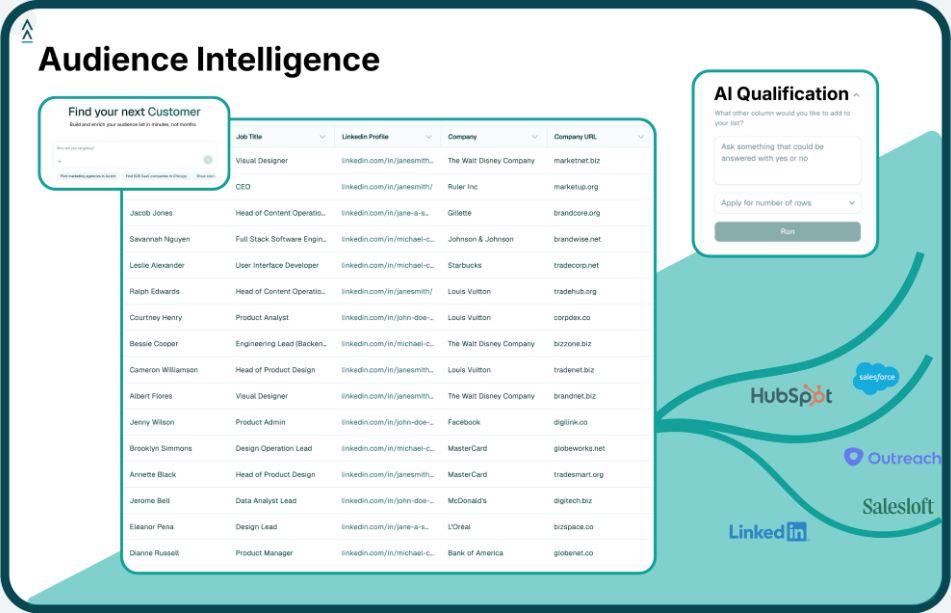
The platform's agentic search capability allows teams to describe their ideal customer profile in plain text and receive verified, scored account lists ready for their CRM. Lookalikes functionality finds net-new companies sharing traits and buying patterns with existing best accounts. Signals provide real-time intent alerts to focus teams on accounts showing meaningful change.
For RevOps teams evaluating sales intelligence in 2026, the choice is clear: continue managing export limits and search-driven filtering with legacy platforms, or embrace agentic AI that automates prospecting workflows and delivers qualified pipeline ready for outreach.
The decision between Lead411 and modern alternatives like Landbase ultimately depends on your team's workflow maturity and strategic priorities. Lead411 serves teams comfortable with search-driven list building and export-based pricing, while Landbase empowers teams ready to eliminate prospecting bottlenecks through AI automation.
Key evaluation criteria for 2026:
Revenue teams that prioritize pipeline quality over contact quantity, automation over manual effort, and account-based intelligence over point solutions will find greater strategic alignment with agentic AI platforms. Landbase's 80% reduction in manual research effort and 4-7x higher conversion rates delivered by autonomous qualification represent a fundamental shift in sales intelligence ROI.
Lead411 offers a 7-day free trial with 50 free exports. Unlike competitors that gate advanced features behind paid tiers, the trial includes verified emails, direct dials, advanced search, and Chrome extension access. Monthly plans appear not to include Buyer Intent Data per Lead411's current pricing page. Trial inclusion of intent data is less clear: the pricing page does not list intent data in the trial row, but Lead411's Bombora page advertises a buyer-intent free trial; confirm current trial terms directly with Lead411. During your trial, focus on export quality validation, search functionality testing, and CRM integration setup. Test whether 50 exports are sufficient to validate data accuracy for your specific ICP, and evaluate whether the search-driven list-building workflow aligns with your team's efficiency requirements.
Based on public user reviews and competitive analysis, commonly cited concerns include: export limits becoming restrictive as teams scale (particularly on Spark tier), monthly plans not including Buyer Intent Data which creates pressure toward annual commitments, and weaker coverage for EMEA/APAC-focused teams. Note that Lead411 does offer built-in Reach email and SMS automation with cadence functionality, so it is not a purely data-only platform. Teams often find the Spark tier's limitations become binding as they scale, but find the Ignite tier's $150/month price point too expensive for their budget, creating a mid-market gap that leads to competitive switching.
Lead411 claims a 96% average email deliverability rate for optimized verified emails, supported by triple verification and at-least-90-day re-verification. Independent public accuracy benchmarks are inconsistent and insufficiently transparent to support a firm alternative figure; user reviews on G2 note occasional outdated or inaccurate contact data, particularly for phone numbers and niche markets. Lead411 is commonly positioned as lower-cost than enterprise alternatives. ZoomInfo does not publish fixed pricing and states its pricing does not start at $15,000; however, several third-party estimates place ZoomInfo entry contracts around $15,000/year, compared to Lead411's $490/year Spark annual entry point. The trade-off may be acceptable for mid-market teams prioritizing cost efficiency, but may be insufficient for organizations with strict data-quality SLAs or low tolerance for bounced or outdated records. Phone number coverage is strong for US direct dials but weaker internationally, reflecting Lead411's primary focus on English-speaking country data per its own FAQ.
Yes, Lead411 explicitly offers contract buyout programs "in certain cases" for teams switching from existing B2B data providers. This reduces switching friction for organizations locked into annual contracts with competitors. The company also states they will "match or beat most Enterprise Competitor Pricing Quotes," creating additional negotiation leverage for teams considering alternatives. On Lead411's intent-data comparison page, Lead411 lists its buyer intent add-on at $1,000/user/year versus ZoomInfo intent at $12,000/user/year and Bombora direct at $30,000/user/year, representing a significant cost difference depending on the specific comparison.
Teams should evaluate API access necessity based on their integration requirements and automation workflows. If your organization relies on custom workflows, Zapier integrations, or programmatic data access, the Spark tier's lack of API will create significant operational friction. Calculate your total cost of ownership including any middleware costs versus the Ignite tier's all-inclusive API access. For teams with 5+ users requiring integrations, the per-user API cost at Ignite may actually be more economical than Spark plus middleware solutions.
Lead411 excels for US-focused sales teams in industries with well-defined contact requirements: SaaS, professional services, and B2B services with domestic customer bases. The platform is well-suited for small to mid-market teams needing affordable intent data without enterprise pricing. However, teams requiring deep global coverage for EMEA/APAC, real-time data verification, or high-volume unlimited exports should consider alternatives. Organizations with mature RevOps functions focused on account-based strategies rather than contact-centric prospecting may find modern agentic AI platforms better aligned with their workflow requirements.
Tool and strategies modern teams need to help their companies grow.