.png)
.png)

Daniel Saks
Chief Executive Officer




At the foundation of every customer data platform is event collection – the continuous capture of customer behaviors and interactions across all channels. Every page view, email click, product login, webinar signup, and ad impression is a valuable data point. By aggregating these events, customer data platforms create a rich timeline of each customer’s journey. This comprehensive behavioral history is what allows you to later identify “high-intent” signals. It’s no surprise that 93% of marketers say gathering first-party customer data is more important now than it was two years ago(2), underscoring how critical event collection has become in a world moving beyond third-party cookies.
Collecting events means instrumenting all your touchpoints with tracking – from website analytics and mobile app events to CRM interactions and in-product usage. A robust CDP will provide SDKs or APIs to stream these events in real time. For example, you might capture when a visitor watches a product demo video, or when a user’s trial account hits a usage milestone. Each event, tagged with details (timestamp, device, content viewed, etc.), feeds into the CDP. Over time, these accumulate into a behavioral profile that reveals interest and intent.
One key challenge here is ensuring no data silos remain. If your web analytics, email platform, and product database all store data separately, you risk losing the unified view. Nearly half of marketers (47%) say data silos are their biggest problem, blocking insights and decision-making(3). A CDP solves this by acting as the central repository where all event data converges. This integrated approach not only saves time (marketers spend less time hunting down data across systems) but also unlocks insights that siloed data could never reveal. In the B2C world, Starbucks famously aggregates purchase, app, and loyalty data to tailor offers; the same principle applies in B2B or any context – you need allthe signals in one place to truly know your audience.
Start by identifying the highest-value events that indicate interest in your offering. For a SaaS company, this might be events like visiting the pricing page, starting a free trial, or using a key feature. Instrument these first. Over time, expand to capture broader engagement (content downloads, support chats, etc.). Every bit of behavior can enrich the picture of intent.
Nearly 84% of marketers rely on first-party customer data as a top source for insights(1). However, only 31% are fully satisfied with their ability to unify and use this data effectively(1). This gap illustrates why simply collecting events isn’t enough – it must be followed by proper identity unification and analysis (steps 2–5 ahead) to realize its full value.
Landbase enhances event collection by injecting live external signals into your data mix. While your CDP gathers first-party events, Landbase continuously scouts the digital landscape for relevant buyer intent cues – from firmographic changes (like a company securing new funding) to technographic insights (e.g. adopting a new tool) and behavioral intent (such as job postings indicating a new initiative). These 1,500+ dynamic signals form an external event layer that Landbase can feed into your CDP profiles, enriching them with context beyond what you directly observe. For instance, if a prospect is visiting your site and Landbase detects that their company is “actively hiring for data engineers” (a possible sign of upcoming projects), you’ve identified a potentially higher intent account. By collecting both internal and external events, you ensure no clue of buyer interest goes unnoticed.
Collecting raw events is only the first step. The true power of a CDP comes from identity resolution – stitching together all those event signals into unified customer profiles. In this step, you connect the dots so that “Anonymous Visitor 123 who downloaded your whitepaper” and “[email protected] who opened your email” and “John Doe, VP at Acme Inc. in your CRM” are recognized as the same person. Customer data platforms use deterministic matching (like email, login IDs, device IDs) and probabilistic algorithms (matching behaviors or IP addresses) to merge records and create a single customer view. This unified profile lets you see each individual’s journey holistically, which is vital for identifying high-intent patterns.
Why is identity unification so critical? Without it, your data remains fragmented. You might see a surge in product trial usage but not realize it’s the same account whose VP just spoke with your sales team. Unified profiles eliminate this blind spot. Yet, it’s a tough challenge – only 31% of marketers are fully satisfied with their data unification ability(1), as noted above. The rest struggle with duplicate or disconnected records. Successful CDP implementations invest heavily in identity resolution rules and data quality: for example, establishing a primary key (such as an email or customer ID), setting up cross-domain tracking, and using identity graphs to reconcile users across devices (web cookie, mobile device ID, etc.). The result is a master customer profile that anyone – marketing, sales, or service – can rely on for accurate, up-to-date information.
A unified profile typically contains attributes (descriptive data like name, title, company, industry, lifetime value) and activities (the timeline of events from Step 1). To illustrate, imagine Jane from XYZ Corp: a CDP might consolidate her webinar attendance, website chats, and product usage under one profile. From there, you can observe her journey and infer intent (e.g., multiple visits to the “Pricing” page + opened our pricing email = strong buying signal). Identity unification also connects accounts in B2B contexts – linking individual stakeholders to an account-level view. If five people from the same company are engaging with you, a good CDP will let you unify that into an account profile as well, giving sales a 360° account snapshot.
Regularly audit your unified profiles for accuracy. Identify common duplicate causes (e.g., slight email variations, tracking issues) and refine your matching logic. Leverage your CRM as a source of truth for known identities, but enrich it with the behavioral data from your CDP. Also, enforce data governance – e.g. ensure consistent spelling of company names or use of a unique account ID – to help automated identity resolution work effectively.
Investment in solving identity and data unification is rising rapidly – integration of martech and data is such a pain point that marketers are predicted to triple their spending on unifying customer data across their tech stack in the next two years(1). Clearly, getting the single customer view right is a top priority as organizations realize it underpins all advanced targeting efforts.
Landbase turbocharges identity unification through data enrichment. Once your CDP ties a user’s identities together, Landbase can append rich firmographic and demographic details to that profile, filling in gaps. For example, Landbase can match a visitor’s email domain to their company and instantly provide insights like company size, industry, revenue, recent funding, technologies used, and more. This enriched profile helps you understand who that person really is and whether they fit your ideal customer profile. Landbase’s data platform covers 210 million contacts and 24 million companies with verified information, so you can often go from just an email to a full prospect persona. Additionally, Landbase’s identity graph can link leads to accounts – ensuring that when multiple people from Acme Inc. engage, you see the consolidated account view. By unifying first-party identities with third-party context, you get a truly holistic profile. As a result, your “single customer view” is not only unified but deeply informative, which is crucial for the next steps of segmentation and targeting.
With unified, enriched profiles in hand, the next step is to define segments that isolate your high-intent audience. Segmentation is where the magic of all that data becomes actionable. A CDP lets you query profiles based on attributes and behaviors to group people or accounts with common characteristics – especially those indicating purchase intent. For example, you might build a segment of “Website visitors from fintech companies who viewed the pricing page 3+ times and have a team size > 500.” These are likely hot prospects.
Segments can be simple or complex. A simple segment might be just “all trial users in the last 30 days.” A more advanced one might layer multiple criteria: demographic (industry, job title), firmographic (company size or revenue), and behavioral (specific events or frequency). The goal is to capture those users who resemble your best customers or who are exhibiting buying signals. According to research, marketers have seen a whopping 760% increase in revenue from segmented campaigns(5) – evidence that finely targeted audiences dramatically outperform one-size-fits-all approaches. Even basic segmentation can yield big gains: segmented emails drive 50% higher click-through rates than non-segmented sends(4), due to the improved relevance(4).
When building high-intent segments in a CDP, consider these strategies:
High-intent segments essentially operationalize the Ideal Customer Profile concept. You’re taking what you know about who is most likely to buy (and buy quickly, with big deals) and finding those prospects in your data. The beauty of a CDP is you can get very granular and combine data types that typically live apart. For instance, a segment could be: “contacts in our CRM who downloaded the last two case studies and whose company just raised a Series B funding.” That mixes behavioral, content engagement data with external firmographic context – a powerful combo that likely indicates a prime target for sales outreach.
Personalization and precision are everything – 80% of consumers say a personalized experience makes them more likely to purchase, and in B2B, campaigns targeting specific accounts or segments see far higher engagement. By focusing on narrower, high-intent segments, you’re catering to this need for relevance and thereby dramatically increasing your odds of conversion.
Landbase shines in the segmentation stage by providing the live intent signals and AI-driven analysis to define truly high-intent groups. Through Landbase, you can incorporate signals like “currently hiring for X roles,” “recently opened new office,” “technologies recently adopted,” or content engagement across the web. For example, Landbase can tell you if a set of target accounts has shown surging interest in a topic related to your product (perhaps via third-party intent data or content consumption patterns). These insights let you create segments that zero in on in-market buyers – something a basic CDP, limited to your own data, might miss.
Landbase also enables look-alike audience creation with ease. You can input a list of your best customers (or a successful segment from your CDP), and Landbase’s AI will find other companies or contacts that mirror that profile. For instance, if your top customers in the cybersecurity vertical share certain firmographic and technographic traits, Landbase can produce a list of similar companies that aren’t yet in your funnel – effectively an automatically generated high-intent segment based on pattern matching. One use case in the Landbase platform saw a marketing director upload a CRM segment of their highest-value accounts; Landbase returned 500 look-alike accounts with matching signal profiles. This kind of audience expansion ensures you’re not leaving any high-potential prospects on the table.
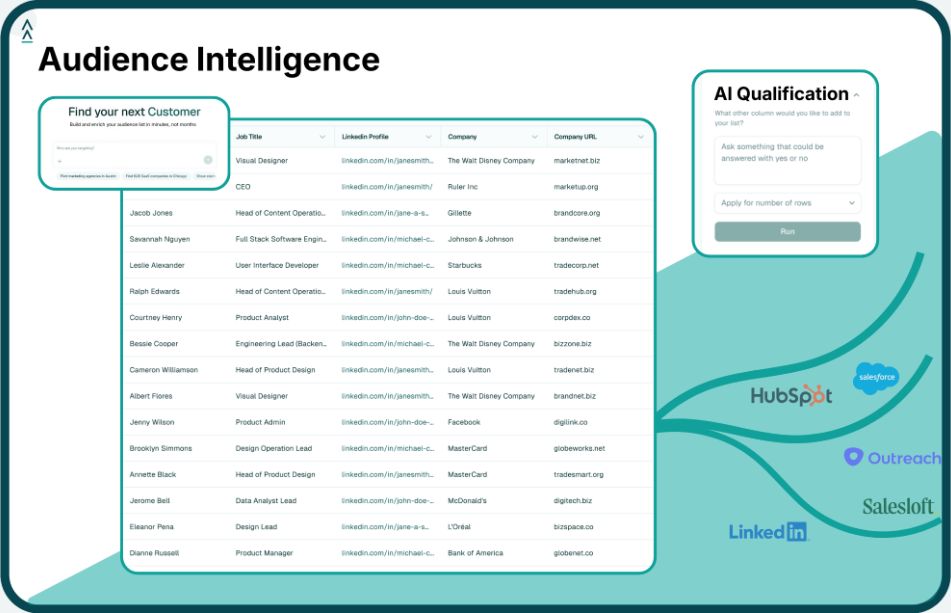
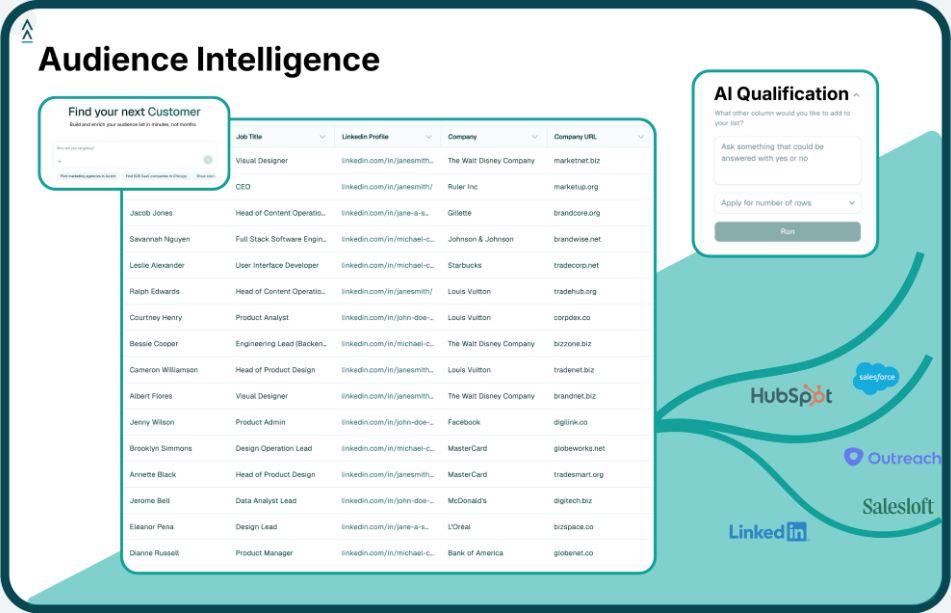
Additionally, Landbase’s natural-language audience search allows GTM teams to craft segments just by describing them. For example, you could ask for “Healthcare CFOs at mid-size hospitals researching revenue cycle solutions,” and Landbase will interpret that prompt to produce a precise list of contacts fitting the description, qualified with real-time data. This agentic AI capability means you can generate hyper-specific high-intent audiences in seconds, without manual data querying. Once Landbase delivers these segments (complete with verified contact info), you can push them back into your CDP or CRM – primed for activation in the next step.
A segment of high-intent prospects isn’t valuable until you act on it. Step 4 is all about activation – using those segments to launch targeted, timely outbound sequences. These could be marketing automation workflows (nurture emails, retargeting ads, SMS campaigns) or sales outreach sequences (personalized sales emails, calls, LinkedIn touches) or a coordinated play across both. Customer data platforms often integrate with various execution tools – email service providers, ad networks, CRM, sales engagement platforms – to push audience segments out and trigger the right sequence for each segment.
For example, once you’ve identified that segment of “fintech visitors with 3 pricing page views,” you might sync that segment to your email marketing tool and enroll them in a special email sequence highlighting your fintech client success stories and inviting them to a custom demo. Simultaneously, the list could be sent to your sales team’s outreach tool so reps can perform quick follow-ups or drop those accounts into a call cadence. The key is using the CDP’s unified data to ensure the outreach is contextual and well-timed. A classic scenario is triggering a sales alert: e.g., “Notify the account owner and start a sequence whenever an existing lead’s intent score goes above 80 or they visit the pricing page 2 days in a row.” These kinds of triggers make sure hot prospects get immediate attention.
The effectiveness of triggered, personalized outreach is clear – automated emails generate 320% more revenue than standard one-size-fits-all emails(5), and triggered communications can have conversion rates 3-5× higher than batch sends. Rather than sending a generic newsletter to everyone, you’re sending the right message at the right moment to a precisely defined audience. Marketing automation statistics consistently show that triggered campaigns (like welcome series, re-engagement campaigns, or post-demo follow-ups) dramatically outperform generic blasts in both engagement and ROI. One study found 77% of email ROI comes from segmented, targeted, and triggered campaigns(5), underlining how crucial this step is for getting results from your data.
In practice, to do this well, you need clearly defined playbooks for each high-intent segment. For each segment, ask: what outcome do we want? If it’s a group of trial users exhibiting purchase intent, perhaps the sequence is designed to get them on a call with sales (so the CTA might be scheduling a consultation). If it’s a segment of existing customers showing upsell intent (e.g., using 80% of their current license capacity), the sequence might promote an upgrade. Using CDP data, you can tailor not just who you contact, but when (trigger immediately after the intent signal) and how (with which channel and content). Align with sales so that marketing and sales sequences complement each other – e.g., marketing might warm them up with content, then sales follows up personally a day later, all orchestrated by triggers from the CDP.
Leverage multi-channel sequences for higher impact. A prospect might receive an email, see a LinkedIn ad, and get a call – all coordinated around the same message – because your CDP segment was pushed to all those channels. Also, use personalization within those sequences: dynamic fields or even AI-driven content that references the specific behavior or attribute that landed them in the segment (“Hi John, noticing you’ve been exploring our pricing page on Product X...”). This level of relevance can significantly boost response rates.
Speed to engagement is essential – studies show contacting a lead within an hour of an intent signal can increase conversion rates up to 7x compared to waiting even 24 hours. Additionally, companies that excel at lead nurturing (with timely, tailored outreach) generate 50% more sales-ready leads at a 33% lower cost(5). In short, triggering the right sequence promptly when intent is detected isn’t just efficient, it’s a major competitive advantage in converting hot leads before they go cold (or a competitor swoops in).
Landbase makes activation seamless by pushing enriched segments back into your CRM and marketing automation platforms (MAP). Once Landbase helps you identify a high-intent audience (as in Step 3), it doesn’t live in isolation – you can export or sync that audience directly into tools like Salesforce, HubSpot, Marketo, Outreach, or others. This means your sales and marketing execution channels are immediately armed with fresh, high-quality data. For example, after using Landbase to compile a list of “500 look-alike accounts” or “all companies in our ICP with active buying signals this month,” you can push those contacts to your CRM with a tag indicating they came from a Landbase segment. From there, your existing workflows can take over – marketing might automatically enroll them in an ABM campaign, while sales sees them marked as a priority call list.
Landbase also provides real-time signal triggers that can initiate outbound sequences. Suppose Landbase is monitoring for a signal like “company just raised a new funding round” among your target accounts. When such a signal fires, Landbase can feed that info into your system, which could trigger a sequence: e.g., send a congratulations email and highlight how your product can help them scale with the new funds. In essence, Landbase’s live data ensures your outbound sequences are not just based on static segments, but on up-to-the-minute developments in your prospects’ world.
To illustrate the impact: one outbound sales team integrated Landbase exports into their sequencing tool and saw a 40% boost in reply rates on their cold outreach. The sequences were more effective because the targeting was laser-focused and enriched with Landbase insights (so the messaging could be highly personalized). This showcases how combining CDP-driven segmentation with Landbase’s enrichment and seamless CRM/MAP integration leads to truly effective outreach. You’re reaching the right people, with the right message, at the right time – the holy grail of outbound marketing.
Even with automated sequences, it’s rare that all prospects will convert immediately – that’s where lead scoring and signal analysis come in. This final step is about continuously analyzing the myriad signals in your CDP to score prospects’ intent and prioritize your efforts on the highest-value opportunities. A good scoring model will assign points for positive indicators (e.g., opened email = +5, attended webinar = +20, job title is VP = +10, company in target industry = +15, etc.) and perhaps subtract for inactivity or negative signals. The output is a score or grade (e.g., 0-100, or A/B/C) that tells marketing and sales who is most likely to convert or is most valuable to pursue.
Customer data platforms can greatly enhance scoring by feeding in a richer set of attributes and behaviors than a standalone CRM might have. By analyzing patterns in your data, you might discover, for example, that leads from companies hiring lots of engineers and consuming certain content on your site tend to convert at higher rates. Those signals can be weighted accordingly in your scoring model. Modern approaches include predictive lead scoring using machine learning: the CDP analyzes historical converted vs. unconverted leads and learns which signals best predict conversion, then applies that model to score new leads. The payoff is significant – implementing predictive lead scoring has led to conversion rate increases as high as 75% for businesses(3). In other words, companies dramatically improve win rates by focusing on the leads their data indicates are hot, rather than treating all leads equally or relying on gut feeling.
Imagine your data reveals that when a lead’s company has “rapid hiring in the Ops team” and recently raised a Series B, the sales cycle accelerates – those deals close, say, 30% faster than average. You’d want your scoring to recognize that pattern as highly favorable. (In fact, a Landbase analysis identified exactly that: accounts with “rapid hiring in RevOps + Series B funding” closed 30% faster in one case.) By scoring such signals, your sales team can prioritize outreach to those accounts immediately, knowing they have a higher likelihood of closing quickly.
Regularly refine your lead scoring model by reviewing closed-won vs. closed-lost deals. Look at which scores turned into wins and which didn’t, then adjust weights. Also, incorporate feedback from sales – if they notice certain emerging patterns (e.g., leads asking about a specific integration tend to be serious), feed that into the model. A CDP can help here by easily crunching the numbers across many data points to validate hunches. Keep your scoring model dynamic; as your product and market evolve, what defines a “high-intent” lead may change. For instance, during a new feature launch, engagement with that feature might become a top intent signal to score.
Companies utilizing a robust lead scoring process experience 138% higher lead generation ROI on average than those without a scoring process(3). And high-performing sales teams are 4 times more likely to use AI-driven lead scoring to prioritize pipeline(3). The data is clear that scoring (especially with AI assistance) leads to better allocation of sales effort and higher conversion rates. By quantifying intent signals, you ensure that your team focuses on leads that matter most, improving efficiency and outcomes.
Landbase elevates lead scoring by supplying signal depth that most CDPs or CRMs can’t match on their own. The platform tracks over 1,500 signals – including intent indicators like content consumption, firmographic changes, technographic data, hiring trends, and more – and can feed these into your scoring model. For instance, Landbase might flag that a target account has been “evaluating zero-trust security solutions” (through web activity or intent data partnerships) or that they “just deployed a new CRM” (indicating a possible need for integrations). Each of these signals could merit points in your scoring.
Landbase doesn’t just provide raw data; it also helps identify which signals correlate with success. In one scenario, by merging Landbase data with CRM outcomes, it became evident that a specific combination of signals (hiring in RevOps + recent funding, as mentioned) was linked to faster deal closures. Landbase can perform this kind of analysis – effectively back-testing your wins to surface the top predictive signals. Those insights allow you to fine-tune your scoring model with confidence. It’s like having a data scientist constantly mining your GTM data for patterns.
Finally, Landbase’s signals are live and continuous, meaning your lead scores can update in near real-time as new intel comes in. If an account suddenly shows a spike in intent (e.g., surging news mentions or a spike in employees researching your category on LinkedIn), Landbase will catch that and your scoring can reflect it instantaneously. This dynamic scoring ensures that when a prospect becomes hot, your team knows right away. By integrating Landbase with your CDP and scoring process, you move toward an AI-enhanced GTM engine that not only finds high-intent audiences but constantly re-prioritizes them based on the latest data – keeping you a step ahead of the competition.
By now, it’s clear that leveraging a customer data platform is key to unlocking high-intent audiences in today’s data-driven marketing landscape. Let’s quickly recap the journey: you collect events across all channels to capture every signal of interest; you unify identities to create a 360° view of each prospect; you build segments that hone in on those showing strong intent; you trigger outbound sequences to engage them with timely, relevant outreach; and you score signals to continually learn and prioritize who is most likely to convert. Each step builds on the previous, and when executed together, they create a powerful feedback loop – more data leads to better targeting, which leads to higher conversions, generating even more data on what works.
Throughout this process, the underlying theme is data quality and intelligence. A CDP is not just a data warehouse; it’s an insights engine that, when paired with the right strategy (and enriched by tools like Landbase), can dramatically improve your Go-to-Market results. The stats we highlighted bear this out: companies that truly harness their customer data see outsized performance – from hundreds of percent improvement in campaign revenue to significantly higher ROI on marketing spend. In the age of AI and big data, making sense of customer signals is both the biggest challenge and the biggest opportunity for GTM teams.
This is where Landbase provides a valuable edge. By enriching CDP profiles with live data, delivering look-alike audiences, and integrating seamlessly with your CRM and outreach tools, Landbase ensures you’re always working with the most complete and current picture of your market. High-intent audiences are a moving target – intent can flare up and fade quickly – so having an agentic AI continuously scouting for signals and updating your audience in real time is a competitive advantage. Landbase essentially acts as an extension of your CDP, bridging the gap between your internal data and the vast external data landscape, all with AI assistance to surface what matters most. The end result: you find and engage the right next customer faster than ever.
In closing, the step-by-step approach outlined here is not a one-time project but an ongoing cycle of improvement. As you collect more data and learn from each campaign, your segments, triggers, and scores should evolve. Keep testing new signals, refining your ICP definitions, and tuning your sequences. Over time, your customer data platform becomes a self-learning system that drives growth on autopilot – turning data into dollars with impressive efficiency. Businesses that embrace this approach are already seeing transformative results. Now it’s your turn to join them.
Tool and strategies modern teams need to help their companies grow.