.png)
.png)

Daniel Saks
Chief Executive Officer


The restaurant technology sector is experiencing unprecedented growth as operators race to adopt AI-powered solutions that cut costs by up to 25%. From voice AI answering every call to robotic kitchens assembling salads, restaurant technology has evolved from "nice-to-have" to survival necessity in 2025. For go-to-market teams in the food service technology space, knowing which platforms lead in AI-powered audience discovery and qualification is just as critical as understanding the restaurant tech landscape itself. Agentic AI platforms like Landbase now sit alongside these restaurant tech leaders, transforming how B2B companies find and engage prospects in the food and beverage sector, including those specifically "researching compliance" or experiencing operational challenges.
Toast provides a comprehensive cloud-based restaurant management platform that includes point-of-sale systems, digital ordering, delivery integration, kitchen display systems, payment processing, and financial services. The platform serves as an all-in-one solution that eliminates the need for multiple vendors, helping restaurants streamline operations from front-of-house to back-office.
Toast represents the gold standard in restaurant POS technology, serving 120,000+ restaurant locations globally and demonstrating massive market validation. The platform addresses virtually every operational aspect of running a restaurant, from taking orders to processing payments to managing inventory. As a publicly traded company (NYSE: TOST), Toast has proven the viability and scalability of comprehensive cloud-based restaurant management solutions. For restaurant tech vendors, understanding Toast's ecosystem is essential since many restaurants have standardized on this platform.
Petpooja offers an all-in-one restaurant management SaaS platform specifically designed for SME restaurants in India, featuring integrated POS, billing, inventory management, online ordering, CRM, and payroll management. The platform caters to cloud kitchens and QSRs with localized solutions that address the unique needs of the Indian restaurant market.
Petpooja represents the massive opportunity in emerging markets, where restaurant digitization is still in early stages but growing rapidly. As India's restaurant industry expands, platforms like Petpooja provide critical infrastructure for SME operators who need affordable, comprehensive solutions. Their success demonstrates that regional specialization can be just as valuable as global scale, with the company achieving a Tracxn Score of 79/100 and ranking #2 among Restaurant IT companies.
SpotOn provides integrated POS systems, payment processing, capital loans, labor management, marketing solutions, and loyalty programs for restaurants and small businesses. The platform differentiates itself by offering comprehensive financial services alongside traditional POS functionality, including equipment financing and capital loans to help restaurants grow.
SpotOn's comprehensive approach spanning POS, payments, marketing, and financing addresses the full lifecycle needs of restaurant operators. With $923M in total funding—the highest among restaurant tech companies—SpotOn has proven its model of combining operational tools with financial services. By providing capital solutions alongside operational tools, SpotOn helps restaurants overcome one of their biggest barriers to growth: access to funding. This integrated model is increasingly important as restaurants seek partners who can support both daily operations and long-term expansion.
TouchBistro offers an iPad-based restaurant POS and management system with tableside ordering, comprehensive front-of-house and back-of-house functionality, and recently launched inventory and labor management modules. The platform appeals to restaurant operators seeking a familiar, intuitive iPad interface for their daily operations.
TouchBistro's iPad-native design provides an accessible entry point for restaurants transitioning from traditional cash registers to digital systems. With $321M raised across funding rounds, the company has demonstrated sustained investor confidence in its platform approach. Its recent expansion into back-of-house functionality with inventory and labor management modules shows the platform's evolution from a simple POS to a comprehensive restaurant management solution. This progression mirrors the industry's broader shift toward integrated operational platforms.
Nory provides an AI-first restaurant management platform focused on predictive analytics, inventory management that reduces waste by up to 50%, and workforce management that cuts labor costs by 10-25%. The platform delivers business intelligence with 98%+ sales forecast accuracy and saves clients over 100 hours monthly in administrative time.
Nory represents the future of restaurant management: AI-driven cost optimization and predictive analytics. As labor costs and food waste continue to pressure restaurant margins, platforms that can demonstrably reduce these expenses become essential. With $62.3M in Series B funding and proven results including 44-75% waste reduction in case studies, Nory's focus on measurable ROI addresses the industry's most pressing financial challenges. The platform is recognized as a G2 Top Performer with a 4.8/5 rating.
SevenRooms offers a guest experience and CRM platform with AI-powered auto-seating, reservation management, marketing automation, and commission-free direct booking. The platform helps restaurants build direct relationships with guests while eliminating third-party booking fees.
SevenRooms addresses the critical need for restaurants to own their customer relationships and reduce dependency on third-party delivery and reservation platforms. Serving 10,000+ restaurants worldwide, the platform has demonstrated massive ROI with clients like Nobu London saving £317K in commission fees over 8 months. As commission fees continue to erode restaurant margins, platforms that enable direct booking and relationship building become increasingly valuable. The company's strategic position in guest relationship management makes it a key player in the broader food service ecosystem.
Hostie AI provides a voice AI virtual concierge that handles 24/7 reservations and takeout orders in 20+ languages, with native integration to Toast POS and OpenTable. The platform is specifically designed by restaurant professionals for upscale and multi-location hospitality operators.
Hostie AI solves the critical problem of missed revenue from unanswered phone calls, which affects restaurants during peak hours when staff are overwhelmed. By providing 24/7 phone coverage with sophisticated language capabilities, Hostie ensures that every potential customer interaction is captured and converted. The platform delivers a 26% average lift in covers after implementation, with proven results like Burma Food Group seeing a 141% increase in covers. The platform's restaurant-specific design by industry professionals ensures it understands the nuances of hospitality operations better than generic voice AI solutions.
Loman AI offers a voice AI phone ordering and reservation system that handles complete voice order cycles with payment processing, direct POS integration, and dynamic menu pricing using machine learning. The platform answers 100% of calls versus the typical 70-80% miss rate during busy periods.
Loman AI represents the cutting edge of restaurant AI technology, combining voice automation with dynamic pricing capabilities. As the voice AI market grows from $10B to $49B by 2029, platforms that can handle complex orders with modifications, process payments, and adjust pricing in real-time will have significant competitive advantages. Despite being founded in 2024, the company secured $4.3M in seed funding, demonstrating strong investor confidence in its unique dynamic pricing + voice AI combination. Loman's ability to answer 100% of calls addresses the fundamental revenue leakage problem that affects virtually every restaurant.
Deliverect provides an omnichannel digital ordering platform with 1,000+ out-of-box integrations with delivery platforms, centralized order and menu management across all channels, and AI-powered automation. The platform processes over 1 billion orders and serves 70,000+ locations across 52 countries.
Deliverect solves the operational complexity of managing multiple delivery channels (DoorDash, Uber Eats, Grubhub, etc.) by providing a single interface for order management, menu updates, and performance analytics. With $236.8M in Series D funding and processing 1 billion+ orders, the platform demonstrates massive scale and validation. As restaurants increasingly rely on delivery and digital ordering for revenue, platforms that can streamline multi-channel operations become essential infrastructure. Deliverect's global scale and enterprise clients like Little Caesars' 4,000 locations demonstrate the massive demand for omnichannel solutions.
UrbanPiper provides a delivery channel management platform that connects restaurants to aggregators, integrates with restaurant POS systems, and offers billing, inventory tracking, and customer account management. The platform specializes in the rapidly growing Indian and Asian restaurant delivery markets.
UrbanPiper dominates the critical delivery channel management segment in India and Asia, where food delivery adoption is growing rapidly. Ranked #1 in delivery channel management among 55 competitors with a Tracxn Score of 78/100, the company addresses a massive, underserved opportunity in emerging markets. By providing seamless integration between restaurants and multiple delivery aggregators, UrbanPiper helps operators manage the operational complexity of multi-channel delivery while maintaining menu consistency and order accuracy. The platform is backed by Tiger Global and Peak XV (formerly Sequoia India).
The restaurant industry faces unprecedented challenges: chronic labor shortages, rising food costs, increasing competition, and evolving customer expectations. Technology has become the critical enabler for restaurants to survive and thrive in this environment. Modern restaurant tech platforms address these challenges by:
Within this ecosystem, AI-powered solutions are redefining what's possible. Voice AI platforms ensure no call goes unanswered, predictive analytics optimize staffing and inventory, and robotic systems address the fundamental labor shortage. For B2B companies selling to the restaurant industry, understanding these technology trends is essential for effective go-to-market strategy.
This list highlights established leaders and fast-growing startups that:
These restaurant tech leaders show how critical AI has become for product innovation in the food service industry. But having AI-rich tools in your stack is only half the story. To grow efficiently, restaurant tech vendors also need AI-powered go-to-market engines that can identify and prioritize the right prospects across this fragmented, rapidly evolving market.
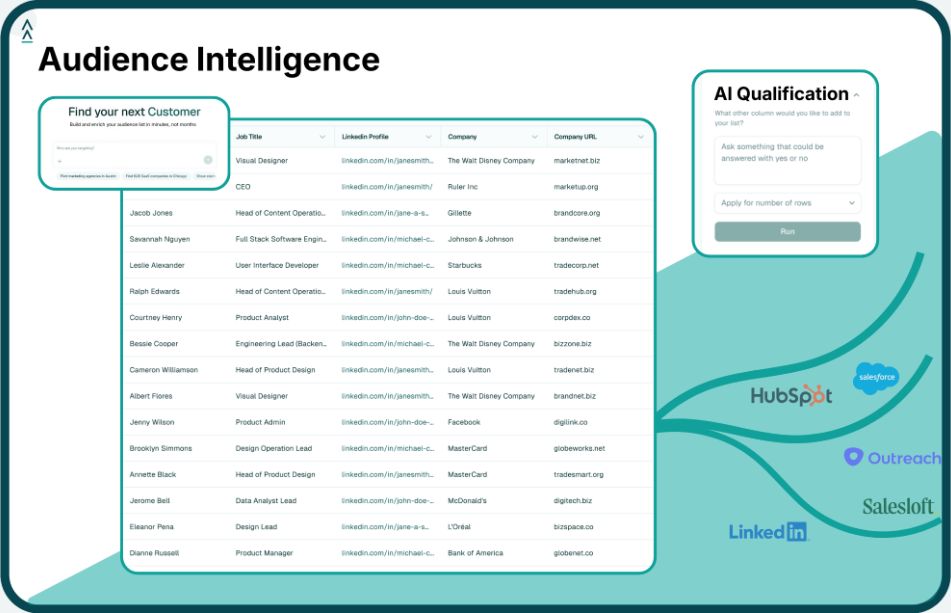
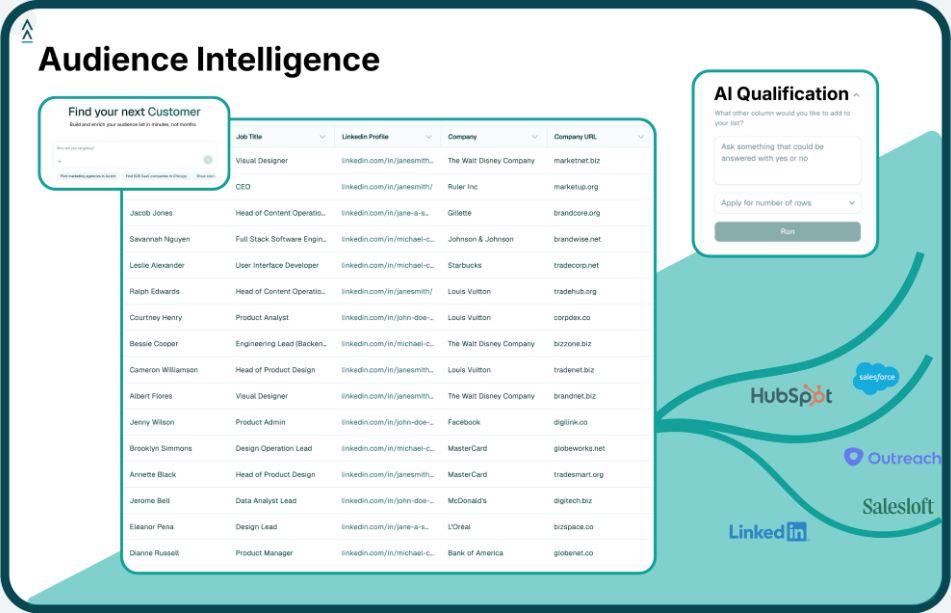
This is where platforms like the VibeGTM interface come in. Instead of manually assembling lists or writing complex filters, GTM teams can use agentic AI to interpret natural-language prompts like: "Restaurant chains in the US with 10+ locations currently using Toast POS and experiencing labor shortages."
By combining company data—which includes 1,500+ unique signals across firmographic, technographic, intent, hiring, and funding data—with natural-language targeting, restaurant tech vendors can:
For B2B organizations competing in the fast-moving restaurant technology market, AI-powered GTM is no longer optional. It's a core capability that connects your innovative solutions to the restaurants that need them most.
Voice AI and automation are the fastest-growing sectors, with 50% of restaurant operators now using AI solutions and the voice AI market projected to grow from $10B to $49B by 2029. Kitchen automation and robotics are also experiencing rapid adoption as restaurants seek to address chronic labor shortages, with companies like Hyphen securing $83M in funding from strategic investors. Omnichannel delivery management remains critical as multi-platform ordering becomes standard across the industry.
Funding directly enables restaurant tech startups to invest in R&D, expand their feature sets, and scale their customer support operations. Companies like Petpooja (Series C) and Loman AI ($4.3M seed in 2024) use funding to accelerate product development and market expansion. Increased M&A activity also shows that funding validates technology approaches, with strategic acquirers seeking innovative capabilities. The correlation between funding levels and platform sophistication demonstrates that capital availability directly impacts solution development speed and market reach.
Successful restaurant tech CEOs combine deep industry expertise with technology vision to drive market success. Many founders, like Hostie AI's team, come directly from restaurant operations, ensuring their solutions address real pain points rather than theoretical problems. Others, like Toast's Aman Narang, demonstrate the ability to scale from startup to public company serving 120,000+ locations. CEO leadership in understanding both restaurant operations and technology innovation is critical for achieving product-market fit and sustainable growth in this competitive sector.
Essential features include integrated POS and payment processing, inventory management with waste reduction capabilities, labor management with scheduling optimization, multi-channel order management, and guest relationship management with direct booking. AI-powered predictive analytics for sales forecasting and dynamic pricing are becoming increasingly important differentiators, as demonstrated by platforms like Nory and Loman AI. The shift toward comprehensive platforms that address multiple operational areas rather than point solutions reflects the industry's need for unified technology stacks that reduce vendor complexity.
AI and data analytics can reduce food waste by 44-75%, cut labor costs by 10-25%, increase covers by 26% through voice AI, and improve sales forecast accuracy to 98%+. These technologies address the industry's most pressing financial challenges by providing actionable insights and automation that directly impact the bottom line. Predictive analytics enable better staffing decisions, dynamic pricing optimizes revenue during peak and off-peak hours, and voice AI ensures no customer call goes unanswered. The key is implementing solutions that deliver measurable ROI rather than just technological novelty, as operators increasingly demand proven results before adoption.
The primary drivers are chronic labor shortages, rising operational costs, increasing competition, and evolving customer expectations for digital experiences. With 88% of restaurant operators planning technology investments in 2025, the focus is on solutions that deliver immediate ROI through cost reduction and revenue enhancement. The consolidation trend in restaurant tech through M&A activity further validates technology as essential infrastructure rather than optional enhancement. Restaurants that fail to adopt technology risk losing competitive advantage in customer experience, operational efficiency, and profitability.
Tool and strategies modern teams need to help their companies grow.