.png)
.png)

Daniel Saks
Chief Executive Officer


These companies form the backbone of the digital asset ecosystem, providing everything from secure custody and cross-border payments to blockchain development platforms and scaling solutions. For go-to-market teams targeting this rapidly expanding sector, knowing which platforms lead in AI-powered audience discovery and qualification is just as important as understanding the infrastructure itself. Agentic AI platforms like Landbase now sit alongside traditional data providers, transforming how teams find and engage decision-makers at these high-growth crypto infrastructure companies using natural-language prompts.
Ripple Labs provides real-time settlement infrastructure for financial institutions through its XRP Ledger and RippleNet network. The company enables instant, low-cost cross-border payments by using XRP as a bridge currency for liquidity between different fiat currencies.
RippleNet enables instant cross-border payments for banks and payment providers globally, reducing settlement time from days to seconds. XRP provides liquidity for international transactions with significantly lower costs than traditional correspondent banking networks. Strategic partnerships with traditional financial institutions position Ripple as a bridge between legacy payment infrastructure and blockchain-based systems, accelerating mainstream adoption of digital asset technology.
Polygon Labs enhances Ethereum scalability with Layer-2 solutions including zkEVM and sidechains. The company provides infrastructure that dramatically reduces transaction costs while maintaining Ethereum's security guarantees.
Polygon maintains position as a leading Ethereum Layer-2 by total value locked (TVL), processing millions of transactions daily at a fraction of mainnet costs. Zero-knowledge (ZK) technology enables both scalability and privacy for enterprise and consumer applications. Enterprise partnerships with major brands including Starbucks, Nike, and Reddit drive mainstream Web3 adoption by making blockchain technology accessible and affordable for high-volume use cases.
Alchemy powers blockchain applications across multiple chains with developer tools, APIs, and node infrastructure. The platform provides scalable Web3 development infrastructure that supports Ethereum, Polygon, Arbitrum, Optimism, Solana, and more.
Alchemy powers major NFT marketplaces, DeFi protocols, and Web3 applications including OpenSea, Aave, and Axie Infinity. Enhanced APIs provide mempool access and transaction simulation capabilities that enable developers to build more sophisticated applications. Sub-20ms latency and 99.9% uptime provide the reliability required for mission-critical blockchain applications serving millions of users.
Fireblocks secures digital asset transfers and custody using multi-party computation (MPC) wallet technology. The company provides enterprise-grade blockchain infrastructure for financial institutions, crypto exchanges, and enterprises managing digital assets.
MPC technology eliminates single points of failure in asset custody by distributing key management across multiple parties, dramatically reducing theft and loss risk. The platform serves over 1,800 financial institutions, crypto exchanges, and enterprises managing billions in digital assets. Industry-leading security standards including SOC 2 Type II certification and insurance coverage up to $30 million enable institutional adoption by meeting stringent compliance requirements.
Ava Labs provides a highly customizable Layer-1 blockchain platform with sub-second finality. The company's unique subnet technology enables custom blockchain networks for enterprise use cases while maintaining compatibility with the broader Avalanche ecosystem.
Subnet technology enables enterprises to launch custom blockchain networks with their own rules, validators, and virtual machines while maintaining interoperability with the main Avalanche network. Sub-second transaction finality with throughput exceeding 4,500 transactions per second provides the performance required for high-frequency applications. EVM-compatibility enables seamless migration of Ethereum applications while benefiting from Avalanche's superior speed and lower costs.
Circle issues USDC, the second-largest stablecoin by market cap, providing blockchain-powered payment infrastructure. The company works closely with regulators and partners with BNY Mellon and BlackRock for custody and reserve management.
USDC is fully backed by US dollar reserves held at regulated financial institutions with monthly third-party attestations ensuring transparency and trust. Strategic partnerships with BNY Mellon as primary custodian and BlackRock for reserve management provide institutional credibility and security. As a regulatory compliance leader working toward public listing, Circle is setting standards for stablecoin transparency and governance that enable mainstream financial integration.
Solana Labs operates a high-throughput blockchain processing thousands of transactions per second using its innovative Proof of History (PoH) consensus mechanism. The platform supports DeFi, NFTs, gaming, and other Web3 applications with minimal fees.
Solana represents one of the fastest-growing blockchain ecosystems with 78% builder interest increase over two years, attracting developers with high performance and low costs. The platform processes 3,400+ transactions per second with average fees under $0.01, making it viable for consumer applications requiring high throughput. The upcoming Seeker smartphone launch in 2025 with embedded crypto capabilities represents a bold push toward mainstream Web3 adoption through mobile-first experiences.
Blockdaemon provides enterprise-grade node infrastructure and staking services supporting 60+ blockchains. The company serves exchanges, custodians, and financial institutions with SOC 2 Type II and ISO 27001 certified infrastructure.
SOC 2 Type II and ISO 27001 certifications meet institutional security and compliance requirements, enabling regulated financial institutions to participate in blockchain networks. HSM (Hardware Security Module) key management provides enhanced security for staking and node operations protecting billions in staked assets. Support for 60+ blockchains provides comprehensive coverage enabling institutional clients to participate across the entire blockchain ecosystem through a single provider.
Mysten Labs operates Sui, a high-throughput Layer-1 blockchain for scalable decentralized applications. The platform uses the Move programming language and parallel execution to achieve high speed and unique object-centric data models.
Founded by ex-Meta engineers from the Diem project, Mysten Labs brings enterprise blockchain expertise to the decentralized ecosystem. Parallel transaction processing enables horizontal scalability, allowing throughput to increase as the network grows unlike sequential blockchains. The object-centric data model enables new use cases including complex gaming economies and sophisticated DeFi applications not possible on account-based blockchains like Ethereum.
Aptos Labs provides a scalable Layer-1 blockchain for Web3 applications using the Move programming language for enhanced security. The platform offers sub-second finality with high throughput and enterprise-grade security features.
Move programming language from Meta's Diem project offers better safety guarantees than Solidity through formal verification and resource-oriented architecture preventing common smart contract vulnerabilities. Sub-second finality with throughput exceeding 10,000 theoretical TPS provides the performance needed for consumer-scale applications. Enterprise-grade security features and partnerships with Google Cloud and Adobe signal growing institutional adoption and real-world integration.
These fastest-growing crypto infrastructure companies represent significant opportunities for B2B vendors serving the digital asset ecosystem. However, reaching decision-makers in this fast-moving sector requires more than traditional prospecting methods. The crypto landscape evolves rapidly, with new funding rounds, partnerships, and technology launches happening weekly.
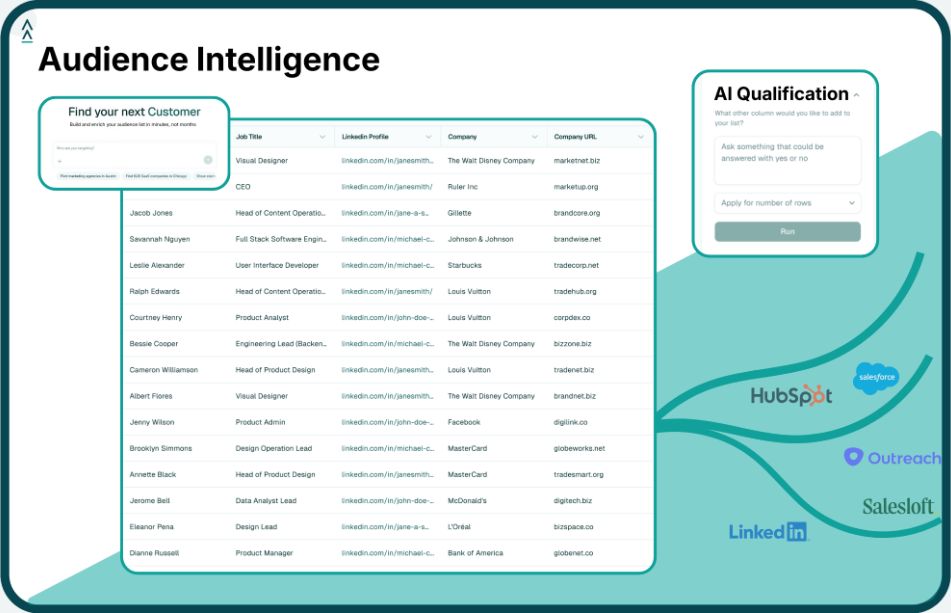
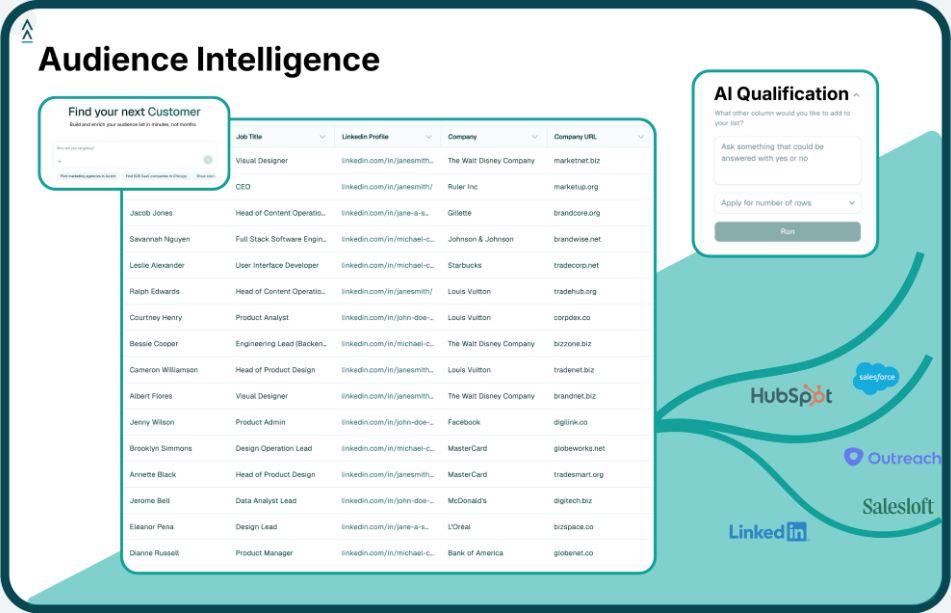
This is where AI-powered audience discovery becomes essential. Instead of manually tracking company news and trying to identify the right contacts through complex database queries, go-to-market teams can leverage natural-language targeting to find qualified prospects instantly. For example, you could search for "CTOs at growth-stage fintech companies that recently launched new products" or "CFOs at enterprise SaaS companies that raised funding in the last 30 days" – including crypto infrastructure firms that fit these criteria.
Landbase's GTM-2 Omni AI model is trained on billions of GTM data points from 50M+ B2B campaigns, enabling it to precisely qualify prospects based on 1,500+ unique signals including funding events, hiring activity, tech stack changes, and website behavior. This allows sales and marketing teams to:
For B2B organizations looking to penetrate the rapidly expanding crypto infrastructure market, combining deep industry knowledge with AI-powered go-to-market capabilities is no longer optional – it's the key to efficient, effective outreach in this dynamic sector.
Crypto infrastructure companies provide the foundational technology that enables the digital asset ecosystem to function, including blockchain networks (Layer-1 and Layer-2), custody solutions, payment rails, oracle networks, development platforms, and institutional-grade services. These companies enable everything from secure asset storage and cross-border payments to smart contract execution and decentralized application development. Without robust infrastructure, the crypto ecosystem would lack the security, scalability, and usability required for mainstream adoption. Infrastructure companies serve as the invisible backbone supporting exchanges, DeFi protocols, NFT marketplaces, and enterprise blockchain applications.
While exchanges focus on trading and custody of digital assets for retail and institutional investors, crypto infrastructure companies build the underlying technology that powers the entire ecosystem. Exchanges like Coinbase facilitate direct buying, selling, and storage of cryptocurrencies for end users, whereas pure infrastructure companies like Polygon, Alchemy, and Chainlink focus on enabling other businesses to build and operate within the crypto ecosystem. Some companies like Coinbase are increasingly expanding into infrastructure (such as Base Layer-2), blurring the distinction, but their core business models remain fundamentally different.
Crypto infrastructure startups are attracting significant venture capital investment, with Q1 2024 alone seeing $2.8 billion invested across 603 deals. Investors are particularly interested in companies providing Ethereum scaling solutions, institutional custody, stablecoin infrastructure, and developer tools that enable mainstream blockchain adoption. Funding rounds for established infrastructure companies often reach hundreds of millions of dollars at multi-billion dollar valuations, reflecting the critical importance and long-term value of foundational blockchain technology. Early-stage infrastructure startups typically seek seed and Series A funding ranging from $5M to $50M to build initial products and gain market traction.
Crypto infrastructure companies face regulatory uncertainty across different jurisdictions, requiring careful compliance planning and sometimes limiting market access. Security vulnerabilities represent existential risks, as breaches can lead to significant financial losses and permanent reputation damage in an industry where trust is paramount. Scalability limitations as user adoption grows require continuous technical innovation and infrastructure investment to maintain performance. The rapidly evolving nature of the crypto ecosystem demands constant adaptation and innovation to stay competitive as new blockchains, standards, and technologies emerge continuously.
Robust crypto infrastructure addresses the key barriers that have historically prevented widespread use of digital assets: security, scalability, usability, and regulatory compliance. Infrastructure companies like Fireblocks provide institutional-grade security meeting the requirements of regulated financial institutions, while Layer-2 solutions like Polygon and Arbitrum address Ethereum's scalability limitations making blockchain viable for consumer applications. Stablecoin infrastructure from companies like Circle enables real-world payment use cases with price stability, and developer platforms like Alchemy make it easier for businesses to integrate blockchain technology without deep cryptography expertise. Without this infrastructure, digital assets would remain too risky, expensive, and complex for mainstream users and businesses.
Businesses can identify and target key decision-makers within crypto infrastructure companies by leveraging AI-powered audience discovery platforms like Landbase that combine comprehensive B2B databases (300M+ contacts, 24M+ companies) with real-time signals including funding rounds, hiring activity, and tech stack changes. These platforms enable natural-language targeting capabilities, allowing go-to-market teams to use plain-English prompts to instantly generate AI-qualified lists of relevant decision-makers based on specific criteria and timing signals. Instead of manually researching individual companies and using complex database filters, teams can search for conditions like "CTOs at Series B crypto companies that raised funding in the last quarter" to receive targeted prospect lists in seconds. This approach is particularly valuable in the fast-moving crypto sector where traditional databases quickly become outdated.
Tool and strategies modern teams need to help their companies grow.