.png)
.png)

Daniel Saks
Chief Executive Officer


Demand generation is a $7.4 billion industry growing at 14% annually, and 87% of B2B marketers say it is their top priority. Yet most demand gen programs are generating more leads without generating more revenue. According to B2B demand generation statistics, 68% of marketers are increasing lead volume year-over-year, but only 32% say their lead quality has improved proportionally.
The gap between volume and quality is the central challenge of demand gen in 2026. Teams that solve it are generating 50% more leads at 33% lower cost. Teams that do not are spending more money on leads that sales will never work.
For a decade, the demand gen playbook was straightforward: create content, run ads, capture leads, pass to sales. Scale by spending more on ads and creating more content. The more you spend, the more leads you get.
This playbook worked when competition for attention was lower and buyer tolerance for generic outreach was higher. In 2026, buyers are drowning in content and outreach. According to inbound marketing research, 73% of B2B buyers actively avoid suppliers that send irrelevant outreach. More volume against this audience means more waste, not more pipeline.
The shift from volume to quality required better measurement. In 2024, most teams could count MQLs but could not tell you which MQLs converted to revenue. In 2026, multi-touch attribution models and connected CRM data make it possible to trace pipeline and revenue back to specific demand gen activities.
This visibility exposed a problem: many high-volume channels (content syndication, generic display ads, broad webinar promotions) produced lots of MQLs that never converted to pipeline. The MQL number looked good. The pipeline number did not. Quality measurement killed the vanity metrics.
The biggest change is that AI-powered targeting made it practical to identify and reach specific high-fit accounts before spending on awareness. Instead of running a broad LinkedIn campaign and hoping the right people see it, teams can now build target account lists based on ICP fit, buying signals, and intent data, then run campaigns only against those accounts.
This inverts the traditional demand gen funnel. Instead of attracting a broad audience and filtering down to qualified leads, you start with qualified accounts and generate demand specifically within them. The waste goes to zero because every dollar of spend targets accounts that already fit your ICP.
Content marketing still generates pipeline. What changed is how it is distributed. High-performing teams in 2026 create content for specific buyer personas within their ICP, then distribute it through targeted channels (LinkedIn ads to named accounts, email to verified contacts, retargeting to website visitors from target accounts).
The content itself has evolved too. Generic thought leadership is oversaturated. Practical, specific, data-backed content that solves a real problem for a defined audience outperforms broad thought leadership by 3-5x on conversion.
According to demand gen statistics, email nurturing generates 41% more leads at 48% lower cost than non-nurtured programs. The key is that nurturing requires accurate contact data and proper segmentation. Sending the wrong nurture track to the wrong persona is worse than not nurturing at all.
LinkedIn sponsored content delivers 2.7x higher conversion rates than organic posts for B2B demand gen. The platform's targeting capabilities (by title, company size, industry, seniority) allow demand gen teams to reach specific buyer personas with precision. The cost per lead is higher than other channels, but the quality is meaningfully better for B2B.
SEO has the highest close rate of any demand gen channel at 14.6%, according to research compiled across multiple sources. The challenge is that SEO takes 6-12 months to compound and requires sustained investment. Teams that invested in SEO 12+ months ago are now reaping the benefits. Teams starting today will not see returns until 2027.
Account-based demand gen targets specific companies with coordinated multi-channel campaigns. It combines display ads, LinkedIn targeting, email outreach, and content distribution all aimed at the same set of target accounts. The coordinated approach produces higher conversion because the buyer encounters your brand across multiple touchpoints.
The teams generating the best results in 2026 run a three-layer demand gen stack:
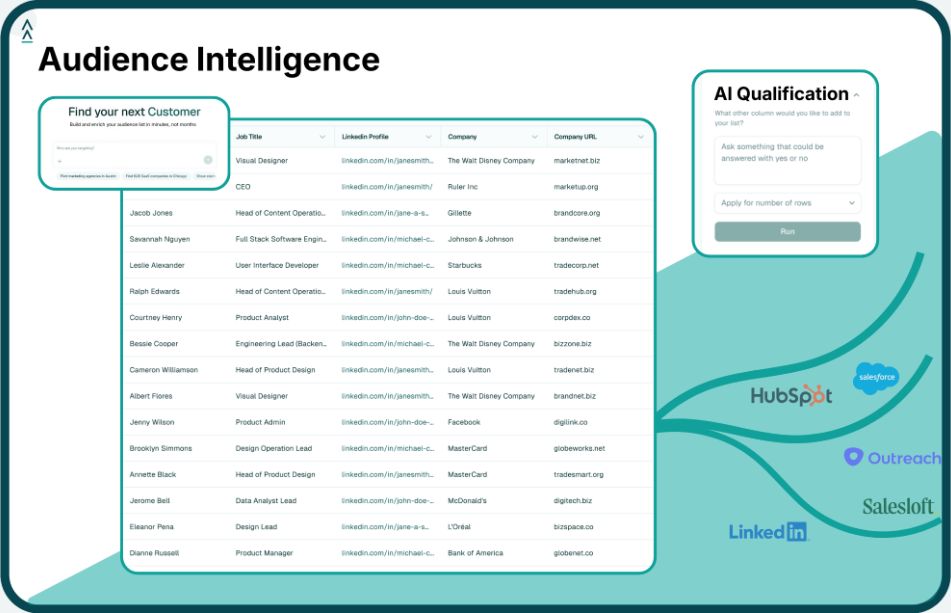
Start by identifying which accounts to target. Use AI-powered platforms like Landbase to find accounts matching your ICP across 1,500+ enrichment fields, filtered by buying signals (hiring, funding, technology changes, intent data). Export these accounts as your campaign target list.
Run coordinated campaigns against the target list. LinkedIn ads targeting contacts at those accounts. Email nurture sequences to verified contacts. Retargeting ads for account-level website visitors. Content syndication to specific personas within the target list.
Track pipeline and revenue attribution back to specific accounts and channels. Use the data to refine targeting, adjust channel mix, and optimize spend. The feedback loop between measurement and audience building is what separates high-performing demand gen from spray-and-pray.
Lead generation captures contact information from interested buyers (form fills, downloads, registrations). Demand generation creates awareness and interest before the buyer is ready to fill out a form. Demand gen is the broader category that includes lead gen as one component.
Most B2B SaaS companies spend 15-25% of revenue on sales and marketing combined, with demand gen representing 30-50% of the marketing budget. The exact number depends on stage, growth rate, and CAC targets. Early-stage companies often spend more as a percentage of revenue to build pipeline from scratch.
Yes. AI SDRs are an activation channel, not a demand gen replacement. Demand gen creates awareness and interest. AI SDRs act on that interest by reaching out to engaged accounts. The two work together: demand gen warms the account, AI SDRs convert the interest into meetings.
Optimizing for MQL volume instead of pipeline quality. Teams that hit their MQL targets but miss pipeline targets are spending money generating interest from accounts that will never buy. The fix is targeting: build your demand gen campaigns around qualified account lists, not broad audiences.
Tool and strategies modern teams need to help their companies grow.