For the past two years, every AI sales tool has promised to replace BDRs. The pitch was always the same: pay us $2,000 a month and fire your SDR team. The reality has been more complicated, and the data from 2025 tells a clearer story than the marketing did.
According to research from Bain Capital Ventures, the autonomous AI SDR narrative peaked in 2024-2025 and by early 2026, fully autonomous AI SDRs have not replaced human sales teams at any meaningful scale. SaaStr reports that 36% of B2B companies cut Sales Development teams in 2025, but most reductions came from not backfilling open roles rather than layoffs.
Key Takeaways
- BDRs are not dead, but the role is shrinking. 36% of B2B companies cut SDR teams in 2025, mostly through attrition.
- AI is replacing transactional outbound first. Templated sequences and basic research are the most automatable parts of the job.
- Complex selling is safe. Enterprise and consultative sales roles are more important than ever in 2026.
- The remaining BDRs are doing higher-leverage work. They use AI as a force multiplier and focus on strategy and account research.
- Hybrid teams are winning. The pure AI SDR approach has not worked. The best teams blend AI agents with human BDRs.
What actually happened to BDR teams in 2025
The story everyone tells is that AI replaced BDRs. The actual story is more interesting.
According to a SaaStr survey of B2B companies, 36% cut their SDR teams in 2025. But the cuts were not uniform. They concentrated in three categories:
- Companies that over-hired SDRs in 2021-2022. The post-ZIRP correction. These cuts had nothing to do with AI.
- Companies that adopted AI SDR tools and saw productivity gains. They reduced headcount as natural attrition happened.
- Companies that gave up on outbound entirely. Some pivoted to inbound-only motion, eliminating the need for SDRs altogether.
The middle category is the one that matters. Teams that adopted AI tools did not lay people off. They stopped hiring. Over 12-18 months, attrition reduced their teams by 30-50% without layoffs. The remaining BDRs took on more work each, supported by AI agents.
What AI agents can actually do in BDR work
Tasks AI handles well
- Prospect research: Reading company websites, news, LinkedIn profiles, and tech stacks in seconds.
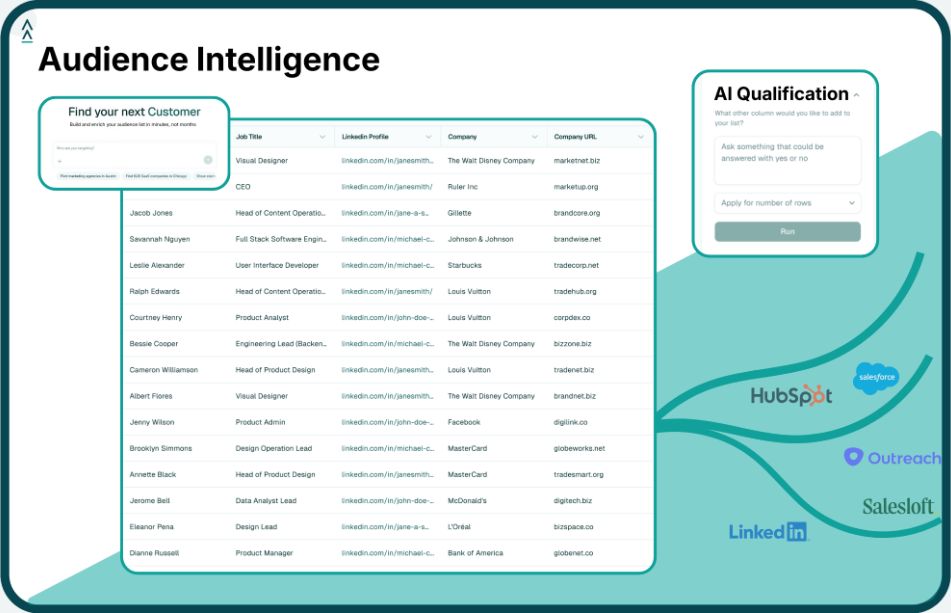
- List building: Querying B2B databases for accounts matching ICP criteria.
- Email drafting: Writing personalized opening lines based on real account context.
- Lead qualification: Applying ICP criteria consistently across thousands of records.
- Follow-up sequencing: Sending automated touch sequences with personalization variables.
- CRM updates: Logging activity and updating fields automatically.
Tasks AI struggles with
- Complex discovery conversations: Asking the right follow-up questions in a discovery call.
- Reading buyer political dynamics: Understanding who has real budget authority versus who claims to.
- Negotiation: Handling price objections and closing complex deals.
- Building champion relationships: Earning trust over multiple touchpoints with multiple stakeholders.
- Strategic account planning: Mapping the buying committee and the path to a multi-year contract.
The pattern is clear: AI handles the repetitive tasks while humans handle the judgment-heavy ones. Bain Capital Ventures argues that transactional SDR roles are most vulnerable while enterprise and consultative sales roles are safe for the foreseeable future.
The new BDR job description
The BDRs who thrive in 2026 look different from the BDRs of 2022. The role is less about volume and more about strategy.
Old BDR job description (2022):
- Make 80 cold calls per day
- Send 200 cold emails per day
- Book 12 meetings per week
- Hit 100% activity quota every quarter
New BDR job description (2026):
- Manage 100-200 strategic target accounts
- Build account intelligence and decision-maker maps
- Orchestrate AI agents for outreach at scale
- Run complex multi-touch outbound campaigns
- Hit pipeline contribution quota (qualified opportunities)
The shift is from activity to outcomes and from volume to depth. From templated outreach to personalized strategic plays. The BDRs who can make this shift are more valuable than ever. The BDRs who cannot are being replaced by AI agents that do volume work better.
The economics of hybrid SDR teams
The math on hybrid teams is favorable for most B2B companies. Here is the comparison:
Traditional 10-person SDR team:
- 10 SDRs at $90k fully loaded each = $900k/year
- ~120 meetings booked per month total
- Cost per meeting: ~$625
Hybrid 5-person + AI team:
- 5 SDRs at $110k fully loaded each (more senior, higher pay) = $550k/year
- AI tooling: $50k-$150k/year
- Total: $600k-$700k/year
- ~150 meetings booked per month total (more personalized, higher conversion)
- Cost per meeting: ~$390
The hybrid team books more meetings at lower cost. The trade-off is that the SDRs need to be more skilled, which means higher salaries and harder hiring.
According to Salesforce's 2026 State of Sales report, 83% of sales teams that used AI in the past year saw revenue growth, compared to 66% of teams that did not. The teams that adopt AI early have a measurable advantage.
What this means for SDRs entering the field
If you are an SDR or considering becoming one in 2026, the rules of success have changed.
Skills that matter more in 2026:
- Account research and strategic thinking
- AI tool proficiency (knowing how to prompt and use AI agents)
- Multi-touch campaign design
- Buyer psychology and complex selling
- Working across the buying committee
Skills that matter less:
- Cold calling volume
- Templated email writing
- Manual data entry
- Basic CRM hygiene
The best path for new SDRs is to learn the strategic skills early. The volume game is being automated away. The strategic game pays better and lasts longer.
What this means for sales leaders hiring in 2026
If you are hiring SDRs, the playbook has changed:
- Hire fewer, more senior people. Five great BDRs with AI tools outperform ten average ones without.
- Pay for AI proficiency. Look for candidates who can demonstrate they have used AI tools effectively.
- Measure outcomes, not activity. Pipeline contribution matters. Activity quotas do not.
- Invest in tools. Spend the headcount savings on AI agents and data platforms.
- Plan for attrition. Expect 30-50% reduction in team size over 12-18 months as you adopt AI. Plan for it instead of being surprised.
Frequently asked questions
Will AI replace all BDRs eventually?
No. The autonomous AI SDR experiment of 2024-2025 did not work. Every successful AI sales deployment in 2026 includes human BDRs in the loop. The role is changing, not disappearing.
How much can I cut my BDR team if I deploy AI?
Most teams see 30-50% reduction in BDR headcount over 12-18 months when they adopt AI tools effectively. The reduction usually happens through attrition, not layoffs. The remaining BDRs are more productive and more valuable.
What is the difference between an AI SDR tool and an AI agent for sales?
AI SDR tools usually claim to replace SDR functions entirely. AI agents are more flexible, designed to assist humans rather than replace them. The latter is winning in 2026 because the autonomous approach has not worked at scale.
Should I still hire entry-level SDRs in 2026?
Carefully. Entry-level SDR roles are the most automatable. If you hire entry-level, plan to train them on strategic skills quickly so they outgrow the automatable parts of the job within their first year.
Build a GTM-ready audience
See AI-powered prospecting for SDR teams
.png)
.png)