.png)
.png)

Daniel Saks
Chief Executive Officer


Sales complains about bad leads from marketing while marketing complains about poor follow-up from sales. The real issue is that both teams are looking at different versions of the same data. The real problem is that they are looking at different data.
In most B2B companies, marketing runs HubSpot. Sales runs Salesforce. The two systems have different schemas, different field definitions, and different versions of the same records. When marketing says "we delivered 200 MQLs," sales sees 140 contacts with missing fields and no context. When sales says "none of these leads are qualified," marketing sees 200 form fills from accounts that match the ICP.
Both teams are telling the truth. They are just looking at different truths because the data underneath is disconnected.
Marketing defines an MQL based on engagement: form fills, content downloads, webinar attendance. Sales defines an SQL based on fit: company size, budget, timeline, authority. The two definitions overlap but do not match. A marketing-qualified lead that downloaded a whitepaper may not be a sales-qualified lead because the company has 5 employees and no budget.
Marketing captures name, email, and maybe company from a form fill. Sales needs industry, employee count, technology stack, funding stage, and decision-maker contacts to qualify. The lead arrives in the sales queue with 3 fields populated out of the 10 that matter. According to CRM data hygiene research, 76% of CRM entries are less than half complete. The gap starts here.
Marketing tracks first touch and last touch in their attribution model. Sales tracks the AE who booked the meeting in theirs. Neither model captures the full journey because the data lives in different systems. The result is attribution fights where marketing claims credit for leads and sales claims credit for deals, and nobody can prove either.
When marketing passes a lead to sales, the context rarely comes with it. The SDR gets a name and an email. They do not get the pages the person visited, the content they downloaded, the signals on the account, or the other contacts at the same company who are also engaged. The SDR starts from scratch.
Most companies try to fix sales-marketing alignment with meetings: SLAs, shared dashboards, weekly syncs, joint planning sessions. These help with communication but do not fix the underlying problem: the data is disconnected.
An SLA that says "marketing will deliver 200 MQLs per month" does not work if sales and marketing define MQL differently. A shared dashboard does not work if it pulls from two systems that have different versions of the same records. A weekly sync does not work if neither team trusts the other team's data.
The fix is unified data, not more meetings.
The most effective RevOps teams in 2026 solve the data gap by establishing a single source of truth for account and contact data. Here is how:
Create a shared list of critical fields: company name, domain, industry, employee count, technology stack, funding stage, contact name, title, verified email. Both systems must have these fields, in the same format, for every record.
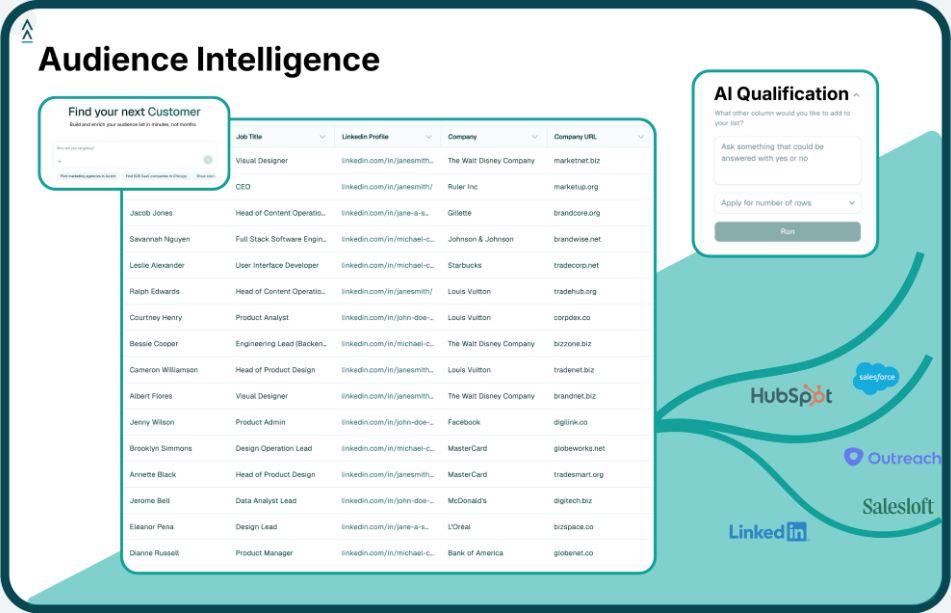
Instead of marketing buying lists from one vendor and sales buying data from another, use a single data platform that feeds both systems. Landbase delivers accounts with 1,500+ enrichment fields that you can export to both HubSpot and Salesforce. Same data, same formats, same enrichment.
Define MQL and SQL using the same criteria. An MQL should include both engagement (marketing's perspective) AND fit (sales' perspective). A lead that matches the ICP and has engaged is qualified. A lead that only engaged but does not fit the ICP is not, regardless of how many forms they filled out.
When a lead comes in from a form fill, enrich it with firmographic and technographic data before it hits either system. This means the lead arrives in both HubSpot and Salesforce with the same complete, consistent data. No more incomplete records that sales has to re-research.
Once the data is unified, build a reporting layer that both teams trust. Track the full journey from first touch to closed deal, using consistent field definitions and a single source of truth. Attribution fights disappear when both teams look at the same data.
Teams that unify their sales-marketing data see measurable improvements:
Both, but technology is the root cause. Different systems with different schemas produce different data. Process alignment (SLAs, definitions, meetings) helps but cannot overcome fundamental data disconnection. Fix the data layer first, then align processes on top of it.
No. Many successful teams run HubSpot for marketing and Salesforce for sales. The key is having a unified data source (like Landbase) that feeds both systems with the same enriched data. You do not need one tool. You need one source of truth.
Most teams can establish a unified data source and standardized definitions in 4-6 weeks. The cultural shift (getting both teams to trust and use the shared data) takes longer, usually 1-2 quarters. Start with one shared metric and expand from there.
Focusing on process alignment before data alignment. You can have the best SLAs and most detailed dashboards in the world, but if the underlying data is inconsistent between systems, the alignment is superficial. Fix the data first.
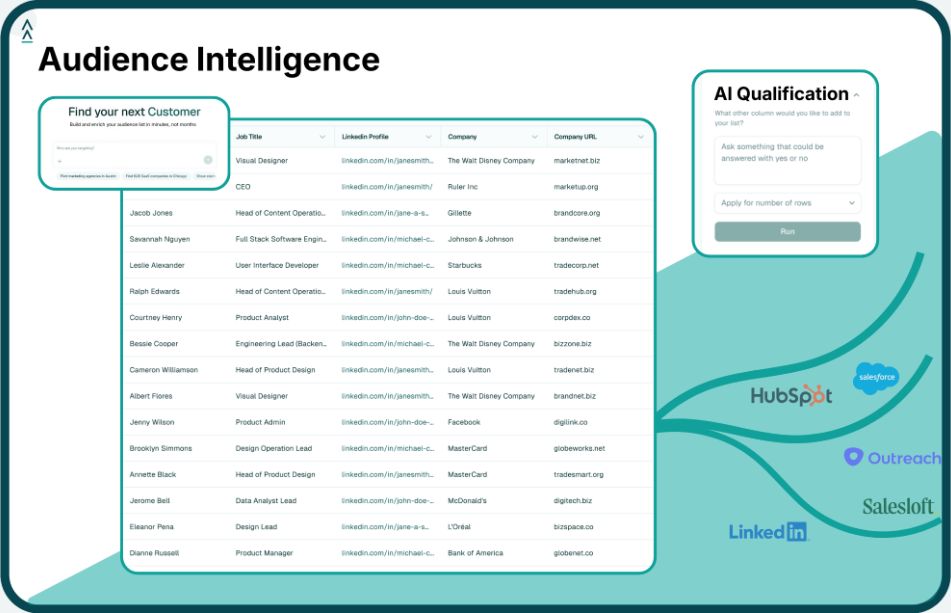
Tool and strategies modern teams need to help their companies grow.