.png)
.png)

Daniel Saks
Chief Executive Officer


Most teams think of CommonRoom as just a signal aggregation platform, but honestly, the pricing structure in 2026 reveals it's become a significant investment for B2B go-to-market operations. More and more companies are finding that CommonRoom pricing starts at $1,700 per month ($20,400 annually) for their Starter plan, which includes 35K contacts, 2 seats, and limited Bombora intent topics. For teams relying on community signals and digital engagement data, this platform promises unified insights—but the costs scale quickly as your database grows and you add more signal sources.
Now, CommonRoom's value proposition centers around bringing together signals from across your tech stack—website visits, community activity, and product usage—into one unified view. Common Room is strongest as a buyer-signal and customer-intelligence platform, but it also offers AI-assisted outbound, workflow automation, and sales-engagement integrations; teams may still use separate sales engagement platforms (SEPs) depending on their workflow.
The pricing landscape for community and signal intelligence platforms is evolving rapidly in 2026, with alternatives emerging that either offer more affordable entry points or comprehensive automation that eliminates the need for multiple tools. If you're evaluating CommonRoom for your GTM strategy, it's worth understanding the full cost structure, comparing alternatives, and considering whether you need just signal detection or complete go-to-market orchestration.
CommonRoom's pricing in 2026 follows a contact-based model that can escalate quickly as your database grows and you add more signal sources. The platform offers three main tiers designed for different company sizes and use cases.
The entry point for CommonRoom comes in at $1,700 per month ($20,400 annually), which includes:
Limitations to consider:
This tier works best for small teams focused primarily on community-led growth with modest database requirements. However, the contact-based pricing model means costs increase directly with database growth, which can become problematic as your pipeline scales.
For mid-market companies, Common Room's Team plan is currently listed as custom pricing on the official pricing page; third-party estimates have reported around $2,500 per month (~$30,000 annually), though that should not be taken as the official current list price. This tier reportedly includes:
This tier provides better value for growing teams. Some teams may still budget for separate sales-engagement or enrichment tools depending on their stack; exact costs depend on vendor contracts.
For larger organizations, CommonRoom offers custom Enterprise pricing. Third-party estimates place many contracts in the $50,000 to $80,000+ annual range, but buyers should confirm directly with Common Room. This tier reportedly includes:
Enterprise implementations can be complex; implementation time varies by data sources, integrations, and workflow complexity. One competitor review cites a 3-4 week anecdote for signal configuration, but this should not be taken as a verified typical timeline.
When evaluating CommonRoom pricing, it's crucial to consider the total cost of ownership beyond the base subscription fee. Depending on your existing stack, you may need additional tools to complete your go-to-market workflow.
Implementation and Onboarding:
Possible Additional Tools (costs vary by vendor contract):
Scaling Costs:
First-year TCO can significantly exceed the base subscription cost once services, add-ons, and adjacent tools are included; teams should build a quote-based model for accurate budgeting.
CommonRoom has demonstrated measurable results for some customers:
However, some reviewers report a learning curve or signal-tuning effort, especially for complex deployments. Common Room surfaces signals and offers workflow and action features, though teams may still need process design and sales-engagement tooling depending on use case.
Several alternatives have emerged in 2026 that address different aspects of the go-to-market intelligence challenge, from budget-conscious options to comprehensive AI platforms.
Salesmotion ($1,020/year) Salesmotion offers an affordable entry at $85 per month ($1,020 annually) for 1 user and 100 monitored accounts. The Team plan is $349/month with 5 users included; Enterprise includes unlimited users. Features include:
This may fit smaller teams seeking low-entry account-intelligence pricing.
Warmly ($4,000/year) For teams focused primarily on website visitor identification, Warmly's Micro plan is reported at $4,000 annually and provides:
6sense ($60,000+/year) 6sense is an enterprise ABM/revenue-marketing platform and was named a Leader in The Forrester Wave for Revenue Marketing Platforms, Q1 2026. It features:
6sense does not publish paid list pricing; third-party estimates place many paid deployments from roughly $50,000-$100,000 at entry/mid-market levels and up to $300,000+ for larger enterprise deployments. Third-party sources commonly estimate multi-week implementation timelines, often roughly 4-12 weeks depending on modules, CRM/MAP integration, and RevOps readiness.
Apollo.io ($588+/user/year) For high-volume prospecting teams, Apollo.io offers:
The most significant shift in 2026 has been the emergence of AI-first platforms that replace multiple point solutions with autonomous workflows, fundamentally changing the pricing and value equation.
Traditional platforms like CommonRoom function as sophisticated dashboards that require manual interpretation and action. In contrast, agentic AI platforms autonomously orchestrate end-to-end go-to-market workflows from audience definition through omni-channel execution.
Key differences:
This represents a fundamental shift from "showing you signals" to "closing deals autonomously."
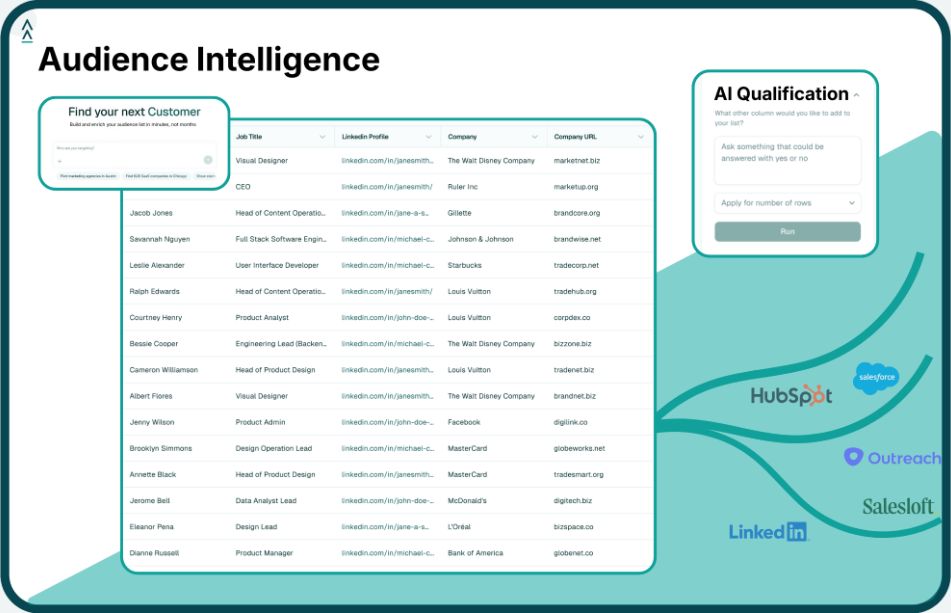
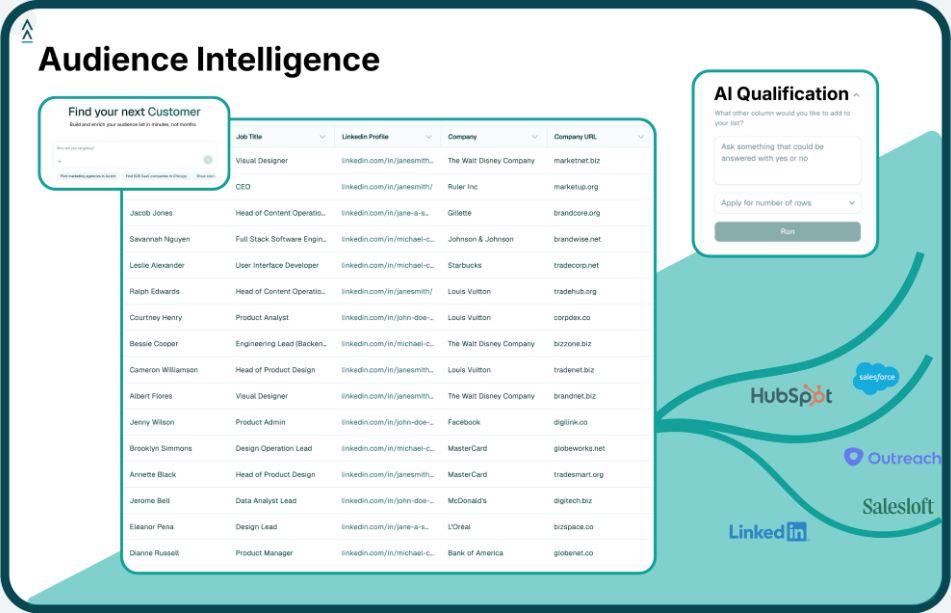
AI-first platforms have introduced natural language audience targeting, allowing non-technical users to define complex criteria in plain English like "mid-market U.S. healthcare companies hiring in compliance, recently raised Series B, using Salesforce."
This eliminates the need for:
The result is 50% accuracy lift in ICP fit and dramatically faster campaign launch times.
While CommonRoom and similar platforms focus on signal detection, Landbase represents a fundamentally different approach to go-to-market intelligence. As the first agentic AI GTM platform, Landbase replaces your entire sales tech stack with autonomous workflows trained on 40M+ sales interactions.
Tool Consolidation Savings Landbase eliminates the need for 5+ point solutions by integrating prospecting, enrichment, scoring, and execution in a single platform. This translates to $50K-$100K+ annual savings compared to traditional stack approaches that require separate signal, enrichment, sequencing, and analytics tools.
Autonomous GTM Orchestration Unlike CommonRoom's signal dashboard approach, Landbase's multi-agent AI system autonomously executes end-to-end campaigns:
Comprehensive Data and Signals Landbase includes everything you need in one platform:
Implementation and Support Landbase offers the fastest time-to-value in the category:
For teams tired of stitching together multiple tools and manually interpreting signal dashboards, Landbase provides a complete solution that actually closes deals rather than just showing you who might be interested. The platform is particularly valuable for mid-market companies ($2M-$50M ARR) seeking AI-powered GTM transformation without the complexity and cost of enterprise ABM suites.
If you're evaluating CommonRoom pricing and considering whether the investment is worth it, Landbase offers a compelling alternative that addresses the fundamental limitation of signal-only platforms: the gap between insight and action. By automating the entire go-to-market workflow, Landbase delivers faster results with dramatically lower total cost of ownership.
CommonRoom pricing is primarily determined by contact volume (35K-200K), number of user seats (2 to up to 10), website activity IP enrichments per year (240K-960K), and Bombora intent topics (6-25). Additional costs may come from signal source integrations, potential overage fees, and adjacent tools for outreach and enrichment depending on your stack.
CommonRoom's $20,400+ annual Starter pricing positions it as a premium option compared to alternatives like Salesmotion ($1,020/year) or Warmly ($4,000/year). Team and Enterprise plans are custom-priced. It is less expensive than enterprise platforms like 6sense, where third-party estimates place paid deployments from roughly $50,000-$100,000 at entry/mid-market levels and up to $300,000+ for larger enterprise deployments. The key differentiator is CommonRoom's strong community signal aggregation and AI-assisted outbound features, though teams may still integrate with dedicated sales-engagement tools depending on their workflow.
First-year TCO can significantly exceed the base subscription cost once onboarding services, add-ons, and adjacent tools are included. Costs for professional services, training, and any supplementary tooling vary by package and vendor contract; teams should build a quote-based model for accurate budgeting.
Free tools can cover pieces of the workflow, but no clearly equivalent free platform matching Common Room's full signal aggregation and identity-resolution scope has been found. Apollo.io offers a free plan, though credit limits vary by credit type and plan system; review Apollo's current pricing page for details. Some teams also use free community monitoring tools like GitHub and Discord native analytics for limited signal detection, but these do not provide the unified dashboard or person-level identification that CommonRoom offers.
Implementation timelines vary depending on data sources, integrations, and workflow complexity. Complex deployments may require signal-source setup, scoring/workflow configuration, and team enablement, with some reviews citing multi-week timelines for full configuration.
Tool and strategies modern teams need to help their companies grow.