.png)
.png)

Daniel Saks
Chief Executive Officer


The GTM engineer role barely existed five years ago. Today, every Series B SaaS company is trying to hire one. The job sits between RevOps and engineering, building the technical scaffolding that makes modern go-to-market work: data pipelines, custom integrations, automation logic, and the glue between sales tools that no vendor sells out of the box.
Claude Code is the most productive tool a GTM engineer has ever had. According to SyncGTM's analysis, GTM teams use Claude Code to automate six core workflows: lead sourcing, data enrichment, CRM cleanup, outreach personalization, competitive intel, and signal processing. Workflows that previously took weeks of engineering can now be deployed in minutes.
A GTM engineer is not a software engineer. They are not a RevOps person either. They sit in the middle, building the technical infrastructure that makes go-to-market scalable.
On a typical week, a GTM engineer might:
None of this is shippable software. All of it requires technical thinking. And until Claude Code, it required either engineering tickets or an expensive no-code tool that broke at the worst possible moment.
Before Claude Code, GTM engineers had three options for any technical task:
Claude Code is option four. You describe what you want, it writes the code, and you ship it. According to developer adoption data, 46% of developers name Claude Code as their most loved tool, more than double Cursor (19%) and five times GitHub Copilot (9%). The productivity gains are real and they apply to GTM work just as much as application development.
For a GTM engineer, this means the workflow looks like:
Total time: a few hours. Same workflow with engineering tickets: a few months.
You want to know when target accounts hire a new VP Sales or CRO. That is one of the highest-converting buying signals in B2B. You can pay for an intent platform that tracks hiring, or you can have Claude Code build a script that monitors LinkedIn and your target account list directly.
The script runs every morning, finds new hires at your target companies, and writes them to a Slack channel or your CRM. Setup time: an hour. Monthly cost: pennies in API usage.
Your CRM is missing technographic data for your top accounts. You could pay $30k a year for a data provider, or you could have Claude Code write a script that pulls from a free or low-cost API and writes the data into your CRM as a custom property.
For a one-time enrichment of a few thousand accounts, this is faster, cheaper, and more flexible than buying a vendor.
You have a list of 500 target accounts and you want a personalized opening line for each one based on their recent press releases. Claude Code can scrape each company's news section, summarize the most relevant article, and write a one-line opener.
This is the kind of work that AI SDR tools charge $2,000 a month for. You can build it yourself in an afternoon and own the outputs.
Every CRM has duplicate accounts and stale contacts. Claude Code can build a deduplication pipeline that runs on a schedule, identifies duplicates by domain matching, and merges them according to your rules. Most RevOps teams pay for a tool like Cloudingo for this. You can build it yourself.
You want to know when your top 5 competitors update their pricing pages, launch new products, or post job openings that hint at a strategy shift. Claude Code can scrape their sites on a schedule and email you when something changes.
This used to require Crayon or Klue, both of which are five-figure annual contracts. You can build the basics yourself in a day.
You have signals coming in from a dozen sources: hiring data, intent data, website visitors, conference attendance lists, podcast appearances. Each source matters individually, but they matter even more when stacked.
Claude Code can build a script that joins signals from multiple sources, scores accounts based on signal density, and triggers an alert when a target account hits a threshold. According to research on B2B buying signals, stacked signals (two to three indicators on the same account) convert at 5 to 10x the rate of cold outreach.
Claude Code is not a replacement for a B2B data platform. It does not have a database of 300M contacts. It does not maintain a continuously refreshed firmographic dataset. It does not own the intent signals.
The smart move is to use Claude Code as the orchestration and automation layer on top of a data platform. Get your accounts and contacts from a verified source. Use Claude Code to enrich them with custom logic, apply your routing rules, and ship the workflow. You get the speed of Claude Code with the reliability of a data platform underneath.
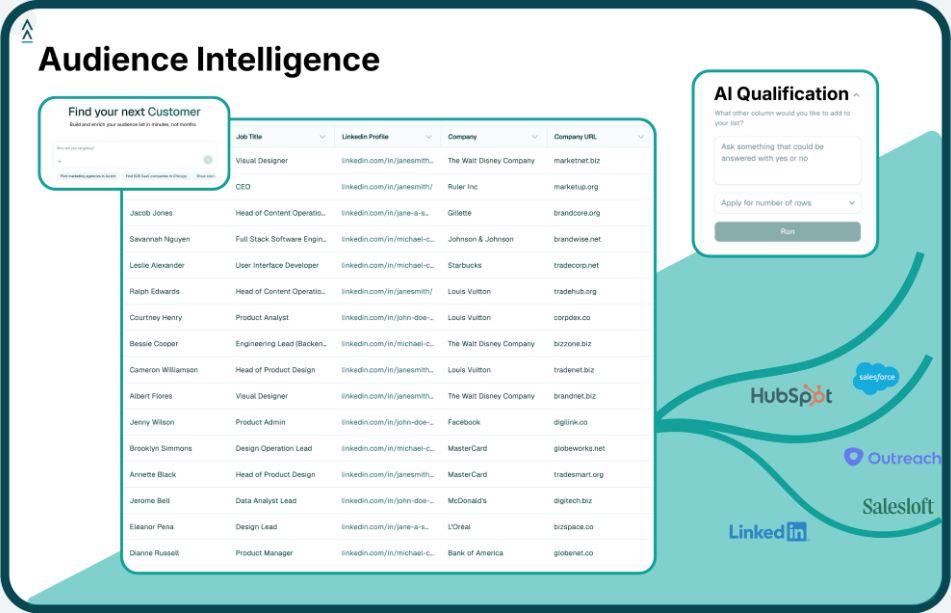
For account targeting and enrichment, that means a platform like Landbase, which delivers verified, scored accounts in CSV format ready for your Claude Code pipeline to process.
If you are a GTM engineer or aspiring one, here is the order to learn things in 2026:
Not in the traditional sense. GTM engineers need to think in systems and write clear instructions. Claude Code handles the actual coding. You need enough technical literacy to verify the output and debug edge cases, but you do not need a CS degree.
GTM engineer salaries range from $120k to $250k base in the US, depending on company stage and location. Senior GTM engineers at venture-backed SaaS companies often earn more in equity than base salary because the leverage is so high.
No. It is a force multiplier. The role is about deciding what to build and ensuring it works. Claude Code just makes the building part 10x faster, which means GTM engineers can build more, ship more, and contribute more to revenue. The role is more valuable in 2026, not less.
For one-off automations and prototypes, yes. For workflows that need to run reliably every day across a team, dedicated platforms still win on reliability. Most GTM teams use both: Claude Code for prototypes and the long tail, platforms for the core daily workflows.

Tool and strategies modern teams need to help their companies grow.






