.png)
.png)

Daniel Saks
Chief Executive Officer


Choosing a B2B data provider is one of the highest-stakes decisions a RevOps team makes. The right provider feeds your pipeline with qualified accounts and accurate contacts. The wrong one fills your CRM with bad data that breaks scoring, routing, and outreach for months.
According to B2B data accuracy research, the average data provider delivers around 50% accuracy. Top-tier providers claim 90-95%+ on verified records. That gap means the difference between a productive sales team and one that wastes 27% of its time on bad data.
This guide provides a framework for evaluating providers so you pick the right one for your specific needs.
Accuracy measures whether the data is correct. An email that reaches the right person at the right company is accurate. An email that bounces, reaches the wrong person, or goes to someone who left 6 months ago is inaccurate.
How to test: request a sample list matching your ICP (at least 500 records). Run the emails through a verification tool. Check a random sample of 50 job titles against LinkedIn. Calculate the accuracy rate.
Benchmark: demand under 3% bounce rate. If the sample bounces higher than 5%, the provider's verification is not rigorous enough for outbound use.
Freshness measures how recently the data was verified. According to CRM data quality benchmarks, B2B contact data decays between 22.5% and 70.3% annually. Email decay runs at 3.6% per month.
A database verified 6 months ago has already lost 15-20% of its accuracy. The question to ask every provider: how often do you re-verify records? Weekly re-verification is excellent. Quarterly is the minimum. Annual is unacceptable for outbound use.
Coverage measures how many of your target accounts the provider can actually find. A provider with 300M total contacts might only cover 30% of your specific ICP if your market is niche or geographic.
How to test: give the provider a list of 200 known accounts in your ICP. Ask them to return contacts matching your buyer persona. Calculate the match rate. If they cannot find contacts at 60%+ of your known accounts, they will have similar gaps across your full TAM.
If you sell into Europe, GDPR compliance is mandatory. If you sell into California, CCPA compliance matters. In 2026, the CCPA Delete Act launched the DROP platform, and starting August 2026, data brokers must check it every 45 days.
Ask providers: where do you source your data? Do you honor opt-out requests? How do you handle GDPR subject access requests? Can you provide documentation of your compliance processes?
Basic providers deliver name, email, phone, and company. Advanced providers add firmographic data (industry, size, revenue), technographic data (technology stack), intent signals (buying behavior), funding data, hiring signals, and more.
The depth of enrichment determines how useful the data is for scoring, routing, qualification, and personalization. A contact record with 10 fields is a list. A contact record with 1,500+ enrichment fields is intelligence.
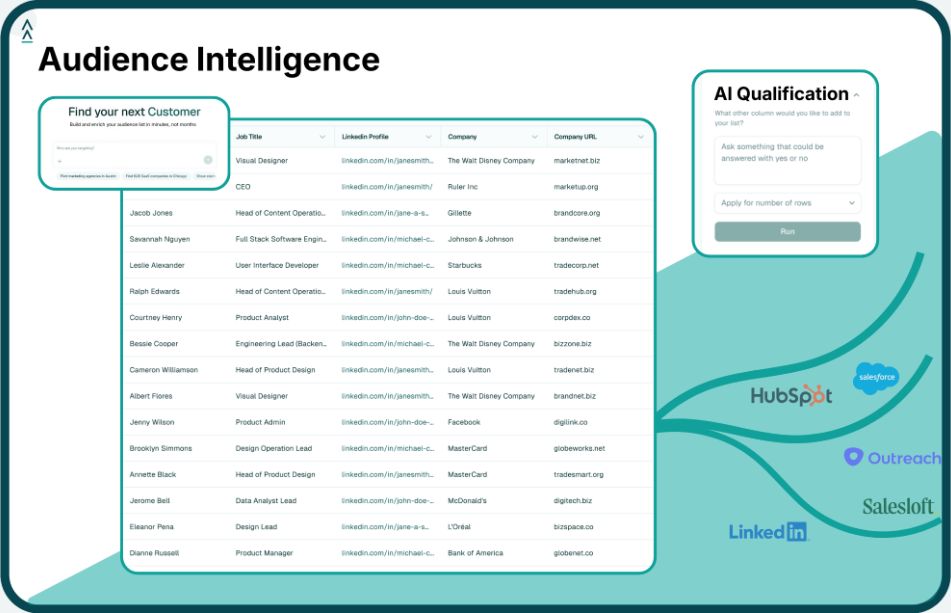
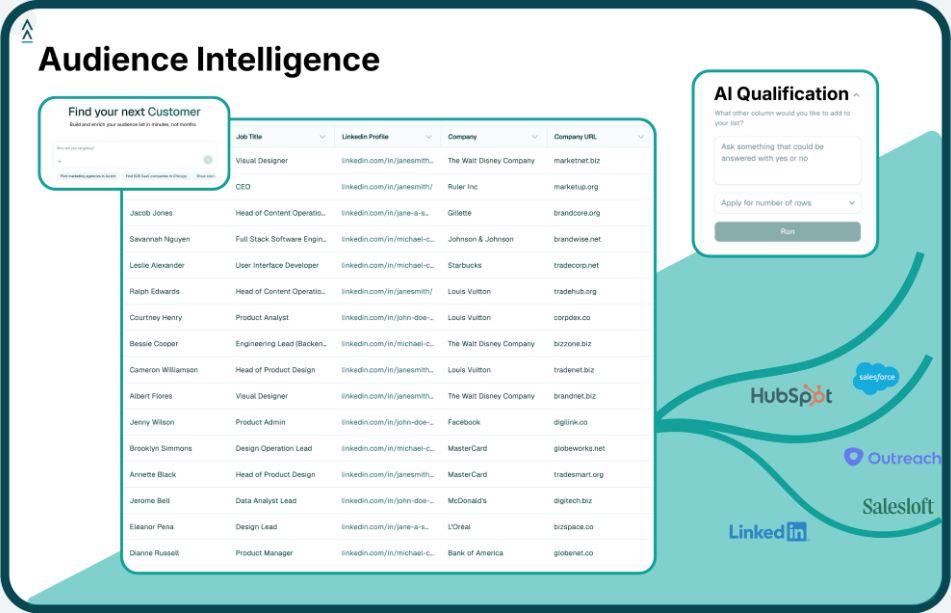
Landbase delivers accounts with 1,500+ enrichment fields including firmographic, technographic, intent, funding, and hiring signal data. This depth enables AI-powered qualification and scoring that basic contact databases cannot support.
Before talking to vendors, document: your ICP (industries, sizes, geographies, personas), your use cases (outbound, ABM, enrichment, scoring), your volume needs, and your compliance requirements.
Ask each provider for a sample list matching your specific ICP. Do not accept generic samples or demos on their best-performing segments. You need to know how they perform on your market.
Run the sample through an independent email verification tool. Check a random sample of job titles and company data against LinkedIn and company websites. Calculate accuracy rates for each provider.
Look at the fields each provider returns. Count how many are useful for your scoring, routing, and qualification workflows. A provider with 50 fields that match your needs is better than one with 500 fields you will never use.
Ask specifically: how often are records re-verified? What triggers re-verification? Can you show me the verification date on sample records?
Before committing annually, run a 30-60 day paid pilot on your actual workflows. Measure bounce rates, match rates, and downstream conversion. This is the only reliable way to evaluate a provider because marketing claims and samples do not always match production performance.
Accuracy. A smaller database with 95% accuracy is more valuable than a massive database with 50% accuracy. Your reps will waste time on every bad record, and your domain reputation takes a hit from every bounced email. Start with accuracy, then expand coverage by adding providers through waterfall enrichment.
Most teams get the best results with 2-3 providers stacked in a waterfall. Start with your primary provider for the bulk of records, add a second for gap-filling, and optionally a third for specialized data (like technographics or intent). More than 3 usually has diminishing returns.
Ranges widely: from $5K/year for basic contact databases to $200K+/year for enterprise platforms with intent data and AI qualification. The right budget depends on your team size, outbound volume, and how much of the workflow the platform handles.
Not without testing. Every provider claims 95%+ accuracy. Independent testing consistently shows the industry average is closer to 50%. Always run your own test on your ICP-specific sample before committing.
Tool and strategies modern teams need to help their companies grow.