Daniel Saks
Chief Executive Officer


Boston-area startups raised about $7.8 billion in venture funding in the first five months of 2026, according to Crunchbase News. That put the region on track for its strongest year in roughly four years, with at least 12 local companies raising rounds of $200 million or more.
That mix shapes the city's AI startups. Alongside coding and security companies, much of Boston's fastest hiring is in healthcare AI, clinical development, and AI for brain and patient data. Several of these companies also appear in Landbase's wider ranking of AI startups adding headcount fastest.
This list ranks venture-backed AI startups headquartered in Boston and Cambridge, Massachusetts, by 12-month headcount growth measured in Landbase data, then verifies each company's funding and operating evidence against public sources.
The starting pool was AI-native startups with a headquarters address in Boston or Cambridge, founded in 2019 or later, with at least 30 employees. Companies based elsewhere, including those whose press materials place headquarters outside the Boston area, were excluded.
Every company on the list had to meet four criteria:
Headcount growth is calculated from professional-profile data and can differ from company-reported figures, particularly for companies with contractors or distributed teams. Funding, valuation, and revenue figures below come from company announcements and press coverage rather than headcount data. Funding alone does not establish growth, so it is treated as one of several company buying signals.
CEO: Brian Elliott
Latest round: $200 million, May 2026
12-month headcount growth: +526%
Category: Enterprise autonomous software development
Blitzy provides an autonomous software development platform for large enterprises with legacy codebases.
The system maps an existing codebase into a knowledge graph, then runs thousands of AI agents in parallel over days or weeks on codebases ranging from one million to more than 100 million lines of code.
Blitzy said its headcount more than doubled in the six months before its May 2026 round, and that it serves dozens of Global 2000 enterprises.
The company raised $200 million at a $1.4 billion valuation, moving from a small seed round to unicorn status in under two years.
Northzone led the round, with PSG, Battery Ventures, and Jump Capital joining and existing backers Flybridge, NFX, and Link Ventures participating. Liberty Mutual Strategic Ventures and Erie Strategic Ventures made strategic investments. Total disclosed funding is a little over $200 million.
Blitzy targets legacy modernization rather than prototyping, and its insurance-industry backers point to demand for agents that work on large, regulated codebases.
CEO: Lior Div
Latest round: $130 million Series A, December 2025
12-month headcount growth: +227%
Category: Agentic security operations
7AI builds AI agents for security operations centers. The agents enrich signals, triage alerts, hunt for known threats, and correlate telemetry.
7AI launched from stealth in February 2025. In its first ten months, the company said its agents had processed more than 2.5 million alerts and completed more than 650,000 investigations, and that customers included Fortune 500 companies in financial services, retail, technology, and healthcare.
The company described its raise as the largest cybersecurity Series A on record.
Index Ventures led the $130 million Series A, with Blackstone Innovations Investments joining and Greylock, CRV, and Spark participating. Total funding reached $166 million.
7AI sells agents that do analyst work rather than another detection tool, which puts it in competition for SOC labor budgets.
CEO: Peter Morales
Latest round: $125 million Series B, February 2026
12-month headcount growth: +200%
Category: Verified AI code translation
Code Metal uses AI to translate code from high-level languages into hardware-specific targets such as Rust, VHDL, and CUDA, then formally verifies the output.
Its customers include the U.S. Air Force, L3Harris, and RTX.
Code Metal reached a reported $1.25 billion valuation with its February Series B, roughly three months after its Series A.
The company had approximately 75 employees at the time and said it planned to double or triple headcount by the end of 2026.
Salesforce Ventures led the $125 million Series B, with Accel, B Capital, and RTX participating. It followed a $36.5 million Series A led by Accel and $16.5 million in combined pre-seed and seed funding.
In defense and embedded systems, unverified AI-generated code is not usable. Code Metal pairs code generation with formal verification, which fits the region's long-standing defense electronics base.
CEO: Rylan Hamilton
Latest round: $50 million Series A, August 2025
12-month headcount growth: +117%
Category: Autonomous naval vessels
Blue Water Autonomy is building long-range autonomous ships for the U.S. Navy and commercial customers. Its first full-scale vessel, expected to be 100 to 150 feet long, is planned for 2026.
The company said its team had quadrupled in size between its April 2025 seed round and its Series A. It also opened a Washington, D.C. office.
Its $50 million Series A came as the Pentagon directed $2.1 billion in new Congressional funding toward medium-sized unmanned surface vessels.
GV led the Series A, with existing investors Eclipse, Riot, and Impatient Ventures participating. It followed a $14 million seed round, for total funding of about $64 million.
Blue Water Autonomy is one of several Boston-area companies applying the region's robotics expertise to defense, where demand for unmanned systems is backed by dedicated budget lines.
CEO: Mikey Shulman
Latest round: More than $400 million Series D, May–June 2026
12-month headcount growth: +116%
Category: AI music generation
Suno, based in Cambridge, lets users create full songs, including vocals and instrumentation, from text prompts.
Shulman said in February 2026 that Suno had 2 million paid subscribers and about $300 million in annual recurring revenue. More than 100 million people had used the product since its December 2023 launch.
Suno's valuation moved from $2.45 billion in November 2025 to $5.4 billion after its Series D.
Bond Capital led the Series D, with IVP, Forerunner, and Union Square Ventures participating. It followed a $250 million Series C in November 2025.
Suno is the largest consumer AI company on this list. It settled with Warner Music Group and signed a licensing agreement, while other copyright suits remain active.
CEO: Thomas Knox
Latest round: $8 million seed, October 2025
12-month headcount growth: +106%
Category: AI operating room intelligence
VitVio uses computer vision and ambient sensing to build a real-time 3D picture of the operating room. The software logs surgical phases, coordinates staff, and predicts when cases will finish.
VitVio described its seed as an oversubscribed $8 million round that would fund expansion across major U.S. hospitals. The company has not disclosed customer counts or revenue.
Bek Ventures led the seed, with LDV Capital participating. It followed a €1.8 million pre-seed, for total funding of about $10 million.
VitVio is the earliest-stage company on this list, so its growth reflects a small starting team.
CEO: Elad Ferber
Latest round: $15 million Series A, February 2026
12-month headcount growth: +104%
Category: Healthcare administrative automation
Synthpop, based in Cambridge, automates administrative work in healthcare, including intake, referrals, and payer processes. Its platform combines document intelligence, payer-aware reasoning, and conversational voice agents.
Synthpop said its platform had handled more than 2 million patients and connects with eight major EHR systems.
Ansa Capital led the Series A, with Defy.vc, Peterson Ventures, Storm Ventures, and strategic investor Bruce Broussard participating. Total funding is $23 million.
Administrative labor is one of the largest cost centers in U.S. healthcare. Synthpop is part of a group of agent companies selling directly into provider operations rather than clinical decision-making.
CEO: Jacob Donoghue
Latest round: Series B expanded to more than $97 million, April 2026
12-month headcount growth: +91%
Category: AI for brain data and EEG
Beacon Biosignals combines FDA-cleared wearable EEG hardware with AI analytics to measure brain activity at home. Its platform is used in neurology and sleep clinical trials, diagnostics, and precision medicine programs.
Beacon upsized its Series B to more than $97 million in April 2026, from a previously announced $86 million.
The extension added JSL Health, Palo Santo VC, Kicker Ventures, and Samsung Next. Earlier Series B investors included GV, General Catalyst, and Casdin Capital. The company said cumulative funding exceeds $132 million.
Brain data has been difficult to collect outside a clinic. Beacon sells to drug developers that need objective neurological endpoints,.
CEO: David Sontag
Latest round: $21 million Series A, March 2025
12-month headcount growth: +90%
Category: AI chart review and clinical registries
Layer Health, spun out of MIT, uses large language models to automate medical chart review. Its first major use case is clinical registry abstraction for hospital quality reporting.
In December 2025, Layer Health announced a multi-year collaboration with Johns Hopkins Medicine covering surgical and oncology registries. The company also lists Intermountain Healthcare, MultiCare, Froedtert, and White Plains Hospital as health system partners, and reports time savings of more than 50% in registry abstraction.
Define Ventures led the $21 million Series A, with GV, Flare Capital Partners, and MultiCare Capital Partners participating. It followed a $4 million launch round from GV, General Catalyst, and Inception Health.
Layer Health sells to health systems through quality and registry teams, a narrower entry point than broad clinical documentation.
CEO: Raviv Pryluk
Latest round: $50 million Series A, May 2025
12-month headcount growth: +86%
Category: AI for clinical trial design and analysis
PhaseV provides machine learning tools to biopharma sponsors and contract research organizations. Its platform covers simulation-based trial design, clinical data analysis, and biomarker identification.
PhaseV was reported to have more than 30 customers globally, including several large pharmaceutical companies. The company said its platform supports more than 20 therapeutic areas, including oncology, immunology, and rare diseases, and it launched an AI Enrollment Lab in January 2026.
Accel and Insight Partners co-led the $50 million Series A, with Viola Ventures, EXOR, and LionBird participating. Total funding is $65 million.
Trial failure and delay are among the largest costs in drug development. PhaseV's Cambridge headquarters puts it close to the biopharma sponsors it sells to.
Several patterns stand out.
First, healthcare and life sciences dominate the list. VitVio, Synthpop, Beacon Biosignals, Layer Health, and PhaseV all sell into hospitals, health systems, or drug developers. That mirrors Crunchbase's finding that more than half of the region's largest funded startups focus on biotech or healthcare.
Second, defense is a second cluster. Code Metal sells verified code to the U.S. Air Force and defense primes, and Blue Water Autonomy is building unmanned ships for the Navy.
Third, funding is concentrated in a few companies. Suno's Series D and Blitzy's $200 million round together exceed the latest rounds of the other eight companies combined. Several healthcare companies raised rounds under $25 million, so their growth often reflects small starting teams. University ties also matter: Layer Health spun out of MIT.
For GTM teams, these companies are hiring quickly and adding enterprise customers. That combination is more useful when paired with hiring, leadership, technology, and data enrichment signals than when funding is viewed on its own. Teams researching specific categories can compare this list with Landbase's ranking of healthcare AI startups hiring fastest and its list of top AI coding and developer tools startups, and with the companion list of New York AI startups hiring fastest. The full city-by-city comparison is in Landbase's ranking of AI startups hiring fastest by city.
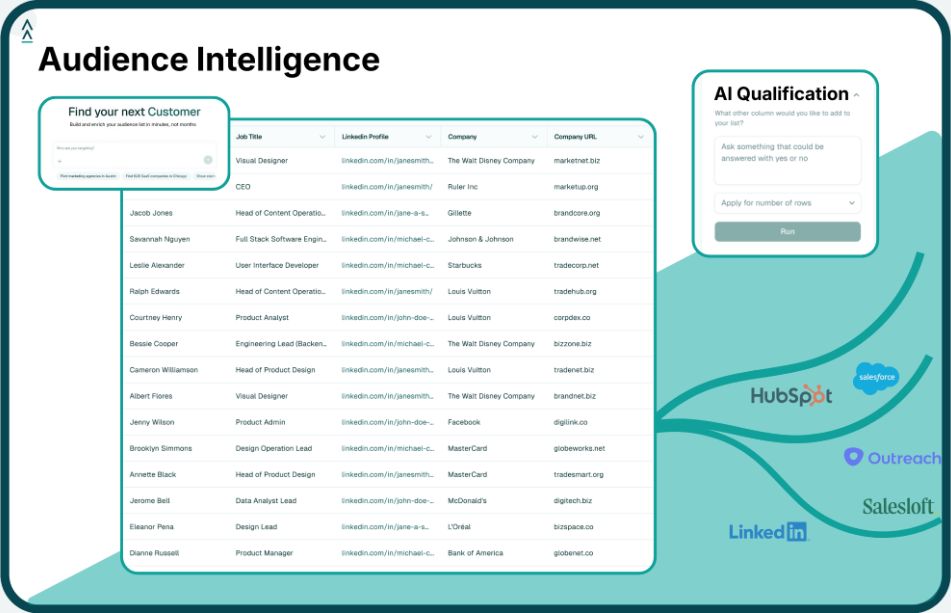
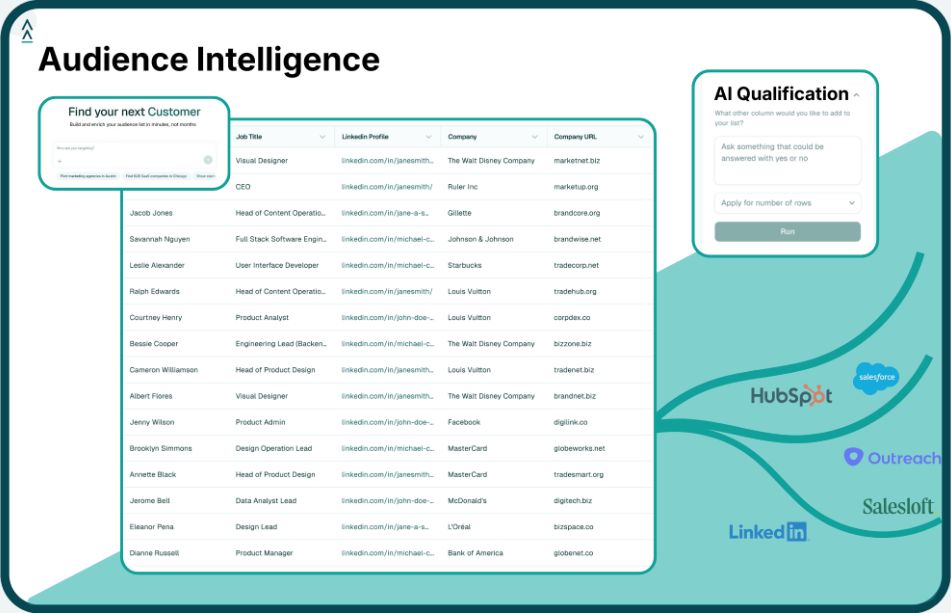
The ranking in this article was built with Landbase. A natural-language search identified venture-backed AI startups headquartered in Boston and Cambridge, an enrichment step added founding year, headquarters city, and 12-month headcount change, and the results were filtered and sorted into a structured dataset.
Landbase's web and CLI interfaces access the same account, datasets, and saved work.
For more complex requirements, the Advanced Dataset Creator supports filters, calculations, and custom output fields.
Landbase's data infrastructure includes more than 800 million contacts and more than 40 million companies across more than 1,500 fields, with enrichment from more than 20 providers.
A Boston workflow could, for example, identify AI startups headquartered in Boston or Cambridge that sell to health systems or biopharma, raised a Series A or later in the past 18 months, grew headcount by more than 75%, and recently hired a first head of sales or partnerships.
The Landbase CLI setup supports these workflows from a standard terminal and from AI coding environments including Claude Code and Codex.
In Landbase's 12-month headcount data, the fastest-growing venture-backed AI startups headquartered in Boston and Cambridge that met this list's criteria were Blitzy, 7AI, Code Metal, Blue Water Autonomy, Suno, VitVio, Synthpop, Beacon Biosignals, Layer Health, and PhaseV. Each grew headcount by more than 80%.
Blitzy recorded the highest 12-month headcount growth among companies that met this list's criteria, at more than 500%. 7AI and Code Metal followed, each at roughly 200% or more.
Boston combines research universities such as MIT and Harvard with a large concentration of hospitals, biopharma companies, and defense contractors. Those organizations supply both talent and nearby customers, which helps explain why healthcare, life sciences, and defense applications are prominent on this list.
Not on its own. Headcount data can differ from company figures, and fast hiring does not guarantee revenue growth. This list therefore pairs headcount growth with disclosed funding, revenue, customer, and valuation evidence wherever it is available.
Teams can start with a geography and category definition, then filter by headcount growth, funding stage, recent rounds, target buyer, and hiring activity. Landbase can combine these criteria into reusable datasets and return company and contact information through web and CLI workflows.
Tool and strategies modern teams need to help their companies grow.