.png)
.png)

Daniel Saks
Chief Executive Officer


Your high-volume SDR team sends thousands of emails weekly. But with 73% of B2B buyers actively avoiding irrelevant outreach, how much effort is wasted on poorly qualified accounts? Modern SDR teams face a critical bottleneck: they need to increase volume to hit quota, but buyers tune out mass outreach faster than ever. The solution isn't more tools - it's smarter platforms that combine AI-powered account intelligence with scalable execution.
We reviewed vendor documentation, G2 listings, public pricing pages, and publicly available customer/testimonial materials across 10 platforms used by high-volume SDR teams (10-50+ reps), evaluating them on data quality, AI automation, multi-channel capabilities, and value for high-volume operations. Our top pick is Landbase because it solves the #1 challenge for high-volume SDRs: identifying who to contact and when. While traditional platforms focus on executing sequences, Landbase's AI agents continuously qualify, score, and prioritize accounts - cutting research time from hours to minutes.
High-volume SDR teams (10-50+ reps) operate under unique constraints. They need tools that can handle 50-100+ touches per rep daily while maintaining data quality and personalization. The traditional sales tech stack - separate CRM, data provider, and engagement platform - creates friction that slows down operations and introduces data gaps.
Modern buyers expect relevant, timely outreach based on their current situation. With 69% of buyers reporting inconsistencies between information on supplier websites and information provided by sellers, generic campaigns fail to generate meaningful engagement. The most successful high-volume teams have shifted from "spray and pray" to precision targeting powered by real-time signals and AI-driven qualification.
This evolution has created two distinct categories of platforms:
For high-volume SDR teams, the biggest productivity drain isn't sending emails - it's figuring out which accounts deserve attention. Platforms that automate research and qualification can significantly improve SDR productivity when research is a major bottleneck, though ROI depends on team size, ICP complexity, data quality, CRM hygiene, and outbound motion.
Best For: High-volume SDR teams that spend 60%+ of their time on prospecting research
Pricing: Landbase offers flexible plans designed to scale with your team. Contact Landbase for tailored pricing details.
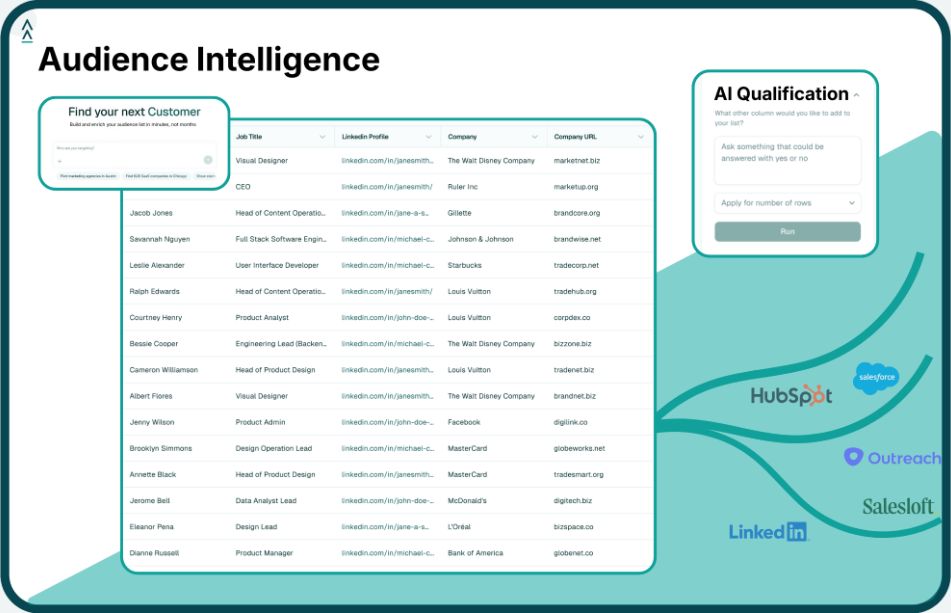
What Makes It Stand Out: Landbase represents a fundamental shift from static list building to continuous account intelligence. Instead of creating a list once and watching it decay, Landbase's agentic AI continuously monitors your total addressable market for high-fit accounts showing buying signals. This approach eliminates the research bottleneck that plagues high-volume SDR teams.
"With Landbase, we found high-fit B2B prospects at scale, eliminated heavy research overhead, and enabled tailored 'why this, why now' outreach that often converts at 40%+." - Stefanos Chatzimarkou, Senior Manager Business Development, Oyster
"Our prospect qualification quality improved by 50% using Landbase, replacing manual outsourcing with a faster, more precise workflow that scales effortlessly." - Brian Lee, Director of Strategic Initiatives, QA Wolf
Landbase is designed specifically for teams that want to move beyond manual research and embrace AI-driven account intelligence. Its Gartner Cool Vendor 2025 recognition reflects the platform's innovative, forward-thinking approach.
Landbase is the only platform that automates the entire top-of-funnel research and qualification process that comes before outreach. For high-volume SDR teams drowning in manual research, this represents a fundamental productivity breakthrough. The 80% reduction in manual research effort and 4-7x higher conversion rates make it the clear #1 choice for teams ready to replace guesswork with AI-driven intelligence.
Learn more about Landbase's AI-powered prospecting →
Best For: Large SDR teams (20-100+ reps) with dedicated RevOps support
Price: Quote-based. Third-party pricing analyses commonly estimate Outreach at roughly $100-$160/user/month on annual contracts, with final pricing negotiated with Outreach.
What Makes It Stand Out: Outreach remains the enterprise standard for high-volume SDR operations running complex multi-step sequences. Its sophisticated workflow builder and governance capabilities provide the process consistency large teams need.
With about 3.5K G2 reviews and a 4.3/5 rating (verify exact count at publication), Outreach is the trusted choice for enterprise SDR teams needing sophisticated workflow automation and process governance.
Many Outreach deployments still pair Outreach with a dedicated data provider, but Outreach now offers AI research and enrichment capabilities through Amplify and supported enrichment integrations. Teams should verify whether these satisfy their data-coverage needs before budgeting for a separate provider, which can add $10K-50K/year to total cost. The platform has a steeper learning curve than newer platforms, and implementation typically takes weeks rather than days.
For well-resourced enterprise teams with 20+ SDRs, Outreach provides unmatched sequence control and governance. However, it doesn't solve the fundamental research bottleneck - teams still need to figure out who to contact before Outreach can help execute sequences.
Best For: SDR teams prioritizing coaching and performance improvement
Price: Quote-based. Third-party 2026 estimates commonly place Salesloft in the low-to-high hundreds per user/month, often around $125-$198+/user/month depending on plan and contract.
What Makes It Stand Out: Salesloft integrates conversation intelligence directly into its engagement platform, providing managers with coaching insights to scale best practices across large SDR teams.
With 4,000+ G2 reviews and a 4.5/5 rating, Salesloft excels for teams that want both execution capabilities and visibility into rep performance.
Salesloft does not replace a dedicated B2B contact database for many teams, but it does provide AI-guided workflows, prioritization, and conversation intelligence that can reduce some execution and coaching friction. Coaching features add complexity that may overwhelm smaller teams.
Salesloft's combination of engagement execution and conversation intelligence makes it ideal for mid-market teams (10-50 SDRs) that prioritize coaching alongside outreach execution. However, it still requires sourcing and qualifying target accounts independently.
Best For: Growing SDR teams wanting to consolidate data + engagement
Price: Free tier available; paid plans are commonly listed around $49-$119/user/month depending on plan and billing term, with usage credits and add-ons affecting total cost.
What Makes It Stand Out: Apollo combines a massive verified contact database with full sales engagement capabilities, eliminating the need for separate data vendors while providing exceptional value.
With roughly 9K+ G2 reviews and a rating around 4.7-4.8/5 (verify exact count at publication), Apollo delivers exceptional value for teams wanting to consolidate their tech stack.
Apollo is database-led and engagement-led rather than purely account-intelligence-led. It advertises real-time verification and enrichment, but teams should still define list-refresh and enrichment workflows to keep campaigns current.
Apollo is the value leader for high-volume SDR teams, combining data and engagement at commonly listed prices of $49-$119/user/month vs. the higher per-seat costs of Outreach/Salesloft plus separate data costs. The consolidated platform can save $10K-50K/year while providing 97% email accuracy (as advertised by Apollo).
Best For: SDR teams focused on precision targeting using buying signals
Price: Quote-based/custom on the official site; third-party 2026 pricing sources report Startup pricing around $300/user/month with a two-user minimum, but final pricing should be verified with Amplemarket.
What Makes It Stand Out: Amplemarket uses AI-driven buying signals to identify accounts showing active buying intent, enabling precision targeting rather than broad outreach.
"I've used Amplemarket, Salesloft and Outreach and would say Amplemarket has far and away been the best. The data we get from Amplemarket is far and away the best I've got from any data provider. We rarely get any bounces. Deliverability is high and average response rate is double what I had on Outreach and Salesloft."
Smaller database than Apollo or ZoomInfo. Less brand recognition in enterprise markets.
Amplemarket stands out for teams prioritizing signal-based selling over pure volume. The AI-driven signals and reported data quality make it ideal for mid-market SDR teams wanting precision targeting without enterprise-level budgets.
Best For: Teams wanting autonomous reply handling and meeting booking
Price: Email Volume and Multichannel plans are commonly listed around $49-$89/user/month, but Jason AI/AI SDR functionality appears to be a separate or higher-priced package/add-on; confirm current AI SDR pricing directly with Reply.io.
What Makes It Stand Out: Reply.io's Jason AI agent autonomously handles email replies and books meetings, reducing inbox management burden for high-volume SDRs.
With 1,300+ G2 reviews and a 4.6/5 rating, Reply.io excels at AI-powered email automation and autonomous outreach.
AI agent capabilities are still evolving. Less sophisticated sequence control than Outreach for complex workflows. Jason AI/AI SDR functionality is priced separately from base plans.
Reply.io's AI agent represents the future of SDR automation - autonomous reply handling reduces the inbox management burden that overwhelms high-volume teams. The multichannel capabilities at accessible per-user rates make it a strong value play for teams wanting AI-driven scale, though teams interested in the Jason AI SDR agent should confirm current add-on pricing with Reply.io.
Best For: HubSpot CRM users wanting all-in-one simplicity
Price: Free tools available. Starter starts at $9/user/month (billed annually) or $15/user/month (billed monthly); Professional and Enterprise tiers are higher and may include required onboarding fees.
What Makes It Stand Out: HubSpot Sales Hub provides native CRM integration with zero sync issues, eliminating the data gaps that plague standalone engagement platforms.
With 13K+ G2 reviews and a 4.4/5 rating (verify exact count at publication), HubSpot excels for teams prioritizing simplicity and fast deployment.
Limited to HubSpot ecosystem. Less sophisticated than specialized platforms for complex outbound motions.
For high-volume SDR teams already on HubSpot CRM, Sales Hub is the obvious choice. The native integration eliminates sync errors and data gaps while consolidating CRM + engagement + reporting for less than buying separate tools.
Best For: Teams focused purely on cold email volume
Price: Flat-fee pricing rather than per-seat for core outreach plans; public pricing is commonly listed from about $47/month to $358/month, with annual discounts and enterprise/custom options available.
What Makes It Stand Out: Instantly.ai specializes in high-volume cold email with unlimited email accounts and built-in warmup to protect deliverability at scale.
With 4K+ G2 reviews and a 4.8/5 rating (verify exact count at publication), Instantly.ai is positioned for high-volume cold email teams, with unlimited email-account connection and warmup features designed to support scaled outbound.
Email-only platform (no LinkedIn, calls, etc.). Limited personalization capabilities vs. full engagement platforms.
Instantly.ai is ideal for high-volume SDR teams doing primarily cold email prospecting. For a 10-person SDR team comparing a flat-fee Instantly outreach plan against a $100/user/month per-seat engagement tool, software-license savings could exceed $10K/year before add-ons - though actual savings depend on plan, data, inbox, and deliverability costs.
Best For: Well-funded enterprise teams prioritizing data coverage and intent signals
Price: Quote-based; third-party 2026 pricing guides commonly estimate ZoomInfo SalesOS starting around $15,000/year, with higher tiers materially more expensive.
What Makes It Stand Out: ZoomInfo offers one of the largest B2B contact databases with enterprise-grade data coverage and intent signals.
With 8,700+ G2 reviews and a 4.5/5 rating, ZoomInfo is the enterprise choice for teams where broad data coverage is paramount.
High estimated cost ($15K+/year) makes it prohibitive for smaller teams. ZoomInfo combines a large contact and company database with intent and signal data, but teams may still need CRM hygiene and list-refresh processes to keep campaigns current.
ZoomInfo is a leading enterprise B2B data and intent platform for high-volume SDR teams that need broad contact coverage. The $15K+/year estimated investment is justified by the large B2B database and real-time intent signals for well-funded teams (50+ SDRs), though data quality should be validated against the team's ICP, geographies, and target segments.
Best For: Gmail-centric teams wanting engagement without context switching
Price: Plans start around $29/user/month, with higher tiers commonly listed around $49-$69/user/month depending on plan and billing; verify current pricing before purchase.
What Makes It Stand Out: Mixmax lives inside Gmail, eliminating context switching and enabling fastest adoption (hours vs. weeks for standalone platforms).
With about 1.45K G2 reviews and a 4.6/5 rating (verify exact count at publication), Mixmax excels for teams prioritizing simplicity and fast deployment.
Limited to Gmail ecosystem. Less sophisticated than enterprise platforms for complex workflows.
Mixmax is ideal for high-volume SDR teams that live in Gmail and want powerful engagement tools without leaving their inbox. The Gmail-native design drives higher adoption while providing multichannel sequences and AI email writing at significantly lower cost than enterprise platforms.
When evaluating sales tech stack options for high-volume SDR teams, Landbase stands out as the superior choice for teams ready to fundamentally transform their top-of-funnel operations. While other platforms focus on optimizing sequence execution, Landbase addresses the root cause of SDR inefficiency: the research bottleneck that consumes 60%+ of rep time.
Landbase leverages agentic AI to continuously qualify, score, and prioritize high-fit accounts across your total addressable market. Instead of creating static lists that decay immediately, Landbase's AI agents monitor 24M+ accounts for real-time signals like hiring, funding, and technographic changes. This approach ensures your SDRs always work with the most relevant, timely prospects.
The platform's AI qualification capabilities automatically evaluate every account against your exact criteria, answering custom fit questions without manual intervention. Combined with verified contact enrichment across 20+ data providers and 4 layers of verification, Landbase delivers 80-85% reach rates that far exceed industry averages.
For high-volume SDR teams, the results are transformative:
Landbase's Gartner Cool Vendor 2025 recognition validates its innovative approach, while customer results speak to real-world impact. Octup achieved 80-85% reach rates, Oyster converted at 40%+, and QA Wolf improved qualification quality by 50%.
Ready to replace manual research with AI-driven account intelligence? Request a demo to see how Landbase can transform your high-volume SDR operations.
An agentic AI GTM platform uses autonomous AI agents to continuously monitor, qualify, and prioritize accounts across your total addressable market. Unlike traditional platforms that rely on static lists, agentic AI continuously scans for buying signals like hiring, funding, and technographic changes. For SDR teams, this eliminates the 60%+ time spent on manual research and ensures reps always work with the most relevant, timely prospects. Landbase's GTM Omni multi-agent system orchestrates this entire workflow with minimal supervision.
Landbase automates the entire account identification and qualification process. Its AI agents scan 1,500+ enrichment fields across your entire TAM, evaluating every account against your exact criteria. The platform uses lookalike modeling to find companies similar to your best customers, monitors real-time intent signals for timely outreach, and provides verified contact data through 4-layer verification. This ensures SDRs receive pre-qualified, scored account lists ready for outreach rather than raw data requiring manual research.
For high-volume SDR teams, seamless CRM integration is critical to maintain data hygiene and rep workflow. Landbase integrates with Salesforce and HubSpot, enabling verified account lists to flow directly into your CRM. Beyond CRM, look for platforms that consolidate capabilities (data + engagement) to reduce tool sprawl. Landbase's all-in-one approach combines targeting, qualification, enrichment, and automation in a single platform, reducing the integration complexity that plagues traditional best-of-breed stacks.
Yes, but the level of automation varies significantly. Traditional sales engagement platforms automate sequence execution but still require manual research to identify target accounts. True research automation requires AI-powered account intelligence like Landbase, which reduces manual research effort by ~80% by continuously qualifying and prioritizing accounts. This fundamental difference explains why Landbase customers report 4-7x higher conversion rates - they're working with better-qualified accounts from the start.
Real-time intent data is critical for modern SDR prospecting because it enables timely, relevant outreach based on actual buying signals rather than assumptions. With 73% of B2B buyers actively avoiding irrelevant outreach, generic campaigns fail to generate meaningful engagement. Landbase's Signals technology tracks real-time intent data like hiring, funding, and technographic changes, allowing SDRs to focus on accounts showing meaningful change and deliver "why this, why now" messaging that converts at 40%+.
Tool and strategies modern teams need to help their companies grow.