Daniel Saks
Chief Executive Officer


Seattle has deep AI talent but fewer very large startup rounds than the Bay Area. GeekWire, citing Carta data, ranked the Seattle area fourth among U.S. metros for AI startup funding in September 2025, and separately reported that no Seattle-area company appeared among PitchBook's 100 largest AI funding deals of 2025 as of August.
That gap has started to close in 2026. Several Seattle and Bellevue AI companies raised rounds of $50 million or more this year, and a broader group of younger startups is hiring quickly. Some of the companies below also appear in Landbase's wider ranking of AI startups adding headcount fastest.
This list ranks venture-backed AI startups headquartered in the Seattle area by 12-month headcount growth measured in Landbase data, then verifies each company's funding and operating evidence against public sources.
The starting pool was AI-native startups with a headquarters address in Seattle or the Eastside cities of Bellevue, Redmond, and Kirkland, founded in 2019 or later, with at least 30 employees.
Every company on the list had to meet four criteria:
Headcount growth is calculated from professional-profile data and can differ from company-reported figures, particularly for companies with contractors or distributed teams. Funding, valuation, and revenue figures below come from company announcements and press coverage rather than headcount data. Funding alone does not establish growth, so it is treated as one of several company buying signals.
CEO: Doug Tallmadge
Latest round: $65 million Series C, June 2026
12-month headcount growth: +217%
Category: AI agents for enterprise marketing operations
Gradial builds AI agents that run enterprise marketing operations from request to publish. The agents handle content updates, localization, tagging, campaign operations, and quality assurance inside systems such as Adobe Experience Manager, Salesforce, and Jira.
Gradial raised a $65 million Series C about six months after its Series B. The company was also named to the 2026 Intelligent Applications 40 list of private AI companies.
A valuation of about $675 million was reported by The Next Web.
Insight Partners led the Series C, with Madrona Venture Group, PruVen Capital, and VMG Partners participating. It followed a Series B reported at $35 million in December 2025. Total funding is reported at more than $110 million.
Gradial sells agents into an existing budget line, marketing operations labor, rather than creating a new category.
CEO: Oege de Moor
Latest round: $120 million Series C, March 2026, extended by $35 million in May 2026
12-month headcount growth: +216%
Category: Autonomous offensive security
XBOW builds an autonomous penetration testing system that uses AI to find and validate exploitable vulnerabilities in applications, work that has traditionally required human security researchers.
XBOW reached the top of the HackerOne bug bounty leaderboard, and the company says Fortune 500 and global enterprises use its platform. Fintech.global reported more than 100 customers at the time of the May extension.
The Series C valued XBOW at more than $1 billion.
DFJ Growth and Northzone led the $120 million Series C, with Sofina and Alkeon Capital joining existing investors Altimeter, NFDG Ventures, and Sequoia Capital. The $35 million extension came from strategic investors including Accenture Ventures, NVentures, Samsung Ventures, and SentinelOne's S Ventures.
XBOW is the most heavily funded company on this list and Seattle's clearest example of a security unicorn built on AI agents.
CEO: Atai Barkai
Latest round: $27 million combined seed and Series A, May 2026
12-month headcount growth: +188%
Category: AI agent frontend infrastructure
CopilotKit provides an open-source framework for building AI agents and copilots that work inside applications rather than in a separate chat window.
The company also created AG-UI, a protocol that standardizes how AI agents connect to and communicate with user interfaces.
TechCrunch reported that AG-UI is supported by Google, Microsoft, Amazon, and Oracle. CopilotKit said its libraries see millions of installs per week and named Deutsche Telekom, Docusign, Cisco, and S&P Global as enterprise customers.
The company raised $27 million to fund generative UI and self-improving agents.
Glilot Capital, NFX, and SignalFire led the round. GeekWire reported that it combined about $20 million in new Series A capital with a previously unannounced seed round of about $7 million.
Protocols that the large cloud providers adopt tend to become defaults. CopilotKit's position as the author of AG-UI gives it a role in how enterprise applications expose agents to users.
Co-founders: Austin Petersmith and Dave Newman
Latest round: $6 million seed, September 2025
12-month headcount growth: +164%
Category: AI scheduling assistant
Howie is an AI scheduling assistant that works through email. Users copy Howie on a thread, and it proposes times, sends invitations, and follows up.
Howie launched publicly with more than 1,000 paying customers alongside its seed round.
True Ventures led the $6 million seed round, with angel investors including Jason Calacanis and Perplexity CEO Aravind Srinivas. Howie previously raised a pre-seed round reported at about $1 million in 2024.
Howie is the smallest company on this list by funding, which shows that a narrow AI assistant with paying customers can hire quickly without a large round.
CEO: Edward Wu
Latest round: $37 million Series B, July 2025
12-month headcount growth: +116%
Category: AI security operations
Dropzone AI builds AI SOC analysts, autonomous agents that investigate security alerts the way a human analyst would and hand findings to security teams.
Dropzone said in January 2026 that it grew annual recurring revenue 11 times in 2025 and onboarded more than 35 enterprise and regulated-market customers that year.
At the time of its $37 million Series B, the company said more than 100 organizations used its products, including UiPath and Zapier.
Theory Ventures led the Series B, with Decibel Ventures, Madrona, Pioneer Square Labs, and In-Q-Tel participating. It followed a $16.5 million Series A in April 2024. Total funding is about $57 million.
Security teams face more alerts than they can investigate. Dropzone and XBOW together show Seattle building AI agents for both the defensive and offensive sides of security.
CEO: Charlie Wu
Latest round: $22 million Series A, September 2025
12-month headcount growth: +110%
Category: AI crop intelligence
Orchard Robotics mounts cameras on existing farm vehicles and uses computer vision to count and assess individual fruit across an orchard or vineyard.
The system is in use at some of the largest apple and grape farms in the United States, and the company expanded to new crops with its Series A, including blueberries, cherries, almonds, pistachios, citrus, and strawberries.
Quiet Capital and Shine Capital led the Series A, with returning investors General Catalyst and Contrary participating. Total funding is reported at more than $25 million.
Orchard is the only agriculture company on this list.
CEO: Dave Clark
Latest round: $50 million Series B, July 2026
12-month headcount growth: +109%
Category: AI supply chain operating system
Auger builds an operating layer that sits on top of a company's existing ERP, warehouse, transportation, and demand planning systems. It uses AI agents and optimization models to make and execute routine supply chain decisions, flagging exceptions for people.
Clark previously led Amazon's worldwide consumer business and later served as CEO of Flexport.
Auger named Meta's Reality Labs division, Fanatics, and Kimberly-Clark as customers. Clark said about 85% of decisions in the process Auger manages at Fanatics now happen autonomously, according to coverage of the Series B.
Eclipse led the Series B, with existing investor Oak HC/FT participating. At launch, Auger was reported to be backed by about $100 million from Oak HC/FT, and reports put total funding at $150 million after the Series B.
Auger draws directly on the Seattle area's Amazon operations alumni. It is one of the clearest local examples of an enterprise AI company founded by a former big-tech executive.
CEO: Rohan D'Souza
Latest round: $10 million seed, April 2025
12-month headcount growth: +97%
Category: AI for employee health benefits
Avante provides an AI-native benefits intelligence platform for employers. It combines claims, vendor, cost, and employee engagement data in one interface and includes an AI benefits assistant that answers employee questions.
Avante named Datavant, OneDigital, Real Chemistry, and Zscaler as early clients. The company announced a $10 million seed round and reported a 40% decrease in HR workload among early users.
Fuse led the $10 million seed round, with HighSage Ventures and Ascend participating. No later round has been announced.
Avante describes health benefits as employers' second-largest line item. It applies AI to a budget that HR and finance teams both control, and draws on Seattle's health-tech base.
CEO: Varun Puri
Latest round: $40 million Series B, December 2025
12-month headcount growth: +59%
Category: AI roleplay and sales coaching
Yoodli provides AI roleplays that let sales, customer-facing, and leadership teams rehearse conversations, such as discovery calls or difficult feedback, and receive coaching on their delivery.
Varun Puri and Esha Joshi, both former Google employees, founded the company in 2021.
Yoodli said average recurring revenue grew 900% over the 12 months before its Series B, without disclosing specific figures. Named customers include Google, Snowflake, Databricks, and RingCentral.
Its valuation rose to more than $300 million, over three times its level six months earlier, according to TechCrunch.
WestBridge Capital led the Series B, with Neotribe and Madrona participating. It followed a $13.7 million Series A in May 2025. Total funding is nearly $60 million.
Yoodli sells into sales enablement, where AI roleplay is replacing some human-led training.
CEO: Manos Koukoumidis
Latest round: $10 million seed, January 2025
12-month headcount growth: +56%
Category: Open-source foundation model platform
Oumi provides a fully open-source platform for building foundation models, covering data preparation, pretraining, fine-tuning, evaluation, and deployment. It supports text and multimodal models.
Oumi came out of stealth with a $10 million seed round and has since released open models including HallOumi, a claim-verification model released in April 2025.
The seed round was reported as led by Venrock and Obvious Ventures. No later round has been announced.
Oumi is the only model-infrastructure company on the list. Its Eastside base and founders from Google Cloud and Apple reflect the large-company AI talent pool around Bellevue and Kirkland.
Several patterns stand out.
First, Seattle's fastest-hiring AI startups sell to enterprises. Gradial sells to marketing operations, XBOW and Dropzone to security teams, Auger to supply chain leaders, Avante to HR and benefits teams, and Yoodli to sales enablement. Only Howie sells primarily to individual professionals.
Second, funding is uneven. XBOW and Auger each have well over $100 million in total funding, Gradial reached a reported $675 million valuation, and four companies on the list have raised only seed rounds.
Third, the local talent base is doing much of the work. Auger is led by a former Amazon executive, Yoodli's founders came from Google, and Oumi's founders came from Google and Apple. Madrona appears as an investor in Gradial, Dropzone, and Yoodli, which reflects how concentrated local venture capital remains.
For GTM teams, these companies are hiring quickly and adding enterprise customers. That combination is more useful when paired with hiring, leadership, technology, and data enrichment signals than when funding is viewed on its own. Teams researching specific categories can compare this list with Landbase's ranking of AI security startups growing fastest, and with the companion list of San Francisco AI startups hiring fastest. The full city-by-city comparison is in Landbase's ranking of AI startups hiring fastest by city.
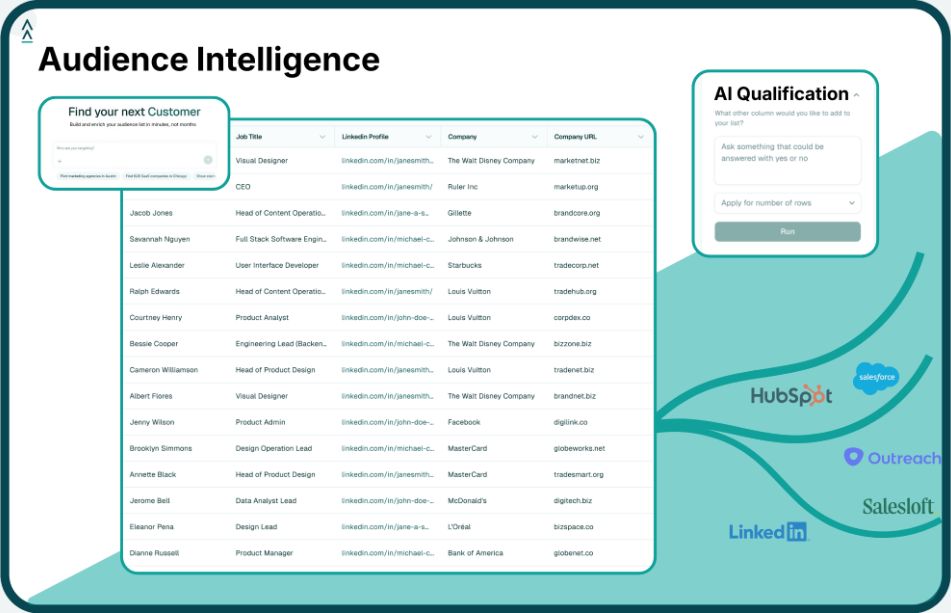
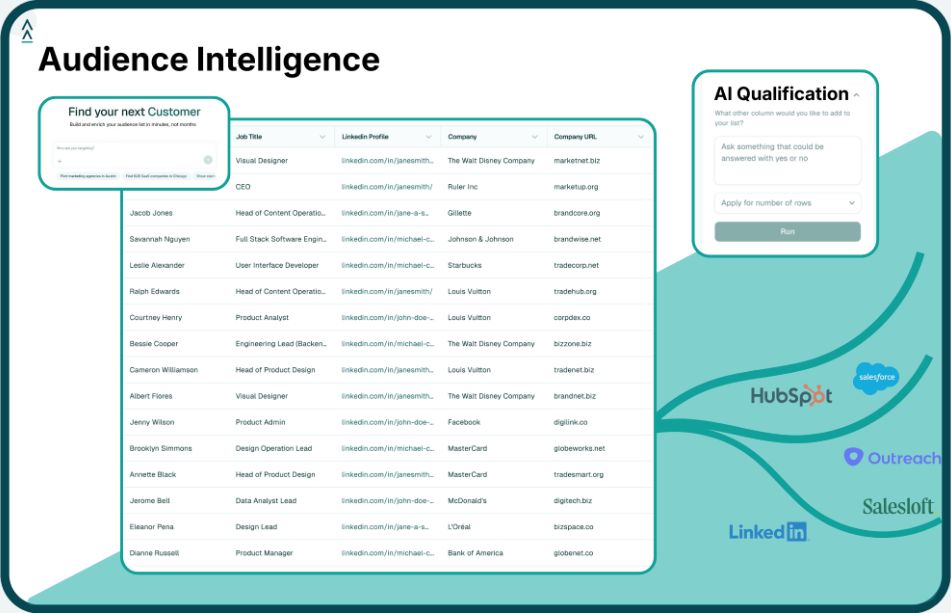
The ranking in this article was built with Landbase. A natural-language search identified venture-backed AI startups headquartered in the Seattle area, an enrichment step added founding year, headquarters city, and 12-month headcount change, and the results were filtered and sorted into a structured dataset.
Landbase's web and CLI interfaces access the same account, datasets, and saved work.
For more complex requirements, the Advanced Dataset Creator supports filters, calculations, and custom output fields.
Landbase's data infrastructure includes more than 800 million contacts and more than 40 million companies across more than 1,500 fields, with enrichment from more than 20 providers.
A Seattle workflow could, for example, identify AI startups headquartered in Seattle, Bellevue, Redmond, or Kirkland that raised a seed or later round in the past year, grew headcount by more than 50%, sell to security or operations buyers, and recently hired a first head of sales.
The Landbase CLI setup supports these workflows from a standard terminal and from AI coding environments including Claude Code and Codex.
In Landbase's 12-month headcount data, the fastest-growing venture-backed AI startups headquartered in the Seattle area were Gradial, XBOW, CopilotKit, Howie, Dropzone AI, Orchard Robotics, Auger, Avante, Yoodli, and Oumi. Each grew headcount by more than 50%.
Gradial recorded the highest 12-month headcount growth among companies that met this list's criteria, at more than 200%. XBOW followed closely, also above 200%, and CopilotKit grew by more than 180%.
The Seattle area has a large pool of engineers and operators from Amazon, Microsoft, and other large technology companies,. Several founders on this list came from those companies, and local investors such as Madrona back many of the region's AI startups.
Not on its own. Headcount data can differ from company figures, and fast hiring does not guarantee revenue growth. This list therefore pairs headcount growth with disclosed funding, revenue, customer, and valuation evidence wherever it is available.
Teams can start with a geography and category definition, such as AI-native startups headquartered in Seattle or on the Eastside, and then filter by headcount growth, funding stage, recent rounds, target buyer, and hiring activity. Landbase can combine these criteria into reusable datasets and return company and contact information through web and CLI workflows.
Tool and strategies modern teams need to help their companies grow.