.png)
.png)

Daniel Saks
Chief Executive Officer


AI is everywhere in GTM. AI SDRs, AI qualification, AI-powered targeting, AI email writers. The tools are real and the models are capable. But most teams that deploy them see mediocre results. The reason is almost always the same: the data is not ready for AI.
According to a Gartner survey, 63% of organizations either do not have or are unsure if they have the right data management practices for AI. Gartner predicts that organizations will abandon 60% of AI projects unsupported by AI-ready data through 2026.
The models are not the bottleneck. The data feeding them is.
AI agents cannot qualify an account if they do not know the company industry, size, or technology stack. They cannot score a contact if the job title is missing. They cannot route a lead if the geography field is blank.
According to CRM data hygiene research, 76% of CRM entries are less than half complete. That means the majority of records in your CRM are missing the fields that AI tools need to function.
AI agents need standardized inputs to produce reliable outputs. If your country field contains "US", "USA", "United States", and "U.S.A.", the AI cannot segment by geography. If job titles are free-text with no taxonomy, the AI cannot identify decision-makers reliably.
Consistency is a schema problem. It requires field-level validation rules, standardized picklists, and normalized data at the point of entry. Most CRMs do not enforce this because it slows down manual entry.
AI agents need to see the full picture. A contact record is useful. A contact record connected to their company firmographics, technology stack, hiring signals, funding history, and engagement activity is 10x more useful.
Most GTM data lives in silos. Contacts in the CRM, engagement in the marketing automation platform, intent signals in a third-party tool, technographics in yet another source. AI agents that can only see one silo produce one-dimensional outputs.
AI agents working with stale data produce stale outputs. According to CRM data quality benchmarks, B2B contact data decays between 22.5% and 70.3% annually. Email decay accelerates to 3.6% monthly.
An AI agent calling someone who left the company 6 months ago is actively damaging your brand because the outreach looks uninformed, not just wasting time.
The root cause is that CRM data was never designed for AI consumption. CRMs were designed for human data entry and human retrieval. Humans can tolerate incomplete, inconsistent, disconnected data because they compensate with judgment. AI cannot.
When a rep opens a CRM record and sees a missing industry field, they Google it. When they see "US" versus "United States", they know it is the same country. When they need technographic data, they check a separate tool. Humans fill the gaps intuitively.
AI agents do not fill gaps. They fail silently. They produce a low-confidence score, skip the record, or make a wrong decision. The output looks plausible but is wrong, and nobody catches it until the pipeline numbers come in short.
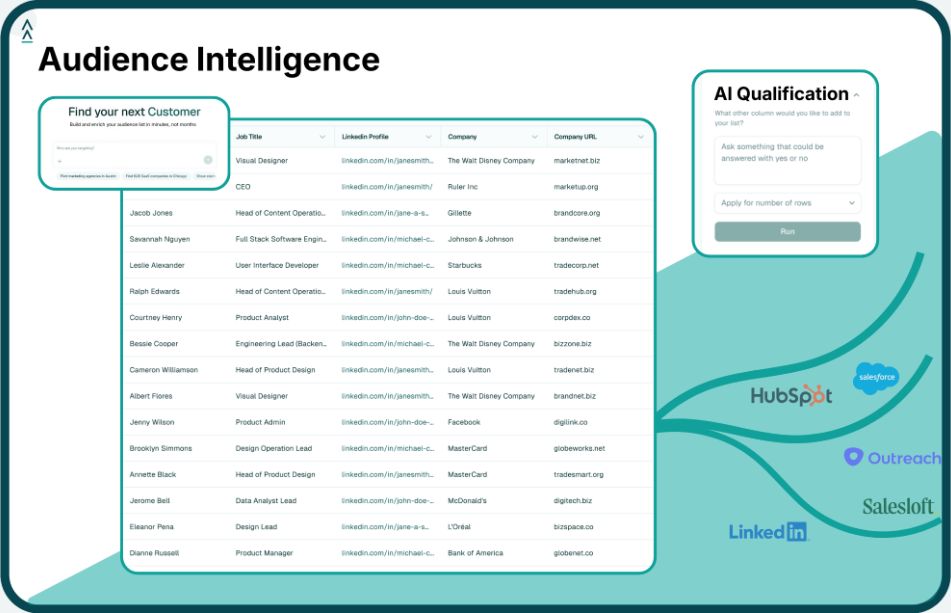
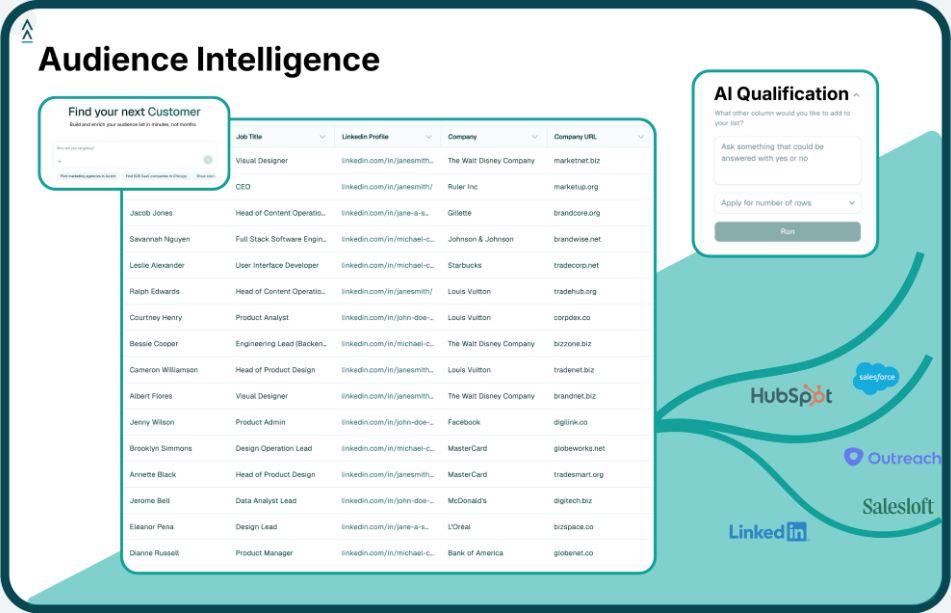
Landbase is built specifically to deliver AI-ready GTM data. The platform takes your internal data and combines it with third-party data on companies and individuals, plus real-time signals, then structures and enriches it so AI can understand your market, identify the right accounts, and execute.
Here is how it maps to the 4 dimensions:
The result is data that AI agents can actually work with. Not a CRM full of gaps that needs a quarterly cleanup project before anyone can trust the outputs.
In 2024, the competitive advantage was having access to AI. In 2026, everyone has access to the same models. GPT-4, Claude, Gemini. The models commoditized.
The new competitive advantage is having the data that makes AI useful. The team with clean, enriched, connected, current data will out-execute the team with a better model running on dirty data. The data layer is the moat.
This is the insight that keeps surfacing at AI conferences like HumanX. Leaders from OpenAI, AWS, Databricks, and others all agree: the biggest blocker to AI adoption is whether your data can provide the right context, not the models.
For GTM teams specifically, solving the data layer is the prerequisite for everything else: AI qualification, AI targeting, AI outreach, AI pipeline management, not optional. None of it works without AI-ready data underneath.
Score your GTM data on each dimension:
If you score below 3 out of 4, your AI tools are running on broken inputs. Fix the data layer before investing more in AI tools.
Partially. AI can identify duplicates, flag inconsistencies, and suggest corrections. But AI cannot create data it has never seen. If a field is empty, the AI cannot fill it without an external data source. The fix requires both AI-powered cleanup and a reliable external enrichment source.
With a bulk enrichment pass from a platform like Landbase, most teams can bring their existing CRM data to AI-ready levels in 1-2 weeks. The ongoing challenge is keeping it there, which requires enrichment at the point of entry for all new records.
Partly, yes. Data quality has always mattered. But AI raises the stakes because AI amplifies whatever it receives. Good data produces good AI output at scale. Bad data produces bad AI output at scale. The cost of bad data is higher with AI than without it.
The direct cost is failed AI projects. Gartner predicts 60% abandonment. The indirect cost is competitive disadvantage: while your team runs manual workflows, competitors with clean data run AI-powered workflows that are faster, cheaper, and more accurate.
Tool and strategies modern teams need to help their companies grow.