.png)
.png)

Daniel Saks
Chief Executive Officer


For the past five years, the standard B2B GTM stack has looked roughly the same: a CRM (Salesforce or HubSpot), a sales engagement tool (Outreach or Salesloft), a B2B database (ZoomInfo or Apollo), an enrichment tool (Clearbit or Cognism), an intent platform (Bombora or 6sense), an ABM platform (Demandbase or Madison Logic), a data orchestration layer (Clay or Tray), and 5-10 other tools depending on what your team needed.
This stack worked, but it was expensive, fragile, and required a full-time RevOps team to keep running. According to 2026 GTM tech stack research, go-to-market tech stacks have grown from 3-4 essential tools to 10-15+ platforms. The teams winning in 2026 are consolidating, not expanding.
Most teams pay for the same data twice. Their CRM has contact data. Their B2B database has contact data. Their enrichment tool has contact data. Their sales engagement tool has its own data. The data is mostly the same, the formats are different, and the team pays four times.
Every tool needs to talk to every other tool. With 10 tools, that is 45 possible integrations. Most teams have 15-20 active integrations and 5-10 broken ones at any moment. Maintaining the integrations is a full-time job.
The bigger the stack, the more RevOps engineers you need to maintain it. According to research from Cognism's analysis of RevOps tools, the modern RevOps stack has grown to require dedicated headcount just for tool administration. This is overhead that does not generate revenue.
Reps using 8 tools daily lose productivity to context switching. They forget where to do what. They duplicate work in multiple systems. They give up and go back to spreadsheets.
The biggest reason the old stack is breaking is that AI agents can do what 5 specialized tools used to do. A single AI-powered platform can target, enrich, qualify, and detect signals. The point solutions exist because the technology was not capable of consolidating. That is no longer true.
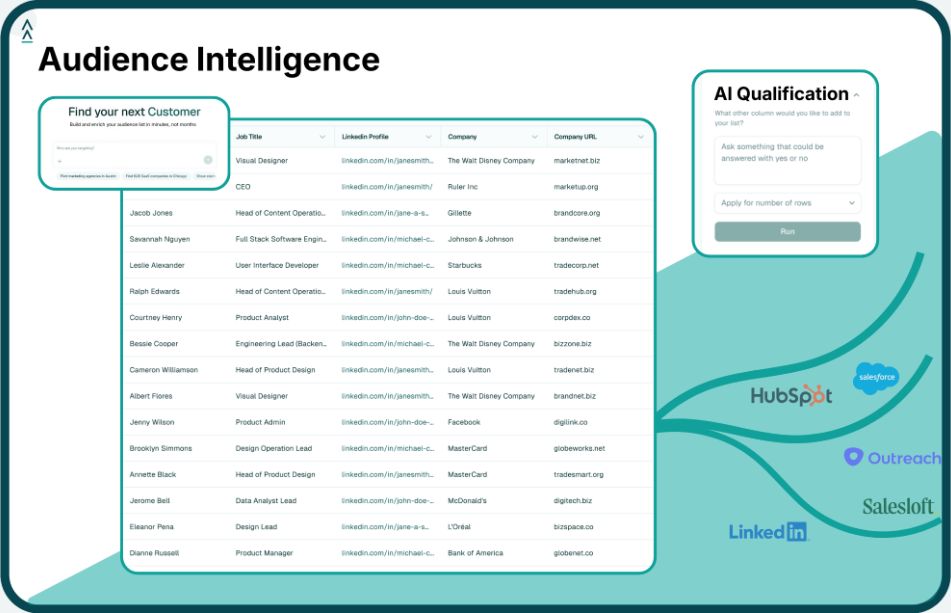
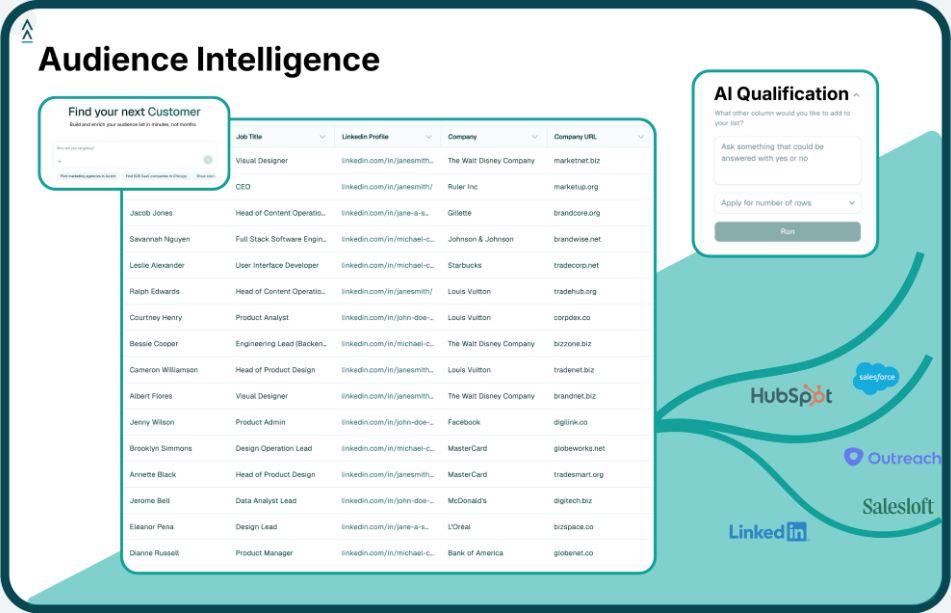
Five years ago, you bought a B2B database (ZoomInfo), an enrichment tool (Clearbit), and a targeting tool (Demandbase) separately. Today, modern AI-powered platforms deliver all three as one workflow. You describe your ICP in plain language, the platform finds matching accounts, enriches them with 1,500+ fields, and delivers them ready for outreach.
Intent data used to come from one vendor, account scoring from another, and engagement signals from a third. Modern platforms combine intent signals (third-party content consumption), first-party engagement (website visits, content downloads), and observable signals (hiring, funding, tech stack changes) into a single account score.
The old stack had separate tools for lead scoring (Marketo or Pardot), qualification (CRM-native scoring), and routing (LeanData). Modern AI agents can apply ICP criteria, score accounts, and route them automatically as one workflow.
Outreach and Salesloft built the sales engagement category. They are now competing with AI-native tools that include personalization, sequencing, and engagement tracking with AI agents writing the actual content. The old playbook of "send 200 emails per day with mail merge" is being replaced by "send 50 emails per day with deep personalization."
The stack that the best B2B teams are running in 2026 has three layers:
Still Salesforce or HubSpot. The CRM is the system of record for your accounts, contacts, and deals. Nothing has replaced this yet, and probably will not for several years.
This is where the consolidation happens. A single AI-powered platform delivers verified accounts and contacts, applies ICP criteria, scores by signal strength, and exports lists ready for outreach. This layer replaces the old combination of B2B database, enrichment tool, intent platform, and ABM tool.
Platforms in this category in 2026 include Landbase (AI-native, agentic targeting and qualification), ZoomInfo Copilot (enterprise data with AI overlay), and Clay (data orchestration with AI enrichment).
Once the data is delivered to your CRM, you need tools to act on it. This is still where Outreach, Salesloft, Apollo, and HubSpot Marketing Hub live. The execution tools are themselves consolidating, but the category is not going away.
That is the whole stack. Three layers. Down from 10-15 tools.
Do not rip out everything at once. Most teams that try this regret it. Instead, follow this gradual migration:
List every tool, what it does, what you pay for it, and which workflows depend on it. Most teams find they have 3-5 tools they did not even know were active.
Mark which tools have overlapping functionality. The B2B database, enrichment tool, and intent platform almost always overlap. So do the targeting tool and the sales engagement tool's contact features.
Choose which tool you are consolidating into. For most teams, this is either an AI-powered GTM platform (replacing 4-6 tools) or a major incumbent like Salesforce that they are already paying for.
Do not cancel the old tools yet. Run the new tool alongside them. Compare the data quality, the workflows, and the results. Make sure the new tool actually does the job before you cut the old ones.
The cleanest cut is at renewal time. Use the renewal date as your forcing function to migrate workflows. Most teams find they can cancel 3-5 tools per year without disrupting operations.
A typical mid-market B2B team running the old stack spends:
Total: $240k-$980k/year in tooling alone. Plus the 1-3 RevOps engineers needed to maintain it.
The new 3-layer stack typically costs:
Total: $140k-$500k/year. Roughly 40-50% savings, plus reduced RevOps overhead.
Three things changed at the same time, which is why 2026 is the year of consolidation.
First, AI agents got good enough to replace point solutions. The targeting, qualification, and enrichment tasks that used to require specialized tools can now be handled by AI agents working off a single data source.
Second, budgets tightened after 2022. The era of "buy every new tool" is over. CFOs are pushing back on tooling spend and asking why you have 12 tools that overlap.
Third, the integration debt got too big. Maintaining 15 broken integrations across 15 tools became unmanageable for most RevOps teams. Consolidation is a forced choice, not just an optimization.
The teams that consolidate in 2026 will save money, reduce RevOps overhead, and execute faster. The teams that keep adding tools will fall further behind.
No. Apollo is still a major player in the B2B database and sales engagement space. But it is being challenged by AI-native platforms that combine more functions in a single tool. Expect Apollo to evolve toward an all-in-one model or lose share to platforms that already are.
Both are still leaders in sales engagement. Both are adding AI features as fast as they can. The execution layer (sequencing, dialing, engagement tracking) is still a real category. They are not going away, but they are consolidating with each other and with adjacent categories.
For the data, targeting, enrichment, and qualification layers, yes. For execution (sequencing, dialing, marketing automation), no. The right model is to consolidate the data and intelligence layer, then keep specialized execution tools.
Tool and strategies modern teams need to help their companies grow.