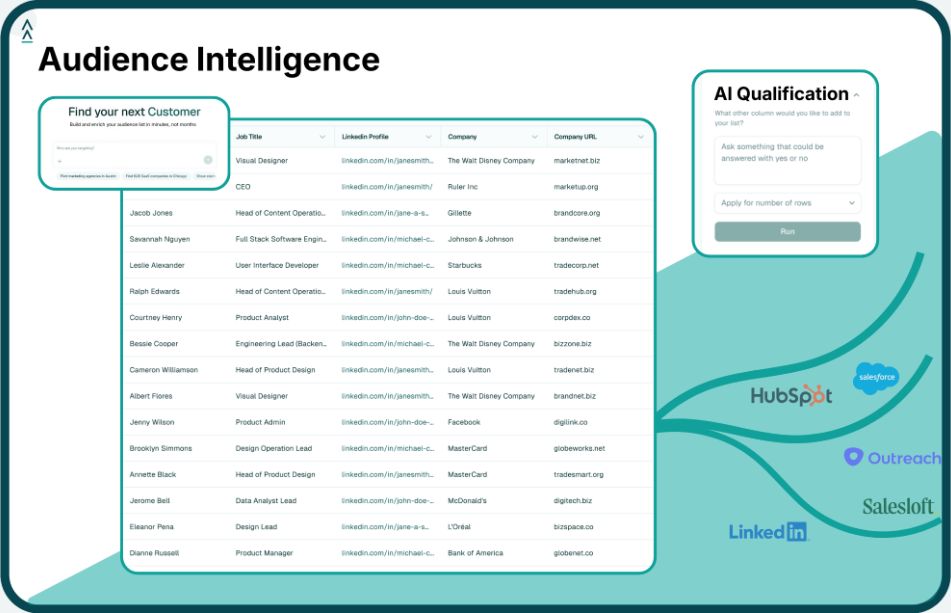
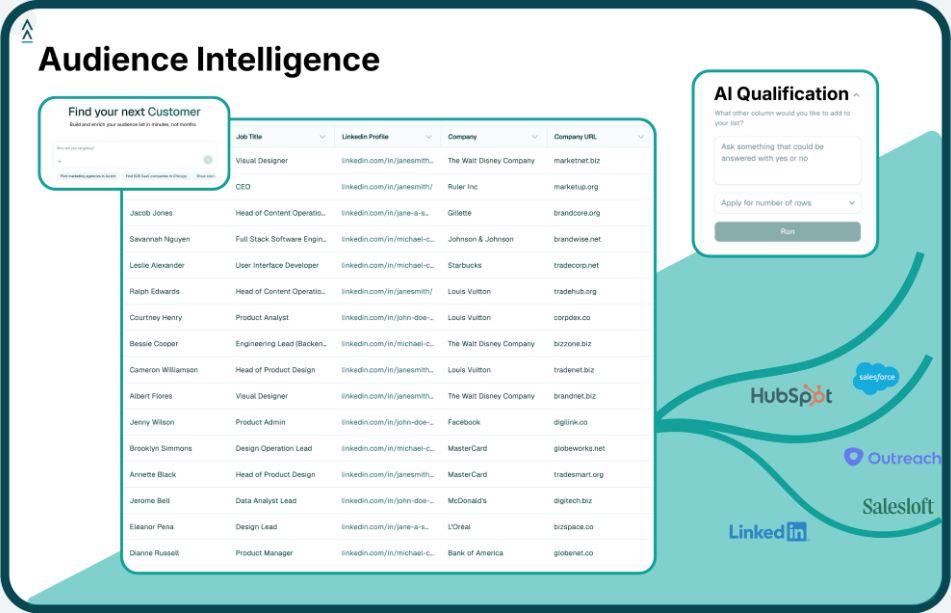
The remote work revolution isn't slowing down—it's accelerating. While some companies mandate office returns, the fastest-growing tech companies are doubling down on distributed teams, proving that location independence drives innovation, not hinders it. From unicorns to public companies, these remote-first organizations are building the infrastructure that powers the future of work. For go-to-market teams at these distributed companies, finding and qualifying ideal customers efficiently is critical. That's where AI-powered platforms like Landbase come in, enabling remote teams to build targeted audiences using natural-language prompts and export up to 10,000 AI-qualified contacts instantly—no login required.
Key Takeaways
- Remote-first is the new growth standard – The fastest-growing tech companies are overwhelmingly remote-first, with 15 of the top performers operating distributed teams across dozens of countries while achieving billion-dollar valuations.
- AI and cybersecurity dominate 2025 funding – Companies like Prepared ($80M) and Huntress ($150M) show that AI-powered security and public safety are attracting massive investment in the remote work era.
- Capital efficiency defines remote success – Zapier built a $250M ARR business on just $1.4M in funding, demonstrating that remote teams can achieve extraordinary growth with minimal resources.
- Public companies are strengthening remote policies – Established leaders like GitLab, Atlassian, and Airbnb are expanding their remote-first approaches, providing distributed work scales to enterprise levels.
- Andreessen Horowitz is betting big on remote – The venture firm led or co-led funding rounds for multiple fastest-growing remote companies, showing strong investor confidence in the distributed model.
- Remote work infrastructure is booming – Companies like Deel ($17.3B valuation) are building the essential HR, payroll, and benefits infrastructure that enables the remote work economy.
- AI-powered GTM automation is essential – For remote-first companies competing in crowded markets, platforms like GTM-2 Omni provide the audience discovery and qualification capabilities needed to accelerate growth without adding headcount.
1. GitLab — All-Remote DevSecOps Pioneer
What They Do:
GitLab provides an AI-powered DevSecOps platform that enables software teams to plan, build, secure, and deploy software. Named a Leader in the Gartner® Magic Quadrant™ for AI Code Assistants, GitLab serves 50+ million users globally with its comprehensive development lifecycle platform.
Why They're Important:
- All-remote blueprint – GitLab has operated as a 100% remote company since its founding in 2011, serving as the definitive model for distributed work
- Global scale proof – Manages 2,500+ employees across 60+ countries with no physical headquarters
- Transparency leadership – Published comprehensive remote work handbook used by thousands of companies globally
- Public company validation – Successfully went public (NASDAQ: GTLB) while maintaining all-remote operations
Key Stats / Metrics:
- 50+ million users globally
- 2,500+ employees across 60+ countries
- Expected to grow at an average rate of 14.8% annually
Leadership:
- CEO: Sid Sijbrandij
- Founded: 2011
Recent Funding:
- Most Recent Round: Post IPO (September 2022)
- Valuation: $4.8B
2. Zapier — Capital Efficiency Champion
What They Do:
Zapier automates workflows by connecting apps and AI tools, enabling businesses to build sophisticated automation without code. The platform processes billions of automated tasks monthly and recently launched AI Agents and Chatbots to enhance workflow automation.
Why They're Important:
- Unmatched capital efficiency – Built $250M ARR company on just $1.4 million in total funding
- Global talent access – 1,000+ employees across 42 countries and 17 time zones
- Remote work enabler – Their automation tools help other companies operate effectively while distributed
- Cultural innovation – "ReadMe" ritual where employees create personal manuals for collaboration
Key Stats / Metrics:
- $250M ARR on just $1.4M total funding
- 3.4 million companies use Zapier
- 1,000+ employees across 42 countries
Leadership:
- CEO: Wade Foster
- Founded: 2011
Recent Funding:
- Most Recent Round: $1.36M Seed (November 2014)
- Valuation: $5B
3. Deel — Global HR Infrastructure Leader
What They Do:
Deel provides an all-in-one global people platform that simplifies hiring, onboarding, payroll, and compliance for remote teams in 150+ countries. They handle employment, contractor management, and payroll for 35,000+ companies, processing $17.3B in global payroll.
Why They're Important:
- Remote work enabler – Processes $17.3B in global payroll compliantly, enabling companies to hire anywhere
- Fastest growth trajectory – On track to match Salesforce's growth trajectory with $12B valuation
- Self-dogfooding – Practices what they preach with 2,000+ fully remote "Wizards"
- Enterprise adoption – Serves 35,000+ companies including Shopify and Reddit
Key Stats / Metrics:
- $982 million total funding raised
- 1.5M workers onboarded globally
- 35,000+ companies served
Leadership:
- CEO: Alex Bouaziz
- Founded: 2019
Recent Funding:
- Most Recent Round: $300M Series E (October 2025)
- Valuation: $17.3B
4. Atlassian — Collaboration Software Giant
What They Do:
Atlassian builds collaboration software for software, IT, and business teams. Their products include Jira (project management), Confluence (knowledge management), Loom (video messaging), and Jira Service Management, serving 300,000+ companies globally.
Why They're Important:
- Industry standard – 80% of Fortune 500 companies use Atlassian products
- Remote work innovation lab – "Team Anywhere Lab" with behavioral scientists testing remote practices
- Massive scale – 10,000+ employees across 10,000 locations worldwide
- Public company success – $47.7 billion market cap while maintaining remote-first operations
Key Stats / Metrics:
- $210 million total funding raised
- 80% of Fortune 500 adoption
- Ranked 1st among 1,482 active competitors
Leadership:
- CEO: Mike Cannon-Brookes
- Founded: 2002
Recent Funding:
- Most Recent Round: $118K Grant Prize Money (September 2020)
5. Huntress — Unicorn Cybersecurity Leader
What They Do:
Huntress provides managed cybersecurity without complexity, offering 24/7 SOC (Security Operations Center), EDR (Endpoint Detection & Response), and identity threat protection. They protect 4.5M endpoints and 9M identities with industry-leading customer satisfaction.
Why They're Important:
- SMB cybersecurity democratization – Making enterprise-grade security accessible to all businesses
- Remote-first security model – Proving cybersecurity can be delivered effectively by distributed teams
- Unicorn achievement – Achieved $1.5B valuation while fully remote
- Rapid deployment – Customers can go from zero to protected in under 30 minutes
Key Stats / Metrics:
- $298 million total funding raised
- 4.5M endpoints protected
- 98.8% customer satisfaction
Leadership:
- CEO: Kyle Hanslovan
- Founded: 2015
Recent Funding:
- Most Recent Round: $180M Series D (June 2024)
- Valuation: $1.5B
6. BuildOps — Construction Tech Unicorn
What They Do:
BuildOps provides a software platform for modern commercial contractors in HVAC, electrical, plumbing, and fire safety. The all-in-one platform handles project management, service scheduling, dispatching, invoicing, and workflow automation with AI-powered insights.
Why They're Important:
- Vertical SaaS leader – Dominating commercial contractor space (vs. residential-focused competitors)
- Fresh unicorn status – Crossed $1B valuation in January 2025 with remote operations
- Industry transformation – Digitizing traditionally paper-based construction workflows
- Dramatic business impact – Customers report cutting receivables from 90-120 days to 30 days average
Key Stats / Metrics:
- $226 million total funding raised
- $1 billion post-money valuation
- Serves thousands of commercial contractor teams across the U.S.
Leadership:
- CEO: Alok Chanani
- Founded: 2018
Recent Funding:
- Most Recent Round: $127M Series C (March 2025)
- Valuation: $1B
7. Coinbase — Remote-First Crypto Leader
What They Do:
Coinbase operates a leading cryptocurrency exchange and financial services platform, recently expanding to offer stock trading alongside crypto. The platform serves millions of users for trading, staking, and financial services while maintaining a remote-first approach.
Why They're Important:
- Intentional remote commitment – Closed San Francisco HQ in February 2022 to strengthen distributed model
- Profitability milestone – Achieved first profitable quarter (Q4 2023) with $273M net income while fully remote
- Mission alignment – "Remote-first" aligns with crypto's decentralized ethos
- Global talent access – Leverages worldwide talent without location restrictions
Key Stats / Metrics:
- $547 million total funding raised
- 3,416 employee count
- 3,500+ distributed employees globally
Leadership:
- CEO: Brian Armstrong
- Founded: 2012
Recent Funding:
- Most Recent Round: Post IPO (August 2021)
8. Aura — Consumer Cybersecurity Leader
What They Do:
Aura provides comprehensive identity theft and fraud protection for consumers, combining digital security, financial fraud protection, and privacy tools in a single platform. They serve as one of the largest identity protection platforms in the consumer market.
Why They're Important:
- Consumer cybersecurity leader – One of the largest identity protection platforms
- Late-stage growth validation – Series G funding shows continued expansion and market demand
- Remote-scaled operations – Grew to 500-1,000 employees while maintaining remote operations
- Unicorn-plus status – Achieved $1.6B valuation as remote company
Key Stats / Metrics:
- $672 million total funding raised
- €678K annual revenue
- $2.5 billion current valuation
Leadership:
- CEO: Hari Ravichandran
- Founded: 2019
Recent Funding:
- Most Recent Round: $140M Series G in 2025
- Valuation: $2.5B
9. Airbnb — Work-from-Anywhere Pioneer
What They Do:
Airbnb operates a global marketplace for short-term lodging and experiences, connecting hosts with travelers in 220+ countries and regions. Their "Live and Work Anywhere" policy allows employees to work from 170+ countries without salary adjustments.
Why They're Important:
- Work-from-anywhere leadership – One of first major platforms to embrace full location flexibility
- No pay cuts policy – Employees can work from 170+ countries without salary adjustments
- CEO practices WFW – Brian Chesky has worked from Airbnbs, leading by example
- Business model alignment – Remote work recovery directly boosted their core business
Key Stats / Metrics:
- $2.95 billion total funding raised
- Ranked 1st among 544 competitors
- 220+ countries and regions served
Leadership:
- CEO: Brian Chesky
- Founded: 2008
Recent Funding:
- Most Recent Round: Conventional Debt (April 2020)
10. Automattic — Longest Remote Track Record
What They Do:
Automattic builds and operates WordPress.com, Tumblr, WooCommerce, Jetpack, and other web publishing tools serving hundreds of millions of websites globally. WordPress powers nearly half of all websites on the internet.
Why They're Important:
- Remote since day one – Operating 100% distributed since 2005, before it was trendy
- Internet scale – WordPress powers 43% of web globally
- Global diversity – 2,000+ employees in 90 countries
- Longest-running proof – 19+ years of remote viability at scale
Key Stats / Metrics:
- $896 million total funding
- $7.5 billion post money valuation
- 2,000+ employees across 90+ countries
Leadership:
- CEO: Matt Mullenweg
- Founded: 2005
Recent Funding:
- Most Recent Round: $275M Series E (February 2021)
- Valuation: $7.5B
11. Hex — Data Analytics Collaboration Platform
What They Do:
Hex builds a workspace for collaborative analytics and data science, turning data into knowledge. The platform enables data teams to collaboratively build analyses, create interactive dashboards, and share insights in a remote-friendly environment.
Why They're Important:
- Modern data collaboration – Modernizing how data teams work together remotely
- Blue-chip backing – Top-tier investors (a16z, Sequoia) validating remote model
- Recent growth momentum – $70M raise in January 2025 shows strong investor confidence
- Data team focus – Purpose-built for remote data science collaboration
Key Stats / Metrics:
- $70M Series C in January 2025
- Backed by Andreessen Horowitz and Sequoia
- 101-200 employees (remote HQ)
Leadership:
- CEO: Barry McCardel
- Founded: 2020
Recent Funding:
- Most Recent Round: $70M Series C (May 2025)
12. Sardine — Fraud Prevention FinTech
What They Do:
Sardine provides fraud prevention and compliance solutions for the digital economy, protecting fintech companies, crypto platforms, and digital businesses from fraud, money laundering, and scams with AI-powered detection.
Why They're Important:
- Digital economy protection – Critical infrastructure as commerce moves online
- Fresh funding momentum – $70M Series C in 2025 demonstrates continued growth
- Remote-native fintech – Building financial security infrastructure without offices
- Tier-one validation – Backed by Andreessen Horowitz
Key Stats / Metrics:
Leadership:
- CEO: Soups Ranjan
- Founded: 2020
Recent Funding:
- Most Recent Round: $70M Series C (February 2025)
The Remote Work Growth Pattern
These 15 fastest-growing remote work tech companies reveal a clear pattern: distributed teams aren't just surviving—they're thriving and outpacing traditional office-bound competitors. The data shows three key trends driving this success:
AI and Security Dominate Funding: Companies like Prepared ($80M) and Huntress ($150M) demonstrate that AI-powered solutions addressing critical needs—whether public safety, cybersecurity, or fraud prevention—are attracting massive investment in 2025.
Capital Efficiency Defines Success: Zapier's $250M ARR on just $1.4M in funding exemplifies how remote teams can achieve extraordinary leverage. Without expensive office overhead and with access to global talent, these companies optimize every dollar.
Infrastructure Enables the Ecosystem: Companies like Deel ($12B valuation) are building the essential HR, payroll, and benefits infrastructure that makes remote work possible at scale, creating a self-reinforcing ecosystem.
For go-to-market teams at these remote-first companies, the challenge isn't just building great products—it's efficiently finding and engaging the right customers in increasingly competitive markets. This is where AI-powered audience discovery becomes essential.
AI-Powered GTM for Remote-First Companies
Remote-first companies face unique go-to-market challenges. Without the informal networking that happens in office environments, they need sophisticated tools to identify and reach ideal customers. Traditional approaches—manually querying databases, building complex filters, or relying on generic contact lists—are too slow and inefficient for today's fast-moving markets.
This is where agentic AI platforms like Landbase provide a critical advantage. Instead of wrestling with complex database syntax, remote GTM teams can use natural-language prompts like "CFOs at enterprise SaaS companies that raised funding in the last 30 days" to instantly generate AI-qualified audiences.
Landbase's GTM-2 Omni model, trained on billions of GTM data points from 50M+ B2B campaigns, interprets these plain-English queries and evaluates prospects using 1,500+ unique signals including:
- Firmographic data: Company size, industry, location, revenue
- Technographic signals: Tech stack changes, new tool adoption
- Intent indicators: Website visits, content engagement, search behavior
- Market triggers: Funding rounds, hiring surges, leadership changes
- Growth signals: Expansion into new regions, M&A activity
For remote-first companies competing in crowded markets, this AI-powered approach to audience discovery provides several key advantages:
- Speed: Build targeted lists in seconds instead of days
- Precision: AI qualification ensures prospects match ideal customer profiles
- Scalability: Export up to 10,000 contacts instantly for immediate activation
- Accessibility: No technical expertise required—natural language targeting for everyone
The VibeGTM interface makes this sophisticated targeting accessible to non-technical users, enabling remote sales and marketing teams to focus on what they do best—building relationships and closing deals—while AI handles the repetitive work of audience discovery and qualification.
How We Selected These Remote Work Tech Companies
This list highlights the 12 fastest-growing remote work tech companies based on a comprehensive analysis of:
- Recent funding activity – Prioritizing companies with significant funding rounds in 2024-2025
- Growth trajectory – Including both established public companies and high-growth startups
- Industry impact – Companies building essential infrastructure for the remote work economy
- Remote commitment – Organizations with genuine remote-first or all-remote policies
- Investor validation – Companies backed by top-tier venture firms like Andreessen Horowitz, Sequoia, and Kleiner Perkins
- Market diversity – Spanning AI, cybersecurity, fintech, collaboration, HR tech, and vertical SaaS
All companies included operate with genuine remote-first policies, not just hybrid or flexible arrangements. The funding data, valuations, and leadership information are verified through multiple sources including TopStartups.io, Open Source CEO, and official company announcements.
Frequently Asked Questions
What defines a 'fastest growing' remote work tech company?
Fastest growing remote work tech companies are defined by significant recent funding rounds (typically $40M+ in 2024-2025), strong growth trajectories including revenue growth, user adoption, or market expansion, and genuine remote-first or all-remote operating models. These companies demonstrate that distributed teams can achieve exceptional growth while building products that often enable remote work for others. The combination of substantial capital raises, rapid scaling, and commitment to distributed operations distinguishes these organizations from traditional tech companies.
How does remote work impact the types of tech companies that are growing?
Remote work has accelerated growth in specific tech categories including AI-powered automation tools like Zapier, global HR and payroll platforms like Deel, cybersecurity solutions like Huntress that protect distributed teams, and collaboration platforms like Atlassian. These companies either enable remote work directly or benefit from the global talent access that remote operations provide. The distributed model allows them to hire the best talent regardless of location, reduce overhead costs, and scale more efficiently than traditional office-based competitors.
What kind of roles are available at these remote tech companies for people with no experience?
Many of these fastest-growing remote companies offer entry-level roles in customer support, sales development, content creation, and community management that don't require previous experience. Companies like GitLab and Zapier are known for their comprehensive onboarding programs and extensive documentation, making them accessible to candidates building their remote work experience. The key qualifications for entry-level remote positions are strong communication skills, self-motivation, adaptability to distributed collaboration, and comfort with digital tools.
How do tech startups secure funding in the current remote-first economy?
Tech startups secure funding by demonstrating capital efficiency (like Zapier's $250M ARR on $1.4M funding), addressing critical market needs such as cybersecurity or AI infrastructure, building strong distributed teams, and showing scalable business models. Investors like Andreessen Horowitz are actively backing remote-first companies, recognizing that the distributed model enables access to global talent and reduces overhead costs. Startups that prove they can execute effectively with remote teams while solving important problems attract significant venture investment.
What are the benefits of using AI-powered platforms like Landbase for remote tech companies?
AI-powered platforms like Landbase provide remote tech companies with efficient audience discovery capabilities without requiring large sales operations teams, enabling them to compete more effectively. The natural-language targeting allows non-technical team members to build qualified prospect lists instantly using plain-English prompts, while AI qualification ensures precision in matching ideal customer profiles. This is particularly valuable for remote-first companies that need to maximize efficiency and can't rely on traditional in-person networking. The ability to export thousands of qualified contacts immediately accelerates go-to-market efforts and reduces customer acquisition costs.
Who are the key leaders driving innovation in the remote tech industry?
Key leaders driving remote tech innovation include Sid Sijbrandij (GitLab), Wade Foster (Zapier), Alex Bouaziz and Shuo Wang (Deel), Kyle Hanslovan (Huntress), and Brian Chesky (Airbnb). These CEOs have not only built highly successful companies but have also pioneered remote work practices that are now being adopted by organizations worldwide. Their leadership demonstrates that distributed teams can achieve extraordinary results when given the right tools, culture, and operational frameworks, proving remote work is not just viable but often superior to traditional office-based models.
.png)
.png)