.png)
.png)

Daniel Saks
Chief Executive Officer


Retail tech companies operate in a dynamic environment where innovation meets operational complexity. Unlike traditional B2B sectors, retail technology providers must navigate rapidly evolving consumer behaviors, omnichannel demands, and supply chain disruptions while demonstrating clear ROI to potential buyers. With 68% of B2B businesses struggling with lead generation, retail tech companies need sophisticated strategies that go beyond basic contact collection to find prospects actively seeking solutions.
The modern retail landscape demands technology that can address specific pain points—from in-store analytics and inventory optimization to e-commerce platform integration and supply chain visibility. Successful B2B lead generation in this sector requires pinpoint accuracy in identifying decision-makers who are not just demographically aligned with your ideal customer profile, but showing real-time buying signals through hiring activity, technology stack changes, or expansion initiatives. AI-powered audience discovery platforms are transforming how retail tech companies build pipelines by enabling natural-language targeting that surfaces prospects like "e-commerce managers at retail brands with 5,000+ employees currently using Shopify" in seconds.
The science behind effective retail tech lead generation has evolved significantly. Companies implementing agentic AI for outbound lead generation are reporting 7x conversion rate improvements compared to traditional approaches. For retail tech startups and established companies alike, understanding these modern frameworks can mean the difference between predictable revenue growth and constant pipeline uncertainty.
B2B lead generation for retail tech companies operates within a unique framework defined by the sector's operational complexity and rapid innovation cycles. Unlike software companies selling generic solutions, retail tech providers must demonstrate deep domain expertise and address specific challenges like inventory optimization, omnichannel integration, or customer experience enhancement.
The modern retail buyer's journey involves multiple stakeholders with different priorities. IT directors focus on integration capabilities and security, supply chain leaders care about logistics optimization, e-commerce managers evaluate platform compatibility, and C-level executives assess ROI and competitive advantage. This multi-threaded buying process demands coordinated outreach strategies that address diverse perspectives within target accounts.
Retail tech companies face additional complexity because their prospects often operate across both physical and digital channels. A successful lead generation strategy must account for whether prospects are primarily brick-and-mortar retailers expanding online, e-commerce-first brands opening physical locations, or omnichannel retailers optimizing both channels simultaneously.
The solution lies in moving beyond simple demographic targeting toward strategic audience building based on real-time retail-specific signals. Companies that combine firmographic data with retail-specific behavioral indicators—like technology stack changes, hiring patterns in e-commerce roles, or expansion into new markets—build significantly more qualified pipelines than those relying on basic contact databases.
The traditional approach of purchasing generic retail contact lists has given way to sophisticated, AI-powered platforms that combine vast data sets with intelligent qualifications specifically designed for retail technology sectors. Modern lead generation tools must integrate multiple retail-specific data sources, including firmographic, technographic, intent, and behavioral signals, to identify prospects with genuine purchase intent.
Agentic AI represents the cutting edge of this evolution, moving beyond simple data aggregation to autonomous audience discovery and qualification. These systems can interpret natural-language prompts like "IT Directors at Fortune 500 retail companies adopting new cloud infrastructure in the last quarter" and instantly generate AI-qualified prospect lists ready for outreach.
The shift toward AI-driven platforms addresses a critical market need, with organizations using AI-driven lead qualification seeing a 28% conversion uplift. For retail tech companies, this means spending less time on unqualified leads and more time building relationships with prospects who are ready to buy.
Free access to advanced AI capabilities has become increasingly important, especially for retail tech startups and growth-stage companies. Platforms offering no-login, instant audience generation allow teams to test retail-specific targeting hypotheses quickly without lengthy procurement processes or significant upfront investment.
Building effective audience lists for retail tech requires moving beyond basic firmographic filters to incorporate retail-specific signals that indicate buying readiness. The most successful approach combines ideal customer profile (ICP) definition with real-time behavioral indicators that show prospects are actively seeking solutions.
Retail tech ICPs should consider not just company size and industry, but specific operational characteristics like e-commerce platform usage, physical store count, supply chain complexity, and technology maturity. For example, targeting "Marketing Directors at e-commerce brands with 5,000+ employees currently using Shopify" provides much higher conversion potential than simply targeting "Marketing Directors at retail companies."
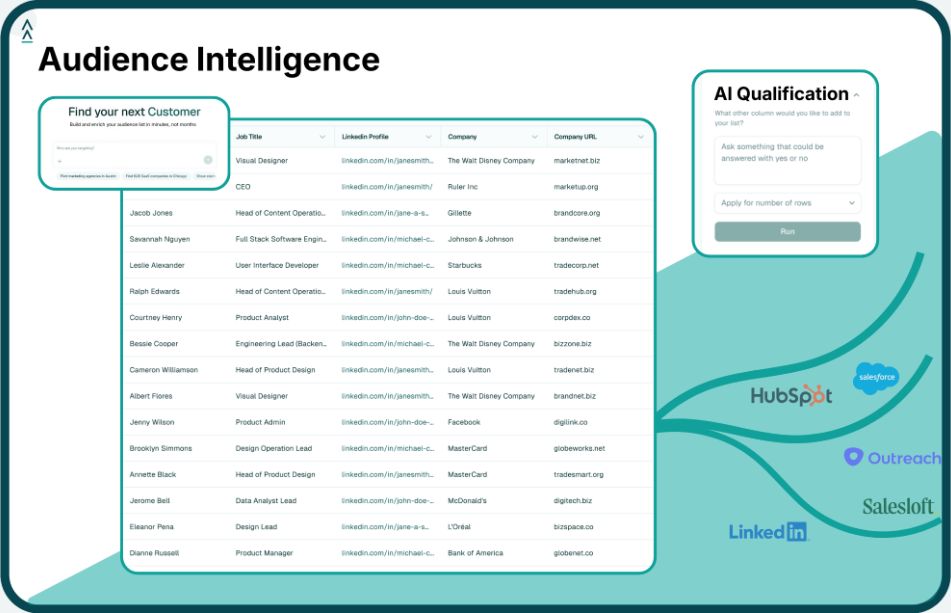
VibeGTM interface enables non-technical team members to build these sophisticated audience segments using natural-language prompts rather than complex database queries. Instead of spending hours constructing Boolean searches or navigating multiple filter menus, users can simply describe their target audience in plain English and receive AI-qualified results instantly.
Look-alike modeling further enhances targeting precision by identifying retail companies that share characteristics with existing successful customers. This approach leverages historical conversion data to find new prospects with similar operational profiles, increasing the likelihood of successful engagement.
The ability to refine targeting in real-time based on campaign performance is equally important. AI assistance can recommend adjustments to audience criteria based on which signals correlate most strongly with conversion, enabling continuous optimization of targeting strategy.
Retail technology purchasing decisions involve multiple stakeholders with different priorities and concerns. Successful lead generation requires identifying and engaging the right individuals at the right time with messaging that addresses their specific role-based challenges.
Key decision-makers in retail tech purchases include C-level executives focused on competitive advantage and ROI, IT directors concerned with integration and security, e-commerce managers evaluating platform compatibility, supply chain leaders assessing logistics optimization capabilities, and store operations managers considering in-store technology adoption.
Landbase Intelligence provides the growth signals and insights needed to efficiently target these retail decision-makers. The platform tracks specific titles like "C-Level or Founders Roles" and "Director/C-Level Management" while monitoring real-time indicators like funding rounds, job changes, and conference attendance that signal buying potential.
Speed becomes critical in retail tech lead generation because buying windows can be short. Retailers often make technology decisions during specific planning cycles or in response to competitive pressures, creating time-sensitive opportunities that require immediate outreach. Platforms that enable instant audience generation and qualification allow teams to capitalize on these windows before competitors respond.
Multi-stakeholder engagement becomes essential for larger retail technology deals, requiring coordinated outreach across different roles within the same organization. AI-powered platforms can help orchestrate these complex campaigns by identifying all relevant stakeholders and ensuring consistent messaging across touchpoints.
The manual processes that traditionally consumed retail tech sales teams' time—researching prospects, building contact lists, and qualifying leads—are now being automated through intelligent GTM platforms. This automation enables teams to focus on what they do best: building relationships and closing deals.
Autonomous GTM systems handle the repetitive work of audience discovery and qualification, delivering engaged buyers to sales pipelines without requiring hours of manual research. For retail tech companies, this means being able to respond instantly to market opportunities like new e-commerce platform launches, retail technology conferences, or competitor vulnerabilities.
The mission of reclaiming your day resonates particularly strongly in retail tech, where sales cycles can be complex and time-sensitive. When machines handle the mundane tasks of list building and initial qualification, humans can focus on strategic relationship building and complex solution selling.
Scalability becomes equally important as retail tech companies grow. Automated GTM systems enable consistent outreach quality regardless of team size, ensuring that messaging and targeting remain precise even as volume increases. This is particularly valuable for retail tech startups that need to scale quickly without proportionally increasing sales and marketing headcount.
The human element remains crucial even as automation advances. The most effective retail tech sales strategies combine machine intelligence for scale and efficiency with human creativity for relationship building and complex problem solving. Technology should enhance, not replace, the human connections that drive retail technology adoption.
Effective B2B lead generation for retail tech requires clear metrics and continuous optimization based on performance data. The shift from simple lead counts toward sophisticated qualification frameworks demands equally sophisticated measurement approaches that track performance across the entire customer journey.
Key Performance Indicators (KPIs) should align with retail-specific business objectives and revenue outcomes rather than just activity metrics. While lead volume might indicate marketing activity, conversion rates, customer acquisition cost, and pipeline velocity provide more meaningful insights into lead generation effectiveness.
The complexity of modern retail buyer journeys—with prospects engaging across multiple channels before purchase—makes attribution challenging but essential. Multi-touch attribution models that distribute credit across all interactions provide more accurate ROI measurement than last-touch models.
Companies that invest in personalizing their outbound outreach earn 40% more revenue than peers who don't, making personalization a critical metric to track. For retail tech companies, this means measuring not just response rates but the quality of engagement and relevance of conversations.
Continuous optimization requires regular feedback loops between sales and marketing teams. Shared definitions of lead quality, unified metrics, and regular performance reviews ensure alignment and enable rapid course correction when strategies underperform. A/B testing different messaging, targeting criteria, and outreach channels systematically improves performance over time.
Modern retail tech lead generation requires seamless integration between audience intelligence platforms and existing sales and marketing tools. The most effective approach connects AI-powered data discovery with the outreach channels where retail decision-makers are already active.
Current integration capabilities should include native connections with email platforms like Gmail and Outlook, professional networking sites like LinkedIn, and communication tools that facilitate multi-channel engagement. Future-proof platforms also provide API connectivity and planned integrations with major CRM systems like Salesforce and HubSpot to ensure long-term compatibility.
The ability to export qualified contacts instantly and activate them in existing tools ensures that retail tech teams can maintain their preferred workflows while leveraging advanced audience intelligence. This approach eliminates the need for complex technical setup or disruption of established processes.
Data flow becomes equally important as tool connectivity. The most effective retail tech lead generation stacks ensure that behavioral data from outreach campaigns flows back to the audience intelligence platform, enabling continuous learning and optimization. AI systems that learn from campaign performance and prospect engagement patterns improve targeting precision over time.
Future-proofing your retail tech GTM infrastructure means choosing platforms that are actively developing new integrations and maintaining compatibility with evolving data standards and privacy regulations. As the retail technology landscape continues to evolve, your lead generation stack should adapt alongside it.
The effectiveness of AI-powered lead generation for retail tech companies is demonstrated through measurable business outcomes. Companies implementing sophisticated audience discovery and qualification strategies are achieving significant gains in pipeline generation, meeting booking rates, and revenue growth.
Brands with strong omnichannel engagement strategies see a 9.5% increase in annual revenue, compared to just 3.4% for those with less comprehensive approaches. For retail tech companies, this translates to coordinated outreach across email, LinkedIn, phone, and content channels that addresses the multi-threaded nature of retail buying decisions.
These results demonstrate that precision targeting and AI-powered qualification deliver measurable business impact for retail tech companies. The combination of retail-specific audience discovery, real-time signal integration, and multi-channel orchestration creates a powerful engine for pipeline generation.
The most successful retail tech companies treat lead generation as a strategic capability rather than a tactical activity. They invest in sophisticated audience intelligence platforms, align sales and marketing around shared definitions of lead quality, and continuously optimize based on performance data. This strategic approach enables them to outperform competitors still relying on generic contact databases and spray-and-pray outreach tactics.
For retail tech startups, these same principles apply at a smaller scale. The ability to test targeting hypotheses quickly, generate qualified leads without significant investment, and focus on high-value prospects enables rapid growth even with limited resources. Founder-led sales teams can leverage AI-powered platforms to punch above their weight in competitive markets.
Landbase stands out in the crowded B2B lead generation landscape by combining agentic AI with instant, natural-language audience discovery specifically designed for retail tech companies. The platform addresses the unique challenges faced by both established retail technology providers and startups through its frictionless approach to finding qualified prospects.
The core innovation lies in GTM-2 Omni, Landbase's agentic AI model trained on 50M+ B2B campaigns and sales interactions. This allows users to simply type plain-English prompts like "e-commerce managers at retail brands with 5,000+ employees currently using Shopify" and instantly receive AI-qualified exports of up to 300M+ contacts ready for activation in existing tools.
Retail tech companies benefit from Landbase's precision targeting capabilities, enabling them to identify prospects showing real-time buying signals like new e-commerce role creation, technology stack changes, or market expansion. Startups appreciate the speed and cost-effectiveness, with founder-led sales teams able to generate consistent pipeline without building complex in-house systems.
The platform's integration with existing tools ensures seamless workflow adoption, while the continuous learning from user feedback improves AI performance over time. For retail tech companies navigating complex buyer journeys and competitive markets, Landbase provides the precision, speed, and intelligence needed to find and qualify the right customers at the right time.
B2B lead generation for retail tech companies is unique because it requires deep domain expertise and addresses specific operational challenges across e-commerce, in-store, and supply chain functions. Retail tech buyers are sophisticated and expect solutions that demonstrate understanding of their specific pain points like inventory optimization, omnichannel integration, or customer experience enhancement. Successful lead generation must identify multiple stakeholders with different priorities—IT directors focused on integration, supply chain leaders on logistics, e-commerce managers on platform compatibility, and C-level executives on ROI—while timing outreach to coincide with retail's seasonal cycles and technology refresh periods.
AI improves precision for retail tech startups by enabling hyper-personalized targeting at scale without requiring technical expertise or significant investment. Agentic AI systems can interpret natural-language prompts like "e-commerce managers at retail brands currently using Shopify" and instantly generate qualified prospect lists based on 1,500+ unique signals. This eliminates the need for complex database queries or expensive contact databases, allowing startups to test targeting hypotheses quickly and focus resources on high-value prospects. Companies using AI-driven lead generation report 7x conversion rate improvements over traditional approaches, making AI adoption essential for competitive differentiation.
The most effective data signals for targeting retail tech buyers include retail-specific technographic data (e-commerce platforms, POS systems, inventory management tools), hiring signals (new e-commerce or retail technology roles), funding events (indicating increased buying capacity), and market expansion indicators (new store openings or geographic expansion). Conference attendance at retail and e-commerce industry events also provides strong buying intent signals. These real-time behavioral signals are more predictive than basic firmographics because they indicate active buying intent rather than just demographic alignment.
Landbase currently integrates with Gmail, Outlook, and LinkedIn for seamless outreach activation, enabling immediate deployment of qualified prospects. While CRM integrations with Salesforce, HubSpot, and Pipedrive are in development, users can easily export up to 10,000 contacts per session in standard formats for immediate import into existing tools. This export-and-activate approach ensures that qualified audiences can be leveraged in current workflows without requiring complex technical setup or disrupting established processes.
Typical ROI metrics for AI-powered lead generation in retail tech include 7x conversion rate improvements over traditional approaches, 28% conversion uplift with AI-driven lead scoring, and 40% more revenue for companies investing in personalized outreach. Real-world examples show retail tech companies achieving 33% more meetings booked without adding headcount and $400k MRR added in slow periods. These metrics demonstrate that precision targeting and AI-powered qualification deliver measurable business impact for retail tech companies.
Landbase is particularly well-suited for early-stage retail tech startups due to its free, no-login access and instant audience generation capabilities. Startups can test retail-specific targeting hypotheses immediately without procurement delays or financial commitment, enabling founder-led sales teams to generate consistent pipeline while conserving limited resources. However, the platform's precision targeting capabilities also benefit larger retail tech companies implementing sophisticated Account-Based Marketing strategies that focus on high-value accounts showing real-time buying signals. The ability to scale from simple natural-language prompts to complex multi-signal qualification makes Landbase valuable across company stages.
Tool and strategies modern teams need to help their companies grow.