.png)
.png)

Daniel Saks
Chief Executive Officer


Most HealthTech companies face a fundamental challenge: their ideal customers make purchasing decisions through complex committees of 6-10 stakeholders, with sales cycles stretching 12-24 months on average. Traditional lead generation approaches that focus on individual contacts fail to capture this multi-threaded reality, leaving HealthTech companies struggling to build predictable pipelines despite significant marketing investment.
Today's most effective B2B lead generation for HealthTech leverages advanced data signals, AI-powered qualification, and strategic account-based targeting rather than volume-based approaches. AI-powered audience discovery platforms are transforming how companies identify prospects who are not just demographically aligned with their ideal customer profile, but actively showing buying intent through hiring signals, funding events, and technology stack changes specific to healthcare organizations.
The science behind successful HealthTech lead generation has evolved significantly. Companies implementing account-based strategies that engage multiple stakeholders simultaneously are seeing SQL conversion increase compared to traditional lead-based approaches. For HealthTech companies navigating regulatory complexities and extended evaluation cycles, understanding these modern frameworks can mean the difference between consistent revenue growth and constant pipeline uncertainty.
B2B lead generation for HealthTech companies operates within a unique framework defined by regulatory compliance requirements, multi-stakeholder buying committees, and extended sales cycles. Unlike other B2B sectors, HealthTech businesses must navigate complex healthcare ecosystems where clinical, operational, financial, and technical decision-makers all influence purchasing decisions.
The modern HealthTech buyer's journey involves coordination across diverse roles—CIOs/CMIOs focus on IT strategy and EHR integration, CFOs evaluate ROI and cost containment, CMOs consider clinical outcomes, IT Directors assess implementation complexity, and physicians weigh workflow impact. This multi-threaded buying process demands coordinated outreach strategies that address the specific concerns of each stakeholder within target accounts.
Healthcare buyers select the first vendor on their shortlist, highlighting the critical importance of early engagement before active research begins. The solution lies in moving beyond simple contact collection toward strategic account-based targeting based on real-time buying signals and healthcare-specific behavioral indicators.
For enterprise HealthTech companies, the focus should be on quality over quantity—identifying accounts that match ideal customer profiles with precision using healthcare-specific criteria. Startups, meanwhile, need speed and flexibility to test hypotheses quickly while conserving limited resources and ensuring compliance from day one.
Building an effective Ideal Customer Profile (ICP) for HealthTech requires granular healthcare-specific criteria that go far beyond basic firmographics. Generic targeting like "hospitals" or "healthcare providers" fails to capture the nuanced differences between healthcare organizations that significantly impact purchasing decisions and implementation success.
Effective HealthTech ICPs incorporate multiple dimensions of data, including firmographic criteria (bed size, revenue, geographic location), technographic data (EHR system, IT infrastructure maturity), behavioral signals (recent technology investments, hiring patterns), and strategic initiatives (value-based care participation, digital transformation efforts).
The GTM-2 Omni model excels at this type of sophisticated ICP recognition, using natural-language queries to interpret complex healthcare targeting criteria and evaluate audience fit using 1,500+ signals including healthcare-specific data points. This eliminates the need for technical expertise in building complex filter combinations while maintaining precision in audience targeting.
Starting with 2-3 specific healthcare segments (e.g., "200-500 bed community hospitals with Epic EHR") rather than overly broad targeting prevents wasted resources on poor-fit accounts. Successful HealthTech companies refine their ICP continuously based on closed/won patterns, adjusting targeting criteria every 90 days to improve precision.
The traditional approach of purchasing generic healthcare contact databases or running broad LinkedIn campaigns has given way to sophisticated, AI-powered platforms that combine vast healthcare-specific data sets with intelligent qualification. Modern lead generation tools must integrate multiple data sources, including healthcare firmographics, technographics, intent signals, and behavioral indicators, to identify prospects with genuine purchase intent.
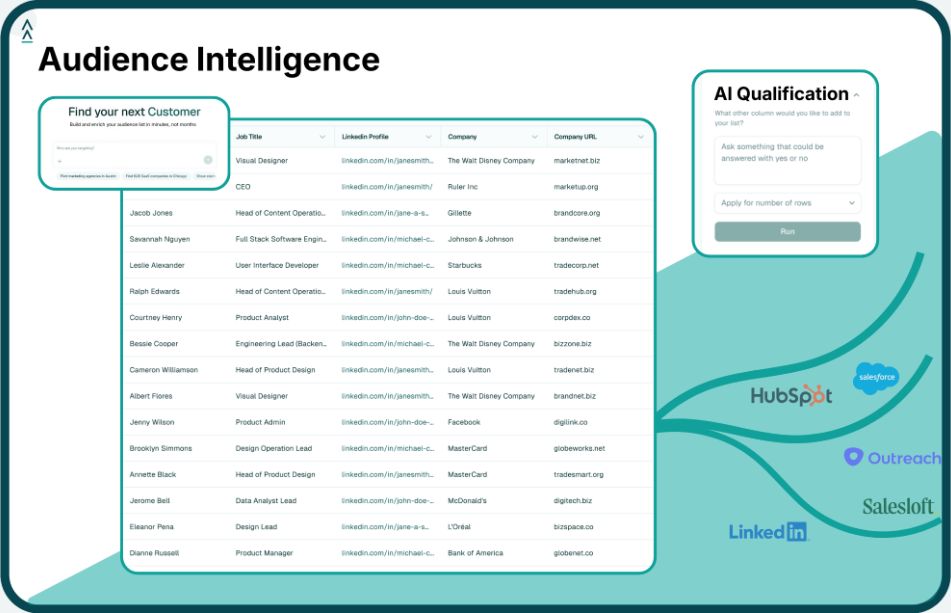
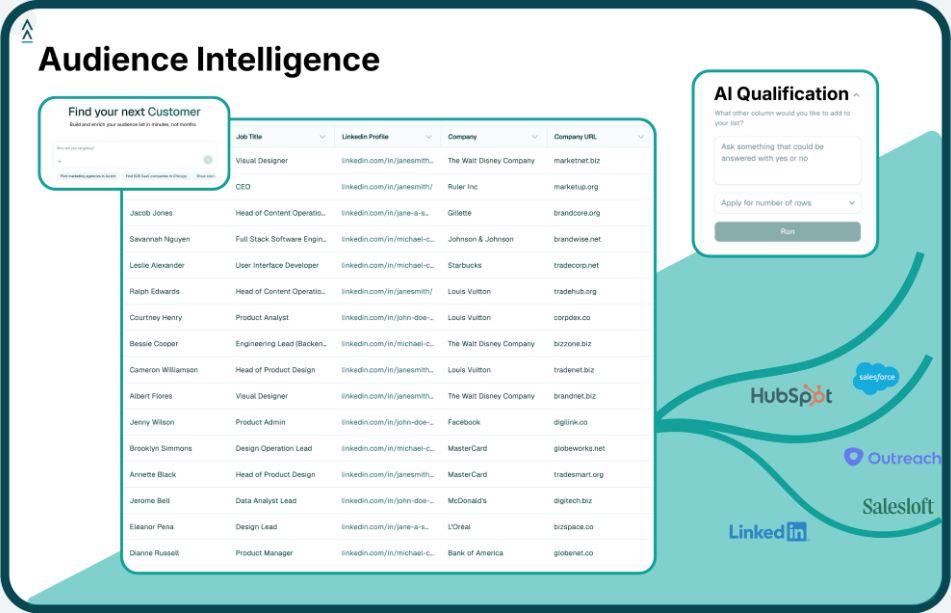
Agentic AI represents the cutting edge of this evolution, moving beyond simple data aggregation to autonomous audience discovery and qualification specifically designed for complex healthcare markets. These systems can interpret natural-language prompts like "CIOs at 200-500 bed hospitals with Epic EHR implementing telehealth solutions" and instantly generate AI-qualified prospect lists ready for coordinated multi-stakeholder outreach.
The shift toward AI-driven platforms addresses a critical market need, with many companies preferring specialized expertise over building in-house capabilities. However, the most successful companies maintain control over their targeting strategy while leveraging external platforms for execution efficiency.
Free access to advanced lead generation capabilities has become increasingly important, especially for HealthTech startups and growth-stage companies. Platforms offering no-login, instant audience generation allow teams to test healthcare-specific targeting hypotheses quickly without lengthy procurement processes or significant upfront investment.
HealthTech companies must move beyond traditional lead generation methods that treat healthcare organizations as collections of individual contacts rather than complex buying committees. The most effective approach is Account-Based Marketing (ABM), which focuses resources on carefully selected high-value target accounts with coordinated multi-stakeholder engagement strategies.
ABM strategies deliver superior ROI by enabling personalized campaigns that address the specific needs of each decision-maker within target healthcare accounts. Rather than sending the same generic message to all contacts, successful HealthTech companies orchestrate role-specific content and messaging across sales and marketing teams, resulting in higher engagement rates and dramatically improved conversion rates.
The key to successful HealthTech targeting lies in precision rather than volume. Companies should identify 50-200 target accounts that closely match their ideal customer profile using healthcare-specific criteria and invest heavily in understanding their specific pain points, buying processes, and decision criteria.
Multi-channel outreach becomes essential in HealthTech, with coordinated messaging across email, LinkedIn, phone, and even direct mail. However, personalization remains critical—generic mass outreach achieves minimal response rates, while personalized approaches leveraging healthcare-specific behavioral and contextual signals see significantly higher engagement.
HealthTech startups operate under different constraints than enterprise companies, with limited resources, urgent need to prove product-market fit, and pressure to generate initial revenue quickly while maintaining strict compliance standards. Their lead generation strategies must emphasize speed, cost-effectiveness, and rapid iteration based on real-world feedback.
Founder-led sales often characterize the early stages of HealthTech startups, where the founding team personally handles outreach and relationship building. This approach allows for deep customer understanding and rapid product iteration based on direct feedback. However, founders need tools that enable efficient prospect identification without consuming excessive time on manual research or violating compliance requirements.
The ability to generate qualified prospect lists instantly using natural-language prompts is particularly valuable for HealthTech startups. Instead of spending weeks building complex filter combinations or purchasing expensive healthcare data licenses, founders can immediately test different targeting hypotheses and adjust based on response rates.
Free lead generation capabilities become crucial for HealthTech startups operating with minimal budgets. Platforms offering no-login access and instant exports of up to 10,000 contacts enable startups to maintain consistent pipeline development without significant financial commitment while ensuring compliance from day one.
Rapid experimentation is the hallmark of successful HealthTech startup lead generation. Teams should test different messaging, targeting criteria, and outreach channels quickly, measuring results and doubling down on what works while abandoning approaches that don't generate engagement with healthcare decision-makers.
When evaluating B2B lead generation partners or platforms, HealthTech companies should prioritize capabilities that align with modern healthcare buyer behavior and strict regulatory requirements. The days of simple contact databases are over—today's effective partners combine healthcare-specific data accuracy with intelligent qualification and seamless integration.
Data quality remains the foundation of effective HealthTech lead generation. Partners should maintain compliance with regulations like HIPAA and SOC 2, ensuring that contact information is ethically sourced and regularly validated. The best platforms go beyond basic firmographic data to include real-time healthcare-specific signals like EHR implementations, value-based care participation, and specialty-specific hiring activity.
The rise of AI-powered platforms has raised the bar for what HealthTech companies should expect from lead generation partners. Modern solutions should offer natural-language targeting, instant audience generation, and AI qualification that evaluates both fit and timing rather than just demographic alignment.
Agency partnerships can provide additional value for companies lacking internal expertise. Partners with deep healthcare domain knowledge can help refine ideal customer profiles, develop targeted messaging that addresses both clinical and business value propositions, and optimize outreach strategies based on healthcare-specific insights and best practices.
Effective HealthTech B2B lead generation requires clear metrics and continuous optimization based on performance data that reflects the complexity of healthcare buying committees. The shift from simple MQL counts toward account-based frameworks demands equally sophisticated measurement approaches that track performance across entire buying committees rather than individual contacts.
Key Performance Indicators (KPIs) should align with business objectives and revenue outcomes rather than just activity metrics. While MQL volume might indicate marketing activity, conversion rates, customer acquisition cost, and customer lifetime value provide more meaningful insights into lead generation effectiveness in the complex HealthTech environment.
The complexity of modern HealthTech buyer journeys—with prospects engaging across multiple touchpoints before purchase—makes attribution challenging but essential. Account-based attribution models that distribute credit across all stakeholder interactions provide more accurate ROI measurement than last-touch models that only credit the final interaction.
Continuous optimization requires regular feedback loops between sales and marketing teams. Shared definitions of lead quality, unified metrics, and regular performance reviews ensure alignment and enable rapid course correction when strategies underperform in the complex healthcare environment.
Landbase stands out in the crowded B2B lead generation landscape by combining agentic AI with instant, natural-language audience discovery specifically designed for HealthTech companies. The platform addresses the unique challenges faced by both enterprise HealthTech organizations and startups through its frictionless approach to finding qualified prospects while maintaining strict compliance standards.
The core innovation lies in GTM-2 Omni, Landbase's agentic AI model trained on 50M+ B2B campaigns and sales interactions. This allows users to simply type plain-English prompts like "CIOs at 200-500 bed community hospitals with Epic EHR implementing telehealth solutions" and instantly receive AI-qualified exports of up to 10,000 contacts ready for activation in existing tools.
Enterprise HealthTech companies benefit from Landbase's precision targeting capabilities, enabling ABM strategies that focus on high-value accounts showing real-time buying signals across multiple stakeholders. Startups appreciate the speed and cost-effectiveness, with founder-led sales teams able to generate a consistent pipeline without building complex in-house systems or navigating lengthy compliance reviews.
The platform's integration with existing tools like Gmail, Outlook, and LinkedIn ensures seamless workflow adoption, while the continuous learning from user feedback improves AI performance over time. For HealthTech companies navigating complex buying committees, extended sales cycles, and strict regulatory requirements, Landbase provides the precision, speed, and intelligence needed to find and qualify the right customers at the right time.
The biggest challenges include navigating complex buying committees of 6-10 stakeholders, managing extended 13-24 month sales cycles, and ensuring HIPAA compliance across all marketing technology. HealthTech companies must also access healthcare-specific data like EHR systems and bed size while proving both clinical and financial value to diverse stakeholders. Traditional lead-based approaches fail because they treat healthcare organizations as collections of individual contacts rather than complex buying committees requiring coordinated multi-stakeholder engagement.
AI dramatically improves lead generation for digital health startups by enabling instant audience discovery through natural-language prompts, eliminating technical expertise requirements for building complex healthcare-specific filters. AI-powered platforms interpret plain-English queries and instantly generate qualified prospect lists, allowing startups to test different targeting hypotheses rapidly without significant upfront investment. AI qualification ensures both demographic fit and real-time buying intent through analysis of 1,500+ unique signals. This speed and precision enable founder-led sales teams to maintain consistent pipeline development while conserving limited resources.
The most important data signals include healthcare-specific firmographics (bed size, facility type, specialty focus), technographic intelligence (EHR system, IT infrastructure maturity), and strategic initiatives (value-based care participation, digital transformation). Real-time behavioral signals such as healthcare-specific hiring activity, technology implementations, and regulatory compliance needs are critical for identifying purchase intent. These healthcare-specific signals enable precision targeting that addresses the unique characteristics of healthcare organizations rather than applying generic B2B criteria that miss critical factors.
The decision depends on available resources and expertise, with many successful startups beginning with AI-powered self-service tools for rapid experimentation. In-house lead generation using platforms like Landbase offers cost-effectiveness and speed, with free, no-login access enabling immediate testing without financial commitment. However, agencies with deep healthcare domain knowledge can provide specialized expertise in compliance, stakeholder mapping, and content development addressing both clinical and business value. Many startups start with AI-powered tools for rapid testing, then partner with specialized agencies as they scale and need more sophisticated account-based strategies.
HealthTech companies must ensure all marketing technology vendors sign HIPAA Business Associate Agreements (BAAs) before implementation and verify platforms maintain SOC 2 and GDPR compliance with proper data encryption and access controls. Companies should avoid non-compliant tools and implement server-side tracking with proper PHI filtering where necessary. All forms collecting health information must include privacy policy links and consent checkboxes, while companies should consider de-identifying data before sending to marketing platforms to reduce compliance burden.
Tool and strategies modern teams need to help their companies grow.