.png)
.png)

Daniel Saks
Chief Executive Officer


Fintech companies face a unique paradox in B2B lead generation: they must build trust around financial data while navigating complex regulatory landscapes, yet move quickly enough to capitalize on rapidly evolving market opportunities. With B2B purchasing decisions involving an average of 6.8 decision-makers, traditional volume-based lead generation approaches simply don't work.
The solution lies in precision over volume—using advanced data signals and AI-powered qualification to identify prospects who not only match your ideal customer profile but are actively demonstrating buying intent. AI-powered audience discovery platforms are transforming how fintech companies find qualified prospects by analyzing real-time signals like regulatory compliance needs, technology stack changes, funding events, and hiring activity specific to financial services.
Today's most effective fintech lead generation leverages account-based marketing, multi-channel orchestration, and AI-driven personalization to overcome the trust barriers inherent in financial services. Companies implementing these advanced strategies report 15% increase in conversion rates and 20% better cost efficiency compared to traditional methods, making the shift from manual prospecting to intelligent audience discovery not just beneficial but essential for competitive differentiation.
B2B lead generation in fintech operates under constraints that make it fundamentally different from other B2B sectors. The combination of stringent regulatory requirements (GDPR, PSD2, AML standards), heightened security concerns around financial data, and the inherent skepticism of financial decision-makers creates significant friction in the customer acquisition process.
Fintech buyers require extensive trust-building before engaging with new vendors, especially when evaluating solutions that will handle sensitive financial information or integrate with critical banking infrastructure. This trust deficit extends sales cycles considerably, with the average B2B fintech sale involving 6.8 decision-makers across compliance, security, finance, and technology departments.
The regulatory landscape alone can derail lead generation efforts if not properly addressed from the start. GDPR compliance in Europe, PSD2 requirements for payment services, and varying state-level regulations in the United States all require specialized approaches that generalist B2B lead generation platforms simply cannot provide.
For fintech startups, these challenges are amplified by limited brand recognition and the need to prove credibility against established incumbents. Enterprise fintech companies face different but equally complex challenges, including the need to navigate existing vendor relationships and demonstrate clear ROI to justify switching costs.
Traditional B2B lead generation methods—purchasing contact databases, running broad LinkedIn campaigns, and relying on manual research—have proven inadequate for the complexities of fintech sales. These approaches generate volume but lack the precision needed to identify prospects who are both qualified and ready to buy.
The shift toward AI-powered lead generation addresses these limitations by combining vast data sets with intelligent qualification algorithms that evaluate both fit and timing. Modern platforms can analyze 1,500+ unique signals including firmographic, technographic, intent, hiring, and funding data to identify prospects showing genuine purchase intent.
AI-powered platforms solve these problems by automating the research and qualification process while providing deeper insights into prospect readiness. Companies leveraging AI for lead generation report 20% better cost efficiency and the ability to identify high-intent prospects with unprecedented precision.
The key innovation lies in moving beyond simple demographic matching to evaluating real-time buying signals. Instead of targeting "CFOs at banks," AI-powered platforms can identify "CFOs at mid-sized banks actively researching cloud security solutions" or "CTOs at fintech startups that recently raised Series B funding and are expanding their engineering teams."
This precision approach is particularly valuable in fintech, where the cost of pursuing unqualified leads is exceptionally high due to long sales cycles and resource-intensive relationship building.
Defining an accurate Ideal Customer Profile (ICP) is especially critical in fintech, where product-market fit often depends on specific regulatory environments, technology stacks, or business models. Traditional ICP development based solely on firmographics like company size and industry proves insufficient for the nuanced requirements of financial services buyers.
AI-powered ICP development leverages multiple data dimensions to create highly specific targeting criteria that account for the unique characteristics of successful fintech customers. This includes firmographics (company size, revenue, location), technographics (current technology stack, recent additions), behavioral signals (website engagement, content consumption), and intent data (funding events, hiring activity, conference attendance).
AI enhances this process through semantic search and ICP recognition capabilities that can interpret natural-language descriptions of target customers and automatically identify relevant signals. For example, describing your ICP as "growth-stage fintech companies hiring their first RevOps leader" automatically translates into targeting criteria based on company size, industry, recent job postings, and organizational maturity indicators.
Look-alike modeling further refines ICP development by analyzing your most successful customers and identifying companies with similar characteristics. This approach leverages historical conversion data to find new prospects with the highest likelihood of success, rather than relying on theoretical assumptions about ideal customers.
The result is an ICP that captures not just who your customers are, but when they're most likely to buy based on real-time behavioral and contextual signals.
Fintech sales funnels require careful orchestration across multiple stages due to the complexity of B2B financial services purchasing decisions. Traditional funnel models that treat all leads the same fail to account for the different needs and concerns of various stakeholders involved in fintech buying decisions.
AI-qualified leads enable more sophisticated funnel management by providing context about why prospects were qualified and what specific signals indicated buying intent. This context allows for personalized nurturing sequences that address the specific concerns of different stakeholders at each stage of the buyer's journey.
Lead scoring becomes particularly important in fintech funnels, where the cost of pursuing unqualified leads is exceptionally high. AI-powered scoring models evaluate multiple dimensions including demographic fit, behavioral engagement, and real-time buying signals to prioritize prospects with the highest conversion likelihood.
The integration of real-time signals like funding announcements, hiring activity, and technology stack changes enables dynamic funnel management that adapts to changing prospect circumstances. For example, a prospect who just announced new funding might automatically move from middle-of-funnel educational content to bottom-of-funnel ROI analysis and pricing discussions.
This precision approach dramatically improves funnel efficiency by ensuring that sales resources are focused on prospects who are both qualified and ready to buy, rather than wasting time on unqualified or poorly timed outreach.
Successfully converting AI-qualified leads requires coordinated multi-channel outreach that builds trust while demonstrating specific value to different stakeholders. Single-channel approaches prove insufficient in fintech due to the complexity of buying committees and the need for multiple touchpoints to overcome inherent skepticism around financial services.
LinkedIn has emerged as the dominant channel for B2B fintech lead generation, with 89% of B2B marketers using the platform and 80% of B2B social media leads originating there. The platform's professional context and precise targeting capabilities make it ideal for financial services conversations that require trust and credibility.
Content marketing plays a particularly important role in fintech conversion, establishing the credibility essential for financial services sales. High-quality, journalistic content addressing regulatory compliance, security concerns, and technical integration requirements builds trust throughout extended sales cycles.
The key to successful conversion lies in personalization at scale—using AI-qualified audience insights to deliver relevant messaging across multiple channels while maintaining the human touch essential for financial services relationships. This requires seamless integration between audience discovery platforms and existing marketing tools to ensure consistent, coordinated outreach.
Effective fintech lead generation requires sophisticated measurement frameworks that go beyond simple MQL counts to track performance across complex, multi-stakeholder buyer journeys. The extended sales cycles and high customer acquisition costs typical in fintech demand equally sophisticated analytics to ensure marketing investments deliver appropriate ROI.
Key Performance Indicators should focus on revenue outcomes rather than just activity metrics, with particular attention to metrics that account for the unique characteristics of fintech sales cycles.
Attribution becomes particularly challenging in fintech due to the extended timeframes and multiple decision-makers involved in purchasing decisions. Multi-touch attribution models that distribute credit across all interactions provide more accurate ROI measurement than last-touch models that only credit the final interaction.
Continuous optimization requires regular feedback loops between sales and marketing teams to refine targeting criteria, messaging, and outreach strategies based on real-world performance data. A/B testing different approaches and systematically scaling what works while eliminating underperforming tactics ensures that lead generation efforts continuously improve over time.
The integration of compliance metrics into performance dashboards is also essential, ensuring that lead generation activities maintain regulatory adherence while delivering business results.
Trust and compliance are not optional considerations in fintech lead generation—they are foundational requirements that must be built into every aspect of the process. The sensitive nature of financial data and the stringent regulatory requirements governing financial services create unique constraints that generalist B2B lead generation approaches simply cannot address.
GDPR compliance in Europe, PSD2 requirements for payment services, CAN-SPAM Act compliance in the United States, and varying state-level regulations all require specialized approaches that demonstrate respect for data privacy and regulatory requirements from the first point of contact.
Trust-building extends beyond compliance to include thought leadership, industry expertise, and transparent communication about capabilities and limitations. Fintech buyers need to feel confident that vendors understand their unique challenges and can navigate the complex regulatory landscape alongside them.
Partnerships with established financial institutions can also provide valuable credibility signals, borrowing trust from organizations with established reputations in financial services. However, these partnerships must be genuine and substantive rather than superficial co-branding exercises.
The most successful fintech lead generation strategies integrate compliance and trust-building into every touchpoint, from initial targeting criteria through final conversion, ensuring that prospects feel confident in both the solution and the vendor throughout the extended sales process.
Real-world examples demonstrate the transformative impact of AI-powered lead generation on fintech growth. Companies implementing precision targeting, multi-channel orchestration, and AI-driven qualification report significant improvements in pipeline quality, conversion rates, and revenue growth.
P2 Telecom, a voice data and cloud communications company, added $400k MRR in a slow period using Landbase's AI-powered audience discovery, with such strong results that they had to pause their campaigns because their account executives couldn't keep up with the qualified leads.
Digo Media, breaking into new markets that traditionally required months of groundwork, booked 33% more meetings in Chicago and LA without adding headcount by leveraging AI-qualified audiences that identified prospects showing genuine buying intent in specific geographic markets.
Rockhop achieved 11% reply rates and 15% interest rates by using AI-qualified audiences to ensure their outreach reached prospects who were not just demographically aligned but actively showing purchase intent through hiring signals, funding events, and technology stack changes.
These results demonstrate that the key to fintech lead generation success lies not in generating more leads, but in generating better qualified leads that are ready to engage in meaningful conversations about specific business challenges and solutions.
The most successful companies combine AI-powered audience discovery with human relationship-building, using technology to identify the right prospects at the right time while maintaining the personal touch essential for financial services sales.
Landbase stands out in the B2B lead generation landscape by combining agentic AI with instant, natural-language audience discovery specifically designed for the unique challenges of fintech companies. The platform addresses the regulatory complexity, trust barriers, and precision requirements that make fintech lead generation fundamentally different from other B2B sectors.
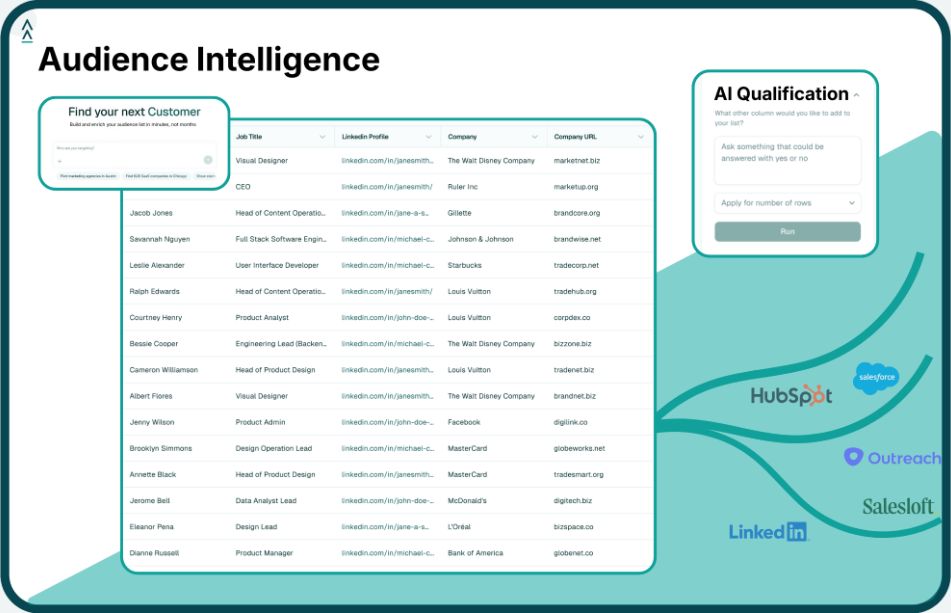
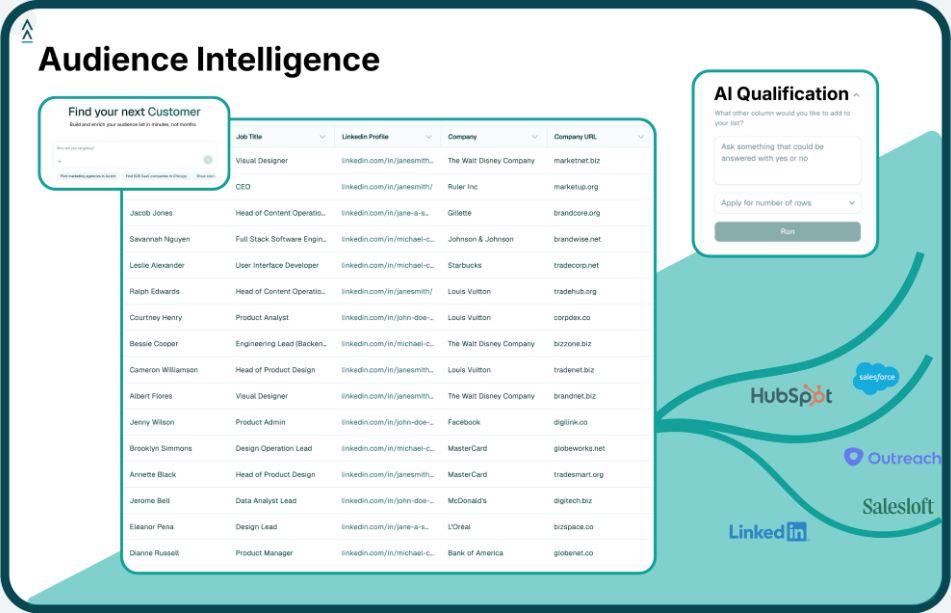
The core innovation lies in GTM-2 Omni, Landbase's agentic AI model trained on 50M+ B2B campaigns and sales interactions. This allows fintech companies to simply type plain-English prompts like "CIOs at enterprise fintech companies adopting new security platforms" or "CTOs at growth-stage payment companies that recently launched new products" and instantly receive AI-qualified exports of up to 10,000 contacts ready for activation.
Enterprise fintech companies benefit from Landbase's precision targeting capabilities, enabling ABM strategies that focus on high-value accounts showing real-time buying signals specific to financial services. Startups appreciate the speed and cost-effectiveness, with founder-led sales teams able to generate consistent pipeline without building complex in-house systems.
The platform's integration with existing tools like Gmail, Outlook, and LinkedIn ensures seamless workflow adoption, while the continuous learning from user feedback improves AI performance over time. For fintech companies navigating complex regulatory landscapes and trust barriers, Landbase provides the precision, compliance, and intelligence needed to find and qualify the right customers at the right time.
B2B lead generation for fintech companies differs fundamentally due to stringent regulatory requirements (GDPR, PSD2, AML standards), heightened security concerns around financial data, and the inherent skepticism of financial decision-makers. Fintech sales cycles are typically longer and involve more decision-makers (average of 6.8) than other industries, requiring coordinated outreach across multiple stakeholders. Additionally, fintech buyers require extensive trust-building and credibility demonstration before engaging with new vendors, making content marketing and thought leadership essential components of successful lead generation strategies.
AI improves fintech lead generation accuracy by analyzing 1,500+ unique signals including firmographic, technographic, intent, hiring, and funding data to identify prospects showing genuine purchase intent rather than just demographic alignment. Companies leveraging AI report 15% higher conversion rates and 20% better cost efficiency compared to traditional methods. For startups specifically, AI-powered platforms enable rapid testing of different targeting hypotheses without significant upfront investment, allowing founder-led sales teams to generate qualified pipeline quickly while conserving limited resources.
The most critical signals for fintech ICP development include regulatory environment alignment (jurisdiction-specific compliance requirements), technology stack compatibility (integration capabilities with existing financial systems), financial health indicators (funding stage, revenue growth), organizational structure signals (team size, decision-maker roles), and real-time buying triggers (recent funding announcements, hiring activity for relevant roles, technology stack changes). AI-powered platforms can analyze these signals simultaneously to identify prospects who not only match demographic criteria but are actively demonstrating buying intent through behavioral and contextual indicators.
Landbase ensures compliance with data privacy regulations through SOC II and GDPR compliant infrastructure that meets the stringent requirements of financial services data handling. The platform combines premium data sources with proprietary enrichment while maintaining transparent data handling policies and explicit consent management for different communication types. This regulatory compliance infrastructure is built into the platform from the ground up, ensuring that fintech companies can generate qualified leads without risking regulatory violations or data security breaches.
Yes, Landbase excels at targeting specific roles within nuanced fintech segments through natural-language prompts that combine multiple targeting criteria. Users can simply type prompts like "CTOs at growth-stage fintech companies (201–500 employees) that recently launched new products" or "IT Directors at Fortune 500 financial services companies adopting new cloud infrastructure in the last quarter" and instantly receive AI-qualified exports. The platform's access to 1,500+ unique signals enables this precision targeting without requiring complex Boolean queries or technical expertise.
Fintech companies investing in AI-powered lead generation can expect 15% higher conversion rates and 20% better cost efficiency compared to traditional methods. Real-world examples include P2 Telecom adding $400k MRR in a slow period and Digo Media booking 33% more meetings without adding headcount. The key to maximizing ROI lies in focusing on lead quality over quantity, using AI to identify prospects who are both qualified and ready to buy rather than pursuing unqualified volume.
Tool and strategies modern teams need to help their companies grow.