.png)
.png)

Daniel Saks
Chief Executive Officer


Digital health companies face a unique set of challenges in B2B lead generation that demand specialized approaches beyond traditional sales tactics. With healthcare organizations operating under strict regulatory frameworks and complex decision-making structures, finding qualified prospects requires precision targeting, compliance-first strategies, and patience for extended buying cycles. The stakes are high—healthcare leads cost $320-$400, 2-3 times more than general B2B leads, making quality far more important than volume.
Today's most effective digital health lead generation leverages AI-powered qualification, multi-stakeholder engagement, and real-time buying signals rather than simple contact collection. AI-powered audience discovery platforms are transforming how digital health companies identify prospects who are not just demographically aligned with their ideal customer profile, but actively showing buying intent through hiring signals, funding events, and technology stack changes specific to healthcare operations.
The science behind successful B2B lead generation in digital health has evolved significantly. Organizations implementing AI-powered personalization see an increase in stakeholder engagement compared to traditional lead-focused approaches. For digital health companies navigating compliance complexities and extended evaluation periods, understanding these modern frameworks can mean the difference between predictable pipeline development and constant prospecting uncertainty.
B2B lead generation for digital health companies operates within a highly regulated, relationship-driven environment defined by compliance requirements, complex stakeholder dynamics, and extended evaluation periods. Unlike general B2B markets, digital health sales must navigate strict regulatory frameworks including HIPAA, HITECH, and GDPR while simultaneously addressing the concerns of multiple decision-makers with different priorities.
The modern healthcare buyer's journey has become increasingly complex, with 70% of the buying process occurring before vendors are ever contacted. During this "invisible" research phase, healthcare professionals evaluate solutions, compare vendors, and often create shortlists without any direct vendor interaction. This creates a significant challenge for traditional lead generation approaches that rely on direct outreach to initiate conversations.
Nearly three-quarters of organizations report having at least 10% of their lead data that is inaccurate, outdated, or non-compliant, creating significant legal and reputational risks in the healthcare space. The solution lies in moving beyond simple contact collection toward strategic audience building based on real-time buying signals and behavioral indicators, all within a compliant framework.
For established digital health companies, the focus should be on quality over quantity—identifying accounts that match ideal customer profiles with precision while maintaining regulatory compliance. Startups, meanwhile, need speed and flexibility to test hypotheses quickly while conserving limited resources and avoiding compliance pitfalls that could derail early growth.
Healthcare technology purchasing involves dramatically more complex decision-making structures than general B2B markets. Research shows that 27% of healthcare organizations indicate 10+ people in the buying process, with the average buying committee including stakeholders from clinical (CMO, CNO, physicians), technical (CIO, IT directors), financial (CFO, procurement), and compliance departments—each with distinct priorities and evaluation criteria.
This complexity demands audience enrichment capabilities that identify not just individual contacts but entire buying committees, providing account-level intelligence about stakeholder roles, organizational initiatives, and technology infrastructure. Traditional lead generation approaches that target single decision-makers often fail because they don't account for the consensus-building nature of healthcare purchasing decisions.
Successful digital health companies start by defining comprehensive ICPs that account for multiple dimensions beyond basic firmographics:
This multi-dimensional ICP enables more precise targeting that addresses the interconnected concerns of all stakeholders in the buying process.
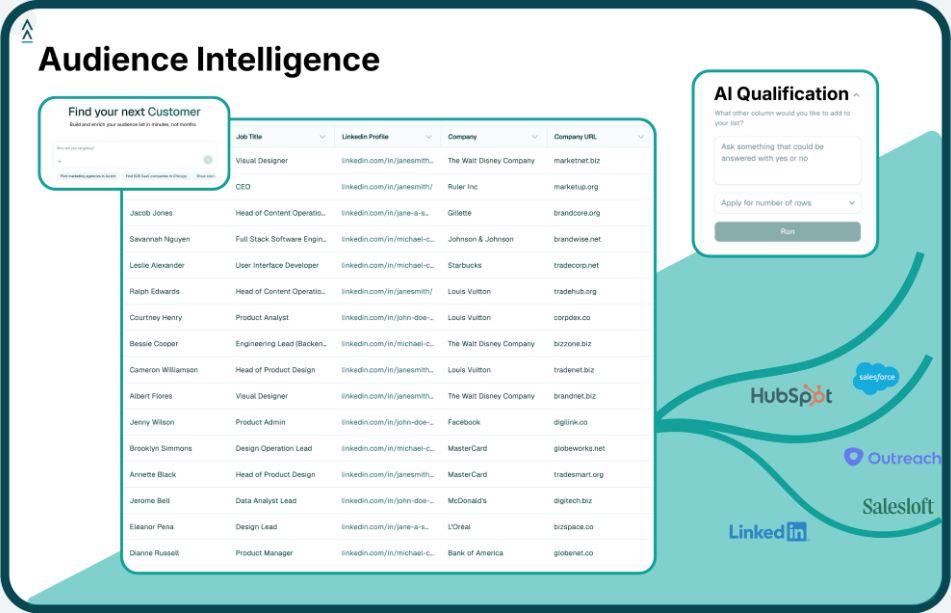
Agentic AI represents the cutting edge of healthcare audience targeting, moving beyond simple data aggregation to autonomous audience discovery and qualification. These systems can interpret natural-language prompts like "CIOs at enterprise IT services companies adopting new security platforms" and instantly generate AI-qualified prospect lists ready for multi-stakeholder outreach.
AI-powered platforms with access to 1,500+ unique signals can evaluate both fit (does this prospect match our ideal customer profile?) and timing (are they actively showing buying intent through hiring, funding, or technology changes?). This dual evaluation ensures that outreach efforts focus on accounts that are both qualified and ready to engage.
The most sophisticated digital health lead generation strategies leverage multiple data signals to identify prospects with genuine purchase intent. Beyond basic firmographic data like company size and specialty, modern platforms track real-time indicators of buying readiness including hiring activity for clinical roles, funding rounds for healthtech companies, technology stack changes in EHR systems, and website engagement with compliance-related content.
These advanced signals enable much more precise targeting than traditional demographic approaches. For example, identifying "Marketing Directors at healthcare technology firms scaling digital teams" provides a much higher probability of engagement than simply targeting "Marketing Directors at healthcare companies." The specific context creates immediate relevance and demonstrates understanding of the prospect's current priorities.
AI qualification goes beyond simple demographic matching to evaluate real-time buying intent through behavioral and contextual signals. This process involves:
For digital health companies, this precision is essential given the high cost of leads and extended sales cycles. Wasting resources on unqualified prospects can significantly impact revenue targets and cash flow, especially for startups operating with limited budgets.
Critical signals for digital health prospecting include:
The integration of these signals into AI-powered qualification systems enables unprecedented precision in audience targeting. Platforms like Landbase Intelligence provide growth signals, Trust Score, and TAM insights, helping digital health companies understand in-market signals and optimal engagement timing.
Digital health agencies face unique challenges when creating B2B lead generation campaigns for their clients. The need for healthcare-specific expertise, compliance knowledge, and multi-stakeholder engagement strategies requires specialized approaches that generalist agencies often lack. Successful digital health agencies combine industry expertise with advanced technology to deliver campaigns that resonate with healthcare decision-makers.
The most effective approach for digital health agencies is Account-Based Marketing (ABM), which focuses resources on carefully selected lists of high-value target accounts rather than casting wide nets. ABM strategies deliver superior ROI by enabling personalized, multi-stakeholder campaigns that address the specific needs of each decision-maker within target accounts.
Effective multi-channel strategies for digital health include:
Landbase Outbound & Nurture helps agencies identify and qualify prospects along their journey and build targeted lists to move fast for their digital health clients, providing the precision targeting needed for effective multi-channel campaigns.
Personalization is particularly critical in healthcare B2B campaigns. However, healthcare personalization must go beyond basic name insertion to demonstrate genuine understanding of clinical workflows, regulatory requirements, and organizational priorities.
Effective personalization in digital health includes:
Landbase's Agency Partner Program offers exclusive access to cutting-edge sales innovations and generous discounts, allowing agencies to provide advanced lead generation for digital health clients while maintaining compliance and precision.
Digital health companies must complement their lead generation efforts with broader digital marketing strategies that establish credibility and reach their target audience effectively. In the highly regulated, trust-driven healthcare environment, building authority and demonstrating expertise are essential for overcoming skepticism and establishing relationships with potential customers.
Content marketing emerges as the top-performing channel for healthcare B2B lead generation, with marketers citing it as most effective for generating marketing-qualified leads. Educational content specifically drives healthcare professionals to prefer it over promotional material, with B2B buyers interacting with 13 pieces of content before engaging with a brand.
Successful digital health companies establish trust through:
Key digital channels for healthcare B2B include:
The emphasis should be on providing value during the 70% of the buyer's journey that occurs before vendor contact, positioning the company as a trusted advisor rather than just another vendor.
Social media represents a valuable but complex channel for digital health B2B engagement. While platforms like LinkedIn offer direct access to healthcare decision-makers, the regulatory environment and professional nature of healthcare require careful approach to content and engagement strategies.
LinkedIn remains the primary social platform for healthcare B2B, but success requires more than just posting product updates. Effective healthcare social media strategies focus on educational content, industry insights, and professional development resources that demonstrate expertise without making unsubstantiated claims or discussing patient outcomes inappropriately.
Best practices for LinkedIn include:
Effective social content for healthcare includes:
The key is maintaining professional boundaries while demonstrating expertise and building relationships. All social media activities must comply with HIPAA and other regulatory requirements, avoiding any discussion of patient data or outcomes without proper consent and de-identification.
Many digital health companies operate with SaaS-like business models, offering subscription-based software solutions for healthcare organizations. These companies can adapt successful B2B SaaS marketing strategies while accounting for the unique compliance and stakeholder complexity of the healthcare environment.
The free tier approach common in SaaS marketing can be particularly effective for digital health companies, allowing prospects to experience the platform's value while maintaining strict compliance boundaries. Landbase's free platform with unlimited prompt searches and up to 10,000 exports aligns with SaaS marketing strategies for attracting and qualifying users, demonstrating how frictionless access can drive adoption.
Key SaaS tactics that translate well to digital health include:
ROI measurement in digital health SaaS requires healthcare-specific metrics:
The P2 Telecom case study demonstrates how SaaS-like speed can drive significant revenue growth, with the company adding $400k MRR using Landbase's instant audience generation capabilities—a model that digital health companies can adapt for their specific market.
Digital health startups face unique challenges in developing comprehensive marketing strategies with limited resources and urgent need to prove product-market fit. The most successful approaches emphasize speed, precision, and compliance from day one, avoiding the costly mistakes that can derail early-stage companies in the highly regulated healthcare environment.
A comprehensive SaaS marketing strategy for digital health startups includes market research, competitor analysis, pricing models, sales funnel optimization, lead nurturing, referral programs, thought leadership, and ecosystem partnerships—all adapted for the healthcare context.
Effective lead nurturing for digital health includes:
Key partnership opportunities include:
These partnerships can accelerate market entry, provide credibility, and expand reach while sharing the compliance burden and market education costs.
The extended sales cycles and complex stakeholder dynamics of digital health B2B sales create significant operational challenges for sales and marketing teams. With 69% of buying cycles exceeding 13 months and 6-10 stakeholders per decision, manual prospecting and follow-up become overwhelming without automation support.
Landbase's mission to "pioneer autonomous go-to-market to help you reclaim your day" by handling repetitive work with machines directly addresses these challenges. By automating the mundane aspects of lead generation and qualification, digital health teams can focus on the high-value relationship building and clinical expertise that drive successful healthcare sales.
AI-powered automation can handle:
This automation improves lead targeting accuracy, allowing sales teams to focus on the complex, relationship-driven aspects of healthcare sales that require human expertise.
Agentic AI represents the next evolution in digital health go-to-market, with autonomous AI agents that can:
The platform's metrics like "Build lists in seconds" and "AI-qualified audiences ready for immediate activation" directly enable digital health companies to save time while maintaining the precision and compliance required in healthcare markets.
Landbase stands out in the crowded B2B lead generation landscape by combining agentic AI with instant, natural-language audience discovery specifically designed for complex markets like digital health. The platform addresses the unique challenges faced by digital health companies through its frictionless approach to finding qualified prospects while maintaining compliance requirements.
The core innovation lies in GTM-2 Omni, Landbase's agentic AI model trained on 50M+ B2B campaigns and sales interactions. This allows users to simply type plain-English prompts like "CIOs at enterprise IT services companies adopting new security platforms" and instantly receive AI-qualified exports of up to 10,000 contacts ready for activation in existing tools.
Digital health companies benefit from Landbase's precision targeting capabilities, enabling ABM strategies that focus on high-value accounts showing real-time buying signals. The platform's ability to identify prospects during the 70% of the buyer's journey that happens before vendor contact provides a critical advantage in reaching invisible buyers.
The continuous learning from user feedback improves AI performance over time, while the integration with existing tools ensures seamless workflow adoption. For digital health companies navigating regulatory complexity, extended sales cycles, and multi-stakeholder buying committees, Landbase provides the precision, speed, and intelligence needed to find and qualify the right customers at the right time.
The biggest challenges include navigating 6-10 stakeholder buying committees, managing 12-24 month sales cycles with 69% exceeding 13 months, maintaining strict HIPAA compliance across all tools and communications, and justifying higher lead costs of $320-$400 through exceptional qualification precision. The fact that 70% of the buyer's journey occurs before vendor contact creates additional complexity in reaching "invisible" buyers during their research phase.
AI improves lead qualification by analyzing 1,500+ unique signals to evaluate both fit and timing rather than just demographic alignment. This drives up to 40% increases in stakeholder engagement over traditional methods while reducing manual prospecting work. AI-powered platforms can identify real-time buying signals like hiring activity for clinical roles, funding rounds, EHR system changes, and website engagement with compliance-related content, ensuring outreach focuses on accounts that are both qualified and ready to engage.
Targeted B2B lead generation benefits various healthcare provider types including hospitals and health systems implementing new technologies, medical practices adopting digital solutions, healthcare payers seeking cost optimization tools, and long-term care facilities implementing remote monitoring. The key is identifying organizations with specific pain points, buying capacity through funding events, and technology infrastructure that aligns with the solution being offered.
Social media marketing can be effective for B2B digital health companies when executed properly, with LinkedIn being the primary platform for reaching healthcare decision-makers. Success requires focusing on educational content and thought leadership rather than promotional messaging, participating in healthcare-specific professional groups, and maintaining strict compliance with HIPAA and other regulatory requirements. Employee advocacy programs where clinical and technical team members share relevant content can be particularly effective in establishing credibility and expertise.
Autonomous GTM helps digital health sales teams by automating repetitive tasks like initial prospect identification, basic qualification, multi-stakeholder mapping, and compliance verification. This allows sales teams to focus on high-value relationship building and clinical expertise that drive successful healthcare sales. By handling the mundane aspects of lead generation, autonomous GTM platforms enable teams to maintain consistent engagement across the 8-12 touchpoints required for extended sales cycles while ensuring precision targeting of accounts showing real-time buying intent.
The most relevant data signals for digital health prospects include healthcare-specific indicators like EHR system changes, clinical hiring activity, healthcare technology funding rounds, regulatory compliance deadlines, and healthcare conference attendance like HIMSS. Website engagement with pricing and compliance pages and technology stack changes in clinical systems also indicate organizational readiness. These signals indicate both organizational readiness and immediate buying capacity, making them more predictive than basic firmographic data alone.

Tool and strategies modern teams need to help their companies grow.






