.png)
.png)

Daniel Saks
Chief Executive Officer


Most AgTech companies quickly discover that lead generation in agriculture operates by entirely different rules than traditional B2B markets. With the average U.S. farmer age at 58.1 years and sales cycles extending 12-24 months, standard SaaS tactics consistently fail to generate qualified pipelines. The agricultural sector's unique characteristics—seasonal buying cycles tied to planting and harvest, multi-stakeholder decision committees, and deep reliance on proven ROI over technological features—demand specialized approaches that account for farming realities rather than generic business frameworks.
Today's most effective AgTech lead generation combines field-proven validation with intelligent targeting based on real agricultural signals. AI-powered audience discovery platforms are transforming how AgTech companies identify prospects who not only match their ideal customer profile but are actively showing buying intent through seasonal timing, equipment investments, and operational expansion signals.
The science behind successful AgTech lead generation has evolved significantly beyond simple contact collection. Companies that integrate field demonstrations with data-driven targeting are achieving 20-40% conversion rates to MQL—dramatically outperforming digital-only approaches that struggle with agriculture's trust gap and proof requirements. For AgTech companies navigating competitive markets with 50% reduced investment funding, understanding these specialized frameworks can mean the difference between sustainable growth and constant pipeline uncertainty.
B2B lead generation for AgTech companies operates within a unique framework defined by agricultural calendars, seasonal revenue cycles, and deeply rooted trust networks. Unlike quarterly-driven B2B markets, agricultural purchasing decisions concentrate around specific windows tied to planting seasons (spring) and post-harvest planning (fall/winter). Missing these critical timing windows can mean waiting an entire year for the next opportunity.
The modern AgTech buyer's journey involves an average of 6-10 stakeholders in purchasing decisions, including farm owners, agronomists, equipment dealers, co-op advisers, and sometimes lenders. Each stakeholder brings different concerns—farm owners focus on ROI measured in bushels per acre, agronomists evaluate agronomic soundness, dealers consider serviceability, and lenders assess risk mitigation. This multi-threaded buying process demands coordinated outreach strategies that address diverse perspectives within target operations.
Global AgTech investment dropped 50% from 2021-2022 peaks to $15.6B in 2023, creating intense pressure for efficient customer acquisition. The solution lies in moving beyond simple contact collection toward strategic audience building based on real agricultural signals and seasonal timing rather than generic firmographic data.
For established AgTech companies, the focus should be on precision targeting of operations showing expansion signals. Startups, meanwhile, need speed and flexibility to test different agricultural segments while conserving limited resources. Both require tools that can adapt to agricultural domain expertise and scale with their growth.
Traditional B2B lead generation approaches consistently underperform in agriculture because they ignore fundamental differences in buyer behavior, decision timelines, and credibility requirements. Most AgTech founders come from technology backgrounds rather than farming, leading them to emphasize features, dashboards, and technical specifications that mean little to experienced farmers who ask "What do you know about farming?" when approached by tech companies.
Generic contact databases and broad LinkedIn campaigns fail in agriculture for several reasons. First, 79% of U.S. farms have internet access, but connectivity quality varies significantly across rural areas, limiting digital-only reach. Second, the agricultural community relies heavily on local proof and peer validation rather than corporate marketing claims. Third, traditional B2B timing assumptions don't account for seasonal purchase windows that can't be accelerated by marketing pressure.
The result is high customer acquisition costs (CAC) and low conversion rates, with many AgTech companies abandoning digital lead generation entirely. However, the problem isn't digital channels themselves—it's applying generic B2B frameworks to a specialized agricultural market that requires domain expertise and proof-driven validation.
Successful AgTech companies adapt by combining digital efficiency with agricultural credibility. They lead with educational content and ROI calculators rather than product features, time campaigns to agricultural calendars rather than business quarters, and integrate dealer partnerships rather than competing with established trust networks.
The traditional approach of purchasing generic farm contact lists has given way to sophisticated, AI-powered platforms that combine agricultural context with intelligent qualification. Modern lead generation tools for AgTech must integrate multiple data sources, including farm size, crop type, equipment investment signals, and seasonal timing indicators, to identify operations with genuine purchase intent.
Agentic AI represents the cutting edge of this evolution, moving beyond simple data aggregation to autonomous audience discovery and qualification specifically adapted for agricultural contexts. These systems can interpret natural-language prompts like "corn farmers in Iowa with 1,000+ acres expanding precision agriculture adoption" and instantly generate AI-qualified prospect lists ready for targeted outreach.
The shift toward AI-driven platforms addresses a critical market need, with AgTech companies requiring specialized expertise that generic B2B platforms can't provide. However, the most successful companies maintain control over their agricultural targeting strategy while leveraging external platforms for execution efficiency.
Free access to advanced lead generation capabilities has become increasingly important, especially for AgTech startups and growth-stage companies. Platforms offering no-login, instant audience generation allow teams to test agricultural targeting hypotheses quickly without lengthy procurement processes or significant upfront investment.
AgTech lead generation requires understanding the complex web of stakeholders involved in agricultural purchasing decisions. Unlike typical B2B scenarios with 3-5 decision-makers, agricultural operations involve 6-10 stakeholders who each require different information and messaging approaches.
Farm owners and operators make final purchasing decisions but rely heavily on recommendations from trusted advisors like agronomists, equipment dealers, and co-op managers. Agronomists evaluate the agronomic soundness and yield impact of new technologies, while dealers assess serviceability and margin potential. Lenders may be involved in larger equipment purchases, evaluating risk mitigation and return on investment.
Successful targeting requires creating role-specific content and outreach strategies. Farm owners respond to clear ROI calculators showing bushels per acre improvements, while agronomists prefer peer-reviewed research and field trial data. Equipment dealers need service training and margin information, while co-op advisers look for member-wide benefits and bulk pricing opportunities.
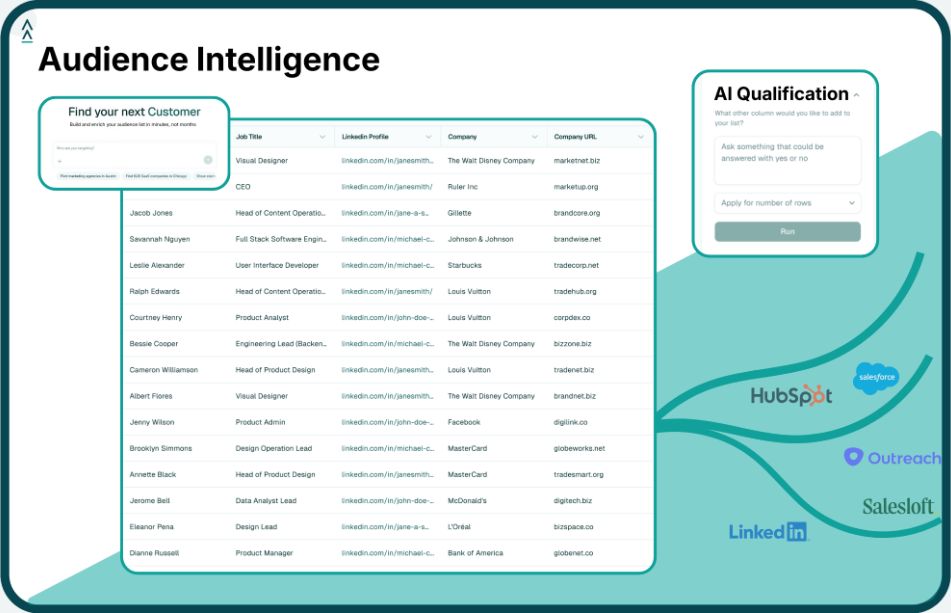
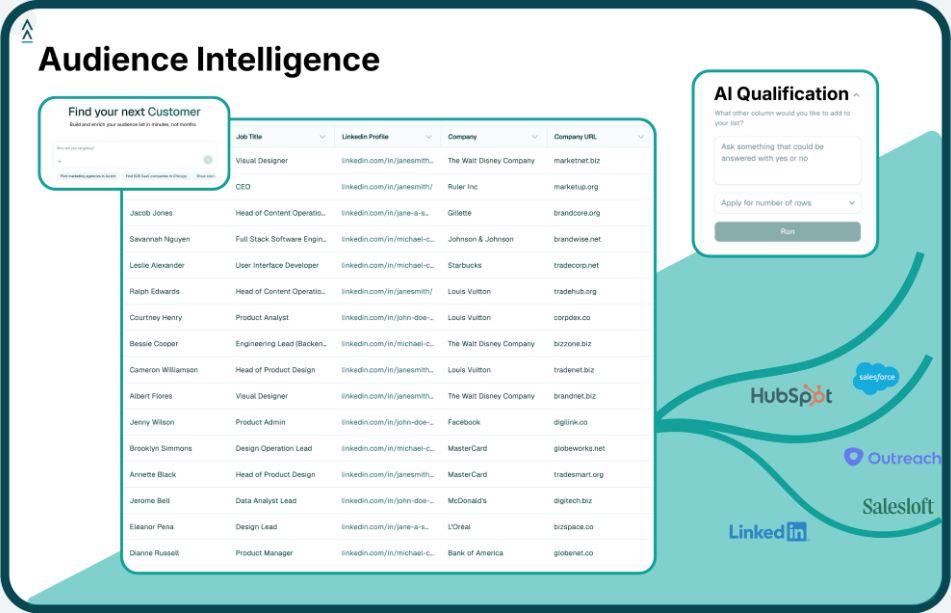
VibeGTM Interface enables users to refine targeting in real time with AI assistance, ensuring the right agricultural roles are identified within target operations. This capability is particularly valuable for AgTech companies that need to reach multiple stakeholders within the same farming operation with coordinated but role-specific messaging.
Effective AgTech lead generation campaigns must address the agricultural community's deep reliance on proof and measurable outcomes rather than technological features. Farmers make decisions based on tangible business results measured in yield improvements, input cost reductions, and labor hours saved—not dashboard aesthetics or technical specifications.
The most successful AgTech campaigns lead with educational content and ROI validation rather than product promotion. Agronomist-led webinars consistently deliver 30-40% registration-to-attendance rates and convert 20-40% of attendees to MQL, significantly outperforming generic digital campaigns. These educational approaches build credibility while demonstrating agricultural expertise.
Landbase's sales solutions provide qualified audiences and targeted lists to accelerate sales and customer support for AgTech solutions. This capability enables companies to reach the right stakeholders at the right time with relevant messaging based on real agricultural signals rather than generic demographic data.
The key to high-converting AgTech campaigns lies in agricultural authenticity. Marketing content should use farming terminology rather than tech jargon, reference regional growing conditions rather than generic agricultural scenarios, and emphasize practical outcomes rather than technological capabilities. Campaigns that demonstrate genuine understanding of farming realities build the credibility necessary to overcome agriculture's inherent skepticism toward technology companies.
The most sophisticated AgTech lead generation strategies leverage multiple agricultural data signals to identify operations with genuine purchase intent. Beyond basic farm size and location data, modern platforms track real-time indicators of agricultural expansion including equipment investments, acreage increases, and technology adoption signals.
These advanced signals enable much more precise targeting than traditional agricultural directories. For example, identifying "corn farmers in the Midwest who recently purchased precision planting equipment and are expanding acreage" provides a much higher probability of engagement than simply targeting "corn farmers." The equipment purchase and expansion signals create immediate buying capacity and urgency.
Landbase Intelligence offers "Growth signals, Trust Score, TAM, and more" providing in-market insights relevant to AgTech. This capability enables companies to evaluate both fit (does this farm match our ideal customer profile?) and timing (are they actively showing buying intent through agricultural signals?).
Look-alike modeling further enhances targeting precision by identifying farms that share characteristics with existing successful customers. This approach leverages historical conversion data to find new prospects with similar profiles, increasing the likelihood of successful engagement in the agricultural context.
Real-time intent tracking becomes particularly valuable for AgTech sales, where timing aligned with agricultural calendars can be as important as fit. Identifying prospects who are actively researching solutions during pre-planting planning windows or post-harvest budget allocation periods allows for perfectly timed outreach that capitalizes on existing decision-making activity.
Effective AgTech pipeline development requires clear metrics and continuous optimization based on agricultural performance data. The shift from simple contact counts toward sophisticated qualification frameworks demands equally sophisticated measurement approaches that track performance across the entire agricultural buyer journey.
Key Performance Indicators (KPIs) should align with agricultural business objectives and revenue outcomes rather than just activity metrics. While contact volume might indicate marketing activity, conversion rates, seasonal timing accuracy, and ROI validation provide more meaningful insights into lead generation effectiveness in agriculture.
The complexity of agricultural buyer journeys—with prospects engaging across offline events, dealer conversations, and digital touchpoints—makes attribution challenging but essential. Multi-touch attribution models that distribute credit across all interactions provide more accurate ROI measurement than last-touch models that only credit the final digital interaction.
Landbase Platform enables instant export of up to 300M+ contacts for immediate activation in existing tools. This capability is particularly valuable for AgTech companies that need to coordinate multi-channel outreach across field events, dealer networks, and digital campaigns while maintaining consistent targeting across all channels.
Continuous optimization requires regular feedback loops between sales and field teams. Shared definitions of agricultural lead quality, unified metrics, and regular performance reviews ensure alignment and enable rapid course correction when strategies underperform during critical agricultural decision windows.
The integration of agentic AI into AgTech go-to-market strategies has transformative potential for companies operating with limited resources and extended sales cycles. GTM-2 Omni, Landbase's agentic AI model, enables AgTech companies to pioneer autonomous go-to-market approaches that scale without requiring large sales operations—particularly valuable given the 50% reduction in AgTech investment funding.
Agentic AI systems can interpret natural-language agricultural queries, coordinate multiple data sources, and execute complex audience discovery tasks without human intervention. This capability allows AgTech companies to maintain consistent pipeline development across multiple crop types, regions, and seasonal windows without proportionally increasing headcount or software spend.
The autonomous nature of agentic AI enables AgTech companies to respond dynamically to agricultural market changes. When drought conditions affect specific regions, AI systems can automatically adjust targeting to focus on irrigation technology prospects. When commodity prices shift, systems can identify operations most likely to invest in efficiency-improving technologies based on historical response patterns.
This approach aligns perfectly with agriculture's need for human relationship building while automating the repetitive work of audience discovery and qualification. When machines handle the mundane agricultural data analysis, human teams can focus on what they do best—building relationships with farm operators, conducting field demonstrations, and providing agricultural expertise that builds the trust necessary for technology adoption.
While specific AgTech customer testimonials aren't available in the provided research, the performance benchmarks demonstrate clear success patterns for AI-powered lead generation in agriculture. Companies implementing field demonstration strategies combined with intelligent targeting achieve 20-40% conversion rates to MQL, compared to 5-12% for search campaigns.
Dealer partnerships consistently reduce cost-per-qualified-lead by 20-40% compared to cold outbound approaches because established dealers have pre-existing trust relationships with local farmers. This partnership approach represents a fundamental shift from competing with agricultural networks to collaborating with them.
Agronomist-led educational content delivers exceptional performance, with 30-40% webinar attendance rates and 20-40% MQL conversion. These results demonstrate that agricultural buyers respond to expertise and education rather than product promotion.
The most successful AgTech companies combine these proven approaches with AI-powered audience discovery to achieve precision targeting at scale. They use AI to identify operations showing expansion signals, then deploy field demonstrations and dealer partnerships to build credibility and close deals. This hybrid approach leverages technology for efficiency while maintaining the human relationships that drive agricultural purchasing decisions.
Pipeline growth metrics for successful AgTech companies show accelerated sales cycles and increased engagement rates when AI-powered targeting is combined with agricultural proof elements. The key success factor is using AI not to replace agricultural expertise, but to amplify it by ensuring the right prospects receive the right agricultural validation at the right seasonal timing.
The future of AgTech lead generation lies in predictive analytics and proactive outreach that anticipates agricultural needs before farmers explicitly express them. AI systems trained on agricultural data—including weather patterns, commodity prices, harvest timing, and historical purchasing behavior—will enable perfectly timed outreach that aligns with natural decision-making cycles.
Continuous learning AI will adapt to regional agricultural differences, recognizing that Iowa corn operations have different needs and timing than California vineyards or Texas cattle ranches. This hyper-localized approach will replace one-size-fits-all agricultural marketing with precision targeting that accounts for crop type, climate zone, soil conditions, and local market dynamics.
Human-AI collaboration will become the standard model, with AI handling data analysis and audience discovery while human teams focus on relationship building, field demonstrations, and agricultural expertise. This division of labor addresses agriculture's fundamental requirement for trust and proof while providing the efficiency necessary to compete in a post-funding-contraction market.
The companies that succeed in this evolving landscape will be those that use AI not as a replacement for agricultural knowledge, but as a force multiplier that enables deeper relationships with fewer resources. By automating the repetitive work of audience discovery and qualification, AI frees human teams to focus on what matters most in agriculture: building trust through demonstrated expertise and proven results.
Landbase stands out in the specialized AgTech lead generation landscape by combining agentic AI with instant, natural-language audience discovery specifically designed for agricultural technology companies. The platform addresses the unique challenges faced by both established AgTech companies and startups through its frictionless approach to finding qualified prospects aligned with agricultural realities.
The core innovation lies in GTM-2 Omni, Landbase's agentic AI model trained on 50M+ B2B campaigns and sales interactions. This allows AgTech users to simply type plain-English prompts like "corn farmers in Iowa with 1,000+ acres expanding precision agriculture adoption" and instantly receive AI-qualified exports of up to 300M+ contacts ready for activation in existing tools.
Established AgTech companies benefit from Landbase's precision targeting capabilities, enabling them to identify operations showing real-time expansion signals and seasonal buying readiness. Startups appreciate the speed and cost-effectiveness, with founder-led sales teams able to generate consistent pipeline without building complex in-house agricultural research systems.
The platform's integration with existing tools like Gmail, Outlook, and LinkedIn ensures seamless workflow adoption, while the continuous learning from user feedback improves AI performance over time. For AgTech companies navigating the unique challenges of agricultural lead generation—including seasonal timing, trust gaps, and multi-stakeholder decisions—Landbase provides the precision, speed, and agricultural intelligence needed to find and qualify the right operations at the right time.
AI differentiates between AgTech sub-sectors by analyzing specialized agricultural signals beyond basic firmographics. For precision agriculture companies, AI evaluates equipment investment patterns, GPS technology adoption, and acreage expansion signals, while biological products companies benefit from analysis of crop rotation patterns, organic certification status, and regional pest pressure indicators. Livestock technology companies receive targeting based on herd size changes, facility expansion announcements, and feed efficiency metrics. The key is training AI models on agricultural-specific data points rather than generic B2B signals, enabling precise sub-sector targeting based on real operational indicators.
The most crucial data points for qualifying AgTech leads include equipment investment signals indicating technology adoption readiness, acreage expansion announcements showing increased input needs, crop diversification patterns indicating openness to new technologies, and seasonal timing aligned with planting and post-harvest planning windows. Additionally, farm size, crop type, and geographic region provide essential context for relevance. Unlike generic B2B qualification that focuses on employee count and revenue, AgTech qualification requires agricultural operational indicators that demonstrate both fit and immediate buying capacity within the agricultural calendar.
Landbase currently integrates with Gmail, Outlook, and LinkedIn for seamless outreach activation. While CRM integrations with Salesforce, HubSpot, and Pipedrive are in development, users can easily export up to 10,000 contacts per session in standard formats for immediate import into existing tools. This export-and-activate approach ensures that qualified agricultural audiences can be leveraged in current workflows without requiring complex technical setup or disrupting established field demonstration and dealer partnership processes.
Landbase ensures data accuracy for AgTech markets through continuous validation processes that monitor and automatically update information across its 300M+ contact database. The platform combines premium data sources with proprietary enrichment while maintaining SOC II and GDPR compliance. AI Qualification evaluates both demographic fit and real-time agricultural signals from 1,500+ unique data points including equipment purchases, expansion announcements, and seasonal timing indicators. This ensures that exported contacts are not just accurate but actively showing agricultural purchase intent aligned with seasonal decision windows.
While specific ROI metrics vary by AgTech sub-sector, companies implementing AI-powered lead generation typically see 20-40% conversion rates to marketing-qualified leads when combining AI targeting with field demonstrations—compared to 5-12% for digital-only approaches. Dealer partnerships enabled by precise AI targeting reduce cost-per-qualified-lead by 20-40% compared to cold outbound approaches. The most significant ROI comes from reduced customer acquisition costs in a post-funding-contraction market where efficiency matters more than volume, combined with accelerated sales cycles through perfectly timed outreach aligned with agricultural decision windows.
Yes, Landbase's free tier includes unlimited prompt searches and up to 10,000 exports per session with AI Qualification included, requiring no login. This enables AgTech companies to test different agricultural targeting hypotheses—such as "soybean farmers in Illinois expanding cover crop adoption" or "dairy operations in Wisconsin investing in automation technology"—without any financial commitment or procurement delays. The free access is particularly valuable for AgTech startups operating with limited budgets who need to validate market segments before investing in field demonstrations or dealer partnerships.
Tool and strategies modern teams need to help their companies grow.