.png)
.png)

Daniel Saks
Chief Executive Officer


.png)

B2B data is the lifeblood of sales, marketing, and revenue operations. But over time, even the best B2B contact lists and account records go stale. Phone numbers disconnect, emails bounce, titles change, and ideal prospects move on. In this post, we’ll explore why B2B data decays, quantify the scale and cost of inaccurate data, and discuss how to keep your data fresh. You’ll learn the key causes of B2B data decay—from constant job-hopping and corporate shakeups to shifting tech stacks and buyer intent—and why stale data is such a silent killer for go-to-market teams. We’ll also highlight the downstream risks of letting your database atrophy (think wasted outreach and clogged CRMs) and share how continuous data enrichment solutions (like Landbase) can deliver live, verified B2B data that keeps your pipeline healthy.
Every B2B database is a moving target. The contacts and companies in your CRM today won’t look the same a year from now. Let’s break down the main reasons B2B data decays over time:
High workforce turnover is enemy number one for data accuracy. People change jobs frequently, and when they do, their email addresses, phone numbers, and buying roles change too. In the U.S., workers change jobs about once every 4 years on average. In fact, roughly 30% of employees change jobs in a given year. That means a large chunk of your B2B contacts will leave their company or position within 12 months of when you added them.
These job changes wreak havoc on B2B databases. A prospect who was a decision-maker last quarter might now be at a different firm (or gone altogether), leaving your sales team unknowingly pursuing a dead-end. Titles and responsibilities also shift: even if someone stays at their company, they might get promoted or move to a new role. One study found 25% of job titles change in an average year. In short, personnel churn – from entry-level employees up to the C-suite – quickly makes contact data obsolete.
Recent trends have only accelerated this churn. During the “Great Resignation” of 2021, over 47 million Americans quit their jobs in a single year, a record level of turnover. And after major disruptions (like the COVID-19 pandemic), 79% of businesses reported an unprecedented acceleration in data decay as people reshuffled jobs and priorities. All these factors mean B2B contact lists require constant upkeep to track who’s who.
Businesses themselves are constantly evolving, which in turn stales your account data. Think of all the corporate events that alter a company’s information: mergers and acquisitions, rebrands, expansions, downsizing, relocations, new funding rounds, or even bankruptcy and shutdowns. Each event can change a company’s name, location, ownership, or key contacts overnight.
For example, roughly 15% of companies reorg, merge, or undergo a major structural change each year. When two companies merge, some contacts get new email domains while others might be let go. When a startup secures a big funding round, it often triggers a hiring spree, role changes, and territory expansions (all new data to capture). Conversely, when companies lay off staff or shut down, huge swaths of contacts in your database become invalid at once.
Even seemingly small firmographic details can drift out-of-date. Physical addresses change if a company moves offices (over 40% of contacts had address changes in one 12-month study ). Phone numbers change (about 42.9% of contacts in the same study got new phone numbers within a year ). Company size and revenue figures shift with growth or contraction. If your B2B data provider isn’t tracking these signals, you may still be contacting “ABC Corp” at an old address when it’s now part of “XYZ Inc.” after an acquisition.
In short, the normal lifecycle of companies—from new startup to IPO or from steady business to decline—creates continuous data drift. Go-to-market teams need to monitor these events (new leadership hires, product launches, office openings/closings, etc.) so that account profiles and lead routing rules stay accurate. One quarter’s hot prospect account can become next quarter’s cautionary tale if a merger, reorganization, or scandal upends their info.
Beyond people and companies, the technology and needs of your prospects are moving targets as well. Modern B2B buying is dynamic: companies add and drop tools in their tech stack, and their intent signals (interest in certain solutions) can surge or fade rapidly. This means technographic data and intent data in your system can go stale if not continuously refreshed.
Consider that 67% of marketers change at least one core tech tool each year (often switching vendors to get better features or price). If you target companies based on the software they use (e.g. what CRM or cloud platform they have), those targets might need updating yearly or more. For instance, if a prospect was a Salesforce user last year but switched to a new CRM this year, your pitch about your Salesforce integration is suddenly irrelevant. Similarly, tracking which prospects use a competitor’s product or a complementary tool is only valuable if you know when that status changes.
Buyer intent signals are also time-sensitive. Maybe a prospect account spiked on intent data for “network security solutions” six months ago, but if that signal isn’t updated, you might be chasing a deal that’s already closed or a problem they solved. Intent (like website visits, content downloads, review site activity) has a short half-life; buyers move on. If your data isn’t live, you risk engaging with accounts using last quarter’s insights about their interests and pain points.
In summary, B2B needs and tech environments are not static. A “tech stack” field in your CRM from a year ago could be inaccurate today. The same goes for lead scoring attributes and intent data – they must be continuously updated or you’ll misjudge who is a warm prospect. Staying on top of technographic changes and real-time buyer behavior is now essential to keep your data-driven targeting accurate.
Stale data has a cascading effect on your go-to-market operations. Bad info at the top of the funnel trickles down to wasted effort and missed opportunities at the bottom. Here are some of the key risks and consequences when B2B data goes stale:
In short, stale data creates a ripple effect of inefficiency across your revenue engine. It’s like putting poor fuel in a car: the engine might still run, but sputter and stall at the worst times. The human costs (wasted time, frustration) and business costs (lost deals, overspending, damaged reputation) compound as data decay goes unaddressed. This is why forward-thinking organizations treat data quality as a continuous priority, not a one-time project. In the next section, we’ll explore how to fight back against data decay and keep your B2B data accurate and up-to-date.
Stopping B2B data decay is not a one-and-done affair – it requires an ongoing strategy and the right tools. Here are several best practices and solutions to combat stale data and maintain a fresh B2B data pipeline:
1. Institute Regular Data Audits and Cleaning: Make data hygiene a routine part of operations. This means scheduling periodic audits of your CRM and marketing databases to identify stale records (e.g. contacts with hard bounce emails, duplicates, or incomplete fields). Simple steps like running email validation tools, checking for recent activity, and purging obvious bounces can prevent a backlog of bad data. Many teams do quarterly or biannual data cleansing projects. While manual cleanup can be tedious, it’s far less costly than letting errors accumulate. Set data quality KPIs (bounce rate, % of records with key fields filled, etc.) and report on them just like you would pipeline or revenue metrics.
2. Enrich and Update Data Continuously: Given how fast things change, continuous data enrichment is emerging as a best practice. Rather than relying solely on static data lists or infrequent updates, consider solutions that push real-time updates into your systems. This could include subscribing to services for change-of-address updates, social media job change alerts (e.g. LinkedIn notifications of moves), or using webhooks that update records when certain events happen (like a funding announcement or product launch at a target account). The idea is to catch changes as they happen. For example, if a contact’s email just bounced, trigger an automated workflow to research the new email or mark the record for review. If a target account appears in the news for a merger, prompt the account owner to verify details. A proactive approach will significantly reduce the window during which bad data sits in your database.
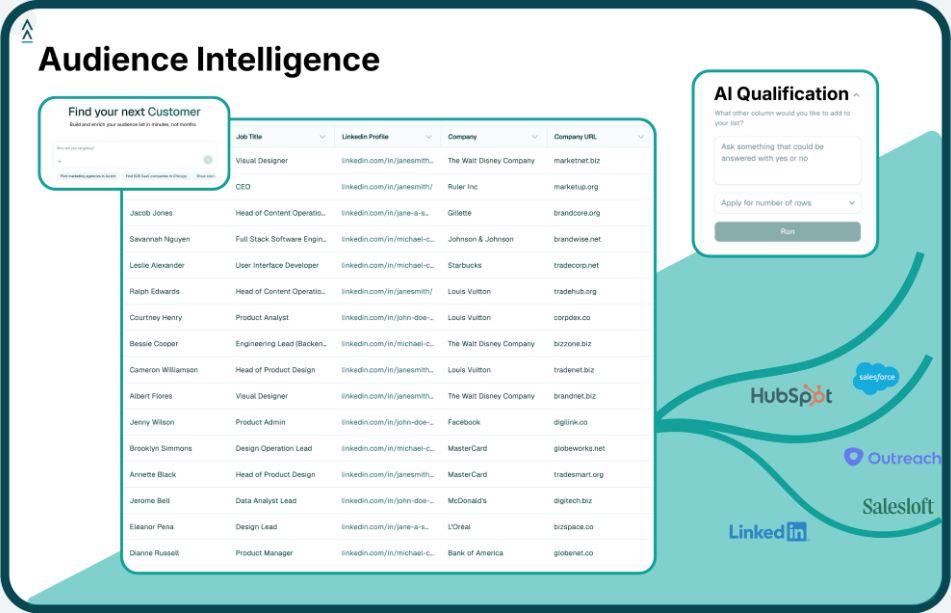
3. Leverage Technology and Human Verification: No single method catches everything, so a combination of AI tools and human intelligence works best. This is where modern data platforms shine. For instance, Landbase offers a platform that continuously monitors over 1,500 signals about companies and contacts – from technographic data to hiring trends – and updates the data in real time. Crucially, Landbase employs an AI + human-in-the-loop verification approach. Automated agents crawl the web for new information (like a new job title or a new domain after a rebrand) and then a research team verifies edge cases to maintain accuracy. As a result, Landbase’s B2B database stays over 90% accurate at any given time. In practice, this means when you query Landbase for leads or company info, you’re getting live data that’s been recently validated – not a static list that might be 6 or 12 months old. The platform’s continuous signal updates ensure company details, contact info, roles, and buying signals remain current instead of going stale.
4. Integrate Live Data into Your Workflow: Even the best data won’t help if it lives in a silo. To truly beat data decay, integrate these continuous updates directly into your CRM and sales tools. Many data providers (including Landbase) allow direct CRM integrations or APIs that sync updated data into your system on a schedule or event basis. For example, Landbase can sync changes to Salesforce or HubSpot so that when a contact in the Landbase dataset updates, your CRM reflects it automatically. By connecting to a live data source, your internal database becomes a living, breathing thing rather than a stagnant repository. RevOps teams should also create processes to merge and de-duplicate records during these syncs to avoid clutter. The goal is to have your reps always looking at the most current info without them even realizing updates happened behind the scenes.
5. Focus on Quality at the Point of Entry: Another key strategy is preventing bad data from entering in the first place. Enforce validation on form fills (e.g., email domain verification, required fields for job title, etc.). If you purchase lists or use third-party data, choose vendors that emphasize data quality and recency. It’s also wise to implement a human verification step for critical records – for instance, if you’re adding a strategic account or a C-level contact, have a researcher double-check their LinkedIn or company bio before importing. This “measure twice, cut once” approach at the point of entry can save a lot of headaches later. Some teams even build human-in-the-loop approval for any net-new record creation in CRM, ensuring nothing enters without basic vetting.
6. Use a Live B2B Data Platform (Landbase and others): Ultimately, many companies are turning to specialized data platforms to outsource the heavy lifting of keeping data fresh. A platform like Landbase is purpose-built to solve B2B data decay. Landbase maintains a vast database of 300M+ verified contacts and 24M+ companies (encompassing firmographics, technographics, intent signals and more). What makes it powerful is that it’s constantly enriched: Landbase pulls in signals like job changes, new funding rounds, hiring trends, and tech adoption in real time, updating profiles continuously. It even spots signs of buyer interest (e.g., topics a company is researching) so you can act on fresh intent signals. By using Landbase, go-to-market teams get access to live B2B data that’s always being verified and refreshed. As Landbase puts it, unlike static data vendors, their database is “live and adaptive,” powered by AI signal refresh and offline human qualification for constant accuracy. The result is you can eliminate bad data before it enters your workflow and ensure your sales and marketing efforts are built on a clean foundation from the start.
By implementing the practices above – routine cleaning, proactive enrichment, integrated live data, and leveraging platforms like Landbase – you can build a self-healing data pipeline. The payoff is substantial: accurate targeting, higher response rates, improved sales productivity, and confidence in your analytics. Salespeople can trust that the contact info they have is correct. Marketers can personalize campaigns knowing the titles and firmographics are up to date. And RevOps can forecast pipeline based on reality, not ghosts.
B2B data decay may be an invisible problem, but its impacts on revenue are very real. Left unattended, stale data will quietly chip away at your pipeline, your budget, and your team’s morale. The good news is you can fight back. By recognizing the causes of data decay—constant job changes, company upheavals, tech shifts—and addressing them with continuous data management, you turn data quality into a competitive advantage rather than a liability.
It’s time to treat your B2B data as the living asset that it is. That means keeping it current, enriched, and accurate day by day. The companies that excel in today’s market are those that make decisions on live data and reach customers with the right message at the right time, thanks to up-to-date insights. Those still grinding away with year-old lists and clunky CRMs full of errors will continue to struggle with wasted effort and missed quotas. Fortunately, solutions like Landbase make it easier than ever to stay ahead of data decay.

Tool and strategies modern teams need to help their companies grow.







