.png)
.png)

Daniel Saks
Chief Executive Officer


The generative AI market exploded from $1.7 billion to $37 billion in just two years, making it the fastest-scaling software category in history. Following ChatGPT's late-2022 launch, a new wave of AI platforms has emerged, collectively raising over $100 billion in venture funding and achieving unprecedented valuations. From OpenAI's $40 billion investment to newcomers scaling to multi-billion valuations in months, these companies are reshaping every industry through artificial intelligence. For go-to-market teams, knowing which platforms lead in AI-powered audience discovery and qualification is just as important as choosing the right foundation model. Agentic AI platforms like Landbase now sit alongside these AI leaders, transforming how teams find and engage their ideal customers using natural-language targeting.
OpenAI develops frontier AI models that power applications across industries—from chat-based assistants like ChatGPT to embedded AI features in third-party products. Its platform serves both end users and developers via APIs. Enterprises build on OpenAI to add natural language, reasoning, and automation capabilities into existing tools and new products. With 500 million weekly users, ChatGPT has become the default interface for AI interaction.
OpenAI created the generative AI category with ChatGPT's November 2022 launch and powers the "fastest-scaling software category in history" with $37 billion spend in 2025. Deep Microsoft partnership provides enterprise distribution and infrastructure. The company sets standards for LLM integration across industries.
Anthropic develops safety-focused foundation models under the Claude brand, emphasizing reliability and enterprise readiness. Claude AI powers enterprise workflows with strong performance in coding, document analysis, and secure data handling. The company's "Constitutional AI" approach prioritizes safety and alignment, making it attractive to regulated industries and enterprises requiring trustworthy AI systems.
Anthropic commands 40% enterprise share, up from 12% in 2023, and dominates AI coding with 54% market share, displacing OpenAI in developer workflows. Safety-first approach resonates with enterprises in regulated industries. Drives 15%+ velocity gains in software development teams.
Recent Funding:
xAI develops foundation models under the Grok brand, integrated directly into the X (formerly Twitter) platform. This provides instant access to hundreds of millions of users without requiring separate sign-up. Grok models emphasize less censorship and real-time information awareness through integration with X's social platform, appealing to users seeking alternatives to mainstream AI systems.
xAI provides independent AI infrastructure outside Google/Microsoft/Amazon ecosystems. Integration with X platform enables current events awareness unavailable to competitors. Makes powerful AI available to X's global user base without separate sign-up. Represents fastest valuation growth – $0 to $200 billion in 2.5 years.
Databricks provides a unified platform combining data engineering, analytics, and machine learning in a single "lakehouse" environment. The platform enables enterprises to manage massive datasets and deploy AI models at scale. Databricks serves as essential infrastructure for AI application development with strong year-over-year growth.
Databricks holds 56% AI infrastructure share among incumbents and provides the "lakehouse" architecture that powers AI model training and deployment at enterprise scale. Machine learning operations (MLOps) capabilities are essential for production AI. Trusted by "AI app builders" for data management and workflow orchestration.
Mistral AI develops open-weight foundation models that make frontier AI accessible to researchers and companies outside the US Big Tech ecosystem. The company takes an open-source approach, making its models available to anyone while maintaining commercial licensing for enterprise use. Le Chat, its chatbot, is known for strong multilingual performance and European regulatory compliance.
Mistral's open-weight models address European regulatory concerns about AI dependence on US Big Tech. Strong French government endorsement and €8.5B data partnership with Nvidia and BPI France. Provides competitive pressure on closed-source models, driving innovation across industry.
Thinking Machines Lab, founded by former OpenAI CTO Mira Murati, builds infrastructure and foundation models for agentic AI – systems capable of multi-step reasoning and autonomous action. The company represents the next evolution beyond current chatbot/copilot paradigms toward truly autonomous AI agents that can plan, execute, and learn from complex tasks.
Thinking Machines secured $2B seed round – largest in history, 16x larger than previous record. Mira Murati led development of ChatGPT, DALL-E, and voice mode at OpenAI. Focus on agentic AI infrastructure addresses deeper market need beyond chat interfaces.
Perplexity AI provides an AI-powered search engine that delivers citation-rich, real-time answers with sources and references. Unlike traditional chatbots that can hallucinate, Perplexity focuses on factual accuracy with verifiable sources. The platform serves as a credible alternative to traditional Google search, particularly for research, education, and professional use cases.
Perplexity represents first credible AI-native challenge to Google's search monopoly. Citation and source features address hallucination concerns in generative AI. Apple and Samsung considering integrating Perplexity search into their devices.
Safe Superintelligence (SSI), co-founded by former OpenAI Chief Scientist Ilya Sutskever, focuses exclusively on building "safe superintelligence" as its core mission. Unlike companies optimizing for revenue or features, SSI prioritizes AI alignment and safety as fundamental requirements. The company represents the growing AI safety movement gaining regulatory and investor attention.
SSI addresses growing concern about AI alignment and safety as models approach AGI. Safety-first approach positions SSI well for increasing government AI regulation. Demonstrates viability of prioritizing safety over speed-to-market. Ilya Sutskever was instrumental in GPT development at OpenAI.
Cohere provides enterprise-focused large language models with a "sovereign AI" approach that trains on clients' private data behind corporate firewalls. This privacy-first model is critical for regulated industries like finance, healthcare, and government. The company partners with major enterprises like Oracle, Royal Bank of Canada, Dell, and Fujitsu.
Cohere provides enterprise-grade AI without dependency on OpenAI or Anthropic. Privacy-first approach critical for regulated industries. Leading non-US generative AI company outside Europe. Part of AWS Bedrock model selection, validating enterprise readiness.
Reflection AI, founded by former DeepMind researchers, focuses on AI coding automation and sustainable frontier model development. The company competes in the AI coding market – the largest departmental AI category. Reflection emphasizes releasing frontier models sustainably to address compute cost concerns.
Reflection addresses $4B AI coding market, the largest departmental AI category. Focus on "releasing frontier models sustainably" addresses compute cost concerns. Building on open standards increases model accessibility. DeepMind pedigree brings cutting-edge research to practical applications.
Glean builds AI agents that "understand organizational knowledge and deliver context-aware answers" across enterprise platforms like Slack, Gmail, and Microsoft tools. The platform solves the critical enterprise problem of fragmented knowledge across multiple systems by unifying information into a single searchable interface that respects existing permissions.
Glean addresses critical pain point of information silos in large organizations. Part of $750M agent platforms category within $8.4B horizontal AI market. Works across Microsoft and Google ecosystems, providing vendor-neutral solution.
Fireworks AI provides an inference platform for building AI applications using open-source models without vendor lock-in. The company competes with hyperscalers on "performance and developer experience," offering optimized serving stacks. The platform makes powerful open-weight models accessible through serverless, high-throughput endpoints.
Fireworks is critical layer between foundation models and applications, enabling cost-effective deployment. Makes powerful open-weight models accessible through serverless endpoints. Provides performance-competitive alternative to AWS/Azure/GCP inference services.
Baseten enables enterprises to deploy and manage AI models efficiently at scale, focusing on optimizing inference costs and accelerating enterprise integrations. The platform helps enterprises move AI from experimentation to production faster by providing developer tooling that wins on "performance and developer experience" compared to hyperscaler alternatives.
Baseten addresses inference costs as major enterprise concern directly. Helps enterprises move AI from experimentation to production faster. Bridges gap between foundation models and production applications.
The $37 billion market represents a fundamental shift in how software is built and consumed. Unlike previous technology waves that took decades to mature, generative AI achieved massive scale in just two years. This unprecedented growth is driven by enterprise adoption with 3.2x YoY growth, developer productivity with 50% using AI coding tools daily, product-led growth like Cursor's $200M revenue without sales teams, and infrastructure criticality with Scale AI's $14.3B investment from Meta.
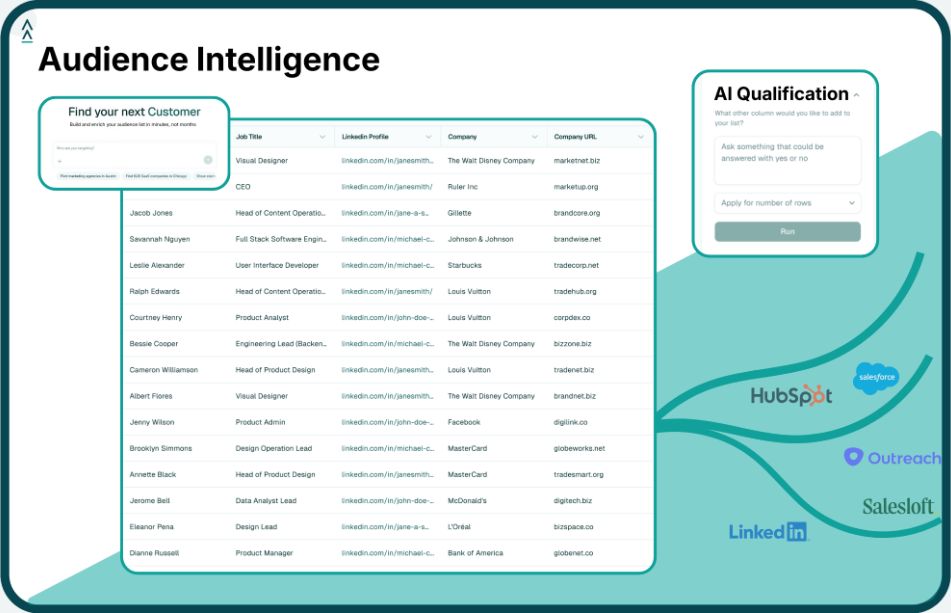
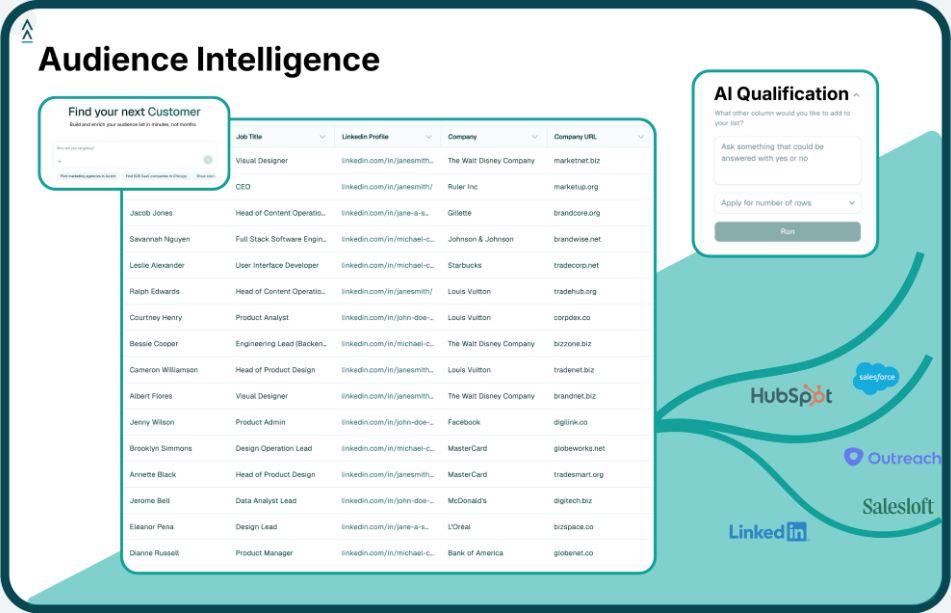
Within this ecosystem, AI-powered go-to-market platforms like Landbase are redefining how B2B teams identify and prioritize accounts. Rather than manually querying clunky databases, sales and marketing teams increasingly rely on natural-language interfaces and rich signals to build better prospect lists in seconds.
This list highlights the 15 fastest-growing generative AI platforms based on funding velocity, market adoption, innovation uniqueness, industry importance, and growth metrics. All companies featured raised significant funding in 2024-2025, achieved billion-dollar+ valuations, and demonstrate measurable market impact through revenue, adoption, or strategic importance.
These generative AI leaders show how critical AI has become for product innovation. But having AI-rich tools in your stack is only half the story. To grow efficiently, companies also need AI-powered go-to-market engines that can identify the right accounts at the right time using natural-language targeting, prioritize prospects based on real-time intent signals from 1,500+ data points, and feed high-quality audiences into CRM, marketing automation, and sales workflows.
This is where platforms like Landbase's GTM-2 Omni come in. Instead of manually assembling lists or writing complex filters, GTM teams can use agentic AI to interpret natural-language prompts like: "CFOs at enterprise SaaS companies that raised funding in the last 30 days." Landbase then returns AI-qualified audiences ready for immediate activation.
By combining comprehensive B2B data—which includes 300 million+ contacts and 24 million+ companies—with natural-language targeting, sales and marketing teams can build targeted lists in seconds instead of days, focus on high-intent prospects based on real-time signals (funding rounds, hiring, tech stack changes, website behavior), and shorten sales cycles and increase engagement rates.
For B2B organizations competing in the fast-moving generative AI market, AI-powered GTM is no longer optional. It's a core layer that connects your AI innovation to the right buyers at scale.
The coding and software development industry leads with $4 billion in AI spend, followed by horizontal enterprise applications ($8.4 billion market). Industries like finance, healthcare, and government are adopting privacy-focused platforms like Cohere due to regulatory requirements. Media and entertainment are embracing generative platforms, while e-commerce and retail leverage AI for personalized experiences. The 50% daily usage rate among developers shows how deeply AI is penetrating technical workflows.
Landbase's GTM-2 Omni uses agentic AI trained on billions of GTM data points to interpret natural-language prompts and build AI-qualified audience lists. Users can type requests like "CMOs at cybersecurity startups adding new marketing automation tools" and instantly receive up to 10,000 verified contacts. The platform leverages 1,500+ unique signals including firmographic, technographic, intent, hiring, and funding data to ensure audience precision and timing.
Fast-growing AI startups are raising unprecedented funding rounds, with OpenAI securing $40 billion and Anthropic raising $16.5 billion in 2025. Even seed rounds have become massive – Thinking Machines Lab raised $2 billion, the largest seed round in history. The top 10 AI mega-rounds totaled over $80 billion in 2025, and 55 US AI startups raised $100M+ in 2025 alone, demonstrating massive investor confidence in the sector.
Successful generative AI companies are often led by executives with strong technical backgrounds and Big Tech pedigree. OpenAI alumni are particularly prominent – Mira Murati (former OpenAI CTO) leads Thinking Machines Lab, while Ilya Sutskever (former OpenAI Chief Scientist) co-founded Safe Superintelligence. Other leaders include Dario Amodei at Anthropic, Sam Altman at OpenAI, and Elon Musk at xAI. Young founders like Alexandr Wang (28 years old) at Scale AI also represent the new generation of AI entrepreneurs.
Generative AI tools help sales and marketing teams build targeted audience lists in seconds instead of days, using natural-language prompts rather than complex filters. Platforms like Landbase provide access to 300 million+ contacts with 1,500+ unique signals spanning firmographic, technographic, intent, hiring, and funding data. This enables teams to focus on high-intent prospects based on real-time signals like recent funding rounds, hiring surges, or technology stack changes, resulting in shorter sales cycles and higher engagement rates.
Tool and strategies modern teams need to help their companies grow.