.png)
.png)

Daniel Saks
Chief Executive Officer


.png)

A B2B lookalike audience is a list of net-new companies that share key attributes with a seller's best existing customers. Unlike B2C lookalike audiences (which match consumer demographics on platforms like Facebook and Google), B2B lookalike audiences match firmographic, technographic, and behavioral patterns derived from closed-won accounts. The goal is to surface high-propensity accounts that traditional firmographic filtering misses.
According to Forrester research on B2B targeting, B2B lookalike audiences differ from consumer lookalikes in three ways: the seed set is smaller (typically 5-50 accounts vs. thousands of consumers), the matching dimensions are more complex (technology stack, hiring patterns, growth signals), and the validation cycle is longer (months of conversion data vs. days of click data). Forrester data shows companies that prioritize well-defined, high-value audiences see 2-3x higher conversion rates than those running broad campaigns.
Quick answer: A B2B lookalike audience expands beyond firmographics to match the technology stack, hiring patterns, growth signals, and organizational characteristics of your best customers. The seed set comes from closed-won accounts. The output is a prioritized list of net-new companies that look like the customers most likely to convert.
A lookalike audience is a targeting approach where you use a “seed” group of your best customers or ideal customer profile (ICP) to find other prospects who share similar attributes. In practice, this means feeding data about your current high-value accounts into an algorithm that identifies other companies with matching characteristics, indicating they are more likely to convert into new business. Consumer ad platforms like Meta pioneered this technique years ago, leveraging personal demographic and behavioral data to match new individuals to your buyer persona. But in a B2B setting, lookalike audiences focus on companies (accounts) rather than individual consumers – emphasizing firmographic and technographic data points (industry, company size, technology stack, etc.) to find businesses that “look like” your best customers.
One key difference in B2B is the importance of organizational fit. A lookalike for a B2B campaign might be defined by criteria such as sector, employee count, annual revenue, location, tech usage, and growth signals, among others. For example, if your top customers are mid-market software companies with 200–500 employees that use AWS and have a growing data science team, a B2B lookalike model will seek out other companies meeting those criteria. Ad platforms have a bias toward consumer data, so standard lookalike tools may not directly offer granular B2B filters. This is why B2B marketers increasingly turn to specialized data platforms (or their own CRM data) to construct lookalike audiences that incorporate rich firmographic detail.
Precision is critical. The goal isn’t just to reach more companies, but to reach the right companies – those that truly mirror your ICP. Doing so dramatically improves efficiency. Instead of casting a wide net and hoping for the best, you’re using data to narrow in on accounts with a high probability of interest. The payoff can be huge: by scaling outreach to strategic lookalike segments based on their best customers, B2B marketers ensure growth aligns with their strongest product-market fit. In other words, you’re pursuing business where you already have proven success, rather than reinventing the wheel in untapped, unrelated markets. As one industry practitioner put it, your chances of replicating a win with a similar company are “exponentially higher” than chasing a completely different profile.
To summarize, a lookalike audience in B2B is all about finding accounts that resemble your ideal buyers, using data-driven matching. This creates a highly targeted pool of prospects that marketing can run campaigns against and sales can prioritize – confident that these prospects share key traits with your happiest customers.
For GTM teams – which include marketing, sales, and revenue operations – lookalike audiences can be a game changer. They address a core need: improving lead quality and conversion rates without simply buying more lead quantity. Consider that only about 12% of B2B marketing-generated leads ever convert to revenue, a sobering statistic Forrester attributes in part to short-sighted, broad targeting that floods funnels with unqualified prospects. In a world of finite budgets and sales bandwidth, focusing on high-propensity accounts is critical. Lookalike modeling provides the mechanism to do just that.
Ultimately, lookalike audiences help GTM teams do more with less. Rather than increasing spend or headcount to hit pipeline goals, you increase the precision of your targeting. This results in higher quality leads that convert at a greater rate, which is exactly what revenue-focused teams want. As one B2B marketing leader quipped, “Precision targeting isn’t just more efficient, it’s more effective” – you’re not just filling the funnel, you’re stacking it with the leads most likely to close.
How can you actually create a B2B lookalike audience? The process starts with good data. Traditionally, a marketer would compile a list of their best customer accounts and analyze attributes to define an ideal customer profile. This could involve working with a data team to pull firmographic info (industry, size, location), technographic data (tools and platforms the company uses), and perhaps past engagement or product usage patterns. The marketer would then try to find other companies meeting those criteria – maybe by querying a database or using a tool. This manual process is labor-intensive and requires the right data sources. In many organizations, it meant begging the data or BI team for a complex export, then uploading CSV files to each ad platform or sales tool.
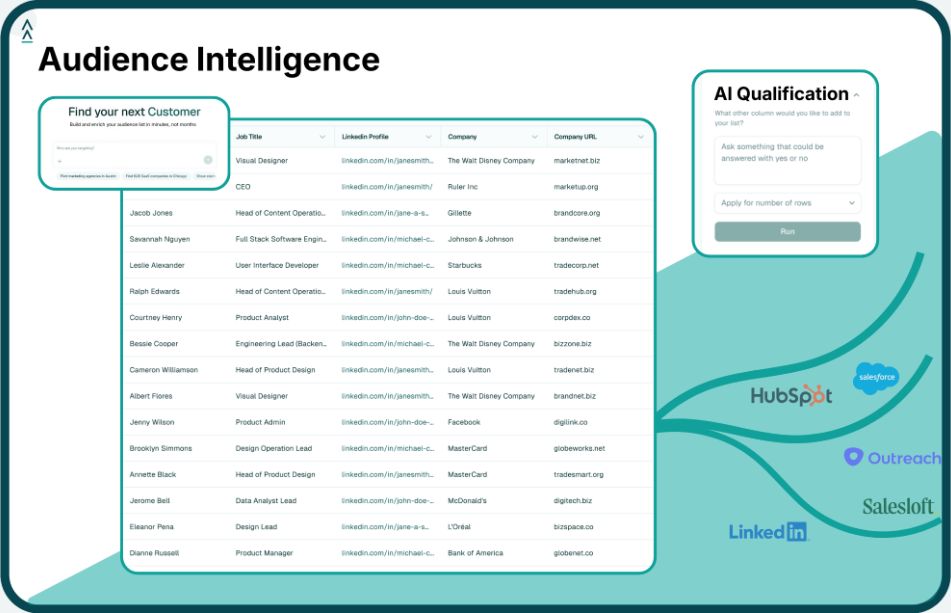
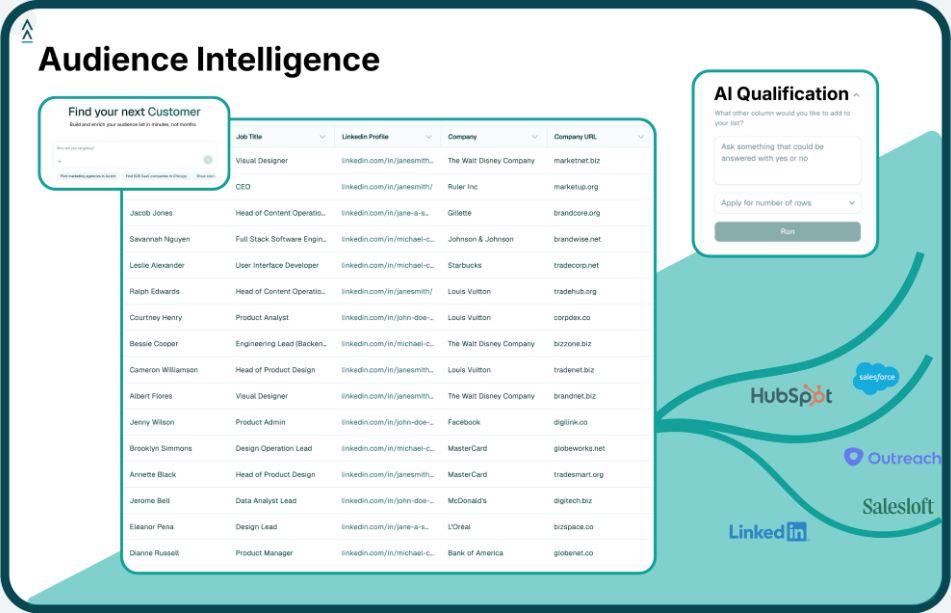
Modern AI tools streamline this process dramatically. For instance, Landbase enables GTM teams to build lookalike audiences with minimal effort. You can upload a customer list (e.g. your top 100 customers) or even just describe your ICP in natural language, and Landbase’s proprietary GTM Omni model will handle the rest. The AI model was trained on vast amounts of B2B data to recognize patterns in what a good customer looks like. It will automatically identify shared traits among your best accounts – things like company size, growth rate, tech stack, hiring trends, locations, industry sub-verticals, and more – to generate a profile of your ideal customer. Then it scans a universe of companies to find others that match this profile.
With these data points, an AI can cluster companies and score similarity to your ideal profile far more quickly and accurately than a human could. For example, Landbase’s GTM Omni might find that your top customers all tend to have a certain technology profile (say, they use Snowflake as a data warehouse and have a marketing automation platform in place) and also share growth indicators (e.g. they all recently hired a VP of Analytics or received Series B funding). The AI surfaces these patterns and then finds other companies exhibiting the same characteristics.
This approach has two big advantages: scale and objectivity. Scale, because the AI can sift through millions of companies and data points (such as a 300M+ B2B contact database with 1,500+ possible signals) to pull in candidates you’d never manually discover. And objectivity, because it might detect non-obvious traits that correlate with success. Perhaps you didn’t realize that many of your best customers are expanding into Europe, or tend to have a specific compliance certification – an AI can pick up on subtle commonalities humans overlook.
Building the list is only half the battle; the end goal is an actionable audience you can pursue. A distinctive feature of Landbase’s platform is that once the lookalike companies are identified, it layers on contact data and buying-stage context. Essentially, the output isn’t just “here are 500 companies that look like your customers” – it’s a ready-to-go targeting list including verified key contacts at those companies (with emails, LinkedIn, etc.) and insights into where each account stands (e.g. are they likely in early research vs. ready to buy). This saves enormous time for sales and marketing. Marketers can immediately upload the audience into ad platforms or email campaigns, while sales development reps can start personalized outreach to the suggested contacts.
By automating data collection and analysis, AI-powered solutions let you reuse your ICP knowledge at scale. Instead of manually researching each new vertical or relying on gut feel, you have a systematic way to expand into new accounts that share the DNA of your winners. The end result is a living, breathing ideal customer profile that updates as you feed in new customer data – and a constantly refreshed lookalike audience that grows alongside your business.
Identifying lookalike accounts gives you a high-quality list of targets. But how do you decide which of those targets to go after first? This is where intent signals come in. Intent signals are signs that a company is actively researching or has a current need for a solution like yours – for example, they just raised a new funding round (often meaning budget and growth plans), they have job postings for skills related to your product, or they’re frequently reading content in your software category. By layering real-time intent signals on top of lookalike modeling, B2B teams can prioritize the lookalike accounts that are “in market” now, focusing their efforts where there is both fit and active interest.
Landbase excels here as well: its GTM Omni model not only finds lookalikes, it continuously monitors those companies for relevant triggers (news, hiring, funding, product launches, website engagement, etc.). For instance, from your list of 500 lookalike companies, Landbase might flag 50 that have strong intent signals this month – those are the ones your sales team should call immediately or your ad campaign should target with higher urgency. The others might be great fits but not showing purchase intent yet, so they can be nurtured at a lower priority until a signal emerges.
Why is this combined approach so powerful? Because it marries quality with timing. B2B purchase journeys are mostly invisible – up to 80% of buyer interactions happen through digital research before they ever talk to a vendor. Buyers often complete 60–90% of their decision process on their own, consuming content and comparing options silently. If you can detect when a lookalike account is in that research phase (via intent data), you can engage them before your competitors even know they exist. Otherwise, you might have a great target on paper, but you reach out at the wrong time when they’re not looking, and the opportunity slips by.
The data backs this up strongly:
Practically speaking, how do you implement this? A best practice is to score or tier your lookalike audience by intent. For example, tier 1 = ICP fit + high intent (engage immediately with sales outreach and high-touch marketing), tier 2 = ICP fit + moderate intent (nurture with targeted content, keep warm), tier 3 = ICP fit + no current intent (add to awareness campaigns or drip marketing until intent emerges). Landbase automates much of this by layering intent signals directly into its audience recommendations. As B2B Media Group advises, “build lookalike models using enriched CRM data and layer intent or engagement filters to avoid wasting budget”. In practice, that means even if two accounts look equally good on paper, you spend on the one actively researching first.
Lookalike audiences give you the “who,” and intent signals give you the “when.” By combining them, GTM teams maximize the impact of every touch. You focus on accounts that resemble your best customers and are ready to talk. That’s a recipe for higher win rates and efficient growth.
Implementing lookalike audience targeting in B2B requires thoughtful strategy and execution. Here are some best practices to maximize success:
Following these best practices will help you get the most value from B2B lookalike audiences while avoiding common pitfalls. The overarching theme is to combine quality data, cross-team alignment, and agile execution.
As B2B marketing and sales become ever more data-driven, lookalike audiences are poised to move from a “nice-to-have” tactic to a central GTM strategy. The writing is on the wall – by 2025, an estimated 80% of B2B sales interactions between suppliers and buyers will happen via digital channels. Buyers are self-educating and engaging online, leaving digital footprints of intent and fit. To thrive in this environment, vendors must leverage AI and big data to identify and reach the right accounts at the right time. Lookalike modeling, especially when infused with real-time signals, is a prime example of using AI to do what humans alone cannot: instantly pinpoint your next best customers out of millions of companies.
Landbase’s approach exemplifies the future of lookalike audiences in B2B. It showcases how AI can automate and greatly enhance what used to be a very manual process – from defining ICPs, to finding lookalikes, to detecting intent, to delivering actionable contact lists. The result is a much more autonomous, intelligent go-to-market engine. Instead of weeks of research and guesswork, GTM teams can generate a highly targeted audience in minutes, and continuously refresh it as markets evolve. This allows companies to respond to market changes faster (e.g. a surge of interest in a new category, or a new wave of funded startups in your space) by immediately finding the relevant lookalike prospects and reaching out.
Tool and strategies modern teams need to help their companies grow.